- A 24-year-old man bypassed boarding pass readers at Stuttgart Airport, triggering a full terminal evacuation.
- Security operations delayed eight departing flights and required mandatory re-screening for hundreds of passengers.
- The incident occurs amid heightened World Cup security and new T-S-A international data-sharing protocols.
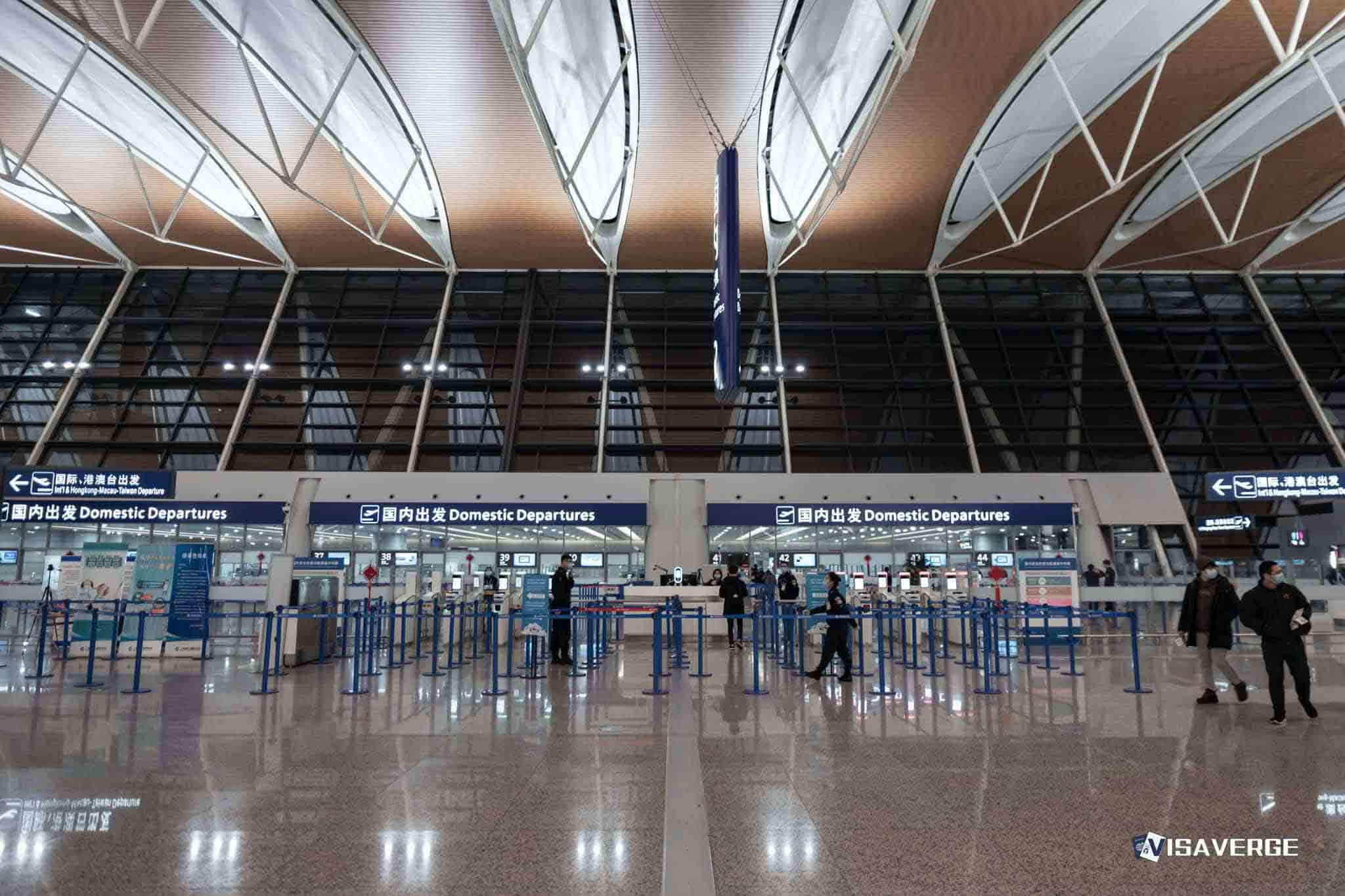
(STUTTGART, GERMANY). A security breach at Stuttgart Airport on Sunday morning forced the evacuation of departure gates and delayed eight flights, leaving passengers to face 60 to 90 minutes of mandatory re-screening during one of the busiest travel windows of the summer.
At approximately 8:30 a.m. local time on June 21, 2026, a 24-year-old Vietnamese national entered the security-controlled departure zone without a valid boarding pass. The individual bypassed the automated boarding pass reader but passed through physical screening in what authorities described as a normal manner.
Free toolB1/B2 Tourist Visa Stay Calculator online
The Bundespolizei ordered an immediate halt to all passenger screening and cleared gate areas across the terminal. Surveillance footage confirmed the access route. A Federal Police spokesperson stated that aviation security was “not ultimately compromised,” but standard precautionary protocols required a full evacuation of the sterile area.
Operations resumed at approximately 9:30 a.m., one hour after the initial breach. Eight departing flights were delayed as passengers already inside the secure zone underwent mandatory secondary screening before being allowed to re-enter.
The incident occurred during a period of heightened international aviation security coordination tied to the 2026 FIFA World Cup. The tournament, hosted across North America, has driven the Transportation Security Administration to expand its international role through enhanced screening programs and cloud-based data sharing with foreign airport authorities.
European airports have faced a difficult stretch in recent weeks. Cybersecurity breaches targeting check-in systems supplied by Collins Aerospace caused knock-on delays across multiple carriers. Labor strikes at Frankfurt and Munich have added strain to already stretched German hub operations, making Stuttgart’s breach the latest in a series of disruptions.
What Changed for Stuttgart Passengers
| Before Breach (Normal Operations) | After Breach (June 21, 2026) | |
|---|---|---|
| Security screening | Standard single-pass screening | Mandatory secondary screening for all passengers in sterile area |
| Gate access | Automated boarding pass checkpoint active | Checkpoint suspended; physical screening only |
| Flight operations | On-schedule departures | 8 flights delayed; 60-90 minute average delay |
| Terminal status | Open | Full evacuation of secure zone from 8:30-9:30 a.m. |
Passengers departing Stuttgart between 8:30 a.m. and 9:30 a.m. on June 21 bore the brunt of the disruption, particularly those on the eight affected flights. Travelers who had already cleared security were required to exit the sterile zone and undergo secondary screening regardless of destination or airline. Arriving passengers experienced no interruption. Travelers departing after 9:30 a.m. faced residual delays but did not require evacuation or re-screening.
TSA Scales Up for World Cup
The TSA outlined its expanded international role in a June 3, 2026 press release, emphasizing real-time data sharing through cloud-based connectivity and strengthened privatized screening programs at partner airports. DHS Secretary Markwayne Mullin, confirmed in March 2026, has requested $11.7 billion for the TSA in FY 2027, with a focus on privatized airport screening to handle the World Cup passenger surge.
A DHS spokesperson signaled a harder line on international arrivals in a statement to Forbes on June 2, 2026. The agency is developing plans to restrict processing of international flights into cities it designates as non-cooperative with federal immigration enforcement, though no specific airports have been named.
Mullin also testified before the House Committee on Homeland Security on June 3, 2026, pressing the case for accelerated technology deployment. The TSA has fast-tracked 3D CT scanners as of June 16, 2026, backed by a $781 million investment. The scanners are being coordinated with European partners to standardize touchless screening for World Cup attendees traveling between continents.
Court Ruling Forces USCIS Policy Shift
USCIS issued a statement on June 12, 2026 confirming compliance with a federal court ruling from Rhode Island that vacated three security-related application policies tied to Presidential Proclamations 10949 and 10998. The agency is preparing updated guidance for vetting foreign nationals from high-risk countries. No implementation timeline has been published.
The ruling overturned application holds that were tied to the vacated policies. Applicants who had cases stalled under the previous framework may see movement once USCIS issues revised guidance, though the agency has not confirmed whether cases will be automatically reviewed or require new submissions. Travelers from countries designated as high-risk under the ongoing proclamations should monitor the USCIS newsroom for updates.
📅 Key Date: The TSA issued a travel advisory on June 17, 2026 warning that travelers from high-risk countries or those involved in recent security incidents face enhanced vetting by CBP officers upon arrival in the United States.
What Affected Travelers Should Do Now
Airlines operating from Stuttgart include Lufthansa, Eurowings, and Ryanair. None reported cancellations tied to the breach. Affected passengers on delayed flights may be entitled to EU261 compensation if the delay exceeded three hours, though the security nature of the disruption may qualify as an extraordinary circumstance under EU regulations, which would exempt carriers from paying.
Travelers transiting through European hubs to World Cup matches in North America should build extra connection time into itineraries. The combination of heightened security protocols, labor actions, and system outages across German airports means that standard two-hour connection windows may not be sufficient through the end of the tournament.
Arrive at least three hours before departure for U.S.-bound flights from Stuttgart or other German airports through the World Cup final. CBP enhanced vetting protocols remain in effect, and check-in procedures for U.S.-bound flights have been extended at several European stations. Carry copies of approved visas, court filings, or USCIS correspondence in case of additional questioning at the gate or upon arrival.