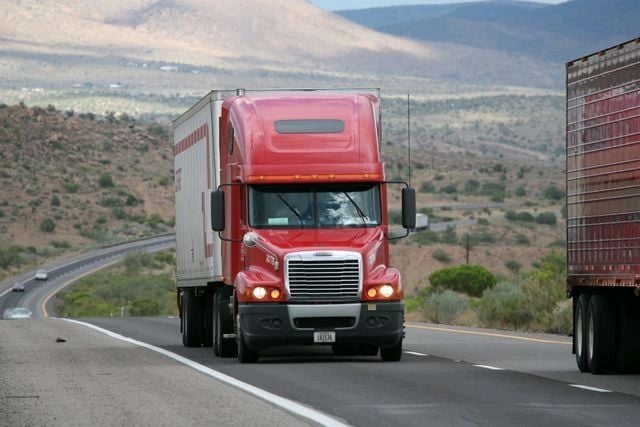
- The Trump administration is mandating English proficiency for Mexican train crews entering the United States for safety.
- A proposed rule establishes a ten-route-mile limit for crews not meeting U.S. certification standards.
- The policy aims to protect American railroad jobs while improving communication with dispatchers and emergency responders.
The Trump administration proposed tighter English-language and operating rules Friday for Mexican train crews carrying freight across the U.S. border, limiting how far those crews could travel and requiring U.S.-certified operators for movements beyond the border area.
The Federal Railroad Administration said its Notice of Proposed Rulemaking would require locomotive engineers and conductors working into the United States to demonstrate English proficiency. The proposal covers safety bulletins, timetables, signs and communication with U.S. dispatchers.
Free toolUSCIS Receipt Number Decoder
The rule would also establish a 10-route-mile limit for Mexican-based crews from their U.S. point of entry. Trains traveling farther would need to transfer control to U.S.-certified crews.
The proposal is about safety and jobs. It has not yet become a final rule.
U.S. Transportation Secretary Sean P. Duffy described English as part of the basic safety requirements for rail operations.
“Whether you’re operating an 80,000-pound big rig or a massive freight train, you need to be proficient in our national language—English. If you aren’t, you create an unacceptable safety risk. These commonsense steps will ensure every train crew operator can communicate with inspectors and understand basic operational bulletins.”
Duffy made the statement on Dec. 19, 2025, and again on July 31, 2026, according to the Transportation Department announcement. The agency said the proposed amendments would apply to 49 CFR Parts 240 and 242, the federal rules governing locomotive engineer and conductor certification.
The proposal would keep Mexican crews near the border
Under the plan, crews must read, speak and write English well enough to handle railroad safety information. That includes General Track Bulletins, hazardous materials information and operational instructions.
The FRA said dispatchers and emergency responders need to communicate directly with train crews. David Fink, the agency’s administrator, made that point in December.
“Train crew operators who can’t speak English pose a significant safety risk that should not be ignored. Dispatchers and first responders need to know that they can communicate with train crews, especially during times of emergency.”
The agency’s proposal follows inspections at rail yards in Eagle Pass and Laredo, Texas, in late 2025. Inspectors documented “numerous instances” involving Mexican crews from Union Pacific and Canadian Pacific Kansas City who could not interpret General Track Bulletins or communicate hazardous materials information in English.
Those findings form the administration’s stated safety basis. The proposed requirements would place crews who fail to meet English or U.S. certification standards in the immediate border area, within the 10-route-mile limit.
Border crew changes would become part of the operating plan
The proposal aligns with the Protecting American Railroad Workers' Jobs Act, or H.R. 8468, introduced on April 23, 2026. That bill would require trains entering from Mexico to stop at the border for crew changes and safety testing.
The proposed rule would shift longer movements to U.S.-certified engineers and conductors. Designated interchange points would become the handoff locations.
Supporters say the practice would also give U.S. Customs and Border Protection more opportunities to inspect rail cars for illicit drugs, including fentanyl. The administration has linked the rail policy to its broader border enforcement approach.
DHS Secretary Markwayne Mullin said on July 16, 2026, that “leadership and policy matter” in achieving “historically low illegal border crossings” and ensuring that people crossing the border follow strict U.S. standards.
Railroads would need to change training and staffing
Union Pacific and Canadian Pacific Kansas City would need to revise training and certification programs for cross-border personnel under the proposal. Carriers would also need to coordinate crew transfers at the border.
The change could increase demand for U.S.-based engineers and conductors at southern border interchange points. Mexican crews who lack the required English proficiency or U.S. certification would not operate beyond the proposed limit.
Rail unions have pressed for tighter restrictions for years. SMART-TD and the Brotherhood of Locomotive Engineers and Trainmen have argued that allowing foreign crews to travel deep into the United States can bypass safety standards and displace American railroad workers.
The administration also framed the proposal as an implementation of Executive Order 14224. President Trump issued that order in March 2025, and the policy was reinforced in 2026. The order designates English as the official language of the United States.
The FRA’s proposal now places the English testing, certification requirements, border limit and crew-change policy in one regulatory framework. Its immediate effect is to set out the standards the administration wants railroads and cross-border crews to meet.