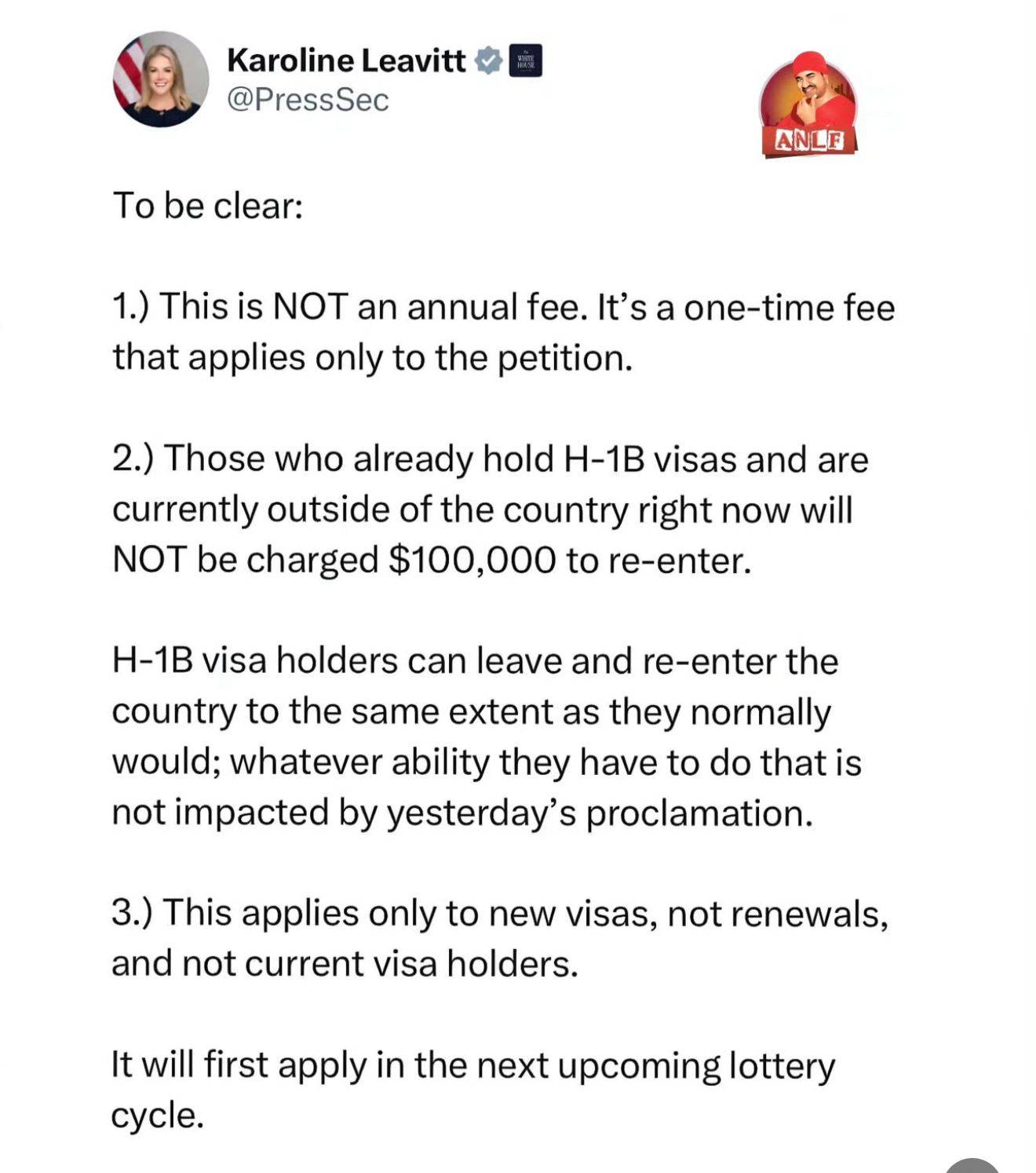
(WASHINGTON, D.C.) Hedge fund manager Spencer Hakimian’s emotional tribute to a close friend touched off a national debate this week after the new $100,000 H-1B surcharge triggered fear and anger across immigrant communities and their employers. The tribute, posted after the 2025 announcement, described the shock his friend felt when the fee news broke and the relief that followed once officials clarified that existing visa holders would not have to pay the surcharge.
The post quickly morphed into a flashpoint, drawing praise for humanizing the policy impact and sharp pushback over why the friend had not secured a green card years earlier.

The post and the personal story
Hakimian wrote about his “best friend,” a professional originally from Italy who has lived in New York for more than a decade. He said the friend arrived as a student, worked hard, pays taxes, and has long contributed to the economy and culture of the United States ??.
“My best friend is an H1B visa holder. Born and raised in Italy. Lives in New York for the past decade. He’s done everything right,” Hakimian wrote. He said his friend was “legitimately devastated at the prospect of having to leave the country he calls home” when he saw the fee headline.
After learning that current H-1B workers were exempt from the new charge, Hakimian said his friend “cried … on the phone for a full minute,” adding, “If he isn’t the American Dream, then I don’t know what is.”
| India | China | ROW | |
|---|---|---|---|
| EB-1 | Feb 01, 2023 | Aug 01, 2023 ▲31d | Current |
| EB-2 | Nov 01, 2013 | Oct 01, 2021 | Apr 01, 2025 ▲90d |
| EB-3 | Jan 22, 2014 ▲21d | Jan 22, 2022 ▲14d | Jun 15, 2024 ▲31d |
| F-1 | Jan 22, 2021 ▲366d | Jan 22, 2021 ▲366d | Jan 22, 2021 ▲366d |
| F-2A | Oct 22, 2026 ▲30d | Oct 22, 2026 ▲30d | Oct 22, 2026 ▲30d |
Public reaction: praise, criticism, and the debate
The post spread quickly and drew a wave of reaction.
- Many users praised the message for putting a human face on policy.
- Others questioned the policy itself and questioned the friend’s choices.
Representative comments included:
– “Ten years? Why doesn’t he have a green card? If he had a green card this wouldn’t have happened.”
– A critic telling Hakimian, as a wealthy individual, he should “just give him that much to stay in the country.”
Those comments reflect broader frustration with a system that can feel confusing and unforgiving, even for people who have spent years building a life and career in the United States.
Policy context: fee shock and what the H-1B does — and doesn’t — do
The H-1B surcharge generated swift concern because of its size and the risk that sudden costs can change hiring plans or push workers to leave. Hakimian’s post underlined how a major fee change, even if it ultimately exempts current workers, can upend lives in a moment.
For new applicants and their employers, the figure is now part of the cost picture for job offers tied to specialty roles.
Key policy realities often missed in online arguments:
- Holding an H-1B, even for many years, does not by itself create a clear path to a green card or citizenship.
- The next step toward permanent residence depends on:
- Employer sponsorship
- Visa category limits
- The worker’s country of chargeability (per-country limits can create long backlogs)
- Nationals of some high-demand countries face significantly longer waits; while Hakimian’s friend (Italian) would not face the same delays as workers from India, the process can still be slow or uncertain.
- Not every employer offers to sponsor, even for long-serving staff.
According to analysis by VisaVerge.com, the fierce debate over the surcharge fits a wider pattern: policy shifts that seem simple on paper often carry uneven effects for workers, families, and companies, especially when timing and eligibility carve-outs differ for new and existing cases.
For official details on H-1B eligibility and process, see the government’s guidance at the USCIS H-1B program page: https://www.uscis.gov/working-in-the-united-states/temporary-workers/h-1b-specialty-occupations.
Why “Why no green card yet?” is not always a simple question
Practical reasons why long-term H-1B holders may not have a green card:
- A worker can spend years on H-1B status without employer sponsorship for permanent residence, due to business policy or job changes.
- Even with sponsorship, backlogs and quotas can delay approval, leaving families in limbo.
- Policy shifts—like a sudden fee—can deepen worry for applicants who have no control over timing.
Hakimian’s message gave that worry a human face. The friend’s tears, once he learned the exemption protected him, captured a truth many temporary workers describe: the idea of home feels fragile when your right to stay depends on evolving rules.
The instant relief after the exemption clarification suggests how close skilled workers can feel to the edge, even after years of steady work, taxes, and community ties.
Misunderstandings about solutions and responsibilities
The comments aimed at Hakimian show how public mood around immigration often blends anger at the system with anger at individuals. Important clarifications:
- Asking an employer or a wealthy friend to pay a one-time fee oversimplifies how U.S. visas work.
- A fee payment is not a substitute for:
- Meeting legal criteria
- Following timelines
- Passing security and eligibility checks
- Structural limits (like per-country caps) cannot be fixed by private payments and continue to push many into wait lists or force hard choices about careers and families.
Broader tensions and stakes
Structural tensions behind the online furor include:
- Temporary design: H-1B status is temporary by design; it allows U.S. employers to fill specialty jobs but does not promise a green card.
- Per-country caps: Green card delays disproportionately affect some nationalities (e.g., India) while Europeans generally face shorter waits.
- Mismatch of experience and perception: A person can spend a decade in the same city, pay taxes, mentor colleagues, and still feel one policy move away from losing the life they built.
Hakimian’s line — “If he isn’t the American Dream, then I don’t know what is” — resonated because it mixed hope with fear. People saw themselves, colleagues, or children in the story and how quickly that dream can feel at risk when rules or fees change with little warning.
Practical implications for employers and workers
For employers:
– Hiring plans for new roles must now account for the $100,000 cost.
– Top candidates may hesitate to enter a system perceived as unstable.
For foreign workers considering a first H-1B:
– The new price point adds another hurdle on top of legal steps, job offers, and relocation.
For those already in the United States:
– The exemption for current H-1B workers brought relief, but it did not calm deeper worries about what might come next.
Final takeaway
As the debate continues, Hakimian’s post has become a symbol of how policy, money, and identity collide. It highlights a simple truth that data alone can miss: behind every headline and fee, there is a person who studies, works, pays taxes, and sets down roots—then waits for a system decision that can change everything overnight.
This Article in a Nutshell
The announcement of a $100,000 surcharge on new H-1B visa applications ignited national debate, fear, and online arguments. Hedge fund manager Spencer Hakimian’s post about his longtime Italian friend — an H-1B holder in New York who feared losing his life in the U.S. until officials clarified current workers were exempt — humanized the policy’s impact. The reaction mixed praise for highlighting personal consequences with criticism asking why the friend had not obtained a green card. Analysts emphasize that H-1B status does not guarantee a path to permanent residency; employer sponsorship, per-country quotas, and administrative backlogs shape outcomes. For employers, the surcharge raises hiring costs; for new applicants, it increases barriers. The episode underscores how sudden policy changes can create immediate anxiety even when exemptions exist.