- New H-1B hiring costs can now surpass $100,000 for international recruits.
- A controversial $100,000 supplemental fee targets new hires from outside the United States.
- Standard extensions and domestic transfers avoid the massive surcharge, favoring existing workers.
(UNITED STATES) — U.S. employers sponsoring skilled foreign workers now face an H-1B fee structure that can climb above $100,000 for some new hires from abroad, after a series of filing fee increases and a new supplemental payment took effect over the past two years.
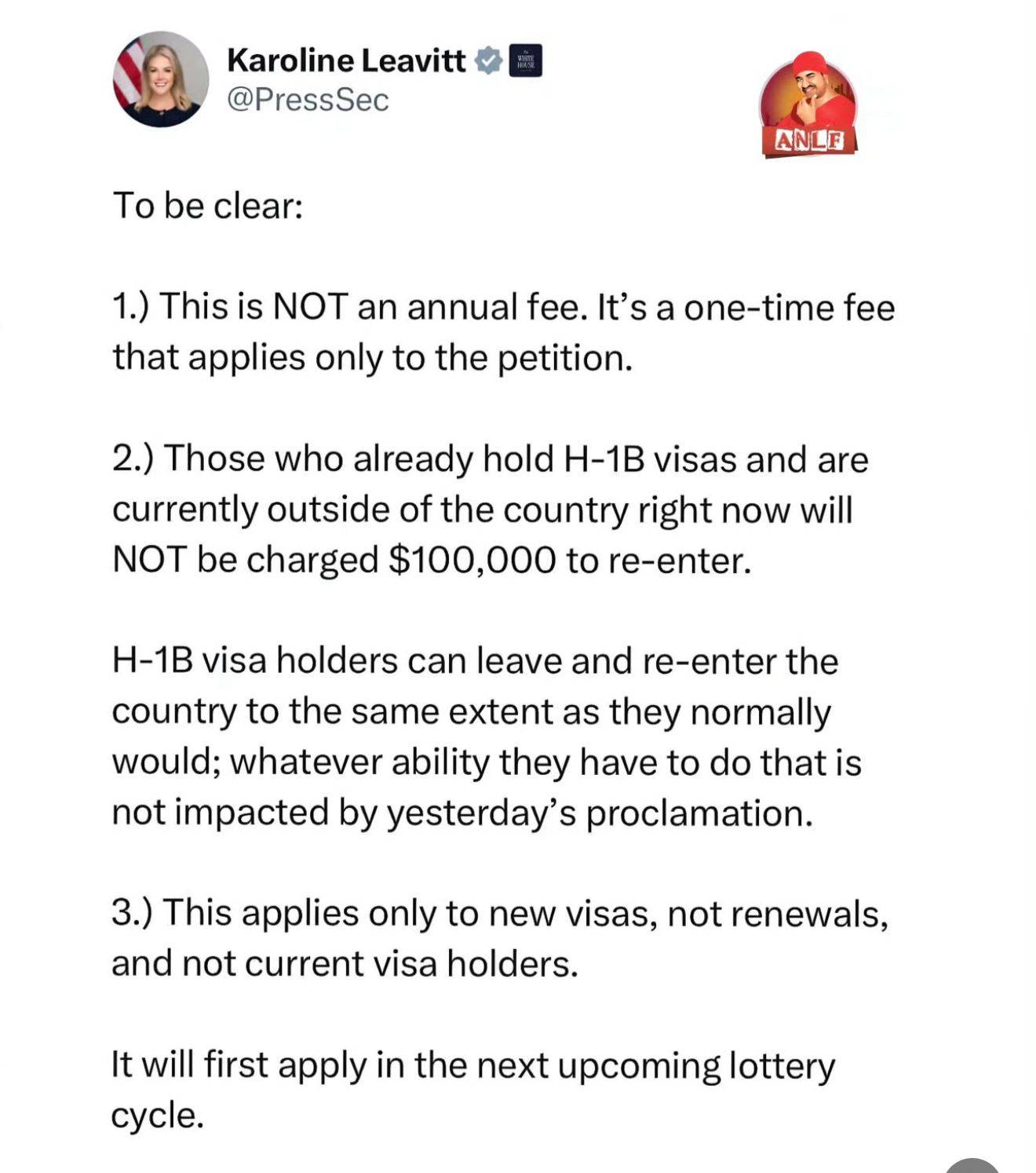
As of March 2026, the cost of an H-1B petition includes higher registration charges, updated Form I-129 filing fees, mandatory employer-paid assessments and, in some cases, a $100,000 supplemental payment that took effect on September 21, 2025 and remains under legal challenge.
The changes have widened the gap between the cost of keeping an existing H-1B worker and bringing in a new employee from outside the United States. They have also sharpened questions over who pays what, especially as federal rules bar employers from shifting most mandatory H-1B costs to workers.
Free toolSubstantial Presence Test CalculatorRegistration and Petition Fees
The process now starts with a $215 non-refundable registration fee per beneficiary for the annual H-1B lottery. That replaced the previous $10 registration fee and applies whether or not a candidate is selected.
Once a registration is chosen, employers file a full H-1B petition. The base filing fee under Form I-129 is $780 for standard employers and $460 for small employers with 25 or fewer full-time equivalent employees and qualifying nonprofit organizations, under a fee schedule that took effect on April 1, 2024.
Beyond that base charge, employers must also pay a $500 Fraud Prevention and Detection Fee for initial H-1B petitions and change-of-employer filings. An ACWIA education and training fee adds $750 for employers with 25 or fewer full-time U.S. employees and $1,500 for employers with more than 25 full-time U.S. employees.
Another layer comes from the Asylum Program Fee, set at $300 for small employers and $600 for larger employers, with qualifying nonprofit organizations exempt. Some large employers also face a $4,000 Public Law 114-113 fee if they have 50 or more U.S. employees and more than 50% of the workforce holds H-1B or L-1 nonimmigrant status.
Premium Processing remains optional, but expensive. Employers seeking a decision in 15 business days can pay $2,805, and that is the only H-1B-related fee employees are permitted to pay, as long as the arrangement does not reduce pay below required wage levels.
The $100,000 Supplemental Payment
The largest change came with the $100,000 supplemental payment announced under presidential directive. It applies primarily to new H-1B petitions filed on or after September 21, 2025, for beneficiaries outside the United States or petitions requesting consular notification.
That supplemental payment does not apply to most extensions for existing H-1B holders, change-of-status cases filed inside the United States, such as F-1 to H-1B conversions, or many change-of-employer filings for workers already in the country. The result is a cost structure that favors retaining workers already in the United States over recruiting new ones from abroad.
Estimated Total Costs
For a small employer using standard processing, the government fees add up to $2,225 before legal costs. With estimated attorney fees of $3,000–$6,000, the total estimated cost reaches $5,225–$8,225.
For a large employer using standard processing, the government total rises to $3,595. With estimated attorney fees of $3,000–$7,500, the full cost comes to $6,595–$11,095.
A large employer that also chooses Premium Processing faces $3,595 in standard government fees plus $2,805 for faster adjudication. Including estimated attorney fees of $3,000–$7,500, the total estimated cost is $9,400–$13,900.
If the employer must also pay the $100,000 supplemental fee for a new hire from abroad, the math changes sharply. Standard large-employer government fees of $3,595, plus the supplemental payment and estimated attorney fees of $3,000–$7,500, put the total estimated cost at $106,595–$111,095.
Who Pays What
Federal rules draw a firm line on fee allocation. Employers must pay the H-1B registration fee, the base Form I-129 filing fee, the Fraud Prevention and Detection fee, the ACWIA training fee, the Asylum Program fee, the Public Law 114-113 fee where applicable, and the $100,000 supplemental fee if it applies.
Employees may pay the $205 Visa Application Fee, known as the MRV, and family-related visa costs. Dependents on H-4 visas pay $205 per dependent through the consular system, plus any applicable reciprocity fees based on nationality.
H-4 dependents seeking work authorization through Form I-539 face a $470 filing fee and a $85 biometrics fee, for government fees totaling approximately $555. Employers are not required to cover those dependent costs, though some choose to do so.
Extensions, Transfers and Location-Based Effects
The new fee structure has created sharply different outcomes depending on whether a petition covers a fresh hire, an extension or a transfer. New H-1B petitions for workers outside the United States trigger the heaviest cost burden, including the $100,000 supplemental payment for filings after September 21, 2025.
Extensions for workers already in the United States usually avoid that supplemental payment. They still require the base filing fee, but the $500 Fraud Prevention and Detection fee generally does not apply to extensions with the same employer.
Transfers sit in the middle. When an H-1B worker changes employers while physically present in the United States, the new employer must file a new petition, but the $100,000 supplemental payment typically does not apply.
That changes if the worker is outside the country or the filing seeks consular notification. In those cases, the supplemental payment may apply, making location at the time of filing an issue for both employers and workers.
Industry Impact
The higher costs have hit industries differently. Technology and finance, which have long sponsored large numbers of H-1B workers, face the steepest increases for international recruitment.
Startups and smaller firms face a different squeeze. Without the budgets of large corporations, many are reassessing whether H-1B sponsorship remains feasible for junior or entry-level roles.
Consulting and professional services firms are also adapting. Some are paying the $100,000 supplemental payment for senior consultants with high billing rates while postponing sponsorship for junior staff or examining other visa categories.
Travel, Dependents and Long-Term Strategy
The fee changes have also altered travel planning for workers and families. After September 21, 2025, an H-1B worker who travels outside the United States may face reentry complications if an employer has not paid the supplemental fee on a petition covering the return.
That has made travel a practical and financial issue, not simply a personal one. It also affects H-4 dependents, who may face visa stamping complications if the principal H-1B worker cannot demonstrate fee payment.
The pressure extends to long-term immigration strategy. Many H-1B workers, especially those from countries with long green-card backlogs such as India, are pressing employers to begin permanent residence sponsorship earlier.
A software engineer from India who began H-1B employment in October 2024 and remains in the United States as of March 2026 illustrates the current divide. The worker is generally protected from the $100,000 supplemental payment so long as future extensions are filed while the worker remains in valid H-1B status in the country.
When that engineer approaches expiration, likely in October 2027, the employer would need to file an extension. If the engineer stays in the United States at the time of filing, the supplemental payment should not apply, though the standard fees still would.
Travel changes that equation. If the engineer goes to India after September 21, 2025 and then seeks to reenter the United States, the employer would need to demonstrate payment of the $100,000 supplemental payment on a petition covering the reentry.
That gap creates a powerful financial incentive for employers to keep current workers in place rather than recruit fresh talent abroad. Sponsoring a new H-1B worker from India in 2026 would cost approximately $106,595–$111,095 in government and legal fees, compared with roughly $6,595–$11,095 for extending the existing engineer’s status.
Legal Challenge and Outlook
The supplemental payment remains unsettled. Multiple business groups and immigration advocates have challenged the fee’s legality, arguing that it exceeds executive authority and harms U.S. competitiveness.
Those challengers include the U.S. Chamber of Commerce and technology industry associations. As of March 2026, the fee remains in effect while those cases move through the courts.
The legal uncertainty leaves employers balancing immediate hiring needs against a rule that has not been finalized through formal federal rulemaking. For workers, the same uncertainty touches job mobility, international travel and family decisions.
The presidential proclamation that created the supplemental payment also requires federal agencies to report after the next H-1B lottery on whether to extend or modify the fee beyond the initial 12-month period through September 21, 2026. Until that decision comes, employers and workers remain tied to a system in which the cost of one overseas H-1B hire can exceed $100,000 before a new employee even starts work.