- Form I-130 proves family relationships but does not grant a beneficiary any legal immigration status alone.
- Eligible residents inside the U.S. apply for permanent residence using Form I-485 to adjust their status.
- Starting September 18, 2026, USCIS will require a new edition of the adjustment of status application form.
U.S. Citizenship and Immigration Services separates family immigration into two different filings: one establishes a qualifying relationship, while the other asks for permanent residence. The distinction determines who files, where the beneficiary must be, and whether the forms can move together.
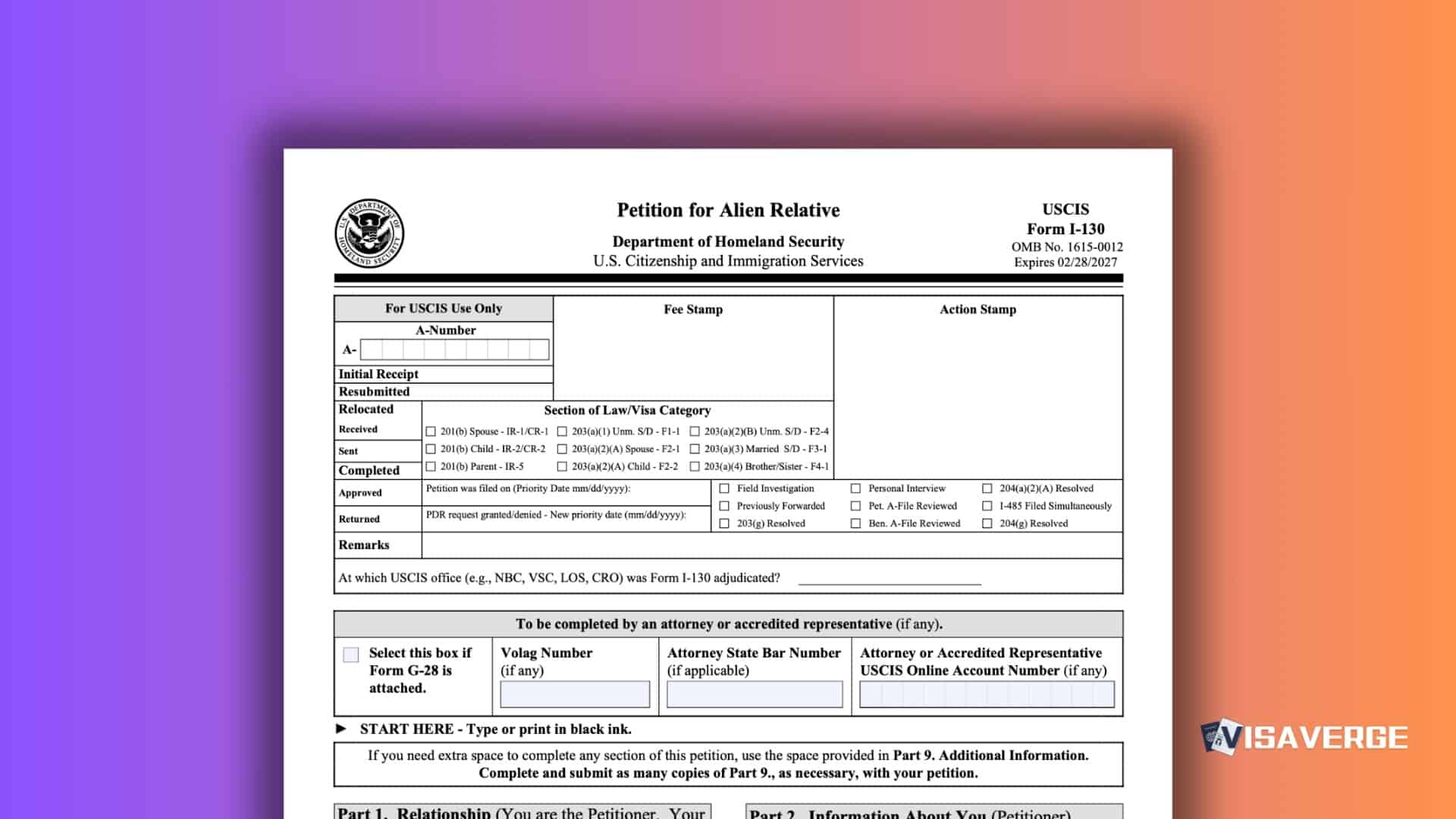
Form I-130, Petition for Alien Relative, is generally filed by a qualifying U.S. citizen or lawful permanent resident. It supports the family based green card case by documenting the relationship between the petitioner and the foreign national.

Form I-485, Application to Register Permanent Residence or Adjust Status, is generally filed by an eligible beneficiary inside the United States. It requests lawful permanent resident status through adjustment of status.
Free toolCSPA Age-Out Calculator OnlineThe forms often appear in the same case. They do not perform the same job.
The petition proves the relationship, but does not grant status
The first filing asks whether the family relationship qualifies under U.S. immigration law. A U.S. citizen or lawful permanent resident acts as the petitioner, while the relative is the beneficiary.
USCIS describes the petition as the first step in helping an eligible relative immigrate to the United States. Its approval establishes the approved immigrant petition, but it does not itself give the relative immigration status or another immigration benefit.
“The filing or approval of this petition does not give your relative any immigration status or benefit. We will generally approve your Form I-130 if you can establish a qualifying relationship.”
USCIS issued that guidance on July 24, 2026. The petition therefore answers a relationship question, not the final residence question.
In a marriage case involving a U.S. citizen and a foreign spouse, the citizen normally submits the petition. The foreign spouse normally submits the adjustment application if eligible to apply from inside the United States.
The adjustment application asks whether the beneficiary can become a resident
The second filing focuses on the individual applicant. An eligible person physically present in the United States uses the adjustment application to request lawful permanent resident status.
The review can involve the applicant’s health, criminal history, and financial self-sufficiency, along with other requirements for the applicable adjustment category. Approval of the adjustment application grants permanent resident status in an adjustment case.
The relationship petition supports that process. It does not replace it.
The adjustment application is not limited to family cases. Employment-based applicants may rely on Form I-140, while other cases can use humanitarian classifications, special immigrant provisions, Diversity Visa eligibility, or other statutory routes.
That is why an approved family petition is not a universal prerequisite for every adjustment filing. The correct underlying category controls.
Immediate relatives may file both forms together
USCIS permits eligible immediate relatives of U.S. citizens to submit the petition and adjustment application concurrently. Immediate relatives include spouses, unmarried children under 21, and parents of U.S. citizens.
Visa numbers remain immediately available for that group. Concurrent filing can allow the relationship petition and the request for permanent residence to proceed in the same overall case, provided the beneficiary meets the adjustment requirements.
The two filings still retain separate functions. Filing them together does not turn the relationship petition into a residence application.
Other family cases usually depend on visa availability. Family preference categories include siblings of U.S. citizens and spouses of lawful permanent residents. Beneficiaries in those categories often must wait for a priority date to become current before filing for adjustment.
For August 2026, USCIS directed all family-sponsored preference categories to use the Dates for Filing chart in the Department of State Visa Bulletin when determining whether they may submit an adjustment application. Applicants must still satisfy the other filing requirements.
An approved petition may be followed by a wait or overseas processing
Approval of the relationship petition does not automatically mean the beneficiary can file for adjustment. A beneficiary outside the United States may instead complete immigrant visa processing through a U.S. consulate abroad.
A beneficiary in a preference category may need to wait for visa availability. An adjustment-related eligibility issue can also prevent the next filing even after the petition succeeds.
The sequence can therefore differ by case:
- The petitioner submits the relationship petition.
- USCIS determines whether the claimed family relationship qualifies.
- The beneficiary checks adjustment eligibility and visa availability.
- The beneficiary files the adjustment application inside the United States, if eligible, or pursues immigrant visa processing abroad.
- USCIS decides the adjustment request, or the Department of State handles the overseas immigrant visa process.
The petition is one stage. Permanent residence is a separate stage.
Neither filing alone creates work permission or lawful stay
A pending or approved relationship petition does not provide employment authorization. It also does not create lawful nonimmigrant status, adjustment eligibility, or another authorized period of stay.
An eligible adjustment applicant may seek an Employment Authorization Document by filing Form I-765. That work authorization request has its own requirements and does not arise automatically from the family petition.
Someone already in the United States should also distinguish a pending family filing from permission to remain. The petition’s existence does not by itself extend a person’s authorized stay or resolve a separate status issue.
August changes raise the importance of the initial filing
USCIS and the Department of Homeland Security announced several policy changes in August 2026 that affect how applicants prepare and submit these filings.
On August 10, 2026, DHS introduced an interim final rule allowing USCIS to require electronic filing for forms available online for at least 180 days. USCIS said the initiative would reduce reliance on physical lockbox services and move fee payments electronically.
“This initiative will eliminate reliance on physical lockbox services and accelerate the shift to electronic fee payments. enhancing fraud detection and streamlining identity management.”
The agency already allows representatives to file the petition and adjustment application online concurrently. Unrepresented applicants must monitor USCIS instructions and the 60-day notice period that applies before mandatory electronic filing begins for particular forms.
Applicants should create a USCIS Online Account as the electronic filing system develops. Submission requirements can differ depending on the form and the filer.
On August 5, 2026, USCIS updated its policy to allow officers to deny an application without first issuing a Request for Evidence when the initial filing is incomplete. The agency said applicants should establish eligibility when they file.
That change makes the first package more consequential. Initial evidence can include the medical examination documented on Form I-693, along with evidence supporting the relationship and the beneficiary’s adjustment eligibility.
“Benefit requestors should establish eligibility for an immigration benefit at the time they file. this policy helps restore integrity to the immigration system and prevents meritless requests.”
An incomplete filing can now face denial instead of an invitation to correct the missing evidence through an RFE.
A revised adjustment form is due September 18
DHS rescinded the 2022 public charge regulation on July 16, 2026. USCIS spokesperson Zach Kahler said the agency is focused on protecting Americans’ safety, security, and financial well-being.
“USCIS is committed to safeguarding the safety, security, and financial well-being of Americans.”
USCIS plans to publish a revised edition of the adjustment application. Starting September 18, 2026, only the new edition will be accepted.
Applicants preparing a filing near that date should check the edition date and current instructions before submitting. Using an outdated edition can create a filing problem when the new requirement takes effect.
Processing times apply to separate filings
USCIS’s National Median Processing Time reports, as of August 10, 2026, listed 12.9 months for an immediate-relative relationship petition. Adjustment processing varies by category, while historical data showed a range of 10–14 months for standard family-based cases.
Those figures describe different agency actions. A petition median does not predict when an adjustment case will finish, and neither figure guarantees a result or a particular timeline.
Applicants should verify current filing instructions, form editions, fees, and processing times at USCIS’s official website before submitting. Requirements and timelines are subject to change.
The official petition overview, adjustment overview, and August 2026 filing-chart guidance provide the agency’s current instructions. USCIS also maintains its alerts page for electronic filing announcements and related updates.