- Form I-130 is the essential first step for U.S. citizens and residents to sponsor family members for immigration.
- New policies mandate consular processing abroad for most applicants, restricting adjustment of status to extraordinary circumstances only.
- USCIS now reserves the right to deny incomplete applications without issuing preliminary warnings or requests for further evidence.
U.S. citizens and lawful permanent residents use Form I-130, officially the Petition for Alien Relative, to establish the family relationship behind many U.S. immigration cases. The petition starts the process, but it does not itself grant a green card.
The petitioner is usually the U.S. citizen or lawful permanent resident. The beneficiary is the foreign relative seeking an immigration benefit. The person seeking to immigrate generally does not file the petition to obtain permanent residence directly.
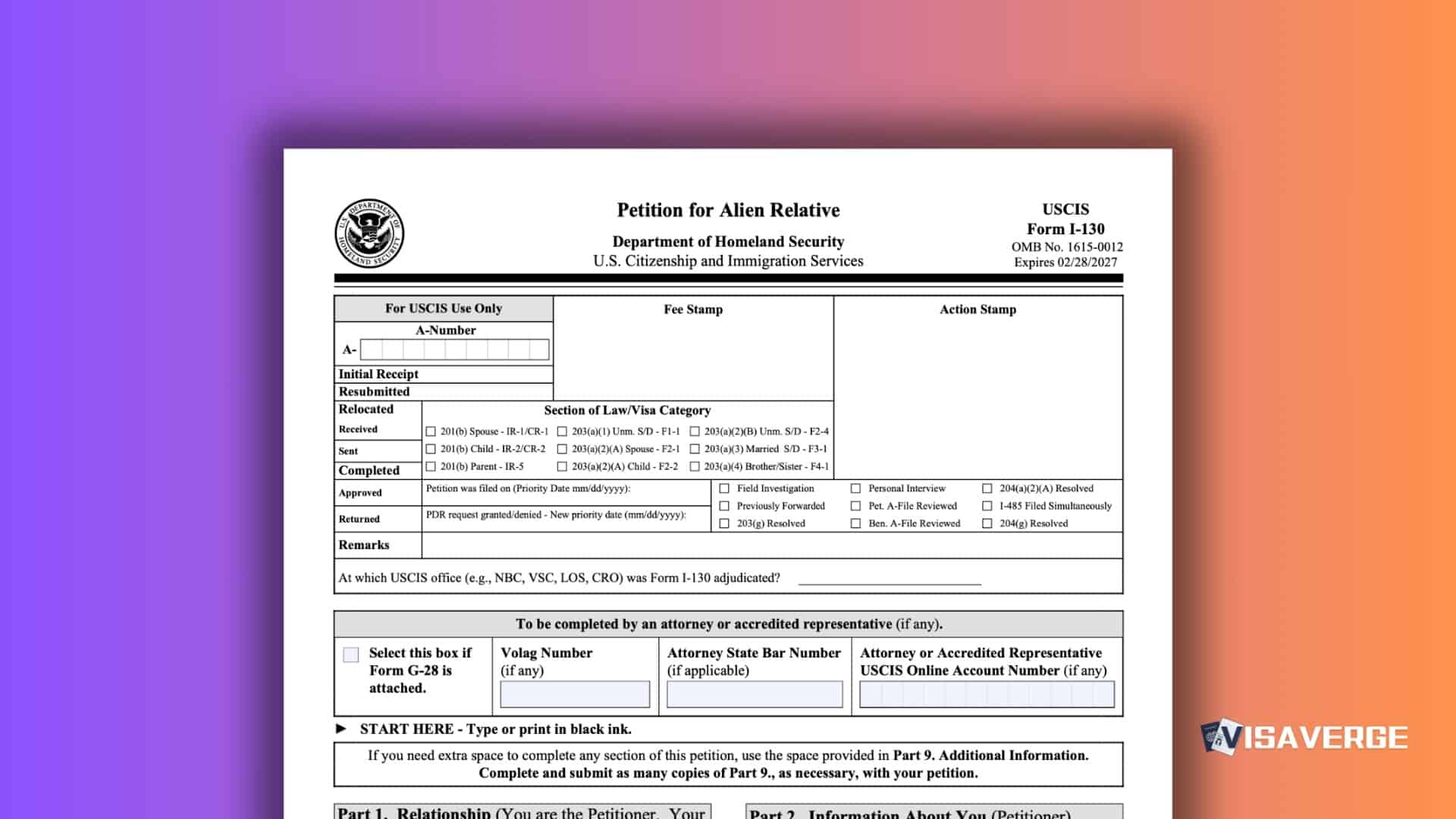
An approval confirms that the agency accepted the claimed qualifying relationship and approved the immigrant petition. It does not ordinarily create lawful permanent resident status, work authorization or a right to remain in the United States.
Free toolCSPA Age-Out Calculator OnlineThe next stage depends on the beneficiary’s location and visa availability. A person eligible to adjust status in the United States may use Form I-485, while someone processing abroad generally continues through immigrant visa processing and Form DS-260.
U.S. Citizenship and Immigration Services, or USCIS, reported that it approved approximately 627,000 petitions in fiscal year 2025 and denied more than 183,000. Relationship problems and insufficient documentation were among the reasons for denials.
The petitioner’s status determines which relatives qualify
A U.S. citizen may petition for a spouse, children, sons or daughters, parents and siblings, subject to the relationship and statutory requirements. The citizen must be at least 21 years old to petition for a parent.
Immediate relatives include qualifying spouses, unmarried children under 21 and parents of U.S. citizens who meet the age requirement. These classifications do not face annual numerical limits on immigrant visas.
Other relatives fall into family preference categories. Those categories have annual caps, so an approved petition can remain valid while the beneficiary waits for a visa number.
| Petitioner | Relatives identified in the material | Immigration classification |
|---|---|---|
| U.S. citizen | Spouse, unmarried children under 21, parents if the petitioner is 21 or older | Immediate relative |
| U.S. citizen | Married children, unmarried sons or daughters over 21, siblings if the petitioner is 21 or older | Family preference |
| Lawful permanent resident | Spouse and qualifying unmarried children or sons and daughters | Family preference |
A lawful permanent resident cannot petition for a parent or sibling. A green card holder also cannot file for a sibling simply because they share a family relationship.
The priority date controls the wait in capped categories
Family preference applicants must watch visa availability before moving to the next stage. The beneficiary’s priority date helps determine when permanent residence processing can proceed.
The August 2026 processing estimates vary sharply by category. Immediate relatives of U.S. citizens, including spouses, parents and minor children, were listed at approximately 10 to 15 months. F1 cases for unmarried sons or daughters of U.S. citizens ranged from 50 to 155 months.
Sibling cases can take much longer. F4 processing may exceed 15 to 20 years, depending on the beneficiary’s country of origin.
The petition fee remains $675 for online and paper filing, according to the material, with the rate set in April 2024. Processing times and fees can change.
An approval does not settle the beneficiary’s immigration case
A petition approval resolves the family relationship question. It does not decide every issue involved in permanent residence or an immigrant visa.
If an immigrant visa is immediately available, the petition and an adjustment application may sometimes be filed together. Concurrent filing is always available to otherwise eligible immediate relatives of U.S. citizens because those immigrant visas are not numerically limited.
Family preference applicants must first consider whether a visa number is available. The answer can depend on the classification and the priority date.
A beneficiary outside the United States generally proceeds through a U.S. embassy or consulate and immigrant visa processing. A beneficiary inside the country may qualify for adjustment of status, although a May 22, 2026 policy announcement described a narrower approach.
Zach Kahler, an agency spokesman, said the government would grant “Adjustment of Status” through Form I-485 only in “extraordinary circumstances.”
“We’re returning to the original intent of the law. From now on, an alien who is in the U.S. temporarily and wants a Green Card must return to their home country to apply, except in extraordinary circumstances. This policy allows our immigration system to function as the law intended instead of incentivizing loopholes.”
The policy shift affects relatives in the United States on temporary visas, including B-2 tourists and F-1 students, who might otherwise seek permanent residence without leaving the country. The stated direction is toward consular processing in the beneficiary’s home country, except in extraordinary circumstances.
Complete evidence matters at the initial filing stage
Marriage does not guarantee approval. A marriage certificate shows that a legal marriage occurred, but the agency may also examine whether the couple entered the marriage genuinely rather than primarily to obtain an immigration benefit.
Couples commonly provide evidence of a shared life and bona fide marital relationship. Other family petitions must establish the qualifying relationship and the petitioner’s statutory eligibility.
The agency may deny a petition when the petitioner fails to prove the relationship, lacks eligibility, submits insufficient evidence or encounters another legal problem. Petitioners should answer carefully if they receive a Request for Evidence or a Notice of Intent to Deny.
An August 5, 2026 policy update also said the agency may deny immigration benefit requests, including family petitions, without first issuing a Request for Evidence or Notice of Intent to Deny when the initial evidence is missing. The stated purpose was to “restore integrity to the immigration system” and prevent “frivolous or substantially incomplete filings” from slowing processing.
That makes the first submission especially important. The material identifies birth certificates, marriage licenses and proof of the petitioner’s status among documents that should be included when required.
A petitioner’s naturalization can change the case
When a lawful permanent resident petitioner becomes a U.S. citizen, the beneficiary’s family immigration classification can change. The effect on visa availability depends on the relationship and the surrounding circumstances.
The petitioner should update immigration authorities when naturalization affects a pending or approved petition. A classification change can alter how the case moves through the preference system, but it does not eliminate the remaining requirements for permanent residence.
DHS also announced in January 2026 that it had terminated categorical Family Reunification Parole programs for several countries, including Haiti, Colombia and El Salvador. Parole returned to a case-by-case basis.
On August 10, 2026, DHS announced an interim final rule allowing the agency to mandate electronic filing for certain immigration forms. The announcement said the measure would “strengthen national security” and modernize operations.
Petitioners should first determine which family relationship and visa category applies. They should then assemble the initial evidence, check whether a visa number is available, and identify whether the case will use adjustment of status or consular processing.
Processing times and fees are subject to change. Petitioners should verify the current requirements at uscis.gov/i-130 before filing.