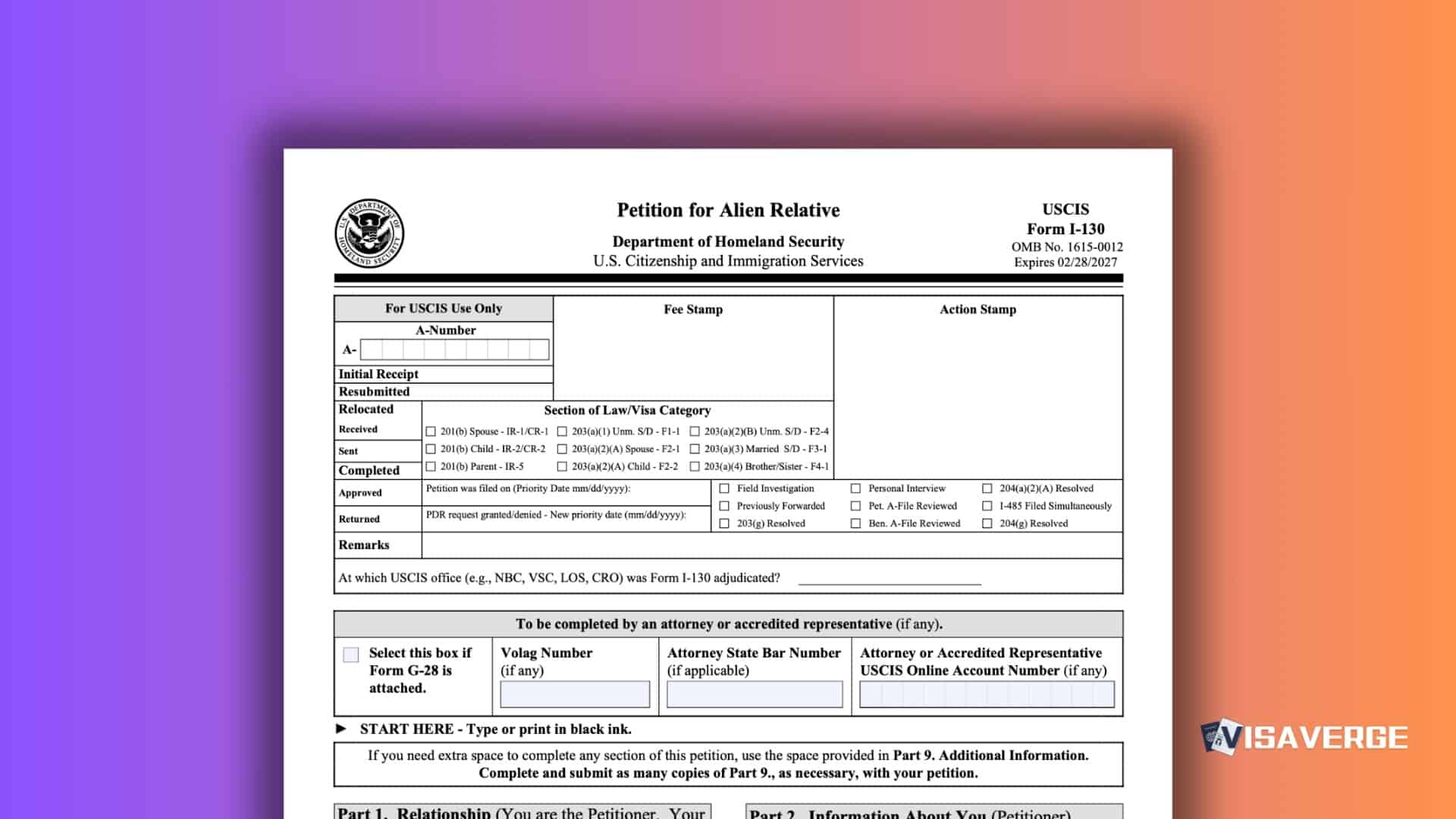
- USCIS says immediate-relative green card applicants must meet nine separate requirements before approval.
- The immediate-relative path covers only spouses, unmarried children under 21, and qualifying parents of U.S. citizens.
- Applicants must file Form I-485 correctly, have admissible entry, and keep the family relationship valid.
USCIS requires foreign relatives seeking a green card through a U.S. citizen to satisfy nine conditions before the agency approves their application. The requirements cover the filing, the applicant’s entry into the country, visa eligibility, the family relationship and USCIS discretion.
The guidance reported on August 24, 2026, and updated that day, applies to the immediate-relative route. Applicants must meet all nine conditions.

That route covers only three family relationships. They are the spouse of a U.S. citizen, an unmarried child under 21, and the parent of a citizen who is at least 21 years old.
Free toolCSPA Age-Out Calculator OnlineThe process begins in the United States. It is separate from consular processing for relatives applying from abroad.
Applicants must clear nine separate requirements
The nine conditions for adjustment of status are:
- File the application correctly. The applicant must submit
Form I-485, Application to Register Permanent Residence or Adjust Status, properly. - Show inspection and admission or parole. The person must have been inspected and either admitted or paroled into the United States.
- Be present in the country at filing. The applicant must physically remain in the United States when submitting the application.
- Qualify for an immigrant visa. The applicant must be eligible to receive an immigrant visa under the applicable family-based rules.
- Have a visa available at the required points. An immigrant visa must be immediately available both when the application is filed and when USCIS decides the case.
- Keep the qualifying relationship intact. The family relationship supporting the underlying
Form I-130petition must continue to exist. - Avoid an adjustment bar. No applicable rule may prevent the person from adjusting status.
- Be admissible or obtain a waiver. The applicant must be admissible to the United States for permanent residence, or qualify for a waiver of inadmissibility.
- Receive favorable discretion. USCIS must determine that the applicant merits a favorable exercise of discretion.
The requirements operate together. Meeting the family relationship requirement alone does not secure approval.
The family relationship determines whether a visa cap applies
Immediate relatives receive different treatment from other relatives of U.S. citizens because the immediate-relative categories are not subject to annual visa caps. A visa is considered immediately available for those applicants.
The broader family-based system includes three additional relationships:
| Family relationship | Category | Visa availability |
|---|---|---|
| Married child of a U.S. citizen | Family-preference | Usually waits for a visa number |
| Unmarried adult son or daughter of a U.S. citizen | Family-preference | Usually waits for a visa number |
| Brother or sister of a U.S. citizen who is at least 21 | Family-preference | Usually waits for a visa number |
Those applicants do not fall within the three immediate-relative groups. Their cases generally proceed through family-preference categories, which can involve visa backlogs.
A U.S. citizen can petition for each of the six listed family relationships. The immediate-relative classification, however, remains limited to spouses, unmarried children under 21 and qualifying parents.
The relationship must still support the petition
The family connection behind the Form I-130 petition must remain valid while the application is decided. That continuing relationship is one of the nine conditions, alongside visa eligibility and admissibility.
Applicants also must satisfy the entry requirement. USCIS looks for inspection followed by admission or parole, and the person must be physically present in the United States at filing.
The visa requirement has two parts. The applicant must qualify for an immigrant visa, and one must be immediately available when the application is submitted and when the agency reaches its decision.
A waiver can address some inadmissibility problems when the applicant qualifies under the applicable rules. It does not remove the need for the remaining conditions.
USCIS also retains discretion over the outcome. Even an applicant who meets the listed eligibility requirements must receive a favorable discretionary decision.
Applicants outside the three immediate-relative groups need another category
A married child, unmarried adult son or daughter or sibling of a U.S. citizen must use a family-preference category rather than this immediate-relative path. Those categories usually require waiting for a visa number.
Spouses, unmarried children under 21 and parents of citizens who are at least 21 can use the immediate-relative framework, but their cases still depend on satisfying every one of the nine conditions.
The requirements reported on August 24, 2026, therefore combine an available visa with a valid family relationship, qualifying entry, admissibility and a favorable decision from USCIS.