- Five paths lead to a green card; family sponsorship has no annual cap for immediate relatives and moves fastest.
- Employment green cards total about 140,000 a year across EB-1 through EB-5, with 46,000 extra released for fiscal year 2026.
- Government filing fees run $1,500 to $4,000 per applicant, with Form I-485 alone costing $1,440 on paper.
A green card gives you the right to live and work permanently in the United States, and there are five main ways to get one: through a family member, through a job, by winning the diversity visa lottery, through asylum or refugee status, or through a handful of special categories. Which path fits you depends on who you know, what you do, and where you were born. This guide walks through every route, what each one costs, how long it takes, and the exact forms involved.
The most common path by far is family sponsorship. Spouses, parents, and unmarried minor children of U.S. citizens face no annual cap and move fastest. Employment-based green cards run through five preference tiers and account for about 140,000 visas a year. The diversity lottery offers up to 50,000 green cards annually to people from countries with low U.S. immigration, though the program’s status has been disrupted in 2026 by a federal court case. Asylees and refugees can apply one year after they are granted protection.
Cost is the other deciding factor. Government filing fees alone run between $1,500 and $4,000 per applicant in 2026, and that is before attorney fees, the medical exam, or translation costs. The single largest fee is Form I-485, the adjustment of status application, which now costs $1,440 on paper with biometrics bundled in.
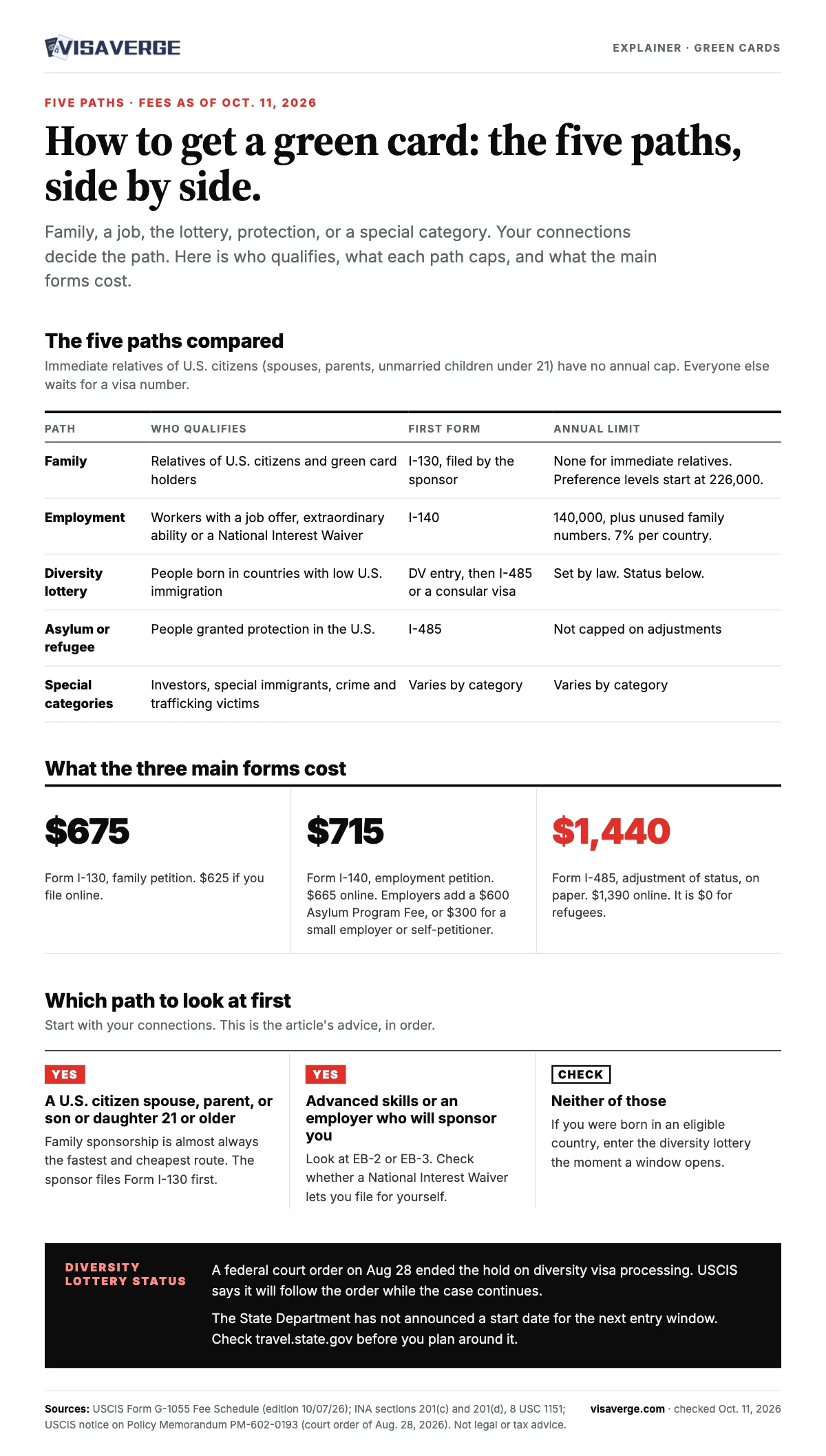
Below is a side-by-side look at the five routes so you can see where you might qualify before reading the detail on each.
Family-based green cards: the most-used route
Family sponsorship splits into two groups, and the difference decides how long you wait. Immediate relatives of U.S. citizens, meaning spouses, parents, and unmarried children under 21, have no annual numerical limit. Visas are always available, so the only delay is processing time. Everyone else falls into a capped family preference system limited to 226,000 green cards per year, which creates the long backlogs you hear about.
The four preference categories rank by relationship. F1 covers unmarried adult sons and daughters of citizens. F2A covers spouses and minor children of green card holders, and usually has the shortest preference wait. F2B covers unmarried adult children of green card holders. F3 covers married children of citizens, and F4 covers siblings of citizens, which carries the longest queue of all, often 15 to 20 years for high-demand countries like India, Mexico, and the Philippines.
Every family case starts with Form I-130, the Petition for Alien Relative, filed by the sponsor. In 2026 it costs $675 on paper or $625 online. The petition establishes the qualifying relationship and locks in a priority date, which is your place in line. Once a visa is available, the relative either files Form I-485 inside the U.S. or completes consular processing abroad. Be aware that vetting has tightened: USCIS now applies stricter scrutiny to family-based filings, so complete documentation matters more than ever.
Employment-based green cards: five preference tiers
About 140,000 employment green cards are issued each year, split across five categories and capped at 7 percent per country. For fiscal year 2026, the State Department released an extra 46,000 employment visas, easing some backlogs. Most employment cases require a job offer and a labor certification proving no qualified U.S. worker is available, though the top categories skip those steps.
- EB-1: Priority workers with extraordinary ability, outstanding professors and researchers, and multinational executives. No labor certification, and often the fastest route.
- EB-2: Professionals with advanced degrees or exceptional ability. Includes the National Interest Waiver, which lets you self-petition without an employer.
- EB-3: Skilled workers, professionals, and other workers. Larger backlogs because demand is high.
- EB-4: Special immigrants, including certain religious workers and former U.S. government employees abroad.
- EB-5: Investors who put at least $800,000 into a targeted employment area or $1,050,000 elsewhere and create 10 jobs.
Employment cases generally run through Form I-140, the Immigrant Petition for Alien Worker, which costs $715 on paper or $665 online in 2026, plus a $600 Asylum Program Fee ($300 for a small employer or self-petitioner). The wait after approval depends heavily on your country of birth. EB-1 can finish in one to two years, while EB-2 and EB-3 applicants from India and China face waits stretching past a decade. Our EB-2 India priority date outlook breaks down those timelines in detail.
The diversity visa lottery
The Diversity Immigrant Visa Program hands out up to 50,000 green cards a year through random selection, open to people born in countries with low rates of immigration to the United States. There is no job offer or family sponsor required, which makes it the only truly open path. Entry historically cost nothing, but the State Department introduced a $1 registration fee and added anti-fraud requirements.
One major caveat for 2026: the program has been in flux. USCIS had placed a hold on pending diversity visa adjustment of status applications (policy memo PM-602-0193). On August 28, 2026, a federal court in Medani v. Trump temporarily vacated that memo while the case continues, and USCIS says it will follow the order, which is aimed at resuming ordinary processing of pending applications. The litigation is ongoing and could change, so check the USCIS statement on PM-602-0193 for the latest. As of our October 11, 2026 check, we could not confirm a start date for the next DV registration window, so watch travel.state.gov. Winners must still complete the green card process by September 30 of the relevant fiscal year, a hard deadline that does not move. If you are counting on this route, read our complete DV-2027 lottery guide for the current status and the new rules before you plan around it.
Asylum, refugee, and humanitarian paths
People granted asylum or admitted as refugees can apply for a green card one year after their grant or arrival. There is no annual cap on these adjustments, and the filing fee for Form I-485 is waived for refugees. The one-year clock is firm, so mark the date you were granted status and file as soon as you reach it.
Other humanitarian routes feed into permanent residence too. Victims of crime on a U visa, victims of trafficking on a T visa, and certain abused spouses and children under the Violence Against Women Act can all reach a green card. Each carries its own waiting period and evidence rules, but they share the same final step: an adjustment of status application.
Adjustment of status vs consular processing
No matter which category sponsors you, the final stage takes one of two forms. If you are already inside the United States in a lawful status, you usually file Form I-485 to adjust status without leaving the country. If you are abroad, you complete consular processing through a U.S. embassy or consulate using Form DS-260 and attend an interview there.
The choice is not always yours. It depends on where you live, whether a visa number is current, and your immigration history. Adjustment lets you stay in the U.S. and often apply for a work permit and travel document while you wait. Consular processing can be faster in some categories but requires international travel and carries the risk of unlawful-presence bars if you have prior violations. Our breakdown of consular processing versus adjustment of status covers how to pick the right one.
What a green card actually costs in 2026
The headline fees are the petition and the adjustment application, but most applicants pay several charges on top. Filing Form I-765 for a work permit alongside I-485 adds $260, and Form I-131 for advance parole travel adds $630. Budget for the medical exam, which runs $200 to $500 and is not a government fee, plus any document translations.
Filing online instead of on paper shaves money off several forms. The I-485 drops by $50 to $1,390, the I-130 drops to $625, and the I-140 drops to $665. Fee waivers exist for some humanitarian categories and low-income applicants who file Form I-912.
How long the whole process takes
Timelines swing wildly by category and country. A spouse of a U.S. citizen filing inside the country can finish in roughly 12 to 20 months. A sibling of a citizen from the Philippines might wait two decades. The two clocks that matter are the priority date, which controls when a visa becomes available, and USCIS processing time, which controls how fast your paperwork moves once a visa is at hand.
Watch the monthly Visa Bulletin from the State Department to track when your priority date becomes current. Until that date is current, no amount of paperwork speed helps, because the law caps how many visas are issued. After you receive the card, you also have to keep it valid: renewal rules tightened in 2025, and long absences abroad can put your status at risk.
Which path should you pursue
Start by listing your connections. If you have a U.S. citizen spouse, parent, or child over 21, family sponsorship is almost always the fastest and cheapest route, so file Form I-130 first. If you have advanced skills or a U.S. employer willing to sponsor you, look at EB-2 or EB-3, and check whether a National Interest Waiver lets you self-petition. If neither applies and you were born in an eligible country, register for the diversity lottery the moment the window reopens.
Then confirm three things before you spend a dollar: that you fit the category, that you are admissible with no disqualifying record, and that you can document the relationship or qualification. Pull the current Visa Bulletin to see realistic timelines for your category and country. If your case involves prior overstays, criminal history, or a complex work history, a consultation with an immigration attorney is worth the cost before you file, because a denied application rarely refunds its fee.
Frequently Asked Questions
What is the fastest way to get a green card?
Marriage to a U.S. citizen is usually the fastest path because spouses are immediate relatives with no annual visa cap. A spouse filing inside the United States can often finish in roughly 12 to 20 months. EB-1 is the quickest employment route, sometimes one to two years, since it needs no labor certification.
How much does a green card cost in 2026?
Government filing fees run between $1,500 and $4,000 per applicant. The biggest single fee is Form I-485 at $1,440 on paper, with biometrics now bundled in. Family petitions on Form I-130 cost $675, and employment petitions on Form I-140 cost $715, plus a $600 Asylum Program Fee ($300 for a small employer or self-petitioner). Filing online lowers several of these fees.
Can I get a green card without a job or family sponsor?
Yes, through the diversity visa lottery, which awards up to 50,000 green cards a year to people born in low-immigration countries. No sponsor is needed. However, the program has been disrupted in 2026: USCIS’s hold on diversity visa adjustment cases was temporarily vacated by a federal court on August 28, 2026, and the litigation continues, so check current status before relying on it. A new $1 registration fee and anti-fraud rules have also been introduced.
What are the family preference categories F1 through F4?
F1 is unmarried adult children of citizens. F2A is spouses and minor children of green card holders. F2B is unmarried adult children of green card holders. F3 is married children of citizens. F4 is siblings of citizens. All four share a 226,000 annual cap, so they face waits that can exceed 20 years.
What is the difference between adjustment of status and consular processing?
Adjustment of status lets you apply for a green card on Form I-485 without leaving the United States, available if you are already here in lawful status. Consular processing happens at a U.S. embassy abroad using Form DS-260. Your location, visa availability, and immigration history decide which applies.
How long does the green card process take?
It ranges from about 12 months for a citizen’s spouse to over 20 years for a citizen’s sibling from a high-demand country. Two clocks matter: the priority date, which sets when a visa becomes available, and USCIS processing time once a visa number is current.
Can asylees and refugees get a green card?
Yes. People granted asylum or admitted as refugees may apply one year after their grant or arrival. There is no annual cap on these adjustments, and the Form I-485 filing fee is waived for refugees. The one-year clock is firm, so file as soon as you reach the date.
What are the employment green card categories?
There are five: EB-1 for priority workers with extraordinary ability, EB-2 for advanced-degree professionals including the National Interest Waiver, EB-3 for skilled and other workers, EB-4 for special immigrants, and EB-5 for investors putting in at least $800,000. About 140,000 are issued each year.