- U.S. citizens aged 21+ can sponsor parents for residency without annual visa caps or waiting lines.
- Relationship proof requirements vary between biological, adoptive, or stepparent categories for the IR-5 visa.
- Sponsors must demonstrate income at 125% of poverty guidelines using Form I-864 Affidavit of Support.
For U.S. citizens aged 21 or older, the IR-5 route remains one of the clearest ways to bring a parent to the United States. The Parent Green Card is an immediate-relative category, so it has no annual visa caps and no waiting line in the Visa Bulletin. That makes it faster than many family-based paths, especially for parents who need care, stability, or a permanent place with their children.
The process still demands care. A missing form, weak financial proof, or an incomplete medical packet can slow everything down. According to analysis by VisaVerge.com, the strongest cases are the ones built early, with clean records and the right filing path chosen from the start.
The first decision: who can file, and for whom
Only a U.S. citizen who is 21 or older can file an IR-5 petition. Green card holders cannot sponsor parents in this category. The parent must be a biological parent, adoptive parent, or stepparent. A child under 21 cannot be included as a derivative beneficiary on the same case.
Free toolCSPA Age-Out Calculator OnlineThe relationship proof depends on the family connection. A biological mother usually needs the birth certificate. A married biological father needs the birth certificate plus proof of the parents’ marriage. An unmarried father needs stronger evidence, such as legitimation records or proof of a real parent-child bond before the child turned 21.
A stepparent must have married the biological parent before the sponsor’s 18th birthday. An adoptive parent case needs an adoption decree completed before the child’s 16th birthday, plus proof of cohabitation.
Building the file before USCIS sees it
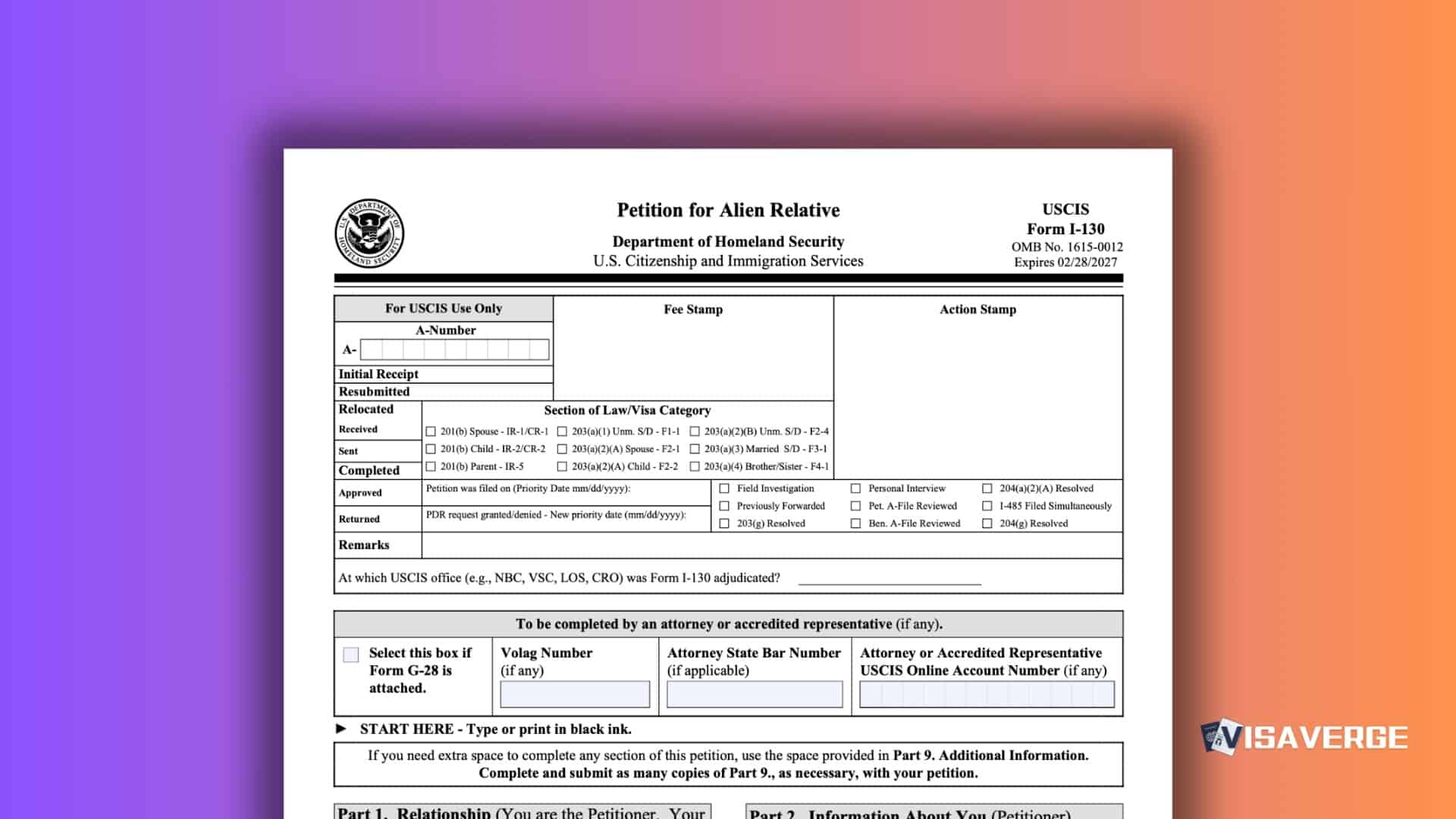
The petition starts with Form I-130, Petition for Alien Relative. File it online or by mail with USCIS. The official form page is Form I-130. The case also needs evidence of U.S. citizenship, such as a passport, birth certificate, or naturalization certificate, along with the parent-child relationship records and certified English translations for any non-English documents.
Financial support sits at the center of the case. The sponsor must file Form I-864, Affidavit of Support, and show income at 125% of the federal poverty guidelines. Tax returns, W-2s, and recent pay stubs usually support that filing. A joint sponsor can step in when the petitioner’s income falls short.
The I-864 creates a legally binding promise to support the parent and reduce the chance that the parent will rely on public benefits.
Filing choices after the petition
If the parent is outside the United States, the case usually moves through consular processing. If the parent is already lawfully in the country, the case can often move through adjustment of status with Form I-485. The official USCIS page for that form is Form I-485.
The filing strategy matters because the two paths move differently. Consular processing ends with a visa interview at a U.S. embassy or consulate abroad. Adjustment of status keeps the parent in the United States while USCIS handles the case. That route can also allow a pending work permit and travel document in some cases.
Recent USCIS practice makes the medical exam especially important. Since the December 2, 2024 change, applicants filing I-485 must submit Form I-693 with the packet. The form page is Form I-693. Leaving it out can trigger rejection.
What happens after filing
USCIS first sends a receipt notice. Then it reviews the petition and supporting evidence. For many cases, the I-130 review takes 8 to 14 months in early 2026. Requests for Evidence are common when the file lacks marriage records, adoption records, proof of citizenship, or complete financial support documents.
Once USCIS approves the petition, the case goes in one of two directions. For consular cases, USCIS sends the matter to the National Visa Center. For adjustment cases, the parent can move into the I-485 stage. Current estimates put full adjustment of status at 7 to 20 months, while consular processing often runs 6 to 18 months after NVC handling begins.
The interview stage checks identity, family history, medical admissibility, and the honesty of the record. Officers often ask simple but detailed questions, such as how the parent and child stayed in contact, where the parent lived, or how the relationship developed over time.
Consular processing abroad
Parents outside the United States complete DS-260, pay the required fees, and gather civil documents, police certificates, and the medical exam. After the interview, a visa is issued if the officer approves the case. The parent then enters the United States as a lawful permanent resident and receives the green card after arrival.
This path usually works well for parents who live abroad and do not need to remain in the United States during processing. It can also cost less than adjustment of status. The tradeoff is that the parent must wait outside the country and manage embassy scheduling, travel, and local document collection.
Adjustment of status inside the United States
A parent who entered lawfully and remains eligible can file I-485, often together with the I-130. That path keeps the family together during processing. It also allows the parent to apply for work authorization and, in many cases, travel permission while the case is pending.
USCIS often asks for biometrics first. Then it may schedule an interview, though some cases move without one. Approval ends with a green card mailed to the U.S. address. This route costs more, but it gives the parent a way to stay in the country during the wait.
Fees, timelines, and common mistakes
The usual fees are $675 for I-130, $325 for DS-260, $345 for the immigrant visa, and $1,440 for I-485. Medical exams and travel add more cost. Many families also pay for translation, passport photos, and document retrieval.
The most common problems are missing income evidence, weak relationship proof, and incomplete medical paperwork. Fathers’ cases and stepparent cases draw extra scrutiny when the family records are thin. If USCIS issues a denial, the notice explains the reason. Some applicants refile, while others file Form I-290B within 30 days.
The long-term payoff is broad. A lawful permanent resident can live and work in the United States, and after five years, the parent can usually apply for citizenship if all other naturalization rules are met. The IR-5 category also gives families a direct path to reunification without waiting for a visa number to become available.
For official filing guidance, USCIS keeps the most reliable information on its website, including form instructions, fee pages, and case tools. Families should check the USCIS filing pages and the State Department’s immigrant visa pages before submitting anything. That step helps avoid expensive mistakes and keeps the Parent Green Card process on track.