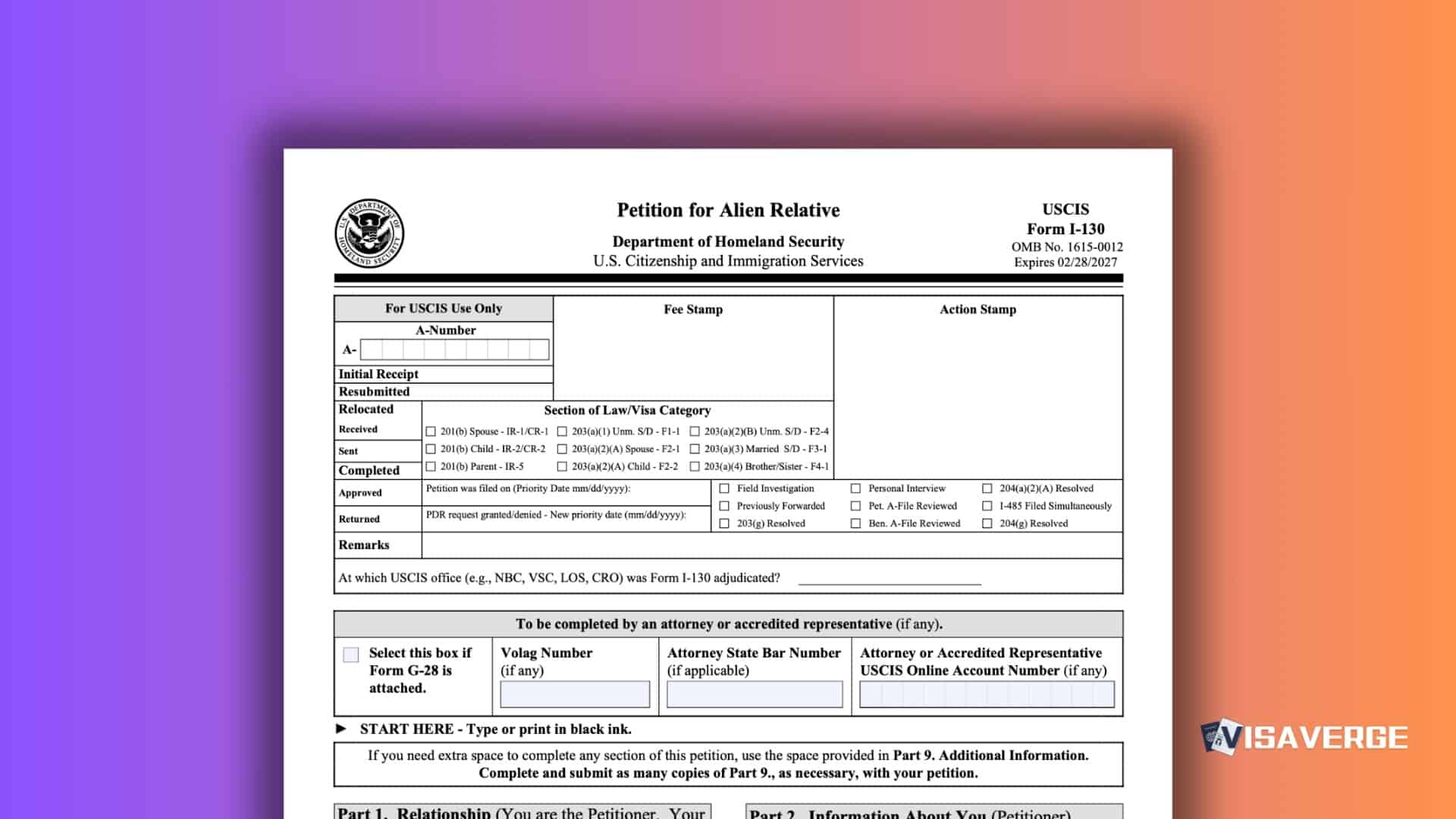
Form I-130, Petition for Alien Relative, is the document that opens nearly every family-based green card case, and the paperwork you attach to it decides whether the case moves or stalls. Filing the petition does one thing: it asks USCIS to formally recognize that a qualifying family relationship exists between you (the petitioner) and your relative (the beneficiary). Strong supporting documents get the relationship approved; gaps invite a Request for Evidence that can add months to an already long wait.
This checklist covers only the documents you file with Form I-130 at the petition stage. It is not the adjustment of status (Form I-485) or consular processing document list that comes later once a visa is available. Running through the essential checks before filing the I-130 alongside this list is the fastest way to catch a missing item before you mail or upload anything.
The current edition of both Form I-130 and its spouse supplement, Form I-130A, is dated 04/01/24. USCIS will reject an outdated edition, so confirm the date printed at the bottom of the form before you sign. The filing fee is $625 when you file online through a myUSCIS account and $675 when you file by paper. Since October 28, 2025, USCIS no longer accepts checks or money orders; paper filers pay by credit or debit card with Form G-1450, or by ACH bank transfer with Form G-1650.
Free toolCSPA Age-Out Calculator OnlineWhich documents you actually need turns on two questions: how you qualify to petition, and your relationship to the beneficiary. A U.S. citizen and a lawful permanent resident prove their status with different documents. A spouse petition, a parent petition, and a sibling petition each call for different relationship evidence, and only spouse petitions require the extra I-130A supplement. Getting the form itself filled out correctly matters just as much as the attachments.
Your relationship category also sets your timeline. Immediate relatives, meaning spouses, unmarried children under 21, and parents of U.S. citizens aged 21 or older, always have a visa available. Family preference relatives, including siblings, married children, and the spouses and children of green card holders, wait for a priority date to become current before the case can move to the next stage. The petition documents are the same either way, but immediate relatives can often file the green card application at the same time.
Two rules apply to everything you submit. Every document written in a foreign language must include a full English translation with a signed certification from the translator confirming it is complete and accurate. And you should file clean photocopies, not originals, because USCIS keeps what you send and will not return it. Use the priority key below: required items apply to essentially every petition, recommended items strengthen the case, and situational items apply only when your relationship type or history calls for them.
Only one form of status proof below applies to you. Pick the document that matches how you became a citizen or resident, then set the others aside. Sending the wrong one, such as a birth certificate from a naturalized citizen, is a frequent Request for Evidence trigger.
USCIS scrutinizes marriage petitions closely for fraud. One certificate is not enough. Show the relationship is real across several categories of evidence and across time, not a single snapshot. The same proof anchors the I-751 petition to remove conditions two years later, so start building the file now.
Before you file, match each item above against your relationship type and run one final review for the mistakes that most often produce a Request for Evidence. The table below pairs the seven most common RFE triggers on family petitions with the fix for each.
| Common RFE Trigger | How to Avoid It |
|---|---|
| Missing certified translation | Attach a full English translation plus the translator’s signed certification for every foreign-language document. |
| Illegible or partial copies | Submit clean, complete photocopies. Dark scans, cut-off edges, and one-sided copies of two-sided documents get flagged. |
| Wrong proof of petitioner status | Use the status document that matches how you qualify. A naturalized citizen submits the naturalization certificate, not a foreign birth certificate. |
| Thin bona fide marriage evidence | Show the marriage across finances, housing, and third-party affidavits over time, not a stack of photos from one trip. |
| Name discrepancies | Document every name difference with a marriage certificate, divorce decree, or legal name-change order. |
| Missing Form I-130A | Include the signed I-130A supplement on every spouse petition. It is not needed for parent, child, or sibling cases. |
| Unsigned form or wrong fee | Sign the petition and pay the exact $625 online or $675 paper fee with an accepted payment method. |
The mailing address for a paper I-130 depends on where you live and whether you file the green card application at the same time, and USCIS updates these addresses periodically. Confirm your exact filing location on the USCIS direct filing addresses page, or file online to skip mailing entirely. Immediate relatives inside the United States can often file Form I-485 concurrently; see the fees for concurrent I-130 and I-485 filing before you decide.
Once the petition is filed, USCIS issues a receipt notice, and for spouse cases it may schedule an interview later in the green card stage. Knowing what to expect at the I-130 interview helps you keep the same evidence organized for the questions that come next. Assemble the file in the order of this checklist, label each section, and you give the officer a clean, decision-ready petition.
Frequently Asked Questions
What documents do I need to file Form I-130?
You need the signed Form I-130 (edition 04/01/24), proof of your U.S. citizenship or lawful permanent resident status, evidence of the qualifying family relationship, and certified English translations for any foreign-language document. Spouse petitions add Form I-130A, passport-style photos, and bona fide marriage evidence.
How much is the Form I-130 filing fee in 2026?
The Form I-130 fee is $625 when you file online through a myUSCIS account and $675 when you file by paper. Since October 28, 2025, USCIS no longer accepts checks or money orders, so paper filers pay by card with Form G-1450 or by ACH transfer with Form G-1650.
Do I need Form I-130A for every petition?
No. Form I-130A, Supplemental Information for Spouse Beneficiary, is required only when you are petitioning for your husband or wife. Petitions for a parent, child, or sibling do not include Form I-130A and do not require photographs of the beneficiary.
What counts as proof of a bona fide marriage?
Strong evidence spans several categories over time: joint bank accounts and tax returns, a lease or mortgage in both names, insurance policies naming each other, dated photos together, birth certificates of any children you share, and sworn affidavits from people who know you as a couple. One marriage certificate alone is not enough.
Do I have to translate foreign-language documents for the I-130?
Yes. Every document in a language other than English must include a full English translation with a signed certification from the translator confirming the translation is complete and accurate and that they are competent to translate it. A translation missing the certification statement is a common rejection reason.
Should I send original documents or copies with Form I-130?
Send clear, legible photocopies, not originals. USCIS keeps everything you submit and will not return your documents, so keep every original in a safe place. Copy both sides of any two-sided document, such as a green card.
What relationship evidence proves a parent or sibling petition?
For a parent petition, you submit your own birth certificate showing your name and your parent’s name. For a sibling petition, both birth certificates must show at least one shared parent. Neither type requires Form I-130A or beneficiary photographs, unlike a spouse petition.
What are the most common reasons USCIS issues an RFE on Form I-130?
Frequent triggers include a missing certified translation, illegible or partial copies, the wrong proof of petitioner status, thin marriage evidence, unexplained name discrepancies, a missing Form I-130A on a spouse case, and an unsigned form or incorrect fee. Each one is avoidable by checking the document before you file.