- The I-130 interview verifies family relationship authenticity to prevent immigration fraud through direct questioning and evidence.
- Processing times vary significantly by office, with some spouse petitions averaging 13-15 months while others take years.
- Successful applicants must provide consistent testimony and extensive documentation, including financial records, photos, and shared history.
The I-130 interview is the point where USCIS checks whether a family relationship is real. For many spouses and other relatives, it is the most personal part of the case, and one of the hardest to predict because processing times vary so widely.

For some families, the interview never happens. For others, it arrives after many months of waiting and a thick file of documents. As of March 2026, VisaVerge.com reports that spouse petitions average 13-15 months, while some field offices stretch family cases to 60 months. That gap shapes everything applicants do next.
Why USCIS calls people in
The interview is a fraud check and a relationship check at the same time. USCIS officers use it to confirm that the claimed bond fits the category on the petition, whether that is a marriage, a parent-child relationship, or another qualifying family tie. The agency is not simply re-reading forms. It is testing whether the story holds up under direct questions.
Free toolCSPA Age-Out Calculator OnlineMarriage cases get the most scrutiny. Officers look for shared history, daily habits, and details that married couples usually know without thinking. The same approach applies, in a different way, to parent-child and sibling cases. The goal stays the same: prove the family link is genuine.
The interview appears more often in adjustment of status cases filed with Form I-485, and in consular processing after National Visa Center steps. It can also be scheduled on its own when USCIS spots red flags. Those flags include prior overstays, large age gaps, or facts that raise fraud concerns.
| India | China | ROW | |
|---|---|---|---|
| EB-1 | Feb 01, 2023 ▲109d | Jul 01, 2023 | Current |
| EB-2 | Nov 01, 2013 | Oct 01, 2021 ▲30d | Jan 01, 2025 |
| EB-3 | Jan 01, 2014 | Jan 08, 2022 ▲7d | May 15, 2024 ▼109d |
| F-1 | Jan 22, 2020 | Jan 22, 2020 | Jan 22, 2020 |
| F-2A | Sep 22, 2026 ▲31d | Sep 22, 2026 ▲31d | Sep 22, 2026 ▲31d |
Who should expect to attend
In marriage cases, both the petitioner and the beneficiary usually attend. That lets the officer compare answers and see how the couple describes their life together. In parent or child cases, the U.S. citizen or lawful permanent resident petitioner often attends as well.
Lawyers may sit in the room, but they do not answer questions for the couple. Their role is to observe and advise.
Not every family-based petition gets an interview. USCIS often waives interviews for lower-risk immediate relatives, especially spouses, parents, and unmarried children under 21 of U.S. citizens. Interviews are more common in marriage-based filings, preference-category cases, and files that contain inconsistencies or earlier denials.
What officers usually ask
The questions are not random. They focus on the life you share.
For marriage cases, expect questions like:
- How did you meet?
- When and where did the relationship begin?
- When did you marry?
- Who cooks, pays bills, or handles rent?
- What does your home look like?
- How do you celebrate holidays?
Officers also ask about future plans, children, travel, and family visits. They want to hear the same answers from both spouses.
For parent-child or sibling petitions, questions often cover birth details, family names, shared homes, and contact over time. The officer may ask how often you speak, visit, or send support.
A normal interview can last 30-60 minutes. If the case is simple, it may move faster. If the officer sees conflicts, it can run longer. In some marriage cases, USCIS uses a Stokes interview, which means the spouses are separated and asked similar questions one by one.
Evidence that should be in the file
Bring originals and copies of the main documents:
- Marriage or birth certificates
- Divorce decrees showing prior marriages ended
- Joint bank statements
- Tax returns for the last 3 years
- Insurance policies
- Lease or mortgage records
- Photos from the wedding and from later dates
- Affidavits from friends or family
- Passports, IDs, and prior immigration records
For parent-child cases, school records and medical records can help prove the relationship.
Missing evidence slows the file. USCIS may issue a Request for Evidence, or RFE, and that often adds 4-7 months. A complete packet from the start helps avoid that pause.
How the I-130 interview differs from the I-485 interview
When both forms are filed together, one appointment can cover both. Still, the focus is different.
| Point | I-130 interview | I-485 interview |
|---|---|---|
| Main question | Is the family relationship real? | Is the beneficiary eligible for a green card? |
| Main topics | Marriage history, family life, shared routine | Criminal history, immigration history, inadmissibility issues |
| Who matters most | Petitioner and beneficiary | Beneficiary, with petitioner for the relationship part |
| Main evidence | Joint documents and proof of family life | Medical exam, police records, background forms |
Put simply, the I-130 asks, “Who are you to each other?” The I-485 asks, “Can this person stay?”
Current processing times and decision timing
The wait is often longer than the interview itself. For immediate relatives of U.S. citizens, average processing now runs about 10-15 months, with FY2025 data showing 14.8 months. VisaVerge.com notes that some USCIS field offices still reach 59.5 months.
Family preference categories move much slower. The F2A category can run 55-106 months. The F1 category is listed at 155 months, and F2B at 170 months. Those cases also depend on visa availability after approval.
Decision timing after the interview is uneven. Some officers approve cases the same day. Others send a written notice in 2-4 weeks. RFEs, staffing shortages, and heavy caseloads all stretch processing times.
What happens after the interview
Approval means the petition is accepted and the case moves forward. For a spouse inside the United States, that usually means the related I-485 can keep moving. For overseas cases, approval sends the file to consular processing through the National Visa Center.
An RFE means more evidence is needed. The response window is usually 87 days, and the clock pauses until USCIS gets the full reply.
A fraud-focused denial is more serious. If the officer thinks the story does not match, the couple may face a denial and appeal rights through Form I-290B within 30 days. In the most serious cases, people re-file only after the record is fixed.
How to prepare without overcomplicating the case
The strongest cases are simple, consistent, and well organized. Review every answer on your Form I-130 before the interview. Match dates, addresses, and family facts. Bring more proof than you think you need, but keep it neat.
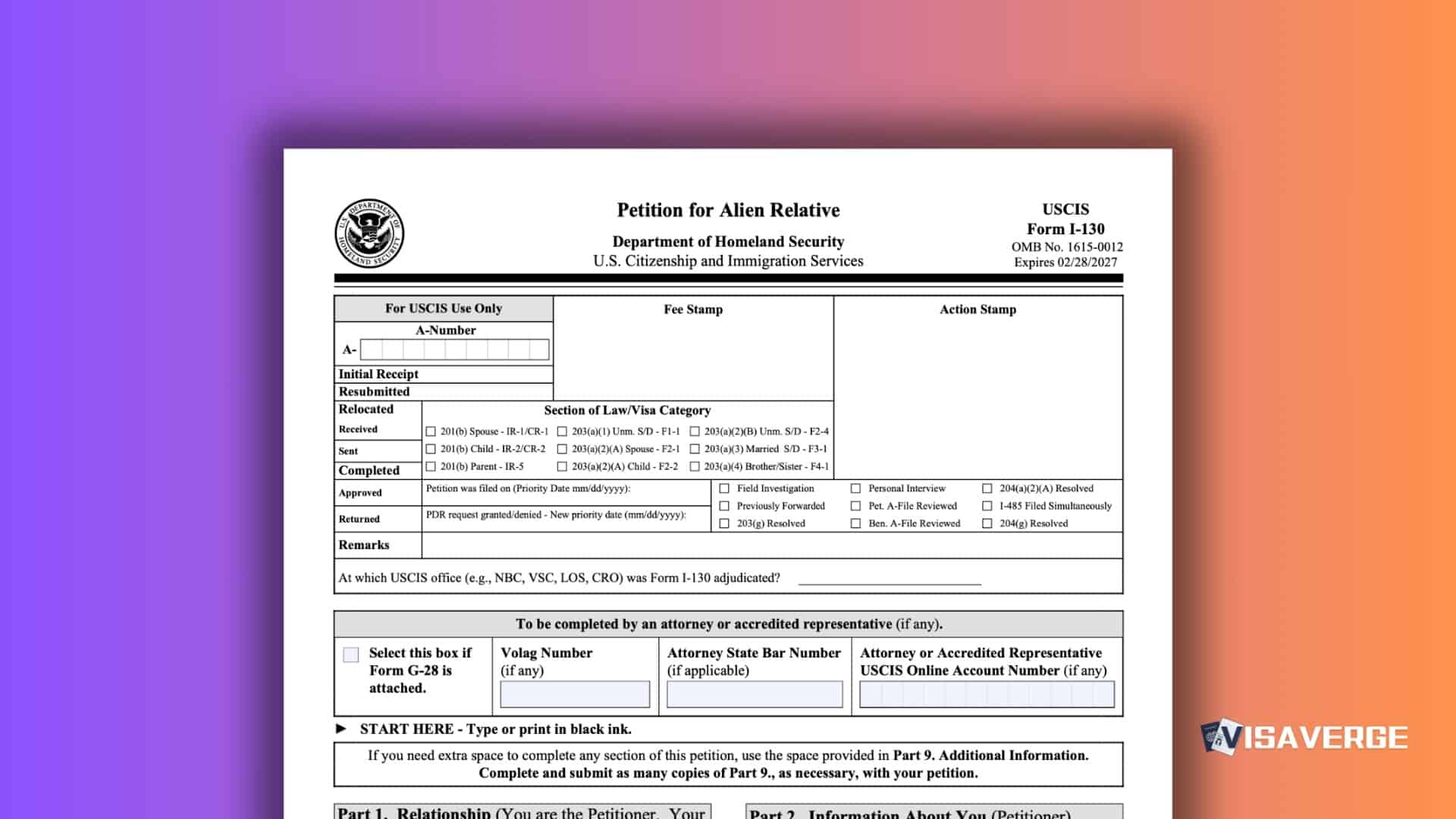
USCIS has official form guidance on Form I-130, Petition for Alien Relative, and applicants who file for status inside the United States often also use Form I-485, Application to Register Permanent Residence or Adjust Status. Those pages are the best place to confirm filing details before an interview notice arrives.
For many families, the process feels slow and personal at the same time. The interview is built to test credibility, but it is also a normal part of how USCIS sorts real relationships from weak ones. According to analysis by VisaVerge.com, families who arrive prepared, keep their records consistent, and understand the difference between the I-130 and I-485 stages move through the process with fewer surprises.
For the latest agency updates, applicants can also review the USCIS family-based immigration page.