The U.S. Court of Appeals for the D.C. Circuit revived a multifaith challenge to the Trump policy permitting ICE arrests at churches, finding that 27 Christian and Jewish religious organizations have standing to sue. The 2-1 ruling came October 20, 2026. It lets the case proceed.
The case, Mennonite Church USA et al. v. U.S. Department of Homeland Security et al., challenges the administration’s rescission of guidance for enforcement at sensitive locations. The panel decided that the coalition could bring its claims, not whether the claims ultimately succeed.
The decision reversed an April 2025 ruling by the U.S. District Court for the District of Columbia. It sent the groups’ request for a preliminary injunction to U.S. District Judge Dabney Friedrich for reconsideration.
That is the next court step. The appeals panel did not decide the injunction request.
The case returns to Judge Dabney Friedrich for an injunction decision
The district court had concluded the coalition lacked standing to sue. The appeals panel rejected that conclusion and returned the case to Friedrich to consider whether preliminary relief is warranted.
| India | China | ROW | |
|---|---|---|---|
| EB-1 | Feb 01, 2023 | Aug 01, 2023 ▲31d | Current |
| EB-2 | Nov 01, 2013 | Oct 01, 2021 | Apr 01, 2025 ▲90d |
| EB-3 | Jan 22, 2014 ▲21d | Jan 22, 2022 ▲14d | Jun 15, 2024 ▲31d |
| F-1 | Jan 22, 2021 ▲366d | Jan 22, 2021 ▲366d | Jan 22, 2021 ▲366d |
| F-2A | Oct 22, 2026 ▲30d | Oct 22, 2026 ▲30d | Oct 22, 2026 ▲30d |
The panel’s decision concerns the organizations’ ability to pursue the lawsuit. Their claims seek to block enforcement at houses of worship without a judicial warrant, which they say burdens religious exercise. The ruling does not resolve those underlying claims.
The organizations filed suit on February 11, 2025. Its plaintiffs include Mennonite Church USA, the African Methodist Episcopal Zion Church, the Episcopal Church, the Union for Reform Judaism, the Latino Christian National Network, the Central Atlantic Conference United Church of Christ, the Unitarian Universalist Association and FaithWorks.
Pan found a credible enforcement threat and a possible partial remedy
U.S. Circuit Judge Florence Pan wrote the majority opinion, joined by U.S. Circuit Judge Robert Wilkins. The panel found that the plaintiffs had shown a credible threat of enforcement near their congregations. Pan pointed to the administration’s stated plan and examples the plaintiffs cited.
“Plaintiffs have direct evidence that the government intends to increase immigration enforcement at sensitive locations — that is the whole point of the Rescission Memo. The government has done the opposite of 'disavowing any intention of' taking enforcement action at or near plaintiffs' members' houses of worship. Instead, it announced a plan to ramp up enforcement, and that initiative has already begun: Plaintiffs point to several specific examples of the government engaging in enforcement activity at or near their members' houses of worship.”
The court said the alleged injury was tied to the new policy and that the requested relief could address some of it. Pan reasoned that restoring the Mayorkas guidance would not fully return conditions to their earlier state, but could discourage at least some enforcement activity.
“The Mayorkas memo required agents to avoid sensitive-locations enforcement 'to the fullest extent possible.' It also narrowly defined the exception for 'exigent circumstances,' and it included additional guidelines to mitigate the adverse consequences of covered actions. Thus, even if a reversion to the Mayorkas memo would not restore the status quo ante, it likely would alleviate 'at least some of' plaintiffs' asserted injury by discouraging at least some immigration-enforcement activities at or near their members' houses of worship.”
The majority also recognized the role of congregations’ ministries. It noted that every plaintiff said at least one member congregation supports undocumented immigrants, including congregants and people receiving charitable help. The groups represent millions of worshippers, including Baptists, Brethren, Catholics, Conservative Jews, Episcopalians, Evangelicals, Mennonites, Quakers, Pentecostals, Presbyterians, Reconstructionist Jews, Reform Jews, Unitarian Universalists, United Methodists and Zion Methodists.
Judge Neomi Rao dissented. She argued that reinstating the former policy would not redress the groups’ claimed injuries, writing: “The memo simply discouraged immigration enforcement in protected” locations. The majority cited a credible threat and concluded plaintiffs should not have to wait for further enforcement before seeking relief.
The coalition alleges burdens on worship and charitable work
The suit says enforcement at houses of worship without a judicial warrant substantially burdens religious exercise under the First Amendment and the Religious Freedom Restoration Act. It also argues that the administration’s change violated the Administrative Procedures Act, which governs federal rulemaking. Those claims remain to be considered.
The coalition is made up of 27 religious denominations and organizations. Its members’ concerns include both worship and services to undocumented people in their communities. The panel’s standing decision accepted the alleged harms as sufficient to let the groups pursue the case, not as a final ruling on their legal claims.
The policy changed after more than three decades of sensitive-location guidance
Federal guidance dating to 1993 directed immigration officials to avoid apprehensions and investigations near schools, places of worship, funerals and other religious ceremonies. The policy remained largely unchanged for more than 30 years.
Then-DHS Secretary Alejandro Mayorkas revised it in 2021. The revision required agents to seek headquarters approval before enforcement at sensitive locations, except in specified “exigent circumstances.” Those exceptions included national security threats, imminent risk of death or physical harm, destruction of criminal evidence, hot pursuit of a person posing a public-safety threat, or cases with no safe alternative.
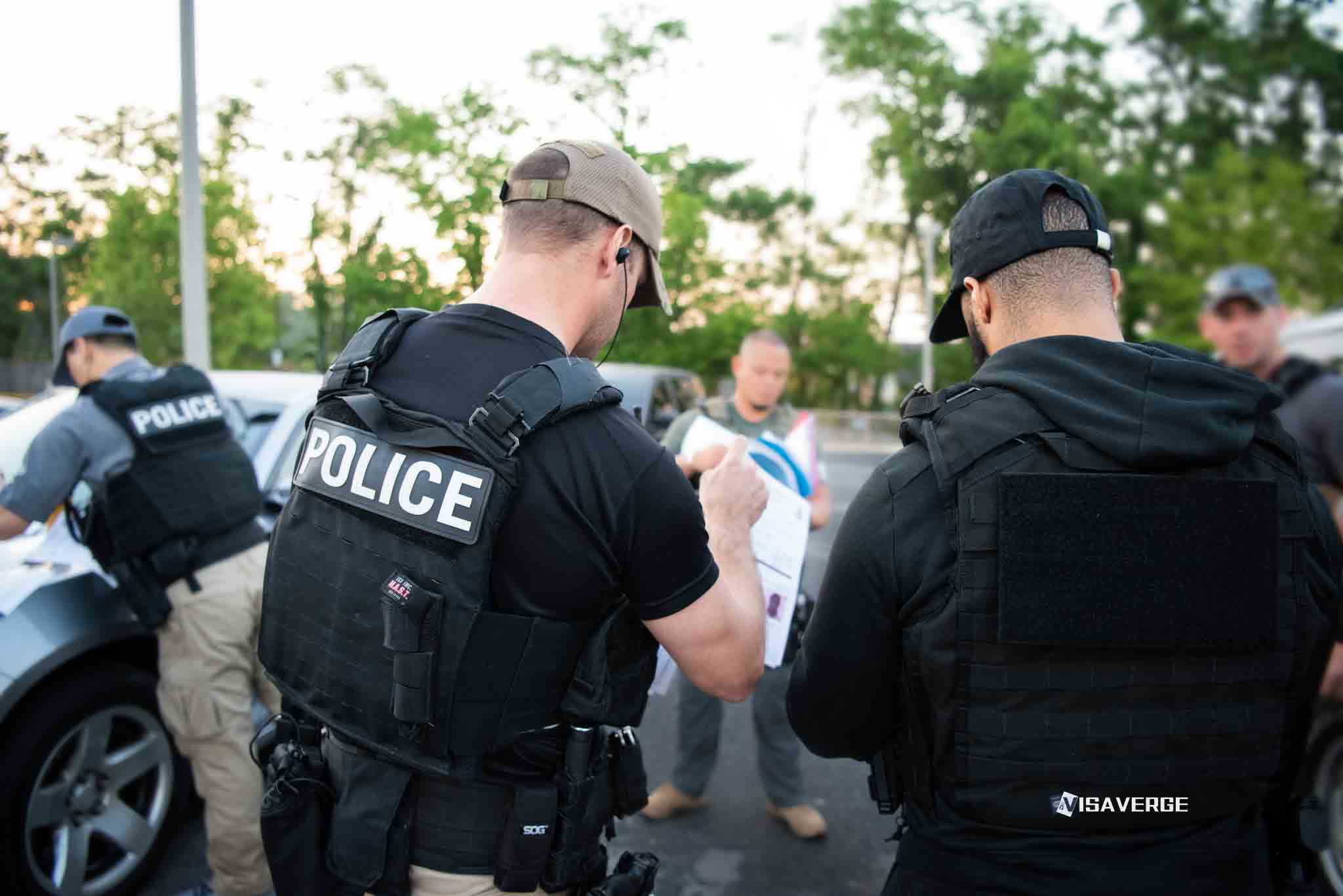
On January 20, 2025, the first day of President Donald Trump’s second term, Acting DHS Secretary Benjamine Huffman rescinded the guidance. His memo said “bright-line rules” about where enforcement could occur were unnecessary and directed Immigration and Customs Enforcement and Customs and Border Protection officers to “use discretion along with a healthy dose of common sense.”
Faith organizations and Catholic bishops describe effects on congregations
Kelsi Brown Corkran, lead counsel for the plaintiffs and Supreme Court director for Georgetown Law’s Institute for Constitutional Advocacy and Protection, said the ruling recognized harm to religious communities after the rescission. She called it a victory for the millions represented by the 27 organizations seeking to worship and serve their communities without fear of an ICE intrusion.
The Rev. Carlos L. Malave, president of the Latino Christian National Network, said: “Our faith calls us to persevere in doing good.” He also said houses of worship and sacred spaces must be respected, and that members’ ability to worship freely should be safeguarded.
Episcopal Church Presiding Bishop Sean Rowe and House of Deputies President Julia Ayala Harris issued a joint statement October 20. They described witnessing enforcement’s effects on congregations and said, “In The Episcopal Church, we cannot truly be ourselves when some cannot freely worship with us.”
The Unitarian Universalist Association, a plaintiff, said the decision allows the lawsuit to move forward. It also cited documented surveillance of UU congregations and said it would take part in the next stage of the case.
The U.S. Conference of Catholic Bishops did not join as a plaintiff. It filed an amicus brief arguing that congregations faced a choice between holding weekly in-person services amid enforcement fears and limiting those services. The bishops called either outcome a “severe and concrete” injury that courts should not dismiss as speculative.
Minnesota court documents describe a separate surveillance operation
A separate federal case in Minnesota raised surveillance concerns. In mid-August 2026, court documents in a case involving 15 people charged with impeding the immigration crackdown in Minneapolis disclosed an undercover operation targeting groups that had led protests earlier in the year.
An Episcopal church in Minnesota was reported to have appeared on a list of worship sites where Homeland Security spied on activists holding meetings. That matter is separate from the D.C. Circuit case.
Friedrich will reconsider the coalition’s request for a preliminary injunction. The groups’ claims over religious exercise and federal rulemaking remain before the district court.
This article provides general information and is not legal advice. Consult a qualified immigration attorney about your specific case.