- British Airways flight BA919 faced air-data failure during its approach to London Heathrow Airport.
- The aircraft experienced two low-altitude stall warnings, descending to just two thousand two hundred feet.
- Investigators are probing a serious incident involving pilot intervention and abrupt recovery maneuvers.
British Airways Flight BA919 landed safely at London Heathrow after an air-data failure and two low-altitude stall warnings during its approach from Düsseldorf on July 6, 2026. The aircraft descended to 2,200 feet during the recovery, and no injuries were reported.
The flight was operating an Airbus A320-232, registration G-EUUN, when the first warning occurred over Canary Wharf at about 4,000 feet. A second warning followed at approximately 3,000 feet during the final approach.
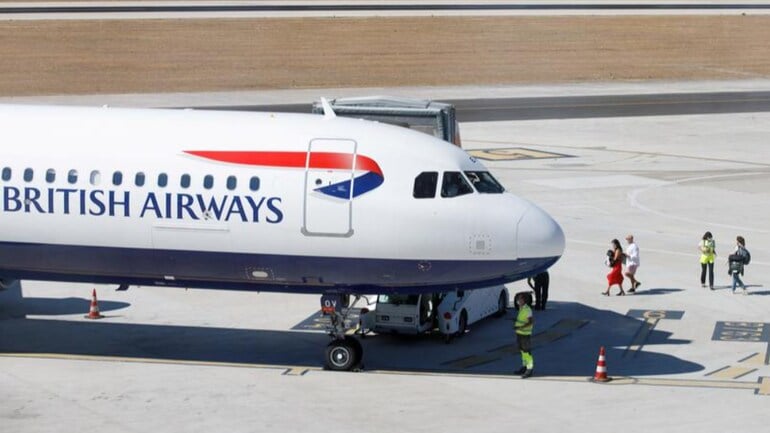
The Air Accidents Investigation Branch has opened a formal serious-incident investigation. Investigators are examining the system failure, the crew’s response and an abrupt recovery maneuver before the aircraft re-aligned with the runway.
The investigation must establish the circumstances that made the captain intervene physically in the cockpit. Unnamed senior aviation figures described the event as “the most serious ‘near miss’ in the UK in years.”
Those figures also said: “It is unheard of for a captain to physically intervene in the cockpit.” The account remains subject to the investigation.
Approximately 180 passengers and crew were aboard the flight. The aircraft landed safely approximately 30 minutes after the initial failure.
The airline said it was assisting investigators but declined to discuss the crew or the sequence of events.
“We’re assisting the AAIB with its investigation and are legally unable to comment further at this stage.”
The British Airline Pilots Association said on July 30, 2026, that the crew was receiving support and urged people not to speculate about the pilots’ conduct or identities.
“The crew are in BALPA’s care. out of respect for the crew and the integrity of the investigative process, we ask all members, commentators and the public to speak with care and compassion, and to avoid speculation.”
The air-data failure reduced the A320’s automated safeguards
The incident began when an Air Data Reference, or ADR, failure disrupted airspeed and altitude information during the approach. The failure caused the A320’s flight-control system to move from Normal Law to Alternate Law.
Normal Law includes built-in stall protections. Alternate Law gives pilots more direct control and fewer automated safeguards.
The preliminary account says the crew flew under Alternate Law after the first warning and declared a PAN. A further warning occurred at approximately 3,000 feet, accompanied by a potentially abrupt recovery maneuver.
The crew then changed the PAN to a MAYDAY. The aircraft reached its lowest recorded point, 2,200 feet, before re-aligning with the runway.
| Flight detail | Reported information |
|---|---|
| Flight | BA919 |
| Route | Düsseldorf to London Heathrow |
| Date | July 6, 2026 |
| Aircraft | Airbus A320-232, registration G-EUUN |
| First warning | About 4,000 feet over Canary Wharf |
| Second warning | Approximately 3,000 feet |
| Lowest recorded altitude | 2,200 feet |
| Outcome | Safe landing, no reported injuries |
| Investigation file | BEA2026-0286 |
Investigators are separating the technical failure from the crew response
The AAIB’s preliminary account says the ADR failure triggered the first warning and led the aircraft into Alternate Law. It also identifies the later warning and recovery maneuver as part of the sequence under review.
Reports have described the first officer’s handling during the second approach as a “blunder.” They also allege that the captain took physical action to correct the aircraft’s flight path. The AAIB has classified the event as a “serious incident” and opened its formal probe under file number BEA2026-0286.
Some aviation analysts have labeled the event “Pilot Induced Loss of Control.” That is a characterization, not a final investigative finding. The inquiry will assess how the system failure and pilot inputs combined.
Investigators are analyzing the flight data recorders to determine why the ADR system failed and to examine the recovery maneuvers. The recordings are expected to help establish the aircraft’s altitude, warnings and control inputs during the approach.
The emergency escalation from PAN to MAYDAY followed the second warning. The aircraft completed the landing without reported injuries.
Reports about the captain’s condition remain unconfirmed
The captain has reportedly taken “stress leave” following the incident. The claim has not been confirmed by the AAIB or the airline.
Both pilots are receiving support and representation from BALPA. The pilots’ association has asked members, commentators and the public to avoid speculation while the investigation continues.
That request also covers speculation about the pilots’ identities and their specific actions inside the cockpit. The inquiry remains focused on the ADR failure, the flight-control change and the low-altitude recovery.
The AAIB is reviewing an event that began over Canary Wharf and ended with a safe landing at Heathrow. Its file, BEA2026-0286, identifies the investigation that will establish the sequence in full.