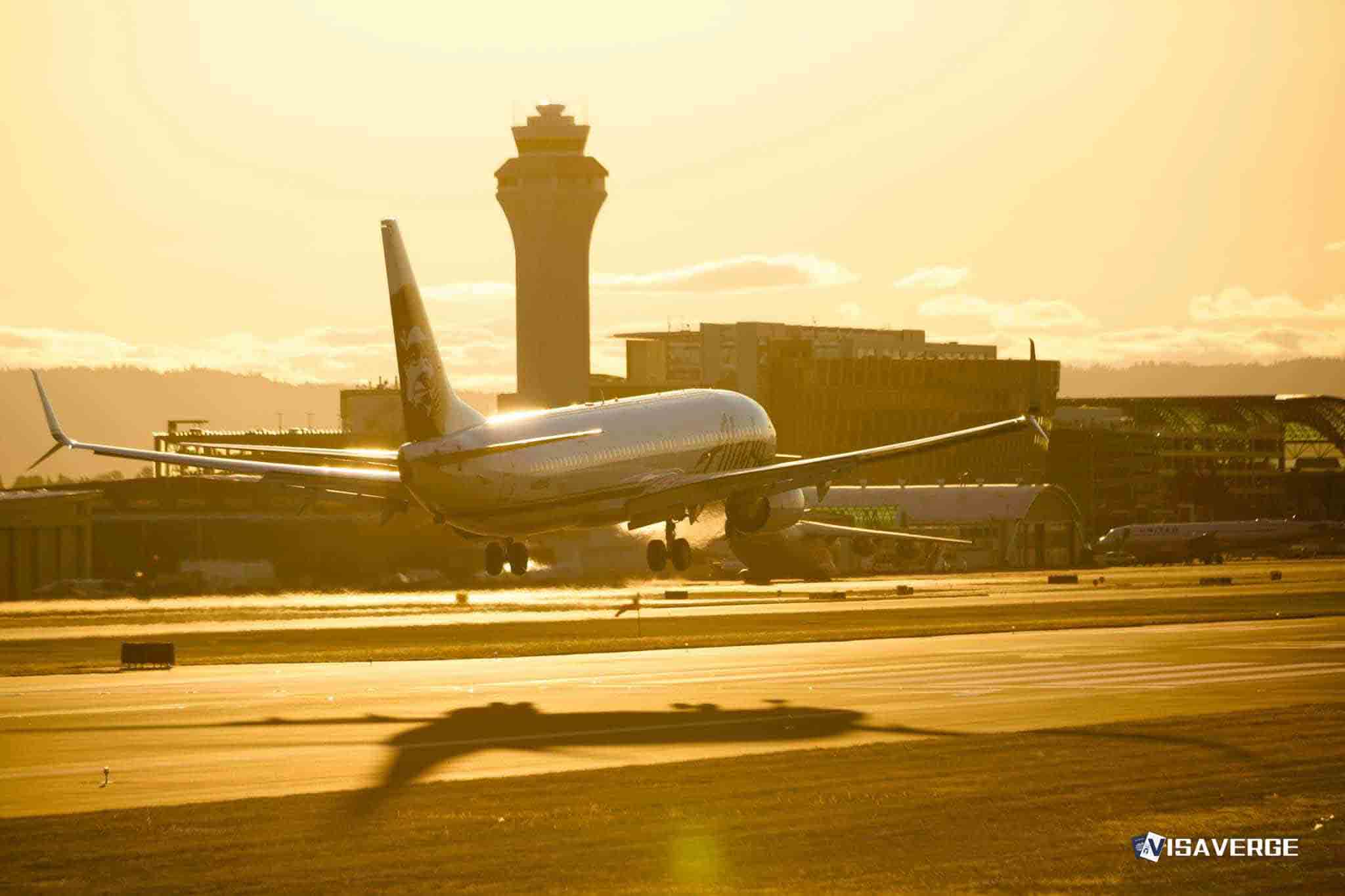
- A Jetstar Airbus A320 braked hard to avoid a towed Qatar Airways Boeing 777 at Sydney Airport.
- One cabin crew member suffered a wrist injury during the emergency stop on August ninth, twenty twenty-six.
- The ground controller and tug driver were stood down for mandatory testing following the incident.
A Jetstar Airbus A320 carrying about 180 passengers braked hard to avoid a Qatar Air Boeing 777 being towed across its path at Sydney Airport on Sunday, August 9, 2026. One cabin crew member suffered a wrist injury, and the Australian Transport Safety Bureau opened a safety investigation.
Flight JQ402 was taxiing for the Gold Coast at approximately 7:00 AM when its pilots saw the empty 777 moving across a crossing taxiway. The aircraft stopped abruptly.
Free toolB1/B2 Tourist Visa Stay Calculator online
Reports placed the incident near Terminal 2 and described the aircraft as coming within “mere meters” of each other. No passengers were injured, but the flight was cancelled and passengers were rebooked onto later services.
The tow connection on the larger aircraft and the tug sustained minor damage. The injured crew member received medical attention at the scene.
The airline said the A320 was following air traffic control instructions when the pilots intervened.
“Our aircraft was following instructions by Air Traffic Control when the pilots were forced to brake firmly after another aircraft came in close proximity.”
A Jetstar spokesperson made the statement. Investigators are examining whether the tug vehicle followed the instructions it received as it crossed the taxiway.
Investigators will match cockpit actions with tower and camera records
The Australian Transport Safety Bureau has formally launched investigation AO-2026-090. Its investigators will interview the flight crew, tug operators, air traffic controllers and other witnesses.
They are also reviewing flight data, recorded air traffic control audio and CCTV footage. Those records will help establish the sequence of instructions, the tow movement and the point at which the A320 began braking.
The inquiry will examine whether mistakes were made by individuals involved in the operation. It will also account for the different circumstances of the two aircraft: one was carrying passengers toward the Gold Coast, while the other was empty and moving under tow.
Passengers reportedly told crew members it was “only by chance” that the Qatar aircraft was spotted in time. The account has not been presented as a finding by investigators.
The emergency stop disrupted the flight even though the aircraft avoided a collision. The crew member’s injury and the damage to the tow equipment added to the operational consequences.
Restricted control hours had already prompted wider departure spacing
The near miss occurred during a period of air traffic control staffing shortages. On Sunday morning, control operations ran under restricted hours from 6:00 AM to 8:00 AM because of “roster constraints.”
Airservices Australia responded by using departure spacing to manage projected airborne and departure demand. Flights were spaced further apart as the agency handled traffic with staffing below its preferred level.
The measure continued through August. Passengers faced secondary disruptions as the airport managed departures more cautiously after the incident.
Rob Sharp, chief executive of Airservices Australia, apologised for the delays and defended the agency’s recruitment efforts.
“We are sorry for our impact on flight delays and we understand the impact it has on travel plans. We've probably added about 100 [controllers] in the last 12 months, so we're recruiting the highest number of air traffic controllers in the history of Airservices.”
Scott Nugent, president of the air traffic controllers’ union Civil Air, said the tower was “constantly stretched thin.” Nugent said the operation needed more people to perform its work properly.
The staffing dispute predates Sunday’s event. Rostering constraints had already affected the hours available for air traffic control, while spacing measures changed the pace of departures.
Two workers were removed from duty after the incident
Transport Minister Catherine King said the air traffic ground controller and the tug driver were stood down for mandatory drug and alcohol testing. The testing followed the near miss.
King spoke after an emergency meeting on Monday, August 10, and criticised the recent disruption at the airport.
“The delays and disruptions we have seen at Sydney Airport over the last three days have been unacceptable. I have made my expectations clear that Airservices must carefully manage the situation.”
She also said improved rostering practices for Sydney’s air traffic controllers would begin in early September 2026. Sharp committed to the changes after meeting with the minister.
The planned roster changes will follow the departure-spacing measures used during August. The immediate response is aimed at managing aircraft movements; the September changes concern how controller shifts are organised.
The two workers’ stand-downs form part of the post-incident response while investigators reconstruct the movements of the tug and the departing A320.
The event came two weeks after another Sydney near miss
The taxiway incident followed a separate event on July 27 involving two Qantas aircraft. A Qantas Boeing 737 had been cleared to cross a runway while a QantasLink Dash-8 was still landing.
The safety bureau is investigating that incident as well. Together, the cases have drawn attention to runway and taxiway clearances, controller workload and the way ground movements are coordinated.
Angus Mitchell, chief commissioner of the bureau, said pilots should not have to prevent collisions at the last moment.
“Planes should not be getting that close and we should never have to rely on, as has happened in both these instances, pilots at the last minute, making an emergency decision to prevent them coming together.”
Mitchell said the two recent incidents were unacceptable. Investigators will use communications, video, flight data and witness interviews to test how Sunday’s movement unfolded.
The inquiry therefore includes the tow operation, the control instructions and the actions of the flight crew. Its findings will determine whether individual errors, operational conditions or both contributed to the near miss.
Airservices is due to begin the revised rostering practices in early September 2026, while departure spacing remains in use during August.