- Chief Inspector of Prisons found professionalism on removal flights while recording earlier uses of physical restraint equipment.
- Communication gaps occurred due to inadequate interpretation and limited information about destination logistics for the detainees.
- Legal interventions successfully halted six removals despite significant barriers to securing timely legal representation.
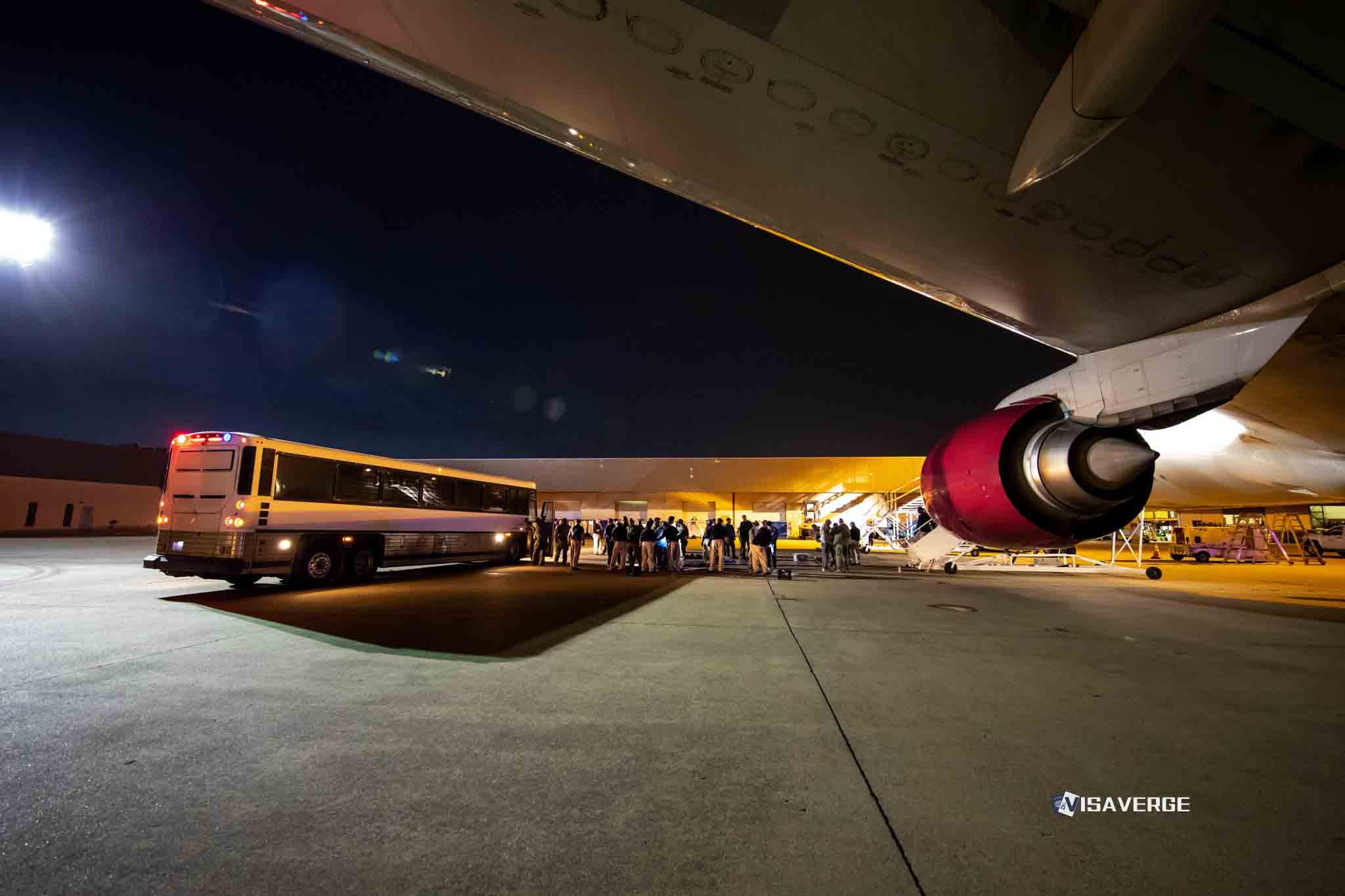
(UK) — HM Chief Inspector of Prisons published a report on April 13, 2026 examining how Britain carried out removal flights to France under the UK-France “one in, one out” pilot, recording a calm charter operation on January 20–21, 2026 and earlier January cases in which staff used restraint equipment on detainees.
Charlie Taylor, HM Chief Inspector of Prisons for England and Wales, reviewed the later flight and records from an earlier disrupted operation. Inspectors found no force was used on the January 20–21, 2026 removal, which took 32 male detainees to France.
Free toolB1/B2 Tourist Visa Stay Calculator online
The report said escort staff “remained consistently professional and respectful in all interactions” on that flight. It also set out a harder account from the previous week, when waist restraint belts were used three times and leg restraints were used in two cases during removals, with one detainee kept in leg restraints for the journey.
The pilot sits inside a wider border arrangement that took effect in August 2025. Under that treaty, people arriving in Britain by small boat can be detained on arrival and returned to France, while a separate legal pathway allows an equal number of people in France to be considered for transfer to the UK.
Adults who cross the Channel face return under the scheme if their asylum claims are treated as inadmissible. That gives the inspection unusual weight: it is not a general review of detention, but a close look at how bilateral returns work in practice when removal follows quickly after arrival.
Taylor’s inspectors watched the second flight after a removal operation the previous week had been thrown off by a sit-down protest on Jan 15. Specialist national resources were then required so the planned removal could proceed, according to the report.
Even with that disruption in the background, the later operation stayed orderly. Escorts and staff moved detainees from Brook House, Harmondsworth and Tinsley House immigration removal centres, with 73 escort staff and two paramedics accompanying the flight.
The findings on force were narrow but specific. Inspectors concluded that the earlier uses of restraints and control techniques were justified on the basis of assessed risk, while placing official evidence of coercive removal practices into the public record under the UK-France “one in, one out” pilot.
Communication failures ran through the report. Inspectors found that detainees generally knew they were being sent to France, but many did not know when they would leave or what would happen once they arrived.
Some feared homelessness in France. Others feared onward removal from France to another country. The report described “inadequate provision of interpretation” at points where basic information mattered most.
In-person interpreters were limited. Phone interpretation was delayed. Digital tools did not reliably support a two-way conversation for detainees who had recently arrived from the Kent coast and could not understand English.
Those communication gaps shaped the removal process itself. A detainee could know the destination and still have no clear grasp of timing, next steps, or what rights remained before boarding.
Legal access carried equally sharp consequences. Inspectors found that six detainees had their removals cancelled after legal intervention, a result that showed how quickly outcomes could change if representation was secured in time.
Many others told inspectors that solicitors either declined their cases or did not respond. No Home Office staff were present in immigration removal centres to answer questions about removal decisions, the report said.
A chief immigration officer was available on the flight, but the journey was too short for everyone who wanted information to be seen. In that setting, the difference between removal and non-removal could turn on whether legal help arrived inside a very short window.
The legal route on the French side is narrower than the political slogan suggests. Guidance for the UK/European Applicant Transfer Scheme says it applies only to people in France, that places are limited and released gradually, and that applicants who previously entered or arrived in the UK illegally are excluded.
Successful applicants receive entry clearance for up to three months to travel lawfully to the UK. The “one out” and “one in” halves are linked by treaty, but they do not operate as mirror images in practice.
That asymmetry gives the removal flights added policy weight. Britain can move quickly on detention and return after a Channel crossing, while the legal route from France works through a narrower system with limited places and exclusion rules.
Recent operational data underlined that imbalance. Since the scheme began in August 2025, roughly 21,172 people arrived via small boats, while only 498 were returned to France.
The pilot has also drawn scrutiny over detention decisions beyond the January flights. Data published on April 10, 2026 showed that 76 “age-disputed” children had been held in adult facilities, with some later confirmed to be minors and released to social services.
Advocacy groups have described a separate toll inside detention. Medical Justice said 82% of clients assessed in detention were survivors of torture, and the group said waist and leg restraints can cause “severe psychological harm” and re-traumatization.
Detainees have also challenged how people are chosen for removal. Some described selection for the “one in, one out” scheme as “arbitrary and discriminatory,” saying that out of boatloads of 80 people, only 10 might be detained for removal while others were moved to hotels.
The Home Office said, “this government is restoring order and control to our border” and that removals are carried out with “dignity.” Taylor’s report did not dispute the government’s authority to run the scheme, but it recorded the friction points where policy meets custody, transport and time pressure.
That record now sits alongside a wider enforcement shift outside Britain. In the United States, the Department of Homeland Security proposed an asylum overhaul on February 20, 2026, saying, “For too long, a fraudulent asylum claim has been an easy path to working in the United States. The Trump administration is strengthening the vetting of asylum applicants and restoring integrity to the asylum and work authorization processes.”
USCIS also paused adjudication of pending Form I-589 asylum applications in January 2026 for what it called a “top-to-bottom security review.” By April 1, 2026, the agency had begun lifting that pause for “non-high-risk” countries while maintaining a freeze on about 40 nations.
On March 26, 2026, DHS issued a proclamation that said, “An actual or imminent mass influx of aliens is arriving at the southern border. requiring a continued federal response.” The statement did not address the British pilot directly, but it reflected a broader official emphasis on fast enforcement and border control in early 2026.
In Britain, the inspection pointed instead to operational detail. Escorts handled the January 20–21, 2026 flight without force, but the earlier use of waist restraint belts and leg restraints showed that removals under the treaty can involve physical control when officials judge the risk high enough.
The report also showed how little margin detainees had to make sense of the process. Limited interpreter access, delayed phone interpretation and incomplete information about arrival in France left some men facing removal without a clear understanding of what came next.
That gap mattered because the legal window was real and short. Six people avoided removal after intervention, while others saw their cases go nowhere because solicitors declined them or did not answer in time.
The inspection did not read like a broad argument about asylum conditions. It read like an enforcement-process account of how bilateral returns operate in real time: men moved from immigration removal centres to a charter flight, escorts outnumbering detainees by more than two to one, and rights turning on minutes, translation and access to a lawyer before the aircraft door closed.