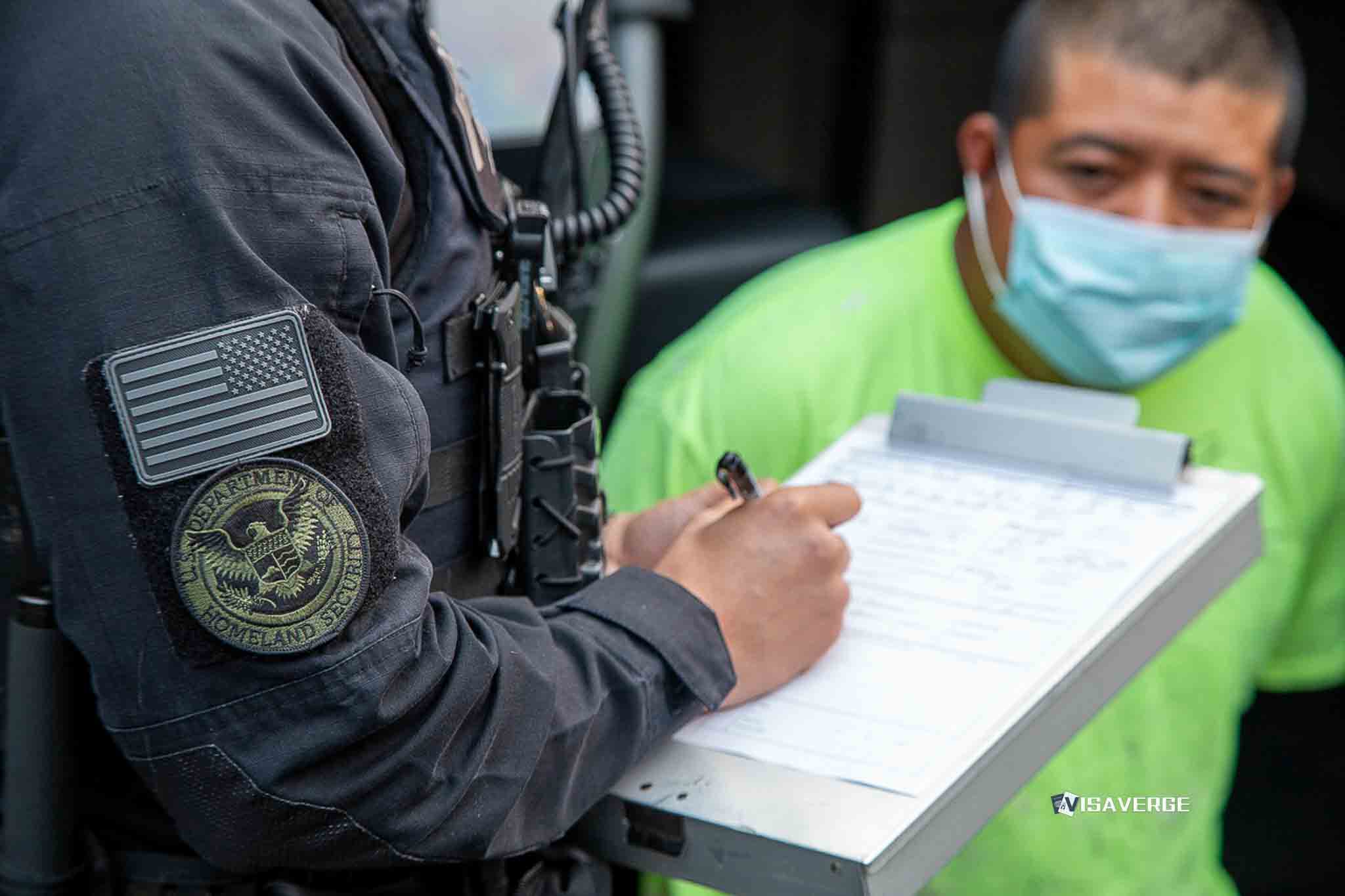
- The U.S. has expanded visa sanctions for 114 countries that refuse or delay accepting deported citizens.
- Over 17,500 individuals were transferred to third countries like Mexico and Costa Rica for removal in 2026.
- USCIS has frozen immigration benefits for 39 high-risk nations, requiring enhanced background checks and re-interviews.
(UNITED STATES) — The Trump administration has expanded visa sanctions, immigrant visa suspensions and third-country removals against nations that refuse or delay taking back citizens ordered deported from the United States, using Executive Order 14159 as the central legal directive for the campaign.
That order, titled “Protecting the American People Against Invasion,” was signed on January 20, 2025. Section 13 directs the secretaries of State and Homeland Security to impose sanctions under Section 243(d) of the Immigration and Nationality Act to the “maximum extent permitted by law.”
Free toolUSCIS Receipt Number Decoder
Immigration and Customs Enforcement defines the target countries in blunt terms. “Countries classified by ICE as uncooperative are also known as recalcitrant. Factors that could lead to a country being classified as recalcitrant include hindering ICE removal efforts by refusing to take the appropriate steps. including the timely issuance of travel documents and the acceptance of the physical return of their nationals.”
The administration now maintains two main sanction tracks tied to removal compliance, alongside a broader immigrant visa pause that extends beyond the recalcitrant countries lists. One track imposes full visa and entry restrictions, while the other applies narrower visa suspensions.
| India | China | ROW | |
|---|---|---|---|
| EB-1 | Feb 01, 2023 ▲109d | Jul 01, 2023 | Current |
| EB-2 | Nov 01, 2013 | Oct 01, 2021 ▲30d | Jan 01, 2025 |
| EB-3 | Jan 01, 2014 | Jan 08, 2022 ▲7d | May 15, 2024 ▼109d |
| F-1 | Jan 22, 2020 | Jan 22, 2020 | Jan 22, 2020 |
| F-2A | Sep 22, 2026 ▲31d | Sep 22, 2026 ▲31d | Sep 22, 2026 ▲31d |
Under Presidential Proclamation 10998, full restrictions took effect on January 1, 2026 for 19 countries and for individuals using travel documents issued by the Palestinian Authority. That suspension bars entry for both immigrants and nonimmigrants from countries that include Afghanistan, Haiti, Iran, Libya, Somalia, Sudan, Syria and Yemen.
A second list covers 20 countries facing partial visa restrictions. Those measures suspend immigrant visas and selected nonimmigrant categories, including B-1/B-2 visitor visas and F, M, and J student and exchange visas, with affected countries including Cuba, Nigeria, Venezuela, Angola, Senegal and Zimbabwe.
The State Department added a wider layer on January 21, 2026, pausing immigrant visa issuance for 75 countries. That directive reaches beyond the 243(d) sanctions lists and includes countries such as Brazil, Colombia, Egypt and Vietnam.
State officials attributed that pause to a “comprehensive review of screening and vetting policies to ensure that immigrants. do not become a public charge.” The order left many nationalities facing restrictions even if their governments were not on the narrower recalcitrant countries lists.
Enforcement accelerated in 2026. In February, the United States denied visas to eight high-ranking Cuban baseball officials under Section 243(d), citing Cuba’s refusal to accept regular deportation flights, and on May 1, 2026 the White House issued EO 14380, which tightened sanctions on Cuba after calling it a “threat to national security.”
At the same time, Homeland Security leaned harder on third-country removals for ICE deportees whose home governments would not take them back. As of May 5, 2026, the administration had transferred over 17,500 individuals to 21 third countries.
Mexico received nearly 16,000 of those transfers. Costa Rica signed an agreement in March 2026 allowing 25 transfers per week, and other destinations included Uganda, Rwanda, El Salvador, Ghana and Uzbekistan.
Internal DHS documents also identified China as a primary uncooperative nation. That designation coincided with a 400% surge in ICE arrests of Asian nationals in late 2025 and 2026, part of an effort to pressure governments to issue travel documents for removals.
The widening sanctions regime has not stopped at deportation logistics. U.S. Citizenship and Immigration Services has paused final adjudication of immigration benefits for nationals of 39 “high-risk” countries, freezing decisions on benefits such as green cards and naturalization applications.
Applicants from those countries also face enhanced vetting. The process includes FBI background checks and mandatory re-interviews before the government makes a final decision.
That leaves some people in prolonged custody when removal is not immediately possible. Under Zadvydas v. Davis, people from recalcitrant countries who cannot be removed within six months generally must be released, but the administration has relied on third-country alternatives to avoid those releases.
The result is a broader immigration crackdown than visa sanctions alone suggest. Recalcitrant countries now sit at the center of a system that links consular penalties, stalled benefit adjudications, extra screening and the transfer of ICE deportees to countries other than their own.
Official guidance on the policy appears in ICE’s recalcitrant countries page, which lays out how the agency classifies countries that obstruct removals. DHS has also published related enforcement announcements through its Making America Safe Again releases.
Visa sanctions under INA 243(d) are tracked by the State Department in its administrative processing information page. USCIS has separately posted its strengthened screening and vetting update, reflecting the agency’s shift toward re-interviews and expanded background checks.
Those records show a policy that now reaches across multiple agencies and several layers of the immigration system. Countries that refuse deportation flights or delay travel documents can face sanctions abroad, while their nationals encounter stalled cases, tougher screening and, in some cases, removal to a third country rather than release inside the United States.