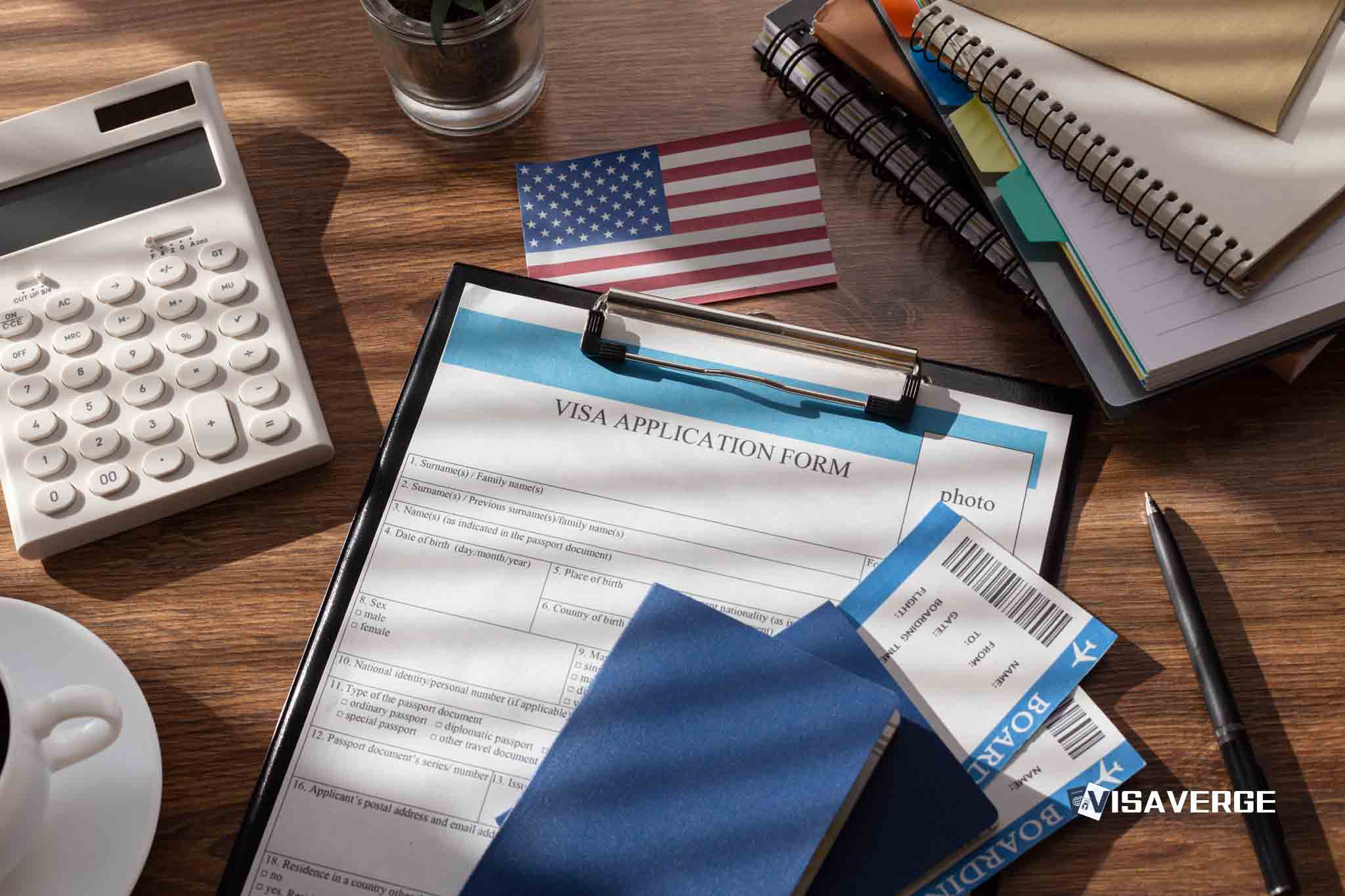
- The U.S. now requires a $250 Visa Integrity Fee for most nonimmigrant visa applicants at consular offices.
- Total upfront costs for B-1/B-2 visas have risen to $435 per person since October 2025.
- Refunds are only possible after the visa expires and require proof of full compliance with stay terms.
(UNITED STATES) — The United States has enforced a $250 Visa Integrity Fee on most nonimmigrant visa applicants at embassies and consulates since October 1, 2025, adding a new upfront cost for tourists, students, exchange visitors and temporary workers under Public Law 119-21.

The fee applies at the consular stage and sits on top of existing visa charges, including the $185 Machine Readable Visa fee for B-1/B-2 visitor visas, bringing the immediate cost for many applicants to $435 per person. Refunds come later, if at all: travelers must wait until the visa expires and then show they complied fully with the terms of admission.
That structure has turned the fee into a long-term deposit for many applicants, especially those receiving multi-entry visas valid for years. For families, employers and frequent travelers, the new rule means repeating the $250 payment with each new visa application or renewal.
Free toolB1/B2 Tourist Visa Stay Calculator onlineCongress created the Visa Integrity Fee through Public Law 119-21, known as the One Big Beautiful Bill Act, which President Trump signed on July 4, 2025. The law requires the charge as part of a broader effort to “restore integrity” in visa programs by tying money to later compliance with U.S. immigration rules.
U.S. officials have framed the measure as a way to reduce the estimated 700,000+ annual overstays. Critics, including travel agents and immigration advocates cited in the broader debate around the rule, argue that the policy places the burden on travelers who follow the rules while offering no immediate relief for those denied visas.
State Department fee schedules have incorporated the charge worldwide, and embassies and consulates now present it as part of standard nonimmigrant visa processing. The fee does not apply retroactively to visas issued before October 1, 2025.
Most temporary visa categories processed abroad fall under the new requirement. That includes B-1/B-2 business, tourist and medical visas; F and M student and vocational visas; J exchange visitor visas; H, L, O and P visas for temporary work and performance; and other temporary categories such as E, Q and TN.
Exemptions remain narrow. Travelers using the Visa Waiver Program for 90-day ESTA trips do not pay the fee because they do not need visas for those visits. Canadian citizens also remain exempt for most short visits, as do holders of certain A and G diplomatic or official visas and immediate relative immigrant visas, which are outside the nonimmigrant system.
The rule makes no distinction for particular U.S. destinations. Visitors bound for Hawaii face the same charge and the same conditions as travelers entering any other part of the country.
Applicants must pay the fee through consular payment systems, including credit card, bank transfer or local equivalents. If a visa application is denied, the Visa Integrity Fee is non-refundable, though it may be transferable in limited cases when an appointment is rescheduled.
The refund process adds another hurdle. Travelers can seek repayment only after the visa expires, not after a single trip ends, and they must prove they did not overstay. That requires documentation such as passport stamps, I-94 records and travel itineraries, with claims handled by the Department of State or USCIS.
For holders of long-validity visas, the wait can stretch for years. A B-2 visa valid for up to 10 years for some nationalities can tie up the $250 long after the traveler’s first or second trip to the United States.
By April 2026, no waivers were available. No evidence of refunds had emerged either, largely because most visas issued since the October 1, 2025 start date were still valid.
The added cost lands differently across applicant groups, but it hits hardest where several family members travel together. A couple with two children applying for visitor visas, for example, must now front four separate Visa Integrity Fee payments in addition to standard visa charges.
Travel agents have reported that 10-20% of travel plans have shifted toward destinations covered by the Visa Waiver Program or other visa-light alternatives. That change matters for the United States because travelers from markets such as China and the Philippines have historically contributed heavily to tourism spending.
Before the fee, China sent 173,000+ annual U.S. visitors and the Philippines sent 111,000+, with average spending of $2,200 per trip. The new charge effectively locks away part of a traveler’s budget, and for lower- and middle-income households that can alter trip length, timing or destination.
Businesses face a different calculation. Employers recruiting temporary workers must account for another upfront payment layered onto visa expenses, and the fee can stack across families when H-4 or L-1 dependents also need visas.
The broader immigration climate has added pressure. A January 2026 suspension paused immigrant visas from 75 countries, though not nonimmigrant visas, while a USCIS Vetting Center announced on December 5, 2025 has increased scrutiny of social media and online presence for H-1B and H-4 applicants.
Another layer arrived through Proclamation 10998, issued on December 16, 2025 and effective January 1, 2026. It expanded full or partial entry suspensions to 39 countries, including Afghanistan, Iran, Yemen, Syria, Haiti, Burkina Faso and Mali.
For 19 high-risk nations, visa issuance is suspended outright. Partial restrictions apply to Burundi, Cuba, Venezuela and others, bringing extra scrutiny even when a person still seeks a visa.
That overlap has created a two-track problem for many applicants. Some face the new fee if they remain eligible for a visa, while others from restricted countries cannot proceed to visa issuance at all.
Country of birth, dual nationality or recent travel can also trigger problems at ports of entry. Employers have been advised to review employee travel profiles early, especially where a worker’s nationality or travel history could intersect with new restrictions.
The fee also arrives as other immigration-related costs rise. A Department of Labor proposal in April 2026 would raise entry-level H-1B wages by 33%, and businesses already navigating overseas hiring rules have had to absorb or disclose those higher costs alongside the Visa Integrity Fee.
For some companies, the numbers get steeper still. New overseas petitions can carry $100,000 fees under separate H-1B reforms, making the Integrity Fee a smaller but still unavoidable addition in a larger cost structure.
Longer waits have compounded the burden. Consular processing times in 2026 have lengthened by 20-50% in some cases, stretching the time between fee payment and any eventual travel.
That delay is especially painful because the refund clock does not begin at application or issuance. It begins at visa expiration, meaning compliant travelers may not be able to seek their money back until years after they first paid.
Applicants hoping for relief have little room under the current rules. No waiver program exists as of April 2026, and refund procedures remain forthcoming even though the documentation requirements are already clear.
For now, compliance records matter more than ever. Travelers must retain DS-160 confirmations, payment receipts, I-94 records, boarding passes and other travel documents if they want any chance of recovering the fee later.
Renewals create another pinch point. Even applicants with a clean record must pay a new $250 for each new visa application, which can tie up far more than the original amount for business travelers, repeat visitors and families with members who renew at different times.
The travel industry has warned that the structure may redirect demand away from the United States, particularly among visitors who compare the total upfront cost with countries offering simpler entry. The divide is sharpest for nationals of the 41 countries in the Visa Waiver Program, who can still avoid visa processing for short trips.
That means two travelers planning the same holiday can face very different costs depending on nationality. A Visa Waiver Program visitor may board with ESTA authorization, while a similarly situated traveler from a non-waiver country must pay the MRV fee, the Visa Integrity Fee and wait through full consular processing.
For now, the policy remains intact and fully operational nationwide. No court has blocked it, no broad exemptions have been added, and no accelerated refund system has emerged in the first six months of implementation.
The practical effect is straightforward. Anyone applying abroad for most temporary U.S. visas now pays more at the front end, waits longer to recover the money, and must keep proof of compliance long after the trip ends.
That reality reaches beyond tourists. Students, exchange visitors, temporary workers and their families all now face the same basic bargain under Public Law 119-21: pay the Visa Integrity Fee first, follow every rule, and wait until the visa expires to try to get the money back.