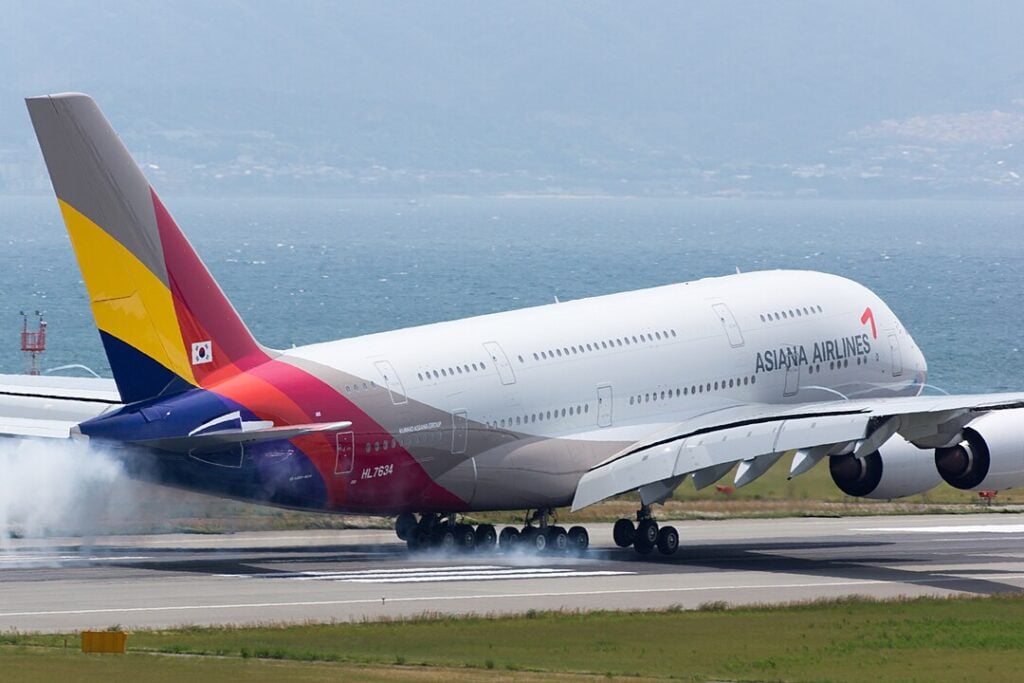
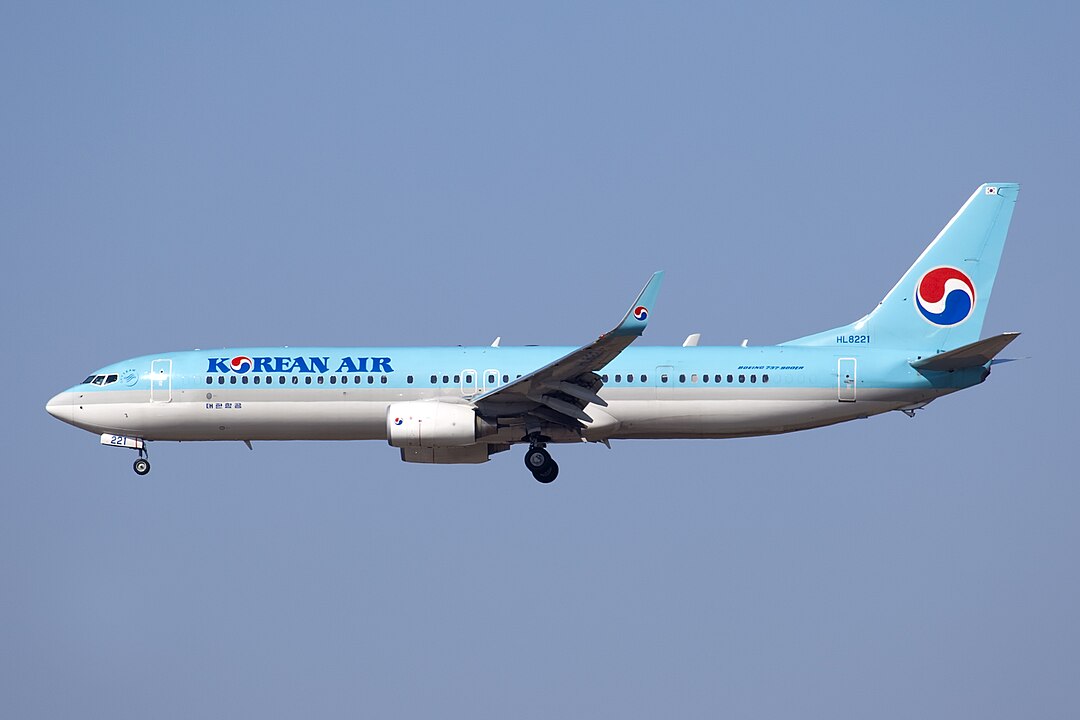
- Korean Air will fully absorb Asiana Airlines on December 17, 2026, ending the latter’s independent brand identity.
- Low-cost carrier Jin Air is expected to consolidate Air Busan and Air Seoul under its operations.
- The merger concludes a six-year integration process that began with an initial announcement in late 2020.
(SOUTH KOREA) – Korean Air plans to fully absorb Asiana Airlines on December 17, 2026, setting a date for the final step in a deal that will end one of South Korea’s two full-service airline brands as a separate company.
The integration will fold Asiana Airlines into Korean Air after Korean Air earlier acquired a 63.88% stake in the carrier. Once that process finishes, Asiana Airlines will cease to exist as a separate corporate brand and operating entity.
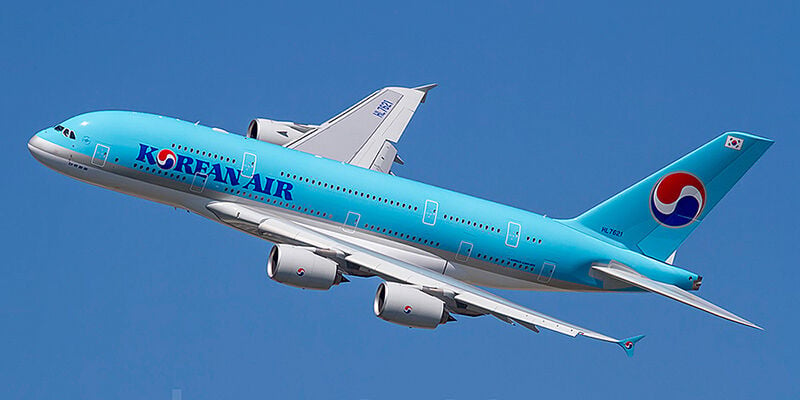
Jin Air is also expected to absorb Asiana’s low-cost subsidiaries Air Busan and Air Seoul under the broader consolidation plan, extending the merger beyond the two flagship carriers into South Korea’s budget airline market.
The transaction has stretched across six years. Korean Air and Asiana Airlines first announced the deal in November 2020, and the companies completed final regulatory and corporate approvals in December 2024.
The December 17, 2026 date now stands as the target for full operational integration. That timeline places a fixed endpoint on a merger that has moved through ownership changes, approval processes and a longer corporate integration period.
By the time the process closes, Korean Air will stand as the surviving full-service brand in the tie-up. Asiana Airlines, long one of the country’s best-known airline names, will no longer operate independently.
That corporate change reaches beyond legal structure. The merger will also reshape how the airline group presents itself in the market, because Asiana Airlines will disappear not only as a company but as a distinct operating identity.
Jin Air’s expected absorption of Air Busan and Air Seoul points to the same pattern in the low-cost segment. Rather than keeping those carriers separate under a wider group umbrella, the plan calls for consolidation into a single budget airline arm.
Korean Air’s earlier purchase of a 63.88% stake in Asiana Airlines gave it control before the final legal and operational merger. The full absorption scheduled for December 17, 2026 marks the point at which that ownership stake becomes a complete corporate combination.
The structure of the deal shows two tracks moving at once: a full-service consolidation through Korean Air and Asiana Airlines, and a low-cost consolidation through Jin Air, Air Busan and Air Seoul. Both strands are part of the same broader plan.
South Korea’s aviation market has long been defined by competition between Korean Air and Asiana Airlines at the top end, while a cluster of budget carriers, including Jin Air, Air Busan and Air Seoul, served lower-fare routes. The merger sets up a different market shape by bringing those brands under fewer operating names.
Regulatory and corporate approvals, completed in December 2024, cleared the way for that structure to move from plan to execution. Those approvals closed one phase of the transaction and shifted attention to implementation.
Implementation now carries a date certain. Korean Air has set December 17, 2026 as the point for full operational integration, giving the company and the market more than two years from the final approvals to complete the process.
The chronology reflects how large airline combinations move in stages. The companies announced the deal in November 2020, Korean Air secured a controlling stake, approvals arrived in December 2024, and full integration is scheduled for December 17, 2026.
Each milestone changed the nature of the transaction. The 2020 announcement established the plan, the stake purchase gave Korean Air ownership control, the 2024 approvals removed formal barriers, and the 2026 date sets the moment when the airlines stop operating as separate entities.
Asiana Airlines’ disappearance as a separate brand is one of the clearest outcomes in the current plan. Airline mergers often leave room for brand coexistence, but the terms laid out here point in the opposite direction.
Korean Air will absorb Asiana Airlines completely rather than operate it as a parallel full-service unit. The same approach appears in the budget segment, where Jin Air is expected to absorb Air Busan and Air Seoul rather than leave them as distinct subsidiaries.
That leaves Korean Air and Jin Air at the center of the future group structure. One will carry the full-service operation, while the other is expected to take in the low-cost subsidiaries tied to Asiana Airlines.
The deal also closes a long chapter for Asiana Airlines. From the date of full integration, the airline’s name will no longer stand as a separate corporate or operating label in South Korean aviation.
Korean Air, by contrast, emerges as the consolidating carrier in the combination. Its earlier acquisition of a 63.88% stake put it in position to drive the merger, and the December 17, 2026 target fixes when that control becomes complete absorption.
Jin Air’s role matters because it extends the consolidation into the lower-cost market. Air Busan and Air Seoul, both tied to Asiana’s side of the business, are expected to be absorbed into Jin Air as part of the same plan.
That arrangement reduces the number of airline brands operating within the merged group. Korean Air remains, Jin Air expands, and Asiana Airlines, Air Busan and Air Seoul disappear as separate operating entities under the stated plan.
The companies have framed December 17, 2026 as the date for full operational integration, not simply a symbolic closing. That wording points to a merger that reaches into day-to-day airline operations, not only shareholding or corporate paperwork.
Operational integration will be the point investors, employees and passengers watch most closely because that is where consolidation becomes visible. The current plan identifies the endpoint, while later announcements will define how the combined airlines execute it.
Any changes to routes, loyalty programs and airfares remain outside the details released so far. Those issues sit near the center of what travelers usually notice in airline mergers, especially when one of the country’s established full-service brands is set to vanish.
Market structure is already easier to read than the customer-facing details. Korean Air and Asiana Airlines are heading toward a single full-service operation, while Jin Air is expected to bring together Air Busan and Air Seoul under one low-cost banner.
That leaves a narrower set of airline brands in South Korea than existed when the deal was announced in November 2020. The broad direction has not changed since approvals were completed in December 2024; what remains is the final integration phase ahead of December 17, 2026.
For Korean Air, the schedule turns a long-running acquisition into a dated corporate deadline. For Asiana Airlines, it sets the point at which the company stops standing apart. For Jin Air, it defines a larger role inside a remade airline group.
South Korea’s airline sector will look different when that date arrives. Korean Air will have completed the absorption of Asiana Airlines, Jin Air is expected to have taken in Air Busan and Air Seoul, and a deal first unveiled in November 2020 will finally reach its operational end on December 17, 2026.