- Indian citizens must register by June 25, 2026 for the subclass 462 Work and Holiday visa ballot.
- The annual program cap is limited to 1,000 visas for the July 2026 to June 2027 cycle.
- Eligible applicants aged 18 to 30 must pay 25 dollars to enter the random selection pool.
(AUSTRALIA) — Australia’s Department of Home Affairs opened ballot registrations on June 4, 2026, for Indian citizens seeking a first 462 Work and Holiday Visa, and the window closes on June 25, 2026.
Indian passport holders cannot directly file for a first visa under subclass 462 unless they first enter the ballot and are randomly selected. India has an annual cap of 1,000 first Work and Holiday visas for the July 1, 2026 to June 30, 2027 program year.
Free toolREAL ID Requirements Checker tool
The ballot covers first-time applicants from India, China and Vietnam. Registration is a pre-application step rather than the visa itself, and selection allows a person to lodge a full visa application that still must satisfy all visa requirements.
The Work and Holiday visa, or subclass 462, allows eligible young adults to stay in Australia for up to 12 months for an extended holiday while working to help fund the trip. It differs from skilled migration, student and employer-sponsored visas, and the program is designed mainly for cultural exchange, travel and short-term work.
That distinction matters in practical terms. The visa offers temporary work experience and time in Australia without requiring an employer sponsor before travel, but it is not a direct route to permanent residence and carries specific conditions and limits.
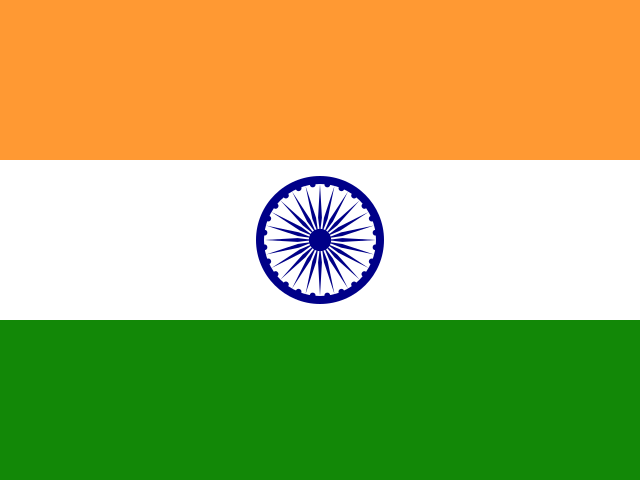
India’s place in the program stems from its entry into Australia’s Working Holiday Maker program under the Australia-India Economic Cooperation and Trade Agreement framework. The pathway gives young Indian citizens another temporary mobility option outside the more familiar student and skilled migration channels.
Demand, however, exceeds supply. The Department of Home Affairs uses a random ballot for high-demand countries rather than a first-come, first-served filing system, and Indian applicants face competition for the 1,000 available first visa grants.
Eligibility for ballot registration starts with age and nationality. An Indian applicant must be between 18 and 30 years old, inclusive, hold a valid Indian passport, register during the official ballot period, use an ImmiAccount, pay the registration fee and provide accurate passport and identity details.
Selection does not waive the normal visa standards. Applicants still need to meet full requirements tied to health, character, financial capacity, education and English-language criteria, where applicable, if the Department later invites them to file the complete application.
The ballot registration fee is AUD 25. That payment covers only entry into the ballot and is separate from the visa application charge that selected applicants must pay when lodging the full 462 Work and Holiday Visa application.
After the registration window closes, eligible entries remain in the selection pool during the program year. The Department may randomly select applicants from that pool, send a notification and invite them to apply for the first Work and Holiday visa.
At that stage, the process becomes document-heavy. Applicants may need a valid Indian passport, national identity details, proof of birth or age, education documents, English-language evidence where required, proof of funds, police clearance or other character documents if requested, health examination documents if required, a passport-size photo and records supporting the personal details entered in the ballot.
Accuracy in those details carries unusual weight because even a small mismatch can create later problems. Name spelling, passport number, date of birth and other identity information need to match exactly across ballot registration and any later visa filing.
Common mistakes often begin before the ballot closes. Applicants who wait until June 25, 2026 risk running into technical or payment problems, while incorrect passport details, an inaccessible email address and confusion about the difference between ballot selection and visa approval can also derail the process.
Some risks stem from assumptions about what the program offers. The Department’s random selection means no agent, consultant or third party can guarantee selection, and applicants should not plan travel before the visa is granted or assume that subclass 462 works like a skilled work visa.
A first visa under the program generally allows a holder to holiday, travel and work in Australia for up to 12 months, with short-term study also potentially allowed subject to visa conditions. Work restrictions, study limits, health insurance considerations and departure obligations still apply, and holders must follow the conditions attached to the grant.
Some visa holders may later qualify for a second or third Work and Holiday visa if they complete specified work in eligible locations and industries and meet other conditions. That prospect can extend a working holiday experience, but it does not amount to automatic renewal.
Timing now sits at the center of the process for Indian applicants. Anyone seeking a first visa in the 2026–27 cycle must register between June 4, 2026 and June 25, 2026, using a valid passport and correct identity details, before the Department of Home Affairs closes the ballot.
With the annual cap fixed at 1,000 and selection left to chance, the ballot offers an opportunity rather than a promise. Young Indians who want a temporary stay in Australia under the 462 Work and Holiday Visa can enter the pool now; only those selected can take the next step and ask the government to approve the visa itself.