- Employers would recruit for at least 90 days instead of a 30-day SWA job order, and print newspaper ads would end.
- Filing would be barred after layoffs of similar U.S. workers within 2 years, up from a 6-month look-back that triggers notice duties today.
- Comments are due about January 16, 2027; nothing changes for current cases until a final rule takes effect.
The Department of Labor has proposed the biggest rewrite of the PERM labor certification process in about 20 years, and the most immediate consequence for employers and workers is time: every employer would have to recruit for at least 90 days instead of the 30-day state job order used today, which pushes the start of an EB-2 or EB-3 green card case months earlier. The proposed rule is on public inspection as of November 16, 2026, and is scheduled for formal publication in the Federal Register on November 17.
The proposal follows the regulation that cleared White House review in October, and it delivers the PERM overhaul the department said it planned for 2026. Titled “Modernizing the Labor Market Test and Improving Protections for U.S. Workers in the PERM Immigrant Visa Program,” it carries docket number ETA-2026-0133 and would amend 20 CFR Part 656.
This is a proposal, not a final rule. Current PERM rules still apply today, including the two Sunday newspaper ads. Public comments are due 60 days after publication, which works out to about January 16, 2027. DOL then has to review the comments, issue a final rule, and wait out a 60-day delayed effective date before anything changes for a real case.
The package goes well beyond recruiting. It would end print newspaper ads, bar employers from filing if they laid off similar U.S. workers in the past two years, end the Schedule A shortcut for nurses and physical therapists, ask whether fully remote jobs should be allowed at all, and make attorneys and agents directly liable for debarment.
DOL frames the rewrite as a response to a labor market that looks nothing like 2004, when the current recruitment rules took shape. The preamble points to online hiring, remote work, tech layoffs at companies that still sponsor green cards, and fraud investigations by the department’s inspector general. It notes that seven of the top ten PERM job categories in fiscal year 2025 were computer or technology jobs.
The scale is large. DOL counts 409,368 PERM certifications over the latest five years and roughly 26,277 unique employers filing each year. For anyone already inside that pipeline, the department says the filing date of the application, not the date of recruitment, decides which rules govern, a point covered in the timeline below.
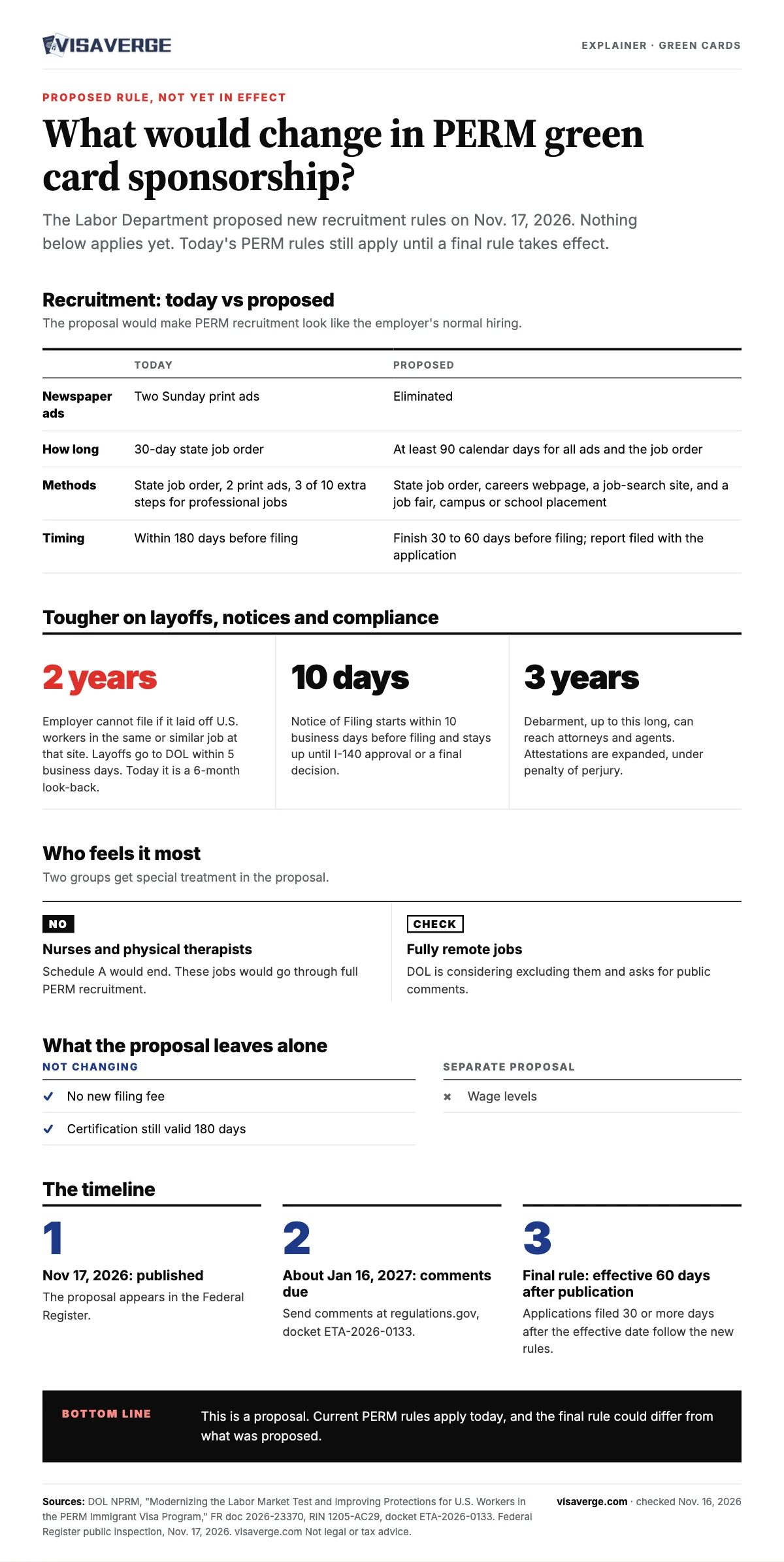
What the proposal changes
PERM is the labor market test that most employment-based green card cases must pass before the employer files Form I-140. The employer recruits U.S. workers, shows none were qualified and available, and DOL certifies the job on Form ETA-9089. The proposal rewrites nearly every step of that sequence.
- Recruitment mix: print newspaper ads are gone, replaced by a set of online and in-person steps.
- Recruitment length: at least 90 calendar days for every step.
- Timing: recruitment must end 30 to 60 days before filing, with a recruitment report filed alongside the application.
- Layoffs: a two-year bar on filing after layoffs in the same or similar occupation at the place of employment.
- Schedule A: DOL would stop administering it.
- Compliance: expanded attestations under penalty of perjury and a debarment reach of up to three years that extends to attorneys and agents.
- Filing: fully electronic prevailing wage and PERM filings, with electronic signatures and decisions.
Recruitment: current vs proposed
Under today’s rules, an employer places a job order with the State Workforce Agency (SWA) for 30 days and runs print ads on two different Sundays. Professional jobs also require three additional recruitment steps chosen from a list of ten. The proposal drops the newspaper requirement entirely and sets one fixed list of steps.
The employer would need an SWA job order, an ad on its own careers webpage, an ad on at least one job-search website, and at least one job fair, on-campus recruiting event or school placement office posting during the SWA job order. Social media counts only if the employer customarily uses it for non-PERM openings.
The proposal also requires the PERM recruitment to mirror how the employer hires for similar jobs outside the green card process. If the company normally posts engineering roles on a particular job board for 120 days, the PERM ad has to follow the same pattern. The 90-day minimum rises to the employer’s customary period when that is longer, measured over the last 12 months.
The 30-to-60-day window is new in this form. Recruitment must finish no more than 60 days and no fewer than 30 days before the employer files, and a recruitment report goes in with the application. Combined with the 90-day minimum, an employer needs roughly four to five months from the first ad to a filed case before analyst review even begins.
The Notice of Filing also changes. Today it is posted for at least 10 consecutive business days in the 30 to 180 days before filing. The proposal starts it within 10 business days before filing and keeps it up until USCIS approves the I-140 or a final determination is made, with electronic notice rules and coverage of third-party worksites.
The two-year layoff bar
The sharpest change for employers is a hard bar. Under the proposal, an employer could not file a PERM application at all if it laid off U.S. workers in the same or a similar occupation at the place of employment within the two years before filing.
The current rule, 20 CFR 656.17(k), is softer. A layoff in the area of intended employment within six months of filing does not block the case; it requires the employer to document that it notified and considered its laid-off U.S. workers for the job. The proposal swaps that duty for a bar and lengthens the look-back from six months to two years.
The duty to consider laid-off U.S. workers would also continue after filing, through I-140 approval or a final determination. Employers would have to report layoffs to DOL, and to DHS if an I-140 is pending, within five business days. Staffing firms could not place a green card worker at a client that is conducting layoffs.
For workers, this means a sponsor’s layoff history becomes part of whether a case can move at all. An employee whose company cuts similar jobs in 2027 could find the employer unable to file, even if the employee’s own job is untouched. DOL cites tech layoffs at companies that continued sponsoring foreign workers as a driver of the change.
Schedule A ends for nurses and physical therapists
Schedule A lets employers hire certain shortage occupations without running the labor market test, because DOL has pre-certified that no U.S. workers are available. Group I covers registered nurses and physical therapists. DOL now says it lacks the authority to maintain the list and cannot justify the pre-certification, so it proposes to stop administering it.
Those jobs would go through full PERM recruitment under the new rules: the 90-day recruitment, the layoff bar, the recruitment report and the analyst review queue. DOL estimates about 1,417 employers use Schedule A in a typical year, and it puts the cost of moving those cases into full PERM at about $14.9 million a year.
The proposal does not expand Schedule A to STEM occupations, a change the department asked about in a December 2023 request for information and now cites as part of its reasoning for ending the list. Nurses and therapists who now rely on the shortcut should expect a materially slower start to their cases if the rule is finalized.
Remote jobs could be excluded
The proposal adds definitions for remote, telework, hybrid and roving positions, because the current rules never addressed where a remote worker’s “place of employment” is. DOL goes further and says it “is considering whether to exclude fully remote positions” from PERM, and it asks the public to comment on a categorical exclusion or a minimum on-site requirement.
That is a question, not a proposal to ban remote roles, but it matters. A green card sponsor with fully remote engineers or analysts could be shut out of PERM, or required to show a minimum number of days on site. Employees now working from home on a PERM-backed job should watch how this section changes between the proposal and the final rule.
New attestations and debarment for attorneys
The rule defines two terms that have long been argued case by case: the actual minimum requirements of a job and business necessity. Employers would also attest, under penalty of perjury, that their recruitment was in good faith and comparable to how they hire for non-PERM jobs.
Enforcement reaches further. DOL could debar attorneys and agents independently of the employer, for up to three years, and a debarment would apply across all of the department’s labor certification and labor condition application programs, not just PERM. Debarred parties could not file new applications or receive approvals during that period.
The department has already been acting on PERM abuse. It recently suspended eight employers amid an H-1B and PERM fraud probe, and the proposal’s preamble cites that kind of investigation as part of the case for tighter rules.
What does not change
Several things stay as they are. The proposal contains no new filing fee, and a certification stays valid for 180 calendar days for filing the I-140. It does not touch wage levels either: the prevailing wage methodology is a separate proposal published on March 27, 2026, whose comment period closed on May 26. The wage rule that went to OMB moves on its own track.
Priority dates are not part of the proposal. For most employment-based cases the PERM filing date sets the priority date, which is why the PERM filing date vs I-140 approval question matters for anyone already in line.
On cost, DOL estimates a net savings of about $164.3 million a year. It reaches that figure by counting about $1.745 billion in savings over 10 years from dropping print ads, against new costs such as longer notices, expanded attestations, layoff reporting and Schedule A cases moving into full PERM.
When it could take effect
No effective date exists yet, because DOL has to finish the comment period and publish a final rule first. The proposal sets a 90-day transition: the rule takes effect 60 days after the final rule is published, and applications submitted up to 29 days after that effective date still follow the old rules. Applications filed 30 or more days after the effective date follow the new rules. The date of submission governs.
What a case could look like under the new rules
Here is an illustration, not a prediction. The dates depend entirely on when a final rule takes effect, which cannot happen by March 2027. Assume the new rules were already in force and an employer began recruiting on March 1, 2027.
That example shows the added months. The 90-day recruitment adds 60 days over a 30-day SWA order, and the 30-to-60-day pause before filing adds more on top of the recruitment itself. DOL’s own data show PERM analyst review averaging 300 days for decisions in the last 30 days, 315 days over 90 days and 360 days over 180 days. Prevailing wage requests are being processed for August 2026 receipts in the OEWS category and July 2026 receipts for non-OEWS requests.
What workers and employers should do now
Nothing in the proposal changes a case filed today. The practical advice depends on where you are in the process.
Employers weighing whether to file early should talk to their immigration counsel about the transition rule, since filing date decides which rules apply.
How to comment
Anyone can comment, including workers, employers, attorneys and professional associations. Comments go in through the regulations.gov docket for ETA-2026-0133 and are due 60 days after the November 17 publication. The full text, including the cost tables and the remote-work questions, is available in the public inspection version of the proposed rule.
Comments that cite concrete numbers, such as how long an employer’s recruitment actually runs or how many remote workers are in a green card pipeline, tend to carry more weight than general opposition. VisaVerge will track the comment deadline and any final rule.
Frequently Asked Questions
Is the new PERM rule in effect now?
No. DOL published a proposed rule on November 16 and 17, 2026. Current PERM rules, including the 30-day SWA job order and two Sunday newspaper ads, apply until a final rule is issued and takes effect 60 days later.
What is changing in PERM recruitment?
Print newspaper ads would end. Employers would need an SWA job order, a careers webpage ad, a job-search website ad and a job fair or campus recruiting step, all running at least 90 calendar days, ending 30 to 60 days before filing.
When are comments due on the PERM proposed rule?
Comments are due 60 days after Federal Register publication on November 17, 2026, which is about January 16, 2027. They go in through regulations.gov under docket ETA-2026-0133.
What is the two-year layoff bar in the PERM proposal?
An employer could not file a PERM application if it laid off U.S. workers in the same or a similar occupation at the place of employment within the two years before filing. Today a six-month look-back triggers notice duties instead.
Does the proposal end Schedule A for nurses and physical therapists?
Yes. DOL proposes to stop administering Schedule A, saying it lacks the authority and cannot justify the pre-certification. Nurse and physical therapist green card cases would go through full PERM recruitment and review.
Could fully remote jobs be excluded from PERM?
DOL says it is considering whether to exclude fully remote positions and asks for comments on a categorical exclusion or a minimum on-site requirement. It adds definitions for remote, telework, hybrid and roving jobs.
Does the proposal change the PERM fee or certification validity?
No. The proposal contains no filing fee, and a PERM certification stays valid for 180 calendar days. Prevailing wage methodology is a separate proposal published March 27, 2026.
Which PERM applications would follow the new rules?
The filing date decides. Applications submitted up to 29 days after the rule’s effective date use the old rules, and those submitted 30 or more days after the effective date use the new rules.