- The United States has ended duration of status for international students, replacing it with fixed four-year limits.
- Graduate students now face rigorous vetting for extensions and a reduced thirty-day post-graduation grace period.
- A 15% enrollment cap at top-tier universities is driving international students toward Canada’s more flexible policies.
The Department of Homeland Security published a final rule on July 17 that limits student stays and is already nudging families toward Canada. A proposed numeric cap on enrollment is adding to the pressure. The shift is already showing up in Seoul.
DHS Secretary Markwayne Mullin defended the change a day earlier. He was blunt.

"For nearly half a century, the outdated 'duration of status' system has compromised national security and created an environment ripe for immigration fraud. By implementing clear, finite limits on these visas, the United States is reclaiming its ability to properly screen, vet, and monitor individuals within our borders. This final rule ensures that foreign students remain focused on their primary purpose: completing their studies and returning home."
The rule ends Duration of Status for F, J and I visa holders. Students will get a fixed stay of up to four years. Programs run long. Ph.D. work often takes 5 to 7 years. Those students, along with medical residents, must file an Extension of Stay request with USCIS once their initial admission ends. The agency says that review will face rigorous vetting. The grace period after graduation also drops from 60 days to 30 days. Since May 2025, some students have reported mandatory disclosure of social media accounts.
Washington had already tightened the picture before this rule landed. In early October 2025, the White House introduced the Compact for Academic Excellence in Higher Education, which moots a 15% cap on international undergraduate enrollment at participating top-tier universities and a further limit of 5% from any single country. Nine initial universities were targeted, including MIT, UPenn and USC. The pressure is broad.
Education agencies in Seoul now report a surge in "US-Plus-Canada" counseling as families compare the two routes. More than 20,000 students are caught in the change. State Department data show F-1 visa issuances to Korean nationals fell 23% in May 2025 from a year earlier. Counselors say the new reviews add stress. The shift is real.
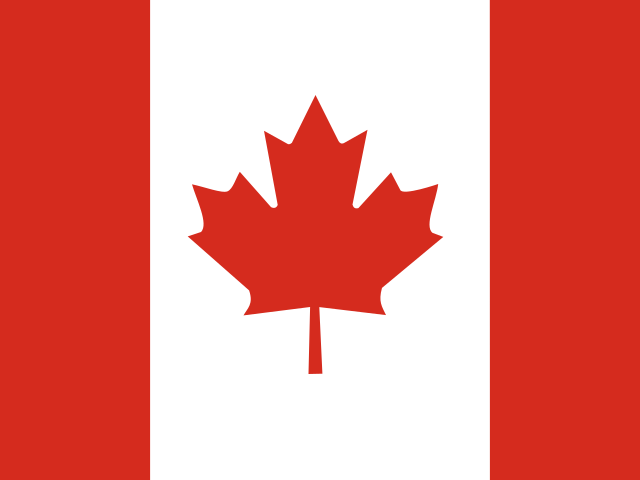
Canada keeps graduate students outside its cap
Free toolCanada Express Entry Points Calculator| Policy point | United States | Canada |
|---|---|---|
| Study stay | Fixed stay of up to four years | Study-permit cap of 408,000 for 2026 |
| Long programs | Need Extension of Stay filing with USCIS | Master's and PhD students exempt from the cap and from PAL |
| After graduation | F-1 grace period falls from 60 days to 30 days | 3-year Post-Graduation Work Permit for Master's and PhD graduates |
| Processing | More intensive screening, including social media disclosure since May 2025 | Study-permit processing averaged 8-12 weeks as of early 2026 |
Immigration, Refugees and Citizenship Canada set 2026 provincial and territorial allocations under the cap in a notice dated Nov. 25, 2025. Master's and PhD students stay outside the cap and outside the provincial attestation letter requirement. Their post-graduation work permit lasts 3 years. Processing averaged 8-12 weeks as of early 2026. Ottawa keeps that door open.
South Korea was Canada's 5th largest source of international students in 2024, with 89,600 students, up 38% from the year before. The numbers already favor Canada. NAFSA estimates the U.S. shift could cost universities $7 billion in the 2025-2026 academic year.