- The co-pilot attacked the captain at about 9:21 a.m. UAE time and the jet fell from roughly 34,000 feet before passengers got into the cockpit.
- Two off-duty flydubai pilots landed the plane in Tabuk at 10:45 a.m., and all 174 passengers survived.
- On October 3, the UAE Attorney General said the co-pilot attempted a terrorist attack; flydubai’s Tel Aviv flights remain suspended.
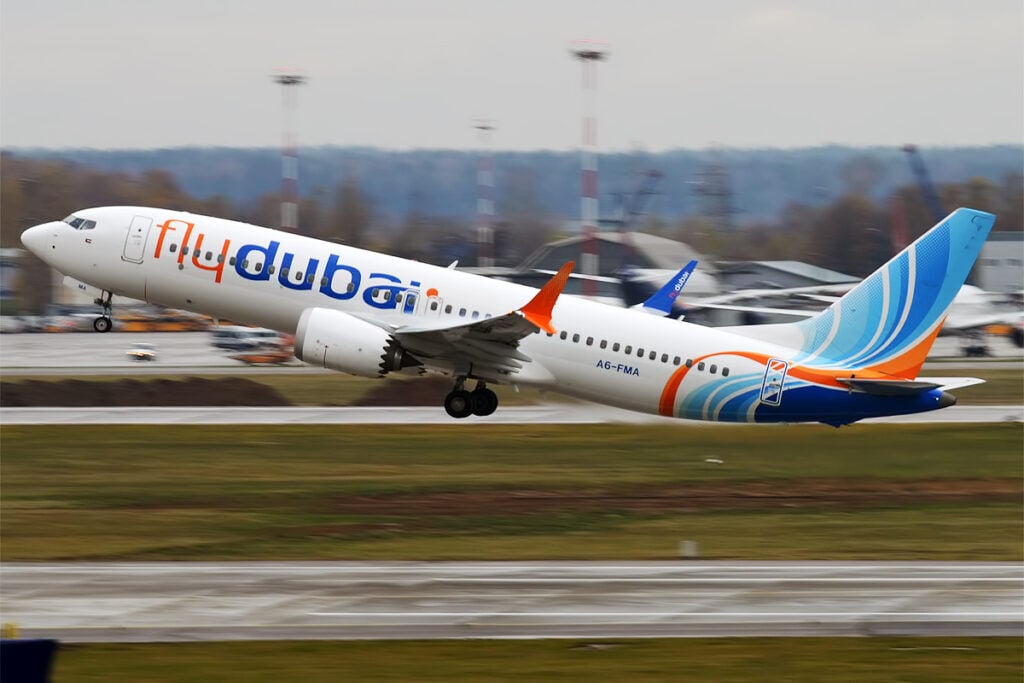
Flydubai flight FZ1073 from Dubai to Tel Aviv was about two hours and 15 minutes into its trip on September 30, 2026 when its first officer attacked the captain with the cockpit’s crash axe and the Boeing 737 MAX 8 plunged from about 34,000 feet. The wounded captain, Indian national Smit Machchhar, opened the flight deck door, passengers and two off-duty flydubai pilots overpowered the attacker, and the jet landed safely in Tabuk, Saudi Arabia, at 10:45 a.m. UAE time with all 174 passengers alive.
Three days later, the UAE’s Attorney General, Hamad Saif Al Shamsi, said investigators had found that the co-pilot “had attempted to carry out a terrorist attack.” The suspect, identified in multiple reports as Omani national Hamam al-Hammami, is in custody in the UAE. According to The Wall Street Journal, Oman had pulled him from flying duty in 2024 over radical views, before flydubai hired him.
Our first report on how the Indian captain foiled the attack covered the basics. This piece rebuilds the full sequence from official statements and passenger accounts: the minutes inside the cockpit, the hours on the ground in Tabuk, and the investigation, flight suspensions and diplomatic fallout that followed.
All times below are UAE time (GST, UTC+4) unless marked otherwise. Saudi Arabia runs one hour behind, so the 10:45 a.m. landing was 9:45 a.m. in Tabuk. Some details, especially the exact altitudes and the order of events in the cockpit, come from passenger interviews and flight-tracking data and differ slightly between outlets; where they conflict, we say so.
Who Was on Board Flight FZ1073
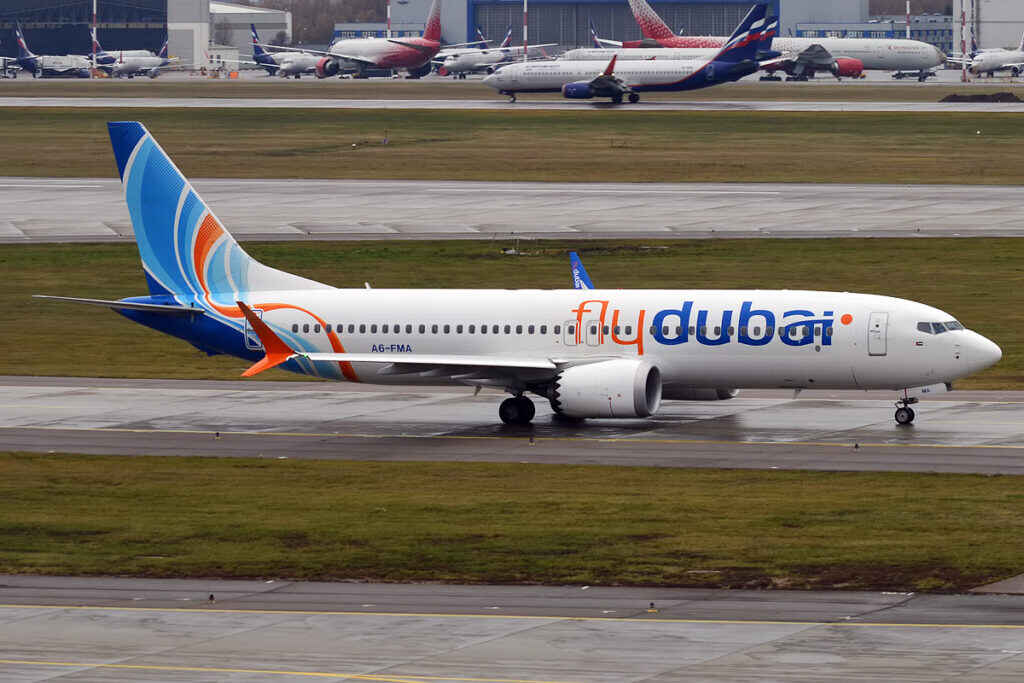
The aircraft was a Boeing 737 MAX 8, registration A6-FKF, delivered to flydubai in December 2022. It carried 174 passengers, most of them Israeli citizens; reports put the Israeli count at about 150 and the number of children at 27. The scheduled flight time from Dubai International (DXB) to Ben Gurion (TLV) was about three and a half hours.
Eight flydubai staff were aboard. Two were operating the flight, four were cabin crew, and two were off-duty flydubai pilots deadheading, meaning they rode as passengers to position for the return flight to Dubai. Those two pilots ended up landing the plane.
- Captain Smit Machchhar, 38: from Ghatkopar in Mumbai, trained at Mainland Air in Dunedin, New Zealand, flew for SpiceJet from 2011 for more than 11 years, rising to line training captain, and joined flydubai as a direct-entry captain in June 2022. He was the pilot flying.
- First Officer Hamam al-Hammami: Omani national, with flydubai for less than a year. He was the pilot monitoring.
- Two deadheading flydubai pilots: one reported to be British.
- Four flight attendants.
Minute by Minute: The Attack in the Air
FZ1073 left Dubai at 7:05 a.m. and climbed to a cruising altitude of about 34,000 feet on the normal routing across Saudi Arabia toward Jordan and Israel. For two hours, nothing appeared unusual on flight-tracking sites.
At about 9:21 a.m., near the Saudi-Jordanian border, the tracking data shows the jet beginning a sharp descent, a brief climb, then a steep dive. According to the UAE Attorney General, the co-pilot “began executing his plan during the flight, attacking the captain inside the flight deck using a crash axe” and tried to take control of the aircraft. Accounts of the drop vary: the Attorney General’s office said the plane fell nearly 14,000 feet in under 30 seconds, while flight-tracking reconstructions put the fall at roughly 34,000 to 17,000 feet in under a minute.
- 7:05 AMDeparts Dubai International174 passengers and 8 flydubai staff on a Boeing 737 MAX 8 bound for Ben Gurion.Cruise ~34,000 ft
- ~9:21 AMCo-pilot attacks the captain with the crash axeNear the Saudi-Jordanian border, the jet drops sharply, briefly climbs, then dives.~17,000 ft in under a minute
- 9:28 AMGeneral emergency code broadcastThe wounded captain gets the emergency signal out while under attack.Squawk 7700
- 9:33 AMPassengers reach the flight deckCaptain Smit Machchhar unlocks the door. Passengers and two off-duty pilots restrain the co-pilot and level the jet.~15,000 ft
- 9:35 AMHijack code setThe jet turns west, briefly enters Jordanian airspace, then heads into Saudi Arabia.Squawk 7500
- 9:44 AMDistress call reaches TabukThe two deadheading flydubai pilots fly the aircraft to the nearest suitable airport.
- 10:45 AMEmergency landing at TabukPrince Sultan bin Abdulaziz International Airport (9:45 AM Saudi time). All 174 passengers survive; the captain goes to hospital.
- 6:40 PMPassengers fly on to Tel AvivAfter about seven hours of Saudi questioning, a replacement flydubai jet takes them onward.
The two transponder codes matter. 7700 tells controllers there is an emergency of some kind. 7500 is reserved for hijacking or unlawful interference, and air traffic services treat it as a security event. Retired airline captain Richard Levy called it “remarkable” that the wounded captain managed both to unlock the cockpit door and to signal the emergency while under attack.
How Passengers Got Into the Cockpit
Since 2001, airliner flight decks have been locked from the inside with reinforced doors. That design kept help out as long as the captain was down. Machchhar has described lying on the cockpit floor with deep wounds to his head and hands and feeling the aircraft fall.
“When I was lying on the floor I could feel the aircraft was going down,” he told Indian Prime Minister Narendra Modi in a video call from his hospital bed. “I told myself that if I didn’t get up, there would be a problem. I managed to open the door, and then everyone else came in.”
According to passenger accounts given to Israeli media, passenger Tali Manes heard the struggle and alerted her husband, Tzvika Manes, and one of the deadheading pilots. Passengers Yaniv Hayun, a plumber, dentist Dr. Shota Musayev and Asaf Rajuan went in with the off-duty pilots. Hayun has said he pulled back on the control column to help level the plane. The attacker was tied up first with headphone cables and then with cable ties; Hayun said he kept shouting “kill me, kill me.”
Flydubai’s own statement credits its staff: the aircraft “was secured by flydubai crew travelling on the flight, who diverted and landed it safely at Tabuk Airport.” The UAE General Civil Aviation Authority (GCAA) later said passengers helped the crew bring the situation under control. Both accounts fit: passengers subdued the attacker, and the two deadheading pilots flew the jet to the ground.
One tense moment came after the plane was under control. Tzvika Manes said cabin crew asked passengers to untie the restrained co-pilot. “They were saying to free the terrorist, we got instantly suspicious of them,” he said, adding that passengers refused: “We didn’t want to kill him; we just wanted him not to kill us.” Flydubai has not commented on that account.
On the Ground in Tabuk
Musayev, the dentist, treated Machchhar during the descent and has said the captain would not have survived if the landing had come even a few minutes later. Reports described his injuries as heavy blood loss and cuts across the head and hands. He was taken to hospital in Tabuk in serious condition and later stabilized. The GCAA said “some members of the aircraft crew were injured” and hospitalized in Saudi Arabia; one passenger also needed hospital care, and most others had minor injuries or none.
Saudi authorities questioned passengers and cabin crew for about seven hours. Saudi Arabia has no diplomatic relations with Israel, and it turned down an Israeli request to send military aircraft to collect the passengers. Instead it allowed flydubai to fly in a replacement plane, which left Tabuk for Tel Aviv at about 6:40 p.m. UAE time.
Saudi Arabia’s National Transport Safety Center opened an inquiry, and the Interior Ministry’s first finding was blunt: “the pilot was assaulted by his co-pilot, resulting in various injuries to both.” A UAE security team took part in the early Saudi work, and Saudi officials coordinated with Israel, Oman, the UAE and the United States.
Day by Day: The Investigation and Fallout
The first official statements were cautious. Flydubai called it “an altercation” in the flight deck, and the GCAA called it a “security incident” that “was brought under control.” Within 72 hours, UAE officials were calling it terrorism.
- Sep 30Attack, landing, first shutdown
- Flydubai confirms an altercation; the GCAA calls it a security incident.
- Flydubai suspends Tel Aviv flights; Emirates halts its codeshare.
- Israel bars flydubai for six days.
- Oct 1Saudi finding, UAE probe opens
- Saudi Interior Ministry: the captain was assaulted by his co-pilot.
- UAE Attorney General opens an inquiry into possible terrorism links.
- The co-pilot is moved into UAE custody.
- Oct 2The suspect’s past surfaces
- WSJ: Oman grounded him in 2024 over radical views.
- Anwar Gargash calls it an act of terrorism.
- Trump floats an Iran link without evidence.
- Oct 3Officially an attempted terror attack
- Attorney General: the co-pilot attempted to carry out a terrorist attack.
- ABC News: he meant to crash the plane in Israel.
- Sheikh Hamdan visits Captain Machchhar in hospital.
On October 1, Attorney General Al Shamsi ordered an investigation into “the circumstances, motives, and any links” to the incident, including whether it involved “terrorist activity or intent” or prior planning. The UAE asserted jurisdiction because the aircraft is UAE-registered. Both pilots were medically cleared in Saudi Arabia and flown to the UAE under an Emirati security escort, the co-pilot into custody.
On October 2, Anwar Gargash, diplomatic adviser to UAE President Sheikh Mohamed bin Zayed, became the first senior Emirati official to use the word, praising Machchhar for confronting “a dangerous and potentially catastrophic act of terrorism.” Gargash also warned against “simplistic interpretations” and conspiracy theories. Flydubai chief executive Ghaith Al Ghaith said: “I want to express my deep gratitude to our crew, our captain, and the pilots who secured the aircraft and landed it safely.”
On October 3, the Attorney General’s office went further, saying the co-pilot had tried to carry out a terrorist attack and to seize the controls. Findings on motive will be released once “necessary procedures” are complete. Israeli investigators are taking part in the UAE-led inquiry, which Prime Minister Benjamin Netanyahu said UAE President Mohamed bin Zayed agreed to.
What Is Known About the Suspect
UAE authorities have not formally named the co-pilot, but Israeli officials, The Wall Street Journal and other outlets identify him as Hamam al-Hammami, an Omani citizen who had worked for flydubai for less than a year. He has not been publicly charged.
- Grounded in Oman: The Wall Street Journal reported that while he was a co-pilot trainee at Oman Air in 2024, he was found with extremist material and pulled from flying, but kept on in an administrative role.
- Hired anyway: It is not known whether Oman shared that concern with the UAE or with flydubai.
- Stated intent: ABC News reported on October 3 that he told investigators he intended to crash the plane in Israel.
- Acted alone? Israeli security officials assessed that he “likely acted alone.” Netanyahu said he “underwent Islamist radical indoctrination” and warned “whoever sent him will pay heavy price.”
- Iran claims: US President Donald Trump said Iran may have been involved “based on what I’m hearing” but gave no evidence. Netanyahu said it was “too early to say.”
A key question for regulators is why an Omani pilot was on an Israel flight at all. Israel’s Transport Minister Miri Regev pushed for the flydubai suspension, citing concerns that the airline had broken an agreement to put only pilots holding passports from countries with diplomatic ties to Israel on Tel Aviv flights. Oman has no diplomatic relations with Israel. Flydubai has not publicly addressed the claim.
Pilot screening in the UAE runs through the GCAA’s licensing rules: a valid license, type rating, Class 1 medical certificate that includes mental health, and English proficiency. Saj Ahmad, chief analyst at StrategicAero Research, told Al Jazeera that vetting is “very thorough” but is “a single snapshot in time and will never uncover whether a person has issues that then manifest in the workplace.”
Flights Suspended: Dubai-Tel Aviv Travel Now
The attack cut the busiest UAE carrier link to Israel overnight. Western airlines had already trimmed Israel service during the regional conflict, and flydubai and Emirates were carrying much of the Dubai-Tel Aviv traffic. That left thousands of Israelis stranded in Dubai.
El Al, Israir and Arkia had not flown to Dubai for about six months because of Israeli security restrictions. Reports say the UAE has now accepted Israeli security demands that clear the way for their return, starting with repatriation flights for stranded travelers. Emirates says customers already en route to Tel Aviv will get “all possible support” to complete their trips.
If you hold a ticket on either Gulf carrier, check the airline’s own refund and rebooking terms; our guide to Emirates refunds through Manage Booking after a cancellation explains how that process works. For how the UAE’s carriers handled earlier disruptions, see our running UAE airline suspension updates.
The Captain Who Opened the Door
Machchhar grew up in a Gujarati family in the textile business in Mumbai and studied textile engineering and then management at Mumbai’s Welingkar Institute before deciding at about 19 to fly. Reports credit him with about 9,750 hours on the Boeing 737, about 6,400 of them as pilot in command.
Modi said the captain showed “immense courage” and prevented “a 9/11-type tragedy.” Netanyahu called him “a true hero.” In the UAE, Dubai Crown Prince Sheikh Hamdan bin Mohammed visited him in hospital and said he “embodied the highest degrees of courage, responsibility, and care for human life.” Asked by Modi how he was, Machchhar answered: “All good, sir. I look at this as a journey. I am confident of my recovery and return.”
What Travelers Should Do Now
- Booked on flydubai or Emirates to Tel Aviv: do not go to the airport. Contact the airline or your travel agent for a refund or reroute, and make sure your booking has a working phone number and email.
- Stranded in Dubai: watch El Al, Israir and Arkia for repatriation and new scheduled flights; El Al’s regular service is planned from November.
- Connecting through Dubai from India or elsewhere: Emirates will not accept passengers at origin whose final stop is Tel Aviv, so rebook on another routing before you leave home.
- Worried about safety on Gulf carriers: this was a deliberate act by one crew member, not a mechanical or systemic failure. Emirates, Etihad and flydubai all placed high in a 2025 global safety ranking; see our safest airlines ranking.
The UAE-led investigation is ongoing, and officials have said they will publish findings on motive once procedures are complete. Expect the next decisions to center on pilot vetting, crew nationality rules for Israel routes, and when flydubai’s Tel Aviv flights can restart after Israel’s six-day ban ends.
Frequently Asked Questions
What happened on flydubai flight FZ1073?
On September 30, 2026, the co-pilot of flydubai FZ1073 from Dubai to Tel Aviv attacked Captain Smit Machchhar with the cockpit crash axe at about 34,000 feet. Passengers and two off-duty flydubai pilots restrained him, and the Boeing 737 MAX 8 landed safely in Tabuk, Saudi Arabia.
Who is the flydubai co-pilot who attacked the captain?
Israeli officials and The Wall Street Journal identify him as Hamam al-Hammami, an Omani national who had worked for flydubai for less than a year. UAE authorities have not formally named or charged him. He is in custody in the UAE.
Who is Captain Smit Machchhar?
Smit Machchhar, 38, is an Indian pilot from Mumbai who trained in Dunedin, New Zealand, flew for SpiceJet for more than 11 years and joined flydubai as a captain in June 2022. Despite severe head and hand wounds, he opened the cockpit door so passengers could help.
Who landed the flydubai plane in Tabuk?
Two off-duty flydubai pilots who were deadheading as passengers to operate the return flight to Dubai took over and landed the jet at Prince Sultan bin Abdulaziz International Airport in Tabuk at 10:45 a.m. UAE time, or 9:45 a.m. Saudi time.
Was the flydubai incident a terrorist attack?
Yes, according to the UAE. On October 3, 2026, Attorney General Hamad Saif Al Shamsi said investigators found the co-pilot attempted to carry out a terrorist attack. ABC News reported he told investigators he meant to crash the plane in Israel. Motives are still being investigated.
Are flydubai flights to Tel Aviv suspended?
Yes. Flydubai suspended Tel Aviv flights until further notice after September 30, 2026, Israel barred flydubai for six days, and Emirates halted its codeshare service to Tel Aviv. El Al, Israir and Arkia are returning to Dubai instead.
How far did the flydubai plane drop?
Flight-tracking reconstructions show the 737 falling from about 34,000 feet to roughly 17,000 feet in under a minute. The UAE Attorney General’s office said it dropped nearly 14,000 feet in under 30 seconds. It later stabilized around 15,000 feet.
Was the flydubai co-pilot banned from flying before?
The Wall Street Journal reported that Oman Air pulled him from flying in 2024 after he was found with extremist material, keeping him in an administrative job. It is unclear whether Oman shared that concern with the UAE or flydubai before he was hired.