- President Tokayev signed a decree to overhaul migration policy by December 31, 2026.
- The new Altyn Visa offers a 10-year residence permit for investors contributing at least $300,000.
- Government expanded the in-demand profession list from 51 to 174 occupations to address labor shortages.
(KAZAKHSTAN) — President Kassym-Jomart Tokayev signed a decree on April 25, 2026 that overhauls Kazakhstan’s migration policy, replacing a permit-and-quota model with an incentive-based framework aimed at drawing investors, entrepreneurs and highly skilled foreign workers.
The government must implement the reforms by December 31, 2026. The package centers on a new long-term residency route, the Altyn Visa, and a broader reworking of how Kazakhstan admits foreign professionals in sectors where labor demand has outpaced local supply.
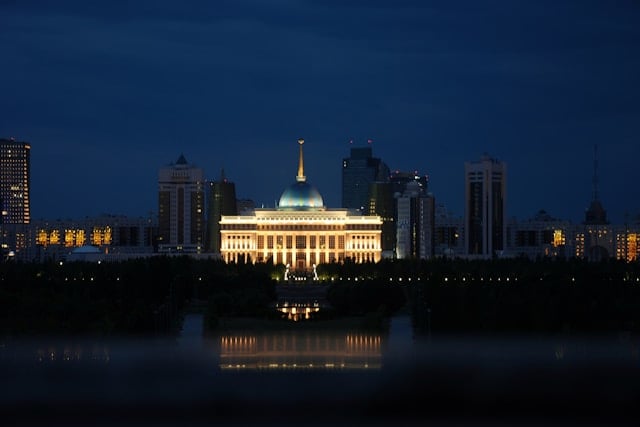
Kazakhstan framed the shift as an economic measure as much as a migration one. Authorities tied the changes to labor shortages, technology transfer and efforts to build up industries including technology and energy.
Free toolDS-160 Form Filling Online Helper ToolAt the center of the changes is the Altyn Visa, a “golden visa” program that gives eligible foreign nationals a 10-year residence permit. The permit offers tax and residency advantages that move well beyond a standard work authorization.
Foreign nationals who invest at least USD 300,000 qualify immediately for the 10-year permit. The qualifying investment can go into the charter capital of Kazakh companies or into local publicly traded securities.
The benefits attached to the Altyn Visa include exemption from personal income tax, property tax, land tax and the universal declaration of income and assets. Holders also receive equal access to government and financial services on the same basis as Kazakh citizens, along with faster pathways to long-term residence.
Family members of Altyn Visa holders also gain residency-linked benefits. Those include access to health insurance, social security and retirement entitlements, and the government said applications will be processed electronically.
The new structure marks a clear shift from the older quota-driven approach that governed much of Kazakhstan’s foreign labor system. Instead of relying mainly on employer permits and annual ceilings, the decree creates direct incentives for investment and creates faster residency tracks for workers in selected categories.
That fast-track system covers several groups of foreign professionals. IT specialists can become eligible after 1 month of residence, and business visa holders can do the same after 1 month.
Skilled worker visa holders become eligible after 6 months. Temporary worker visa holders become eligible after 1 year, and participants in the Astana International Financial Centre, or AIFC, tax residency program also fall within the pathway.
The business visa category covers investors, entrepreneurs, members of boards of directors and public administration recruits. Kazakhstan’s decree uses that category to draw both capital and management talent, pairing short entry timelines with a route into longer-term residency.
A separate skilled worker visa targets professionals with job offers, scientists, medical professionals, cultural and arts figures, leading university graduates and specialists in priority professions. The government also included workers it identifies as needed in areas where domestic supply remains thin.
The temporary worker visa applies to professionals working on government-approved investment projects. That places infrastructure and project-based hiring inside the wider migration overhaul rather than leaving those workers only under the older labor-permit framework.
Kazakhstan paired the new visas with a broad expansion of the occupations it classifies as in demand. The Ministry of Labor and Social Protection increased that list from 51 professions to 174.
The expanded list covers IT, healthcare, education, culture, the nuclear industry, energy, biotechnology, genomic medicine, water management and irrigation. Employers can request hires outside quotas for those roles, a change designed to ease bottlenecks in technical and professional recruitment.
Annual quota controls still remain in the system for 2026. Kazakhstan set its foreign labor quota for 2026 at 0.25% of the total workforce.
That quota includes 726 permits for senior executives and deputies, 3,402 for heads of structural divisions, 5,893 for specialists, 3,131 for skilled workers and 4,994 for seasonal labor. Those figures show that the country is not abandoning labor controls outright, even as it builds new exceptions for selected categories.
Foreign specialists who obtain Altyn Visa status sit outside those quotas. After a qualifying employment period, they gain access to tax incentives, healthcare, education and financial services without being counted under the annual labor ceilings.
The tax treatment is one of the program’s strongest selling points. Kazakhstan said the Altyn Visa supports territorial taxation, meaning no tax on foreign income, while the AIFC maintains zero corporate tax for financial services until 2066.
Those terms place the program in direct competition with residency-by-investment systems that other countries use to attract capital and high-income professionals. Kazakhstan’s version combines investment entry, labor-market targeting and administrative digitization in one scheme.
The Altyn Visa also broadens the government’s appeal beyond investors. A foreign national does not need to arrive only through the investment threshold of USD 300,000; the system also opens a route for workers whose expertise matches the sectors Kazakhstan now treats as a priority.
IT specialists stand out in that design because they can move into Altyn Visa residency after 1 month of residence. Business visa holders, including entrepreneurs and board members, receive the same timeline, while other highly skilled workers face longer but still defined waiting periods.
Medical professionals and scientists also appear prominently in the new visa architecture. So do cultural figures and top university graduates, showing that the decree reaches beyond heavy industry and finance into research, healthcare, education and the arts.
Water management, irrigation, biotechnology and genomic medicine also appear on the expanded priority list, indicating where Kazakhstan sees future shortages or growth opportunities. Energy and the nuclear industry appear as well, placing technical migration policy alongside industrial planning.
Despite the investment incentives, the decree does not create a direct citizenship-by-investment route. Kazakhstan kept naturalization separate from the Altyn Visa and attached citizenship to residence, language and integration requirements rather than to capital alone.
A foreign national must complete 5+ years of continuous legal residence to naturalize. Applicants must also show proficiency in Kazakh or Russian, knowledge of the country’s history and constitution, stable income and accommodation.
That distinction gives the Altyn Visa a long-term residence function without turning it into an immediate passport program. Investors can secure a decade of residence and a wide package of rights, but citizenship remains tied to time spent in the country and to broader eligibility rules.
Kazakhstan’s approach also tries to connect foreign recruitment to domestic skill development. The government said the reforms are meant not only to fill gaps in the labor market but also to transfer skills to local workers.
That goal helps explain the mix of fast tracks, quota exemptions and targeted occupation lists. The decree does not open every category equally; it favors workers and investors tied to sectors where authorities want capital, expertise or both.
Electronic processing is another part of the redesign. By shifting Altyn Visa applications online, Kazakhstan is trying to cut friction from a system that historically depended more heavily on permits and administrative approvals.
The broader message is that the country wants to compete for mobile capital and specialized labor at the same time. The Altyn Visa offers a residency term long enough to appeal to investors, tax treatment built to attract internationally active earners and family benefits that make relocation more feasible.
Business visa holders, skilled worker visa holders, temporary worker visa holders and AIFC tax residency participants now sit inside one migration framework rather than a loose collection of separate rules. That structure gives authorities more ways to steer foreign entry toward sectors they want to develop.
Official implementation details are available through the Ministry of Labor and Social Protection and the gov.kz portals. By the end of 2026, Kazakhstan is set to replace much of its older migration architecture with a model built around incentives, targeted labor recruitment and the long-duration Altyn Visa.