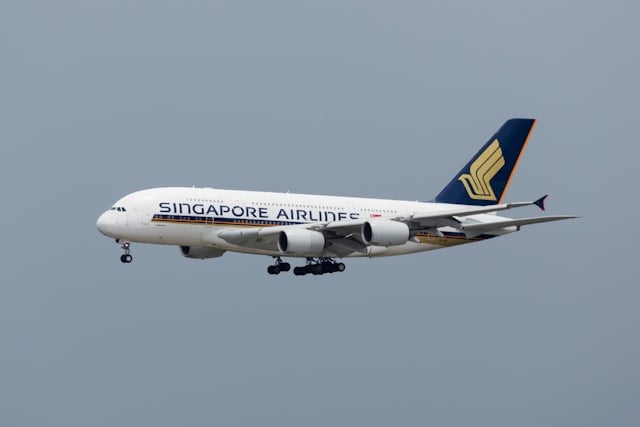
(SINGAPORE) Singapore will impose a new charge on air travel to fund cleaner jet fuel, with authorities confirming a mandatory Sustainable Aviation Fuel (SAF) fee for all departing passengers starting October 1, 2026, and tickets becoming subject to the charge from April 1, 2026. The country’s first-of-its-kind SAF levy will range from S$1.00 for economy-class passengers on short-haul flights to S$41.60 for business-class passengers on long-haul services to the Americas, anchoring a national push to cut aviation emissions under the Singapore Sustainable Air Hub Blueprint.
The plan makes Singapore the first jurisdiction to require outbound flights to contribute to the cost of cleaner fuel through a fixed passenger fee, a move officials say gives airlines and travelers price certainty as the industry shifts to greener operations.
How the levy is structured
The levy links cost to flight distance and cabin class, while setting a predictable price band to help airlines plan.
Free toolB1/B2 Tourist Visa Stay Calculator online- Economy and Premium Economy: S$1.00–S$10.40
- Business and First Class: S$4.00–S$41.60
This differential reflects higher emissions from larger seat footprints and longer routes. The charge is a fixed cost envelope, not a fluctuating tax tied to oil markets. It’s based on projected prices and volumes of SAF needed to meet Singapore’s starting uplift requirement of 1% of jet fuel in 2026.
Official information is available from the Civil Aviation Authority of Singapore, which oversees implementation: https://www.caas.gov.sg/about-caas/what-we-do/sustainability.
Policy timeline and targets
- Tickets subject to levy: from April 1, 2026 (for sales)
- Mandatory fuel uplift requirement: from October 1, 2026
- SAF share target by 2030: 3–5%
- Long-term goal: net zero emissions by 2050
Authorities say the initial 1% mandate is the first step on a schedule to build supply and confidence in alternative fuels as more producers come online.
Where the levy money goes
Revenue from the SAF levy will be directed to the Singapore Sustainable Aviation Fuel Company (SAFCo), a government-established entity tasked with:
- Aggregating demand from airlines
- Procuring SAF from producers
- Managing blending and logistics at Changi and Seletar airports
- Ensuring fuel quality and safety standards are met
By centralizing purchasing, SAFCo aims to secure better prices and provide producers a clearer signal of steady demand—critical for scaling a market currently constrained by limited output and higher costs.
What is SAF and technical readiness
- Feedstocks: Mostly waste oils (used cooking oil, animal fats), municipal solid waste; synthetic routes are also being developed.
- Current blends: Airlines operate with blends up to 50% SAF under existing standards.
- Longer-term: Industry working toward 100% SAF operations in commercial service (testing and certification ongoing).
SAF can be used with existing aircraft engines and infrastructure when blended with conventional jet fuel, making it a pragmatic bridge until new airframe technologies become mainstream.
Coverage and compliance
- The rule applies to all departing flights from Singapore, including passenger services, cargo, and business aviation.
- Fuel uplift must occur at airport-level blending points (Changi and Seletar), not via book-and-claim schemes that credit fuel use elsewhere.
- Centralized blending simplifies compliance checks and enables fuel suppliers to certify blend ratios delivered.
Rationale for a fixed envelope
Policy designers chose a fixed envelope because SAF markets are thin and prices volatile. Benefits include:
- Shields passengers and airlines from sudden price spikes
- Provides clarity for fare displays and reduces disputes
- Allows airlines to explain the charge clearly at point of sale
Travel systems will integrate the levy into fare displays as tickets for travel from April 1, 2026 go on sale, giving six months before the uplift requirement starts.
Industry and public response
- Many passengers view the small charge as a fair contribution toward cleaner fuel, despite concerns about higher airfares and affordability for families.
- Airlines are expected to work closely with SAFCo to meet uplift requirements, benefiting from centralized procurement and lower administrative burden.
- Skeptics note the persistent price gap between SAF and fossil jet fuel and the need for more production capacity and financeable projects.
Economic and strategic logic
- Singapore frames the levy as both a climate measure and a competitiveness strategy for a major hub.
- The levy spreads costs across a large passenger base, supporting stable purchasing contracts that make investment in new SAF plants and supply chains more viable.
- If other hubs follow, producers could build closer to demand centers, reducing transport costs and stabilizing supplies.
Corporate and consumer implications
- For corporate travel buyers, the levy becomes a measurable line item that can be reported in emissions calculations.
- For consumers, clear communication at checkout will be essential. The fee’s distance- and class-based structure is intended to reflect real differences in per-passenger fuel burn.
“A small fee now to build fuel demand and supply that can scale over the next decade,” is how the blueprint frames the tradeoff—modest added cost today for a steadier path to cleaner travel.
Risks and pressure points
- Global oil price swings could widen or narrow the SAF–fossil fuel price gap, prompting calls for adjustments.
- Supply chain disruptions could force SAFCo to expand sourcing or adjust contracts.
- Uneven passthrough of costs by airlines may require regulatory review of fare displays and enforcement.
Implementation staging and review
- Six-month staging (tickets on sale April 1; uplift from October 1, 2026) allows testing of contracts, storage, quality checks, and documentation.
- The levy’s fixed envelope will be reviewed as the SAF share rises toward 3–5% by 2030, to reflect market evolution and cost changes.
Broader significance
If Singapore successfully runs a mandatory, transparent SAF program without operational snags or major passenger pushback, it could become a model for other hubs. Clear, rule-based charges tied to a defined beneficiary (SAFCo) tend to draw less resistance than ad hoc levies, since passengers can see the link between payment and specific climate action.
Summary and long-term pathway
- Start: 1% SAF in 2026, funded by a universal passenger levy included at ticket purchase.
- Build: 3–5% by 2030, with levy reviewed as markets evolve.
- Endgame: Contribute to the aviation sector’s goal of net zero by 2050 by scaling SAF use now while longer-term technologies mature.
For travelers, the ambition will appear as a small line item on a checkout screen; for the industry, it signals adapting procurement and operations so aviation can continue in a warming world.
This Article in a Nutshell
Singapore will impose a mandatory Sustainable Aviation Fuel (SAF) levy on all departing passengers, with tickets showing the charge from April 1, 2026, and mandatory SAF uplift from October 1, 2026. Fees range from S$1.00 to S$41.60 based on distance and cabin class. Revenue will fund SAFCo to centralize procurement, blending at Changi and Seletar, and scale supply to meet a 1% SAF uplift in 2026 and a 3–5% share by 2030, supporting long-term net-zero goals.