- Germany proposes a one thousand three hundred thirty-two euro per tonne charge for missing sustainable fuel quotas.
- Airlines face fines of up to fifty thousand euros for failing to comply with reporting and verification rules.
- New EU proposals could expand carbon levies to international flights within five thousand kilometers starting in twenty twenty-nine.
Germany is preparing a €1,332 per tonne charge for airlines that fail to meet sustainable aviation fuel requirements, putting another cost on budget carriers that rely on low fares and thin margins. The draft also allows penalties of up to €50,000 for reporting violations.
The measure would operate under the EU’s ReFuelEU Aviation framework, which requires airlines to use 2% sustainable aviation fuel from 2025 and increase the share later. Germany’s Federal Aviation Office (LBA) is expected to oversee enforcement.
Free toolSubstantial Presence Test Calculator
That combination points first toward short- and medium-haul flying. Low-cost airlines concentrate on those routes, where a small fare increase can affect bookings quickly.
Passengers may ultimately pay more. Airlines and industry groups say higher SAF costs and emissions charges will feed into ticket prices, while one industry view says penalty revenue should finance alternative fuels rather than flow into general government budgets.
The German plan is only one part of the pressure. The European Union is also moving toward wider emissions pricing, with the Commission proposing a new test for international flights departing Europe.
The proposed expansion has a 2029 start date. It would cover flights landing within 5,000 kilometers of the geographic center of Europe.
Business and private jets would face the proposed system on all incoming and departing flights, regardless of distance. The measure would therefore reach beyond the routes traditionally associated with Europe’s internal aviation market.
A 2029 proposal would bring nearby international routes into the system
The European Commission presented the proposal on July 17, 2026, as a targeted revision intended to strengthen Europe’s industrial competitiveness. Its geographic test could affect international services that begin in Europe and end within the stated 5,000-kilometer radius.
Destinations discussed in connection with the proposal include New York, Dubai and New Delhi. Those examples require route-specific assessment because the proposal uses distance from Europe’s geographic center, not a simple country list.
The proposal would also remove much of the practical effect of the earlier “Stop the Clock” arrangement, which had largely limited emissions trading coverage to flights within the European Economic Area. That earlier approach helped avoid trade disputes.
Airline groups object to the direction of travel. Willie Walsh, director general of IATA, said the EU was repeating a historic error and warned that the policy could create disputes over extraterritoriality, slow global decarbonization and weaken European competitiveness.
Ourania Georgoutsakou, managing director of Airlines for Europe, said the priority should be reducing both emissions-trading and SAF costs. She said the July reform did not comprehensively deliver that result.
The International Civil Aviation Organization formally expressed concern on July 29, 2026, saying the EU’s unilateral expansion could undermine the global CORSIA offsetting scheme.
The Commission has defended faster implementation. Wopke Hoekstra, European Commissioner for Climate, Net Zero and Clean Growth, said on June 23, 2026:
"Climate action, competitiveness, and independence must go hand in hand. The answer cannot be to slow down the green transition. Instead, Europe must accelerate implementation."
The cost reaches beyond the SAF charge
The EU’s SAF requirements create both a fuel expense and a compliance obligation. Airlines must obtain the required fuel volumes, document their use and report their performance under the German draft.
The proposed €1,332 charge applies to missing SAF volumes. The separate €50,000 maximum concerns reporting violations.
Those are different risks. One concerns fuel procurement; the other concerns records and compliance.
The EU began mandatory monitoring, reporting and verification for non-CO2 effects, including contrails, on January 1, 2025. Airlines faced their first reporting deadline on June 30, 2026.
The rules are arriving as carriers remain exposed to fuel-market swings. A research account attributes a doubling of jet-fuel prices to $1,500 per metric tonne during the U.S.-Iran conflict in Feb 2026. That figure is presented as part of the wider squeeze on airline margins, rather than as a charge created by the SAF rules.
EasyJet CEO Kenton Jarvis described the supply problem on May 21, 2026:
"We have mandates but we don’t have sustainable aviation fuel. If SAF was the same price as jet fuel, we wouldn’t need mandates."
EasyJet’s board recommended a £5.7 billion buyout by Apollo funds in July 2026. The proposed transaction has been linked in the research to the capital needed for a transition involving hydrogen and SAF, although the board recommendation itself is the concrete development.
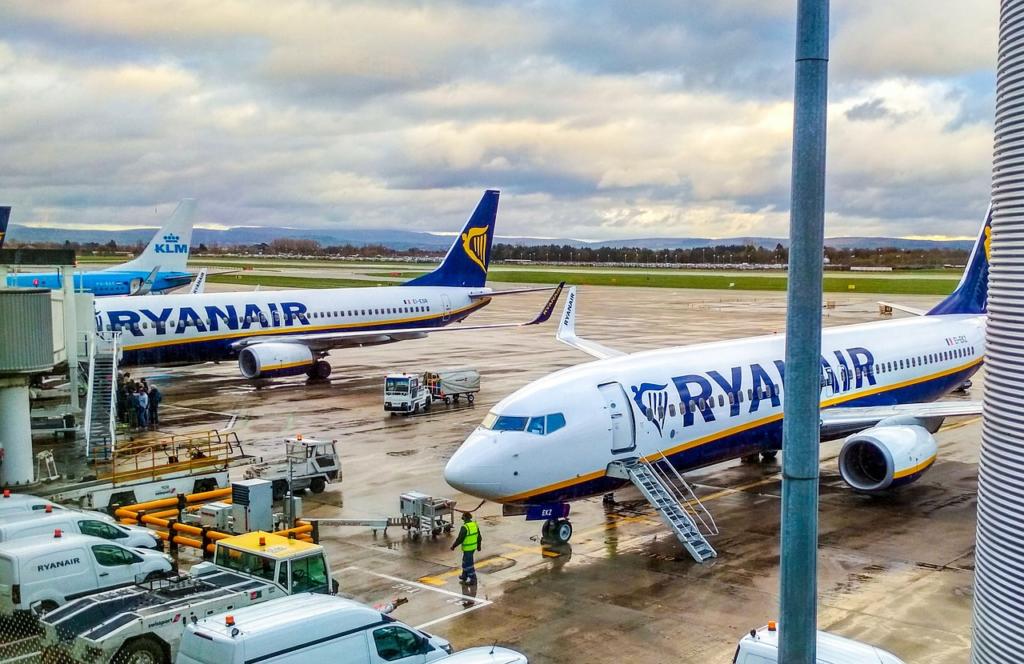
Ryanair Group CEO Michael O’Leary called the emissions-trading system a “failed” scheme that creates “indefensible” competitive distortion in letters to Irish ministers released July 16, 2026. He has also described carbon costs as “dumb enviro taxes.”
Wizz Air CEO Jozsef Varadi warned on April 30, 2026:
"Airlines go bust two times a year, in September and February. Airlines with weak liquidity positions will come under immense pressure."
Varadi has separately dismissed carbon offsetting as “a bit of a joke” and “greenwashing.”
The compliance calendar now has several moving parts
| Obligation or proposal | Timing | What airlines face |
|---|---|---|
| Non-CO2 monitoring, reporting and verification | January 1, 2025 | Mandatory monitoring of effects such as contrails |
| First non-CO2 reporting deadline | June 30, 2026 | Submission of the first reporting information |
| SAF requirement | 2% from 2025 | Fuel use must meet the European quota, with higher shares later |
| German SAF shortfall charge | Draft plan | €1,332 per tonne of missing SAF |
| German reporting penalty | Draft plan | Up to €50,000 for reporting violations |
| Wider international emissions coverage | Proposed for 2029 | Flights departing Europe and landing within 5,000 kilometers, with separate treatment for business and private jets |
The table combines requirements already in force with measures that remain proposals. The German charge and reporting penalty are tied to the draft plan, while the wider international coverage still depends on the Commission’s proposal advancing.
Low-cost carriers have less room to absorb higher costs
Budget airlines face a sharper fare dilemma than carriers with large premium cabins. Their model depends on keeping headline prices low, and their networks contain many short European sectors that fall directly within the policy focus.
University of Antwerp researchers estimated Ryanair’s price elasticity at -2.07. Under that estimate, a 10% fare increase could result in a 20% decline in bookings.
That calculation is an estimate, not a forecast for every route. It shows why carriers may weigh fare increases against reduced demand rather than simply passing every new expense to customers.
The research also links the rules to possible base closures and route cuts in peripheral regions. Wizz Air has shifted its focus back toward Central and Eastern Europe after a 35% stock price drop in late 2024–2025, a move described as an effort to stabilize the business.
The result could be uneven across the market. A long-haul operator may have more ways to distribute a new cost across its network and cabin mix, while a low-cost carrier selling short flights has fewer pricing options.
Penalty revenue is part of that debate. Airlines and industry groups argue that money collected for SAF shortfalls should be directed into alternative-fuel production and supply, not general budgets.
The Commission’s position is that climate action, competitiveness and energy independence should advance together. The carriers’ response is that mandates are arriving before affordable fuel is widely available.
The next policy marker is 2029, when the proposed distance-based expansion would bring additional international routes into the emissions discussion. Until then, German enforcement of the SAF draft would give budget airlines an earlier test: secure the required fuel, document it correctly and protect fares that their customers can still afford.