A self-transfer layover almost always means passing through immigration. If you booked your flights on separate tickets, or your bags are not checked through to your final destination, you have to collect your luggage and check in again, and at nearly every major hub the baggage hall and check-in desks sit on the far side of passport control. That makes you a visitor, not a transit passenger, and you need whatever the country asks of visitors: a visa, an electronic authorisation, or a visa-free passport.
This catches travelers because a transit visa does not help. An airport transit visa in the Schengen Area, or a Direct Airside Transit visa in the United Kingdom, only covers time in the international transit area. The European Commission says plainly that the airport transit visa “does not allow you to leave the international transit area.” Walk out to the carousel and that document is worthless.
Two countries make the question simpler and harsher. The United States and Canada have no general airside transit at all. Every international passenger connecting in the US clears US Customs and Border Protection at the first airport, and Canada requires a transit visa or an eTA from most travelers who only change planes there. Self-transfer or not, you need permission to be in the country.
Free toolB1/B2 Tourist Visa Stay Calculator onlineElsewhere, the answer depends on the hub. Dubai, Doha and Singapore let most passengers connect airside with nothing, but a bag recheck pushes you into their entry rules. Japan stopped issuing transit visas on July 1, 2026, so travelers who must enter Japan during a connection now need a short-term stay visa. The UK charges GBP 74.50 for a Visitor in Transit visa to visa nationals who go through border control and GBP 20 for an ETA to everyone else.
Below you will find a four-question decision tree that tells you whether your connection crosses a border, a region-by-region table, the mistakes that strand self-transfer passengers, and links to our airport-specific guides for Munich, Frankfurt, Paris Charles de Gaulle and London Heathrow.
Every rule here was checked against government sources on October 10, 2026. Transit rules change with little notice, so confirm your nationality on the official page linked in each section before you buy a non-refundable ticket.
Check Whether Your Trip Is One Ticket or Several
Look at your booking confirmations. If both flights share one booking reference and the airline issued them together, the first airline is responsible for getting you and your bags to the end of the journey. If you have two or more confirmations, or a travel agency labelled the connection “self-transfer,” each airline only carries you on its own leg.
A protected single ticket usually means your bags are tagged to your final airport and you stay airside, subject to the terminal question in Step 3. Separate tickets usually mean the opposite. The second airline has no record of your first flight, so it will not accept your bags until you bring them to its check-in desk.
Some carriers will through-check bags on separate tickets if they have a baggage agreement with each other. Ask at your first check-in desk, but do not plan around it. If the agent says no, you are collecting your bags.
Online agencies often sell “virtual interlining” itineraries that combine unrelated airlines. Any guarantee they offer covers rebooking if you miss a flight. It does not get you a visa or let you skip passport control.
Decide Whether You Must Collect and Recheck Bags
Baggage reclaim is the line that matters. At most international airports, arriving passengers reach the carousels only after passport control, and departing passengers check in on the public side before security. Collecting a bag and checking it in again therefore means entering the country and leaving it again.
The UK government spells this out. It says you may need a Visitor in Transit visa if you are “going through UK border control, for example to check in your luggage for a connecting flight.” Germany’s transit guidance, summarised in our Frankfurt transit visa guide, treats collecting and re-checking baggage the same way: you are entering Schengen, not transiting.
Traveling with hand luggage only removes this trigger. If both airlines issue boarding passes online and you carry no checked bag, you may be able to stay airside even on separate tickets, as long as the next airline lets you board without visiting its desk and you do not have to change terminals through a public area.
- Two or more booking references, or a “self-transfer” label on the itinerary
- Checked bags tagged only to the connecting airport
- No boarding pass yet for the second flight
- A terminal or airport change through a public area
- An overnight layover where you plan to use a hotel outside the airport
- A connection in the United States, or in Canada without a qualifying transit program
Check for Terminal and Airport Changes
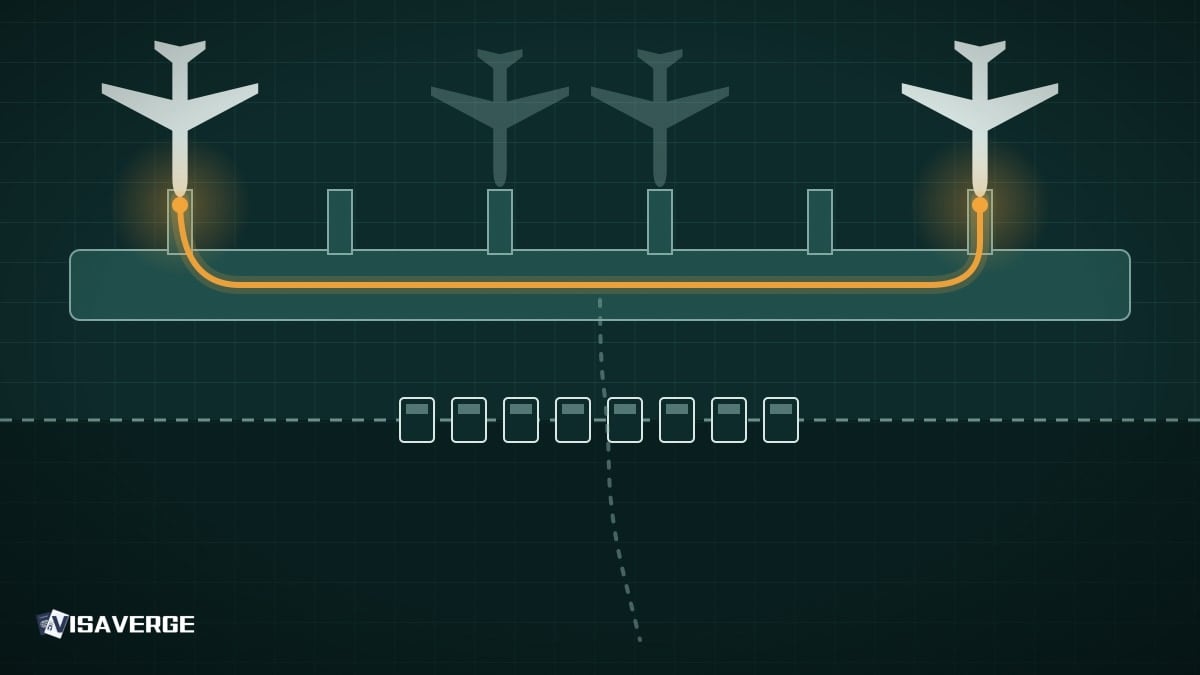
Even on a single ticket, some connections force you through immigration because the airside link does not exist. At Paris Charles de Gaulle, the CDGVAL shuttle between Terminal 1, Terminal 2 and Terminal 3 runs through the public part of the airport. Our Paris CDG transit visa guide explains why that ride means clearing French border control and entering Schengen.
Changing airports in the same city is always an entry. Landing at Tokyo Narita and leaving from Haneda, or arriving at London Gatwick and departing from Heathrow, means passing immigration, getting on ground transport and checking in again. Plan for the visa you would need to visit that country.
Munich is the opposite case. Its Terminal 1 and Terminal 2 are linked by a shuttle bus for connecting passengers, which our Munich airport transit visa guide covers in detail. Ask your airline or the airport how your specific terminals connect before you book a tight layover.
Match the Country’s Entry Rule to Your Passport
If Steps 1 to 3 show you will cross the border, stop asking about transit visas. Ask what a visitor with your passport needs to enter that country for a few hours. That might be nothing, an electronic authorisation, or a full visa that takes weeks to issue.
If Steps 1 to 3 show you stay airside, you still have one check left: whether your nationality needs an airport transit visa at that hub. Germany requires one from 20 nationalities and France from 36, while many other countries require none. The table below summarises both cases for the hubs self-transfer travelers use most.
If you cannot get entry permission in time, change the plan rather than the paperwork. Rebook both flights on one ticket, choose a hub where your passport is visa-free, or route through a country that offers a visa-free transit scheme you qualify for.
Self-Transfer Rules by Region
The table compares what you need if you stay airside with what you need if a self-transfer pushes you through immigration. It covers the general rule only; nationality lists and exemptions sit in the sections that follow and on the official pages.
| Region | Stay airside | Self-transfer with bag recheck |
|---|---|---|
| United States | Not possible; all international arrivals clear CBP | C-1 transit visa, B visa or ESTA |
| Canada | Transit visa or eTA for most; visa-free only under TWOV or the China Transit Program | Transit visa (48 hours or less) or visitor visa, or eTA |
| Schengen hubs | Airport transit visa only for listed nationalities | Schengen Type C visa (EUR 90) unless visa-free |
| United Kingdom | DATV (GBP 41.50) for listed nationalities | Visitor in Transit visa (GBP 74.50) or ETA (GBP 20) |
| Dubai (UAE) | Nothing for airside connections | Visa-free entry, or a 48-hour or 96-hour transit visa via a UAE airline |
| Doha (Qatar) | Nothing for most airside connections | Visa-free entry or a Hayya e-visa |
| Singapore | Nothing for most airside connections | Visa-free entry, a visa, or the 96-hour VFTF if eligible |
| Japan | Nothing for most airside connections | Visa-free entry or a short-term stay visa; transit visas ended July 1, 2026 |
United States: No Airside Transit at All
The US has no sterile international transit area. Every passenger who arrives on an international flight goes through CBP inspection at the first US airport, collects checked bags for customs, and rechecks them before boarding the next flight. A self-transfer therefore changes nothing about the paperwork. It only adds time, because you also have to check in with the second airline.
The State Department issues the C-1 transit visa to travelers in “immediate and continuous transit” through the US. A valid B-1/B-2 visitor visa also covers transit. Citizens of Visa Waiver Program countries need either an approved ESTA or a visa, and CBP tells ESTA applicants who are only passing through to write “In Transit” and their final destination in the address fields. A stopover to sightsee or visit friends requires a B visa, not a C-1.
Our guide on whether you need a visa to transit through the USA walks through the C-1 application and the ESTA option in more detail.
Canada: Transit Visa or eTA, With Two Narrow Exceptions
Canada’s rule depends on your passport. Visa-required nationals connecting between two international flights need a transit visa if the stop lasts 48 hours or less, or a visitor visa for a longer stop. Travelers from eTA countries need an eTA to transit by air. US citizens and US lawful permanent residents can transit without a visa.
The exceptions are the Transit Without Visa program and the China Transit Program. TWOV covers passport holders from Indonesia, the Philippines, Thailand and Taiwan (passports without a personal identification number) who hold a valid US visa and are flying to or from the US. They must leave Canada within 24 hours and stay in the international transit area at Toronto Pearson Terminal 1, Vancouver, Calgary or Winnipeg. IRCC says travelers who need to change terminals are not eligible, and the airline must confirm eligibility before boarding, so a self-transfer that sends you to baggage claim falls outside the program.
Canada’s newer Free Flow process lets some international-to-international passengers at Vancouver, Montreal and Toronto Pearson Terminal 1 skip the border officer, as we reported in our story on Canada’s Free Flow international transit change. It requires automatic baggage transfer, so a self-transfer does not qualify, and it never waives the visa or eTA.
Schengen Hubs: The Airport Transit Visa Stops at the Carousel
The 29 countries of the Schengen Area share one border. An airport transit visa lets listed nationals wait in the international transit area for a flight leaving Schengen. It does not let them reach baggage claim. A self-transfer at Frankfurt, Munich, Paris, Amsterdam or Madrid that requires a bag recheck means entering Schengen, and you need a Schengen short-stay (Type C) visa, which costs EUR 90 for adults, unless your passport is visa-free.
Two big hubs dropped their transit requirement for Indian nationals in 2026. France removed India from its national list from April 10, 2026, and Germany followed on June 3, 2026, as we covered in Indians get visa-free airport transit in Germany. Neither change helps on a self-transfer. An Indian traveler who must collect bags in Frankfurt still needs a Type C visa.
Entering Schengen also means registering in the EU’s Entry/Exit System. EES began on October 12, 2025 and has been fully operational at all border crossings since April 10, 2026, so first-time visitors give fingerprints and a facial image at passport control. Budget extra time for it on any self-transfer.
A connection from one Schengen country to another is not transit. If you fly Lagos to Munich to Paris, you enter Schengen at Munich and need a Type C visa or visa-free status, even on a single ticket.
United Kingdom: DATV Airside, Visitor in Transit Landside
The UK splits transit by whether you go through UK border control. If you change flights without passing border control, nationals on the UK’s list need a Direct Airside Transit visa, which costs GBP 41.50. If you go through border control and leave within 48 hours, a visa national needs a Visitor in Transit visa at GBP 74.50. A stay longer than 48 hours needs a Standard Visitor visa.
Non-visa nationals such as Americans and most Europeans need an ETA, which costs GBP 20, when they transit landside. GOV.UK says you need an ETA “if you’re passing through border control at a UK airport before continuing your onward journey.” Holders of a valid ETA, Standard Visitor visa or Marriage Visitor visa do not need a separate transit visa.
Self-connecting through Heathrow or Gatwick on separate tickets almost always means landside transit. Our London Heathrow transit visa guide lists the DATV nationalities and exemptions. If you buy duty-free on the first leg, read our report on duty-free rules for UK travelers on self-connecting flights: sealed bags and receipts matter when you go back through security.
| Direct Airside Transit visa (no border control) | GBP 41.50 |
| Visitor in Transit visa (border control, leave within 48 hours) | GBP 74.50 |
| Electronic Travel Authorisation (non-visa nationals, landside) | GBP 20 |
Dubai and Doha: Easy Airside, Entry Rules on a Recheck
At Dubai International, passengers who stay in the transfer area need no UAE visa. A self-transfer with checked bags is different, because you have to pass UAE immigration to reach the carousels. Nationalities eligible for visa-free entry or a visa on arrival can do that at the border. Everyone else needs a visa arranged in advance.
The UAE offers 48-hour and 96-hour transit visas, sponsored only by UAE-based airlines and approved before arrival. The government portal requires an onward ticket to a third destination and a passport valid for at least three months. Fees differ between the government rate and what airlines charge, so check the price with your airline when you apply. Our report on Emirates’ 96-hour Dubai transit visa for Bangladeshi travellers shows how the airline route works in practice.
Hamad International in Doha works the same way airside. To enter Qatar on a self-transfer, you need visa-free status for your nationality or an e-visa through Qatar’s Hayya platform, which handles tourist visas, including for holders of a US, UK, Canadian, Australian, New Zealand or Schengen visa or residence permit. Qatar Airways’ free transit visa has not always been available, so confirm its status on the airline’s site before relying on it. Australia’s Smartraveller has also issued updated guidance on transit through UAE and Qatar airports.
Singapore: The 96-Hour Visa-Free Transit Facility
Most travelers connecting airside at Changi need nothing. If you are on separate tickets and your airlines cannot through-check your bags, plan on clearing Singapore immigration. Passengers from visa-free countries can do that at the border. Visa-required nationals need a Singapore visa unless they qualify for the Visa Free Transit Facility.
Under the VFTF, Indian nationals and holders of certain PRC travel documents can enter for up to 96 hours if they hold an onward ticket out of Singapore within 96 hours and a valid visa or long-term pass for Australia, Canada, Germany, Japan, New Zealand, Switzerland, the United Kingdom or the United States. That visa must be valid for at least one month from the date of entry. Nationals of CIS countries, Georgia, Turkmenistan and Ukraine can use the facility with an onward air ticket and no third-country visa. ICA does not allow extensions, and its officers make the final decision at the border.
Japan: Transit Visas Ended on July 1, 2026
Japan no longer issues transit visas. The Consulate-General of Japan in San Francisco announced that it would stop issuing them from July 1, 2026, and that transiting travelers must instead apply for a short-term stay visa. Other Japanese missions published the same change alongside the new visa fees, as we explained in our report on the Japan visa fee change and the end of the transit visa.
The change matters most for self-transfer travelers and anyone switching between Narita and Haneda. If your passport is visa-free for Japan, nothing changes. If it is not, a connection that leaves the transit area now requires a short-term stay visa, so apply well before you book, or choose a single-ticket routing that keeps you airside.
Common Self-Transfer Mistakes
A Schengen airport transit visa or a UK DATV covers only the international transit area. If you have to collect bags, you need entry permission instead: a Type C visa in Schengen, or a Visitor in Transit visa or ETA in the UK.
If a delay makes you miss a separately ticketed flight, you often have to go landside to a ticket desk or a hotel. Without entry permission, you can be stuck in the transit area or sent back.
The US has no airside transit and Canada requires a transit visa or eTA from most travelers. Book these connections only after you hold an ESTA, eTA or visa.
A self-transfer adds passport control, baggage claim, check-in and a security check. At Schengen airports, EES registration also adds time for first-time visitors.
A self-transfer guarantee may pay for a new flight. It does not cover visa refusals, and the first airline can deny boarding at your origin if your documents do not cover the connection.
Before You Book a Self-Transfer
Work through the four steps for every connection on the trip, not only the long one. Then check the official page for your nationality: GOV.UK for the UK, IRCC for Canada, the State Department and CBP for the US, the relevant Schengen embassy for Europe, ICA for Singapore, and your nearest Japanese mission for Japan.
If the answer at any hub is that you need a visa you do not have, price the same trip on a single ticket. Paying slightly more to stay airside is often cheaper than a visa application, and far cheaper than a missed flight. For airport-specific rules, start with our Munich, Frankfurt, Paris CDG and London Heathrow transit guides.
Frequently Asked Questions
Do I need a visa for a self-transfer layover?
Usually yes. If you must collect checked bags and check in again, you pass passport control at most airports, so you need whatever a visitor with your passport needs to enter that country: a visa, an electronic authorisation such as an ETA or eTA, or visa-free status.
Does an airport transit visa cover a self-transfer?
No. A Schengen airport transit visa or a UK Direct Airside Transit visa only covers time in the international transit area. Reaching baggage claim means entering the country, which needs a Schengen Type C visa (EUR 90) or a UK Visitor in Transit visa or ETA.
Can I stay airside when connecting in the United States?
No. The US has no international transit area. Every international arrival clears CBP at the first US airport, so you need a C-1 transit visa, a B visa, or an approved ESTA if you are a Visa Waiver Program national.
How much is a UK Visitor in Transit visa?
GOV.UK lists the Visitor in Transit visa at GBP 74.50 for visa nationals who go through border control and leave within 48 hours. The Direct Airside Transit visa costs GBP 41.50, and non-visa nationals transiting landside need a GBP 20 ETA.
Do I need a visa to transit Canada on separate tickets?
Most travelers need a transit visa (for stops of 48 hours or less) or an eTA to transit Canada by air. The Transit Without Visa program requires staying in the international transit area for under 24 hours, so a self-transfer that sends you to baggage claim does not qualify.
Can Indians transit Singapore without a visa on separate tickets?
Possibly, under the 96-hour Visa Free Transit Facility. Indian nationals need an onward ticket within 96 hours and a visa or long-term pass for Australia, Canada, Germany, Japan, New Zealand, Switzerland, the UK or the US, valid for at least one month.
Can I still get a transit visa for Japan?
No. Japanese missions stopped issuing transit visas from July 1, 2026. Travelers who must enter Japan during a connection, including a Narita to Haneda transfer, now need a short-term stay visa unless their passport is visa-free for Japan.
Does changing terminals mean going through immigration?
Sometimes. At Paris CDG, the CDGVAL shuttle between terminals runs through the public area, so riding it means clearing French border control. Changing airports, such as Narita to Haneda or Gatwick to Heathrow, always means entering the country.