What’s Happening with TikTok Employees at U.S. Airports?
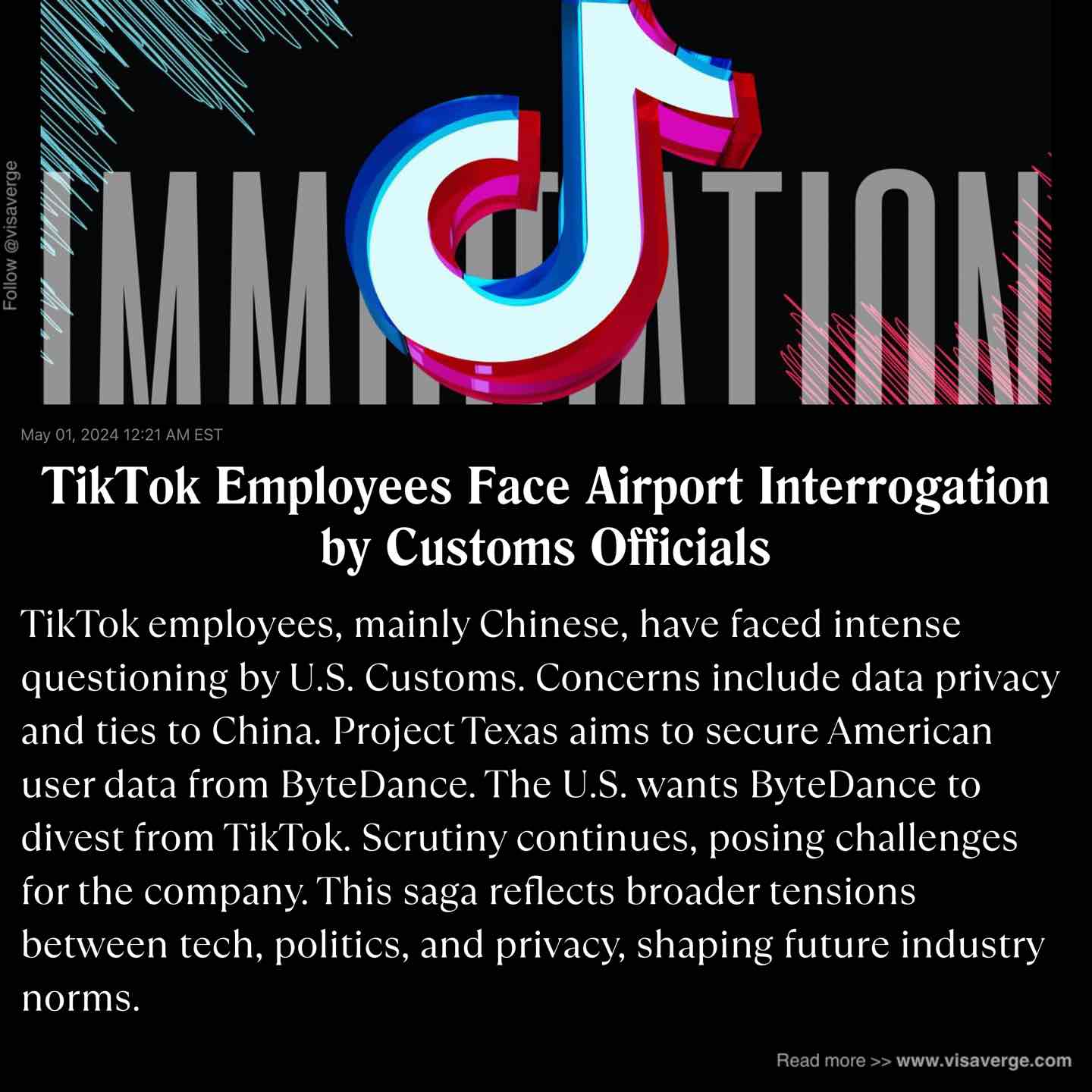
Recent reports suggest a striking trend: more than thirty TikTok employees, predominantly Chinese nationals, have faced interrogations by the Customs and Border Protection (CBP) upon traveling to the United States. These unsettling encounters have raised significant questions about data privacy, international relations, and the scrutiny of foreign nationals working for tech companies with roots in China.

Why are TikTok and ByteDance Employees Being Questioned?
The employees, coming from both TikTok and its China-based parent company ByteDance, were reportedly pulled aside for in-depth questioning. A key concern for CBP agents has been the access these individuals might have to U.S. users’ private data via TikTok. The interrogation topics ranged widely from the operational specifics like the locations of TikTok’s U.S.-based data centers to their involvement with Project Texas, a significant restructuring initiative aimed to safeguard U.S. users’ data from access by ByteDance’s workforce in China.
In addition, informal inquiries have extended into personal realms, with questions about possible affiliations with the Chinese Communist Party and the employees’ educational and political backgrounds in China. For instance, TikTok CEO Shou Chew was repeatedly asked during a congressional hearing if he was a member of the Chinese Communist Party. Moreover, a CBP spokesperson, Erin Waters, stated, “All international travelers attempting to enter the United States, including all U.S. citizens, are subject to examination.”
What is Project Texas?
Launched in 2022, Project Texas represents TikTok’s commitment to severing the potential for ByteDance’s access to American users’ data. This project has been highlighted as an “unprecedented initiative” to ensure that the platform remains insulated from outside influences and that user data stored within the U.S. remains secure. Despite this, scrutiny continues as reports suggest that the project has not fully curtailed ByteDance’s operational reach into TikTok’s data management.
What Does the U.S. Government Think of TikTok’s Data Practices?
The increased scrutiny by U.S. authorities, including the CBP, aligns with broader concerns regarding ByteDance’s influence and control over TikTok data management. The Committee on Foreign Investment in the United States, under the Department of Homeland Security, has been investigating ByteDance since 2019. Reflective of these escalating concerns, in 2023, this committee recommended banning TikTok in the U.S. unless ByteDance divests from it. Following up on these concerns, President Joe Biden signed a foreign aid package which includes legislation that could ban TikTok if not divested within a year.
Key Challenges and What’s Next for TikTok?
As tensions rise around these interrogations and the broader implications for international tech companies operating in the U.S., TikTok and ByteDance face ongoing challenges. The company’s efforts to reassure both the public and the U.S. government about its data handling practices, particularly through initiatives like Project Texas, continue to be met with skepticism and rigorous scrutiny.
Given these multifaceted security and privacy concerns, TikTok must navigate an increasingly complex regulatory environment while sustaining its immense popularity among U.S. users. For anyone interested in the broader implications of these enforcement actions, the detailed examination policies and procedures by CBP can be explored on the official U.S. Customs and Border Protection website, providing critical context about what international travelers, including corporate employees, can anticipate upon entering the U.S.
Final Thoughts
The intersection of technology, international politics, and personal privacy remains a hotly debated arena. As global tech giants like TikTok maneuver through these turbulent waters, the outcomes of such debates will likely set precedents influencing the global tech industry’s future operational and strategic frameworks. Meanwhile, the TikTok employee interrogation saga continues to highlight the fragile balance between national security and the global movement of tech industry talent.
Learn Today:
- Customs and Border Protection (CBP):
- Definition: The Customs and Border Protection (CBP) is a federal law enforcement agency within the Department of Homeland Security responsible for facilitating lawful international trade and travel while enforcing U.S. regulations, including immigration and customs laws. CBP officers are stationed at ports of entry like airports to inspect and approve individuals entering the United States.
- Foreign National:
- Definition: A foreign national refers to a person who is not a citizen or legal resident of the country they are visiting or residing in. In the context of the provided content, Chinese nationals employed by TikTok and ByteDance are examples of foreign nationals who faced CBP scrutiny upon traveling to the United States.
- Committee on Foreign Investment in the United States (CFIUS):
- Definition: CFIUS is an interagency committee under the Department of the Treasury that reviews the national security implications of foreign investments in U.S. companies or assets. It assesses transactions like mergers and acquisitions to ensure they do not pose a threat to the country’s security interests.
- Data Privacy:
- Definition: Data privacy refers to the protection of personal information and data from unauthorized access, use, or disclosure. In the case of TikTok employees, data privacy concerns relate to the access Chinese employees might have to sensitive user data and the efforts by companies like TikTok through initiatives like Project Texas to safeguard this data.
- Divestment:
- Definition: Divestment is the process of selling off assets, subsidiaries, or business units to reduce or completely end ties with a particular entity or business. In the context of the U.S. government’s concerns over ByteDance’s control of TikTok, divestment refers to the potential requirement for ByteDance to fully separate itself from TikTok to address national security concerns.
This Article In A Nutshell:
TikTok employees, mainly Chinese, facing interrogations by U.S. authorities reveal concerns on data privacy and national security. Project Texas aims to secure American user data. U.S. authorities scrutinize ByteDance’s control over TikTok. Tensions persist as the company navigates stricter regulations while striving to maintain user trust.
— By VisaVerge.com
Read More:
- Enhancements in U.S. Customs Technology for Passenger Screening Post-Pandemic
Explore how U.S. Customs is utilizing advanced technology to streamline and secure passenger screening in the post-pandemic era. -
Ultimate Guide to U.S. Customs Jewelry Declaration: Limits and Required Documents
Learn about the specific limits and necessary documents for declaring jewelry at U.S. Customs. -
Duty-Free Import: Carrying Gold to the USA or India – Customs Regulations and Rules
Understand the ins and outs of carrying gold into the USA or India, including duty-free allowances and important customs regulations.