- Visa Waiver travelers blocked by an emergency can ask for satisfactory departure of up to 30 days, at the officer’s discretion.
- B-1/B-2 visitors must file Form I-539 before the I-94 date; the fee is $420 online or $470 on paper.
- The 3-year and 10-year bars start at more than 180 days of unlawful presence, but even a 1-2 day overstay can end ESTA eligibility.
If your authorized stay ends this weekend and flights are stopped, a delay caused by an emergency is not an automatic extension, and a one- or two-day overstay still counts as an overstay. What protects you is acting before your I-94 date passes: check the date, ask for the right relief, and keep proof of every attempt to leave.
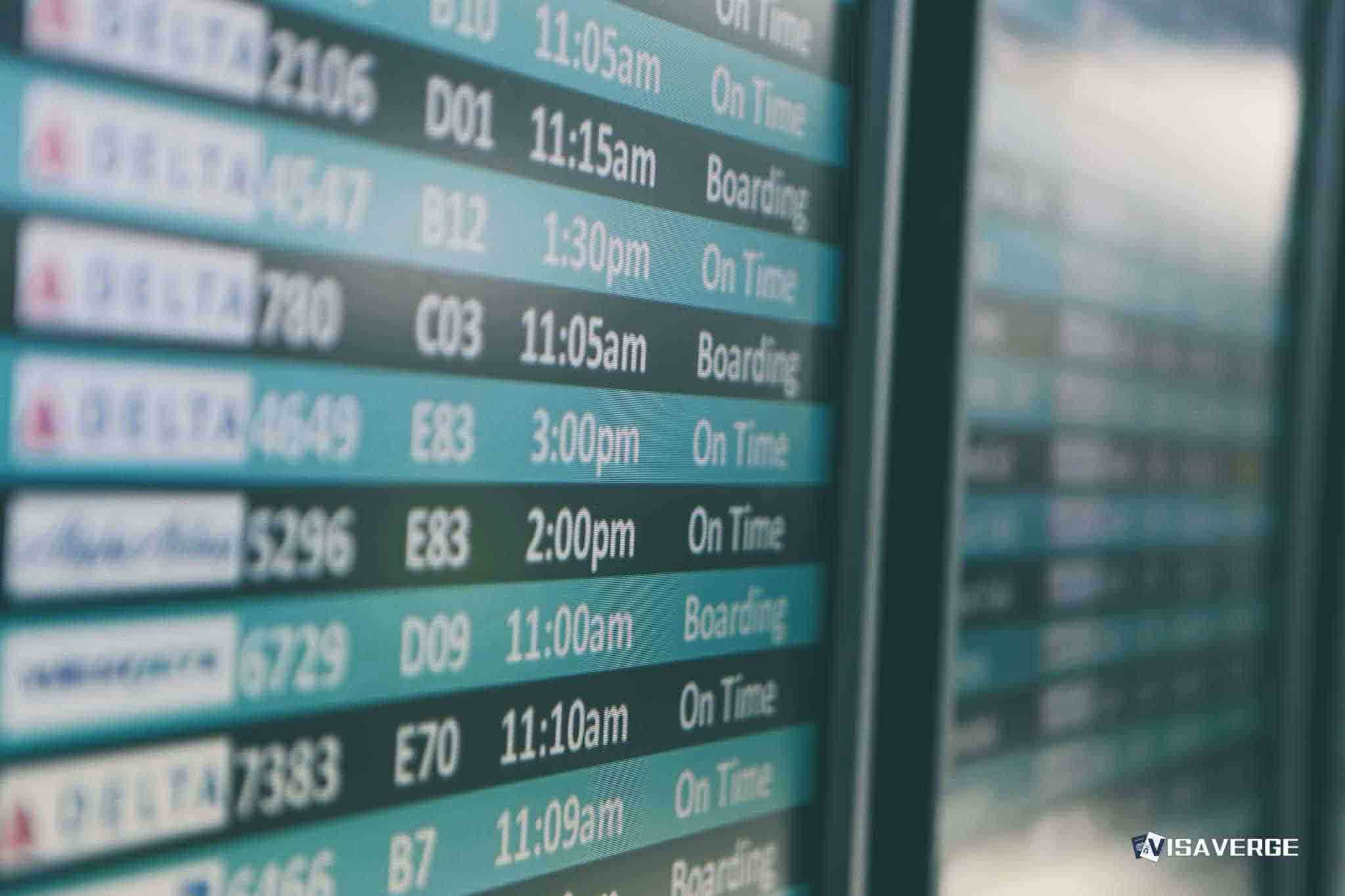
The FAA ordered a nationwide ground stop for all U.S. airports at 3:53 p.m. ET on Friday, Nov. 13, 2026. As we reported in our main story on the nationwide ground stop, departures were halted “until further notice,” and after 6 p.m. ET the FAA said flights could depart through coordination with its command center. The FAA lifted the stop at 8:15 p.m. ET, but cancellations are continuing into Saturday, and JetBlue told staff it would cancel all of its Saturday flights. For most travelers that means a rebooked flight. For a visitor whose admission runs out in the next day or two, it can mean a legal problem.
This guide covers visitors on the Visa Waiver Program (ESTA), visitors with B-1/B-2 visas, and people in other nonimmigrant statuses such as F-1, J-1 and H-1B. It sticks to what the regulations and agency pages say, and it flags where the answer depends on your facts and a lawyer should look.

One point on facts: at the time of writing, we had not found a DHS, CBP or USCIS notice granting blanket relief to travelers affected by the ground stop. Do not assume one exists. If DHS issues one, it will appear on the agencies’ own sites.
Step one: find the date that actually controls your stay
Your authorized stay is the “Admit Until Date” on your Form I-94, not the date on your visa and not the date your ESTA expires. CBP now records most arrivals electronically and has moved away from stamping passports, which is why the online record matters (see our report on CBP ending routine passport stamps).
CBP says travelers can retrieve their record on its I-94 website using “Get Most Recent I-94,” at i94.cbp.dhs.gov. Print it or save a PDF today. Visa Waiver travelers are normally admitted for up to 90 days, so the date may be earlier than you remember.
If you are in the Visa Waiver Program (ESTA)
Visa Waiver travelers have the least room. Under 8 CFR 217.3(a), if an emergency prevents a person admitted under the program from leaving within the authorized stay, the district director where the person is staying “may, in his or her discretion, grant a period of satisfactory departure not to exceed 30 days.” If you leave within that period, you are treated as having completed the visit without overstaying.
Three limits matter. The relief is discretionary, so a request is not a guarantee. It is capped at 30 days. And it is meant for an emergency that actually prevents departure, so you should be able to show that you tried to leave. USCIS lists Visa Waiver admissions (WT and WB) among the categories that cannot extend or change status with Form I-539, so an I-539 is not the tool here.
The regulation does not spell out a filing procedure, and agency practice has varied. Our reading of law-firm reports is that requests have gone to USCIS (through its Contact Center) or to a CBP port of entry or deferred inspection office, with some sites asking for requests only when expiry is days away. We could not confirm the current intake method on a primary source, so confirm with USCIS or CBP, or a lawyer, before you rely on a particular office. Ask early, and write down who you spoke to.
If you overstay the program anyway, the consequences are legal, not just practical. Section 217(a)(7) of the Immigration and Nationality Act requires that a person who was previously admitted under the program “must not have failed to comply with the conditions of any previous admission.” In practice, an overstay can cost you future ESTA eligibility, and you would then need a visa to come back. Section 217(b) also requires Visa Waiver entrants to waive rights to contest removal, other than by applying for asylum, and 8 CFR 217.4(b) provides for removal by the district director without referral to an immigration judge.
If you hold a B-1/B-2 visitor visa
Visitors admitted on a B visa can apply to extend their stay with Form I-539, but timing is the whole game. USCIS says you must file before your authorized stay expires and suggests filing at least 45 days ahead, “or as soon as you determine your need.” If your I-94 date is days away, file now and do not wait for the airline picture to clear. Our Form I-539 documents checklist lists what to attach.
The current USCIS fee schedule (Form G-1055, edition 10/26/26) lists the Form I-539 fee at $470 for a paper filing and $420 filed online. Your passport must be valid for the whole period you request. File on the wrong form and USCIS can reject the case without refunding the fee.
A visitor who misses the date is not automatically out of options. Under 8 CFR 214.1(c)(4), USCIS “may excuse the late filing in its discretion” if the delay was due to extraordinary circumstances beyond your control, the delay was reasonable, you did not otherwise violate status, you remain a bona fide nonimmigrant, and you are not in removal proceedings. That is a discretionary standard, and it is a weaker position than filing on time. Whether a flight shutdown counts depends on the length of the delay and what you did about it, which is a question for a lawyer.
If you hold another status: F-1, J-1, H-1B and others
The correct filing depends on the category. USCIS says Form I-539 cannot be used for E-1, E-2, E-3, H-1B, H-1B1, H-2A, H-2B, H-3, L-1, O-1, O-2, P, Q-1, R-1 and TN nonimmigrants. For those workers, the employer files Form I-129 before the stay expires (8 CFR 214.1(c)(1)). Dependents of E principals generally file I-539.
Students and exchange visitors should speak to their school’s designated school official or program responsible officer today. USCIS notes that F and M students use Form I-539 for reinstatement, and that J-1 and M-1 status can extend only under restrictions. A 2026 rule that would have set fixed admission periods for F, J and media visitors was postponed by a federal court on Sept. 14, 2026, and USCIS says it is proceeding under the previous provisions until further order, so check your own I-20 or DS-2019 and I-94 instead of assuming new rules apply.
Some categories cannot extend or change status at all: USCIS lists C, D, K-1, K-2, S, TWOV, WT and WB. If you are in one of them, leaving, or asking for an emergency departure period, is the realistic path.
Your situation, and what to do
What an overstay costs: the 3-year and 10-year bars, at a high level
The harsh statutory bars come from time, not from the day you pass your I-94 date. Under INA 212(a)(9)(B), a person who accrues more than 180 days but less than a year of unlawful presence, leaves voluntarily, and seeks admission again within 3 years is inadmissible; one year or more of unlawful presence triggers a 10-year bar. Unlawful presence generally starts when the authorized stay ends. The statute also tolls the 180-day clock, up to 120 days, for someone who filed a nonfrivolous change or extension application before the stay expired and did not work without authorization.
So a two-day overstay does not trigger the 3-year or 10-year bar. That is where the good news stops. A short overstay still counts as an overstay: it can end Visa Waiver eligibility under INA 217(a)(7), and it can be raised when you later apply for a visa. One of our reports, on an 82-year-old traveler whose visa was revoked after a two-day overstay, shows how a small gap can follow a traveler. Whether any particular overstay carries more weight, for example for someone with a pending green card case, is something to ask a lawyer.
Documents to keep, and a few mistakes to avoid
- Your passport photo page and your current I-94 (PDF from the I-94 website)
- Original and rebooked itineraries, airline cancellation or delay notices, and screenshots of the ground-stop coverage and your flight status
- Receipts for any I-539 or I-129 filing, and the name, office and time of every USCIS or CBP contact
- If you leave by land to Canada or Mexico, evidence of departure such as entry stamps, tickets or receipts, because CBP says a land departure may not be recorded accurately for an electronic I-94
The common mistakes are waiting for the airline to solve the problem, assuming the ground stop pauses your I-94 clock, and paying a third-party site for an “extension.” For ESTA travelers, an I-539 is not available. For others, only file after you confirm the form for your status. For the broader airline side, including DOT refund rules, see our coverage of the ground stop.
Bottom line: the ground stop is a reason you cannot leave, not a legal extension. If your date is within days, check your I-94 tonight, document your efforts to depart, and file or ask for the correct relief before the date, not after.
Frequently Asked Questions
What happens if my ESTA stay ends while flights are grounded?
An emergency does not extend your stay automatically. Under 8 CFR 217.3(a), an officer may grant satisfactory departure of up to 30 days at their discretion. Ask before your I-94 date passes and keep proof you tried to leave.
How do I check my I-94 expiration date?
Use CBP’s I-94 website at i94.cbp.dhs.gov and choose Get Most Recent I-94. The Admit Until Date is the date that controls your authorized stay, not your visa or ESTA expiry. Save a PDF copy.
Can I extend an ESTA stay with Form I-539?
No. USCIS lists Visa Waiver admissions (WT and WB) among the categories that cannot extend or change status with Form I-539. The available relief is a discretionary period of satisfactory departure of up to 30 days under 8 CFR 217.3.
How much does Form I-539 cost in 2026?
The USCIS fee schedule (Form G-1055, edition 10/26/26) lists $470 for a paper filing and $420 for an online filing. Fee waivers and some categories carry a $0 fee. Check the current schedule before you pay.
Is a one-day overstay a problem?
Yes, it still counts as an overstay. It does not trigger the 3-year or 10-year bar, which require more than 180 days of unlawful presence. It can end Visa Waiver eligibility under INA 217(a)(7), so ask a lawyer how it affects you.
What are the 3-year and 10-year bars?
Under INA 212(a)(9)(B), more than 180 days but under one year of unlawful presence followed by departure triggers a 3-year bar. One year or more triggers a 10-year bar. A timely-filed extension can toll the 180-day count for up to 120 days.
What if my H-1B or L-1 I-94 runs out soon?
Tell your employer immediately. USCIS says Form I-539 cannot be used for H-1B, L-1, O-1, TN and similar categories. Under 8 CFR 214.1(c)(1), the employer files Form I-129 before your authorized stay expires.
What documents should I keep if I cannot leave?
Keep your passport, current I-94 PDF, original and rebooked itineraries, airline cancellation notices, and a log of each call or visit to USCIS or CBP, plus any receipt number. These show you tried to depart on time.