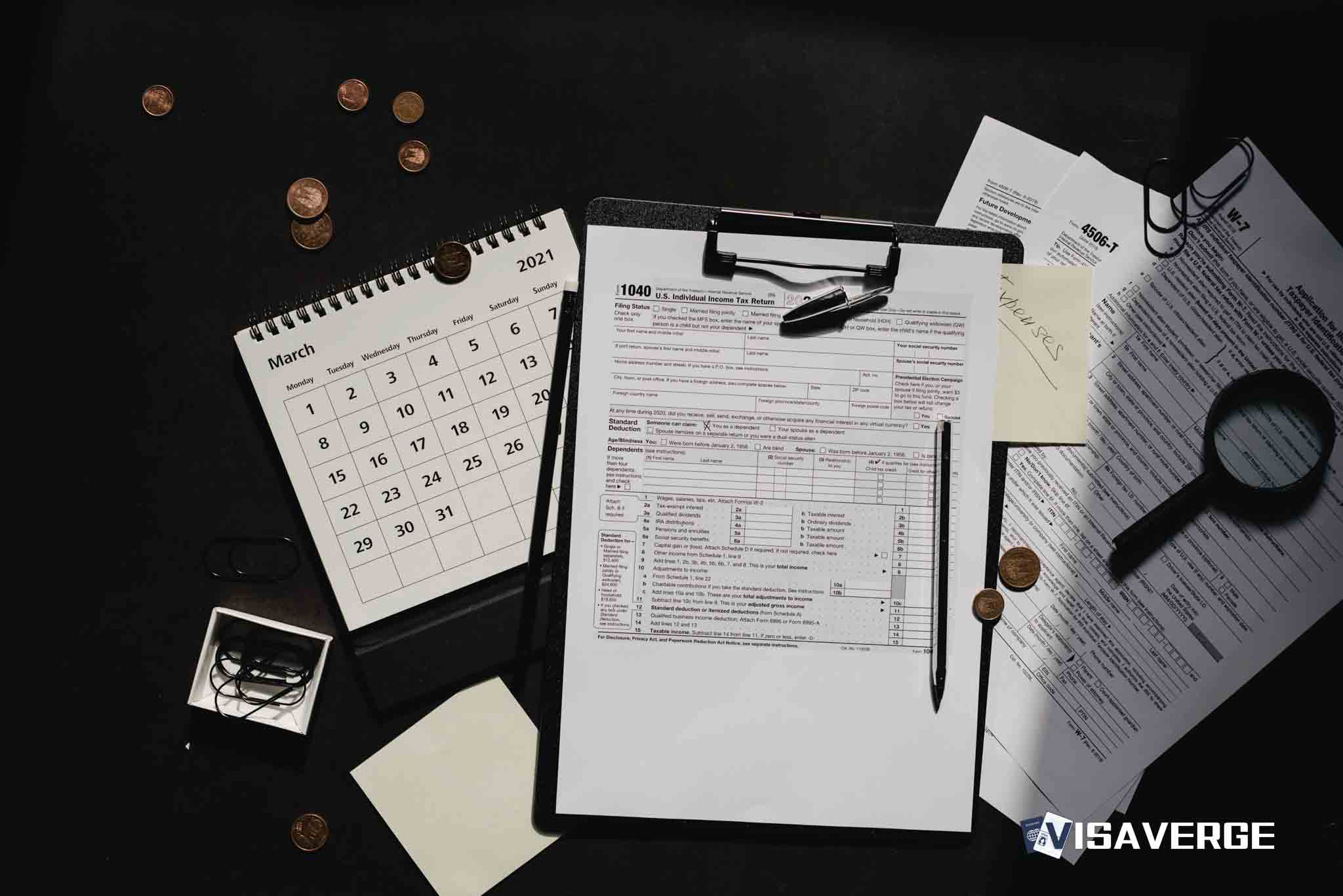
- Taxpayers who missed April 15, 2026 should file now, because waiting increases penalties and interest.
- A proper extension gives time to file until October 15, 2026, but it does not extend the payment deadline.
- The failure-to-file penalty can reach 25% of tax due, while IRS payment options can help reduce damage.
(UNITED STATES) — Taxpayers who missed the April 15, 2026 federal filing deadline should file as soon as possible, pay what they can, and check whether they already secured an extension, because delay increases penalties and interest.
The missed deadline does not end the filing obligation. It changes the cost of waiting. Tax owed for 2025 returns was generally due by April 15, 2026, and the IRS has advised late filers not to wait for a notice before acting.
Free toolSubstantial Presence Test Calculator
Filing late is usually better than not filing at all. That point carries extra weight for immigrants, NRIs, visa holders, green card holders and U.S. citizens abroad, whose tax records can overlap with payroll history, immigration filings, loan applications, student aid and foreign account reporting.
Late filers first need to sort out one basic question: whether an extension was filed by April 15, 2026. An extension gives more time to file, not more time to pay, and taxpayers who properly requested one generally have until October 15, 2026 to submit the federal return.
Payment still mattered in April. A taxpayer who filed an extension but did not pay enough by the April deadline can still face late-payment penalties and interest, even with extra time to file the paperwork.
Anyone who did not file an extension and still owes tax faces the sharper risk. The failure-to-file penalty and the failure-to-pay penalty can both apply, and the IRS can later send notices about a balance due, a missing return, penalty assessments, interest, income mismatches, refund adjustments, identity verification, missing forms or unpaid estimated tax.
The immediate step is simple: prepare and file the return now. That applies across a wide range of taxpayers, including workers with W-2 income, freelancers and contractors with 1099 income, H-1B and L-1 employees, F-1 students with taxable income, green card holders, U.S. citizens and residents abroad, NRIs with U.S. income, and people with investment, rental or side income.
Waiting for an IRS letter usually makes the position worse. Filing quickly can reduce the period during which the failure-to-file penalty applies, even if the taxpayer still cannot pay the full amount due.
The IRS treats the filing penalty more harshly than the payment penalty. The failure-to-file penalty is generally 5% of the tax due for each month or part of a month that the return is late, up to a maximum of 25%.
That amount is calculated on the tax required to be shown on the return, reduced by tax paid on time and available refundable credits. Filing the return quickly can stop or reduce that exposure, while leaving the return unfiled allows the charge to keep building until it reaches the cap.
A separate failure-to-pay penalty applies when tax is not paid by the due date. Interest also continues to accrue on unpaid taxes until the balance is paid in full, which is why tax professionals often urge late filers to send as much money as they can with the return instead of holding everything back.
That is where IRS payment options come in. Taxpayers who cannot pay in full can still file the return, make a partial payment and arrange payment for the rest through short-term or long-term plans, online account tools, card payments, or other collection alternatives.
Individual taxpayers who owe $50,000 or less in combined tax, penalties and interest may qualify for a long-term online payment plan. The trade-off is straightforward: the longer the payment period, the more interest, penalties and fees can add up.
The agency’s menu of IRS payment options also includes Direct Pay, debit or credit card payments, short-term payment plans, long-term installment agreements, payment through an IRS Online Account, Offer in Compromise in serious hardship cases, and temporary delay of collection where applicable. None of those options erase the value of filing quickly; they matter after the return is in.
Some late filers have a different issue. They are due a refund. In those cases, there may be no failure-to-file or failure-to-pay penalty because no unpaid tax is due, but the return still must be filed to claim the money.
That point matters for students who had tax withheld, part-year workers, low-income workers, taxpayers eligible for credits, new immigrants whose payroll withholding was too high, and nonresident aliens with over-withheld tax. Refund claims do not stay open indefinitely.
Visa holders and immigrants also need to make sure they use the correct return. Some taxpayers should file `Form 1040` as U.S. tax residents, while others should file `Form 1040-NR` as nonresident aliens, and the answer can turn on green card status, visa category, days of physical presence, treaty rules and specific exemptions.
F-1 and J-1 students often sit in the most confusing category. Many are treated as nonresident aliens for a certain period and may need to file `Form 1040-NR` if they have taxable income, and some may also need `Form 8843`.
H-1B and L-1 workers can move into resident tax status under the substantial presence test, depending on how many days they spent in the United States. Green card holders are generally treated as U.S. tax residents unless treaty or status issues apply, while Indian NRIs with U.S.-source income can still have filing obligations even if they do not live full-time in the country.
Filing the wrong form can create a second problem after the missed deadline. A taxpayer who submitted the wrong return, or skipped required international filings, may need to correct the record before amending the filing history grows more complicated.
Foreign asset reporting adds another layer for many Indian-origin taxpayers and other residents with overseas accounts. U.S. tax residents, including many green card holders and resident aliens, may need to report Indian bank accounts, NRE, NRO and FCNR accounts, Indian fixed deposits, Indian mutual funds, foreign brokerage accounts, foreign rental income, and interests in foreign companies, trusts, partnerships, pensions or retirement accounts.
Two reporting regimes appear most often: FBAR, filed with FinCEN for foreign financial accounts that cross the reporting threshold, and `Form 8938`, attached to the federal return for specified foreign financial assets when applicable. The FBAR deadline usually aligns with the April tax deadline and carries an automatic extension to October.
State taxes can complicate matters further. Filing a federal return does not automatically satisfy state obligations, and rules can vary on deadlines, extensions, payment dates, penalties, interest, residency, remote work income and part-year resident filings.
A taxpayer who moved between states during 2025 may need to file in more than one state. That can affect immigrants, NRIs and remote workers whose income ties span multiple jurisdictions even if their federal filing looks straightforward.
Taxpayers who missed the deadline still may have a path to penalty relief. The IRS says reasonable cause relief may be available when a taxpayer exercised ordinary care and prudence but was still unable to file or pay on time, including cases involving serious illness, a death in the family, natural disaster, inability to obtain records or other documented hardship.
The agency also offers administrative relief, including First Time Abate in eligible cases. A taxpayer may request First Time Abate even without fully paying the tax, though the failure-to-pay penalty may continue until the full balance is paid.
U.S. citizens and residents abroad should review whether special filing rules apply to them. The instructions for `Form 4868` state that a taxpayer who is out of the country and files a calendar-year income tax return may pay the tax and file the return or extension form by June 15, 2026, with additional extension possibilities if properly requested.
That rule can affect U.S. citizens living in India, green card holders temporarily abroad, U.S. residents working overseas, expatriates with foreign earned income, and taxpayers claiming the foreign earned income exclusion or foreign tax credit. Payment and interest consequences can still apply, which makes timing important even when extra filing time exists.
Three recurring patterns emerge after April 15, 2026. Workers due refunds should still file promptly to collect them. H-1B employees who owe tax and did not file an extension should submit the return, pay what they can and consider a payment plan. F-1 students who forgot `Form 8843`, even without U.S. income, should file the required form as soon as possible.
Late filers also need to watch their mail and online account for IRS notices. Many notices carry response deadlines, and a missed reply can deepen the problem long after the original filing date passed.
The practical sequence is direct: confirm whether an extension was filed, prepare the return, pay as much as possible, review state obligations, verify whether `Form 1040` or `Form 1040-NR` is correct, check foreign account reporting, keep proof of filing and payment, and consider penalty relief if ordinary care and prudence did not prevent the delay. Acting now usually costs less than waiting another month.