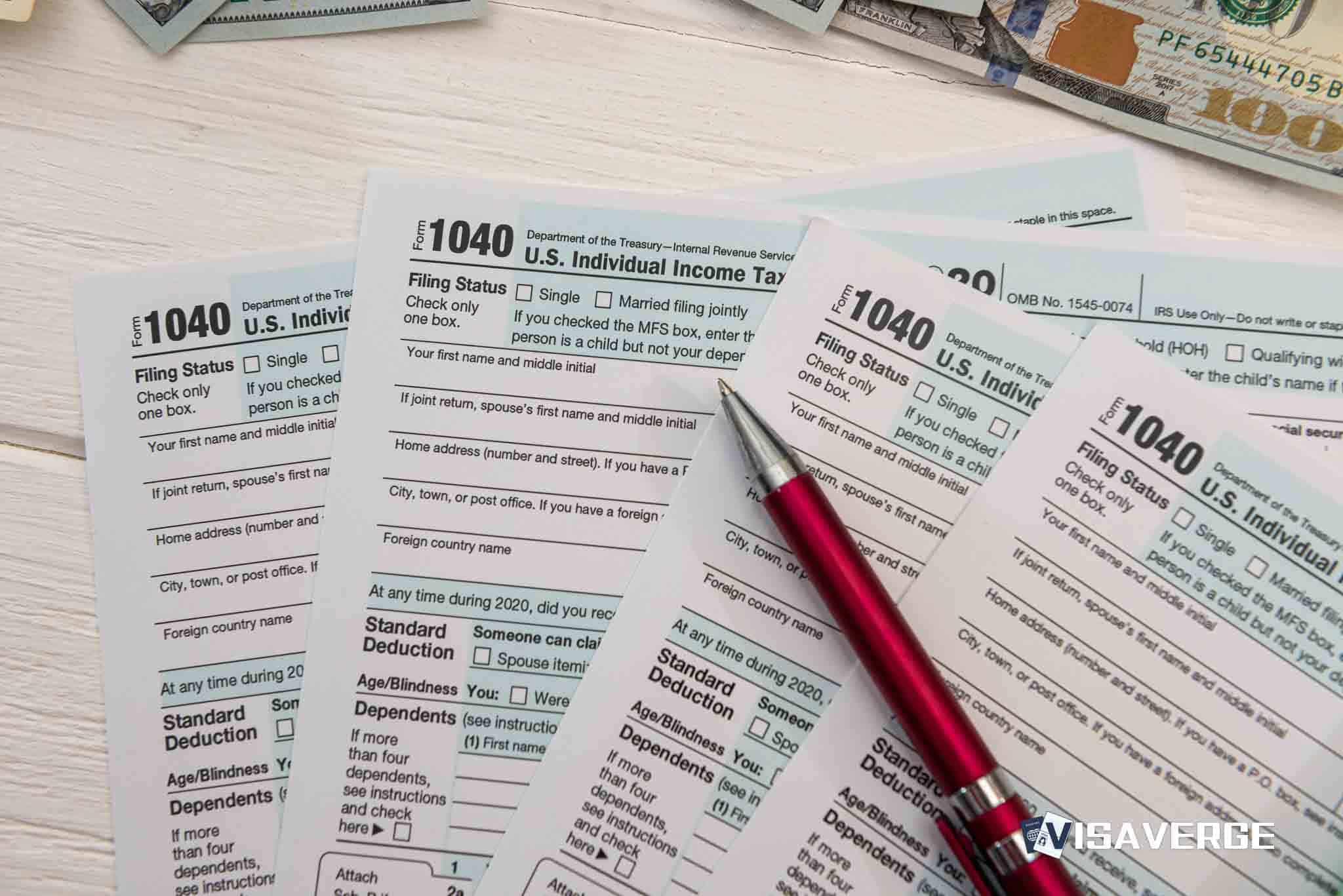
International students on F-1 visas must navigate complex tax residency rules that typically change after five calendar years. After this period, the Substantial Presence Test applies, potentially converting them to resident aliens for tax purposes. This shift requires filing Form 1040 instead of 1040-NR and reporting worldwide income and foreign bank accounts to the IRS starting in 2026.
- F-1 students can exclude U.S. presence days from tax residency for only five calendar years.
- The five-year limit counts any part of a year as a full calendar year toward the total.
- After five years, students may become U.S. tax residents and must report their global income.
(UNITED STATES) – U.S. tax rules require many F-1 students to stop excluding their days of presence after five calendar years, a shift that can change whether they file Form 1040-NR or Form 1040 and whether they must report worldwide income.
The change turns on a rule often overshadowed by Form 8843, the document students use to explain why they are excluding U.S. presence days for the Substantial Presence Test. Filing Form 8843 each year does not keep an F-1 student a nonresident forever, and the ordinary student rule generally lasts only five calendar years.

Long-term students, PhD scholars, workers on optional practical training, or OPT, and employees on STEM OPT often miss that limit. Some keep filing the same tax forms they used in earlier years, even after the Five-Year F-1 Rule no longer lets them exclude their days automatically.
Under the tax code, “exempt individual” does not mean exempt from all U.S. tax. It means that, for certain years, a student may exclude days of physical presence in the United States when applying the Substantial Presence Test, one of the main ways a foreign national becomes a U.S. tax resident.
Form 8843 exists to explain the basis for excluding those days. That distinction matters because immigration status and tax residency do not always match; a person can remain lawfully in F-1 status while becoming a resident alien for federal tax purposes.
The five-year limit is measured by calendar years, not five full twelve-month periods. A partial year counts. A student who first arrived in August 2021 may have used Year 1 in 2021, followed by Years 2 through 5 in 2022, 2023, 2024, and 2025.
That timeline puts 2026 in a different category. Beginning in the sixth calendar year, the student may need to count U.S. presence days under the Substantial Presence Test unless a special exception applies.
Many errors begin there. Students often assume continued F-1 status means continued nonresident tax treatment, but the Sixth Year turns on tax rules, not the visa label on an immigration record.
If the Substantial Presence Test is met after those five calendar years, the filing position can change. A student may need Form 1040 instead of Form 1040-NR, and that can bring worldwide income into the return, including foreign bank interest, dividends, rental income, salary, crypto transactions, and capital gains from foreign investments.
Other consequences can follow. Standard deduction and credits may apply differently, foreign bank interest may need to be included, and separate reporting regimes such as FBAR and Form 8938 may need review once a taxpayer becomes a U.S. tax resident.
The confusion around Form 8843 often deepens after the fifth year because the form also asks whether the individual was exempt as a teacher, trainee, or student for any part of more than five calendar years. If that answer is yes, the filer may need to provide sufficient facts to establish that they do not intend to reside permanently in the United States.
That is a technical position, not an extension of the ordinary first-five-year rule. Students who have already used more than five calendar years cannot assume continued exempt-individual treatment without reviewing the facts and documentation behind that claim.
One common mistake is simple arithmetic. Students often count five full years from their arrival date instead of counting calendar years, which can push the start of the Substantial Presence Test analysis a year too late. An arrival in December can still use one calendar year, even if the student spent only part of that year in the country.
Another mistake cuts the other way. Some students treat the sixth calendar year as automatic resident status, but the Substantial Presence Test still has to be applied. The result depends on days of presence, prior years, visa history, and whether any exception applies.
OPT and STEM OPT also complicate the analysis because they usually remain part of F-1 status. Graduation does not end the tax question. A student who arrived in 2021 and is working on STEM OPT in 2026 may still need to ask whether the Five-Year F-1 Rule has already been used up and whether U.S. days now count toward the Substantial Presence Test.
That issue becomes sharper for students who continue filing Form 1040-NR out of habit. Once a taxpayer meets the Substantial Presence Test and can no longer exclude days, continuing to file the nonresident return can lead to the wrong filing position and the omission of income that a resident must report.
Students who switch too early face a different risk. Filing Form 1040 before the Substantial Presence Test requires it can also be incorrect. The tax outcome does not arise automatically from the calendar alone; it comes from the interaction between the five-year limit and the day-counting rules.
The practical example in the guidance is straightforward. A student who first arrived in August 2021 may treat 2021 through 2025 as the five calendar years. In 2026, while still on STEM OPT, that student may no longer automatically exclude U.S. presence days under the ordinary student rule and may need to file Form 1040 instead of Form 1040-NR if the Substantial Presence Test is met.
Foreign accounts can add another layer once residency changes. Students and OPT workers with Indian savings accounts, NRE or NRO accounts, fixed deposits, foreign brokerage accounts, demat accounts, foreign mutual funds, or joint family accounts may need to review FBAR and Form 8938 separately from the income tax return.
Students nearing a sixth year can reduce mistakes by identifying the first calendar year of F-1 presence, counting each calendar year including partial years, and then checking whether five years have already been used. Only after that does the Substantial Presence Test analysis begin.
The next step is to decide the filing position that matches the facts for the current year. That can mean Form 1040-NR, Form 1040, or another position if an exception or special statement applies. Prior copies of Form 8843 can help document how earlier years were treated.
The question often surfaces just before a move to H-1B. A student who tracked the five-year rule correctly may have a different tax residency position in the change year from a student who did not, and that can affect whether the year is treated as nonresident, resident, or dual-status.
By the time the immigration status changes, the tax result may already be set in motion by years spent in F-1 status. Students planning an H-1B transition need to review whether the five calendar years were exhausted before the change year rather than assuming the immigration filing alone will determine the tax answer.
The rule behind Form 8843 is narrow but consequential. It allows qualifying F-1 students to exclude U.S. presence days for a limited period, and once that period ends, the Substantial Presence Test can convert a routine student filing into a resident return that reaches income and accounts far beyond the United States.