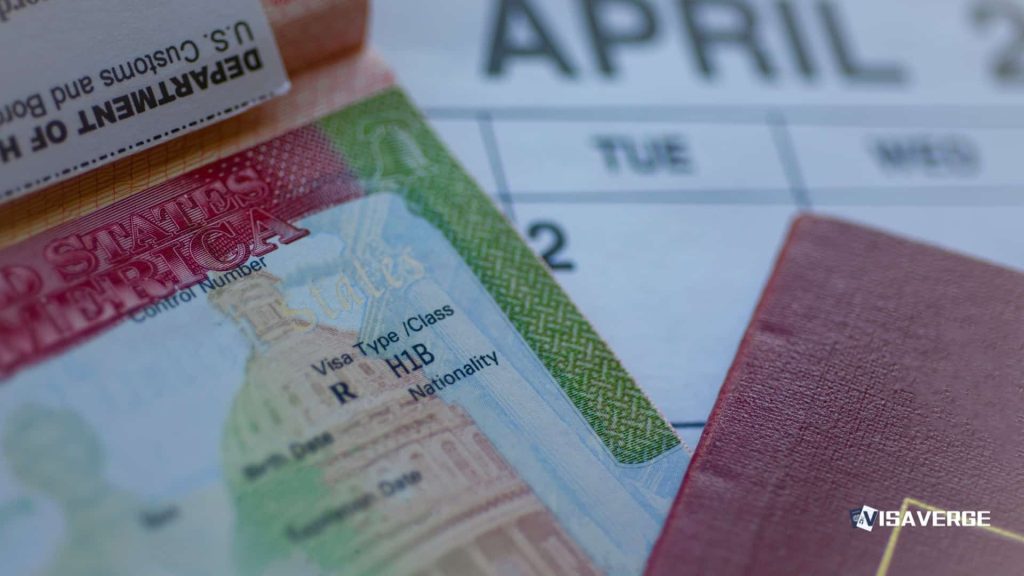
- F-1 to H-1B transitions create dual-status tax years where residency rules change mid-calendar year.
- Taxpayers frequently file the wrong return by ignoring the substantial presence test or exempt-individual rules.
- Incorrect filings can lead to overpaid taxes or missed foreign income reporting requirements like FBAR.
(UNITED STATES) — Taxpayers who change from F-1 student status to H-1B worker status during the year often file the wrong federal return, because their immigration status and their tax residency do not change in lockstep.
That mismatch can produce a dual-status tax year, a calendar year in which the same person is a nonresident alien for part of the year and a resident alien for another part for U.S. tax purposes. In an F-1 to H-1B transition, that result can apply when a student begins the year as a nonresident alien, later moves to H-1B, and then meets the substantial presence test or otherwise becomes a U.S. tax resident during the year.

IRS rules say that if a taxpayer becomes a U.S. resident during the year and remains a U.S. resident on the last day of the tax year, the taxpayer generally files Form 1040 as the main return and attaches a statement for the nonresident part of the year. Form 1040-NR may be used as that statement.
Confusion often starts with the F-1 rules. Students in F-1, J-1, or M-1 status are often treated as “exempt individuals” for substantial presence test purposes during their exempt years, but that does not exempt them from tax. It means certain days in the United States may be excluded when counting days for the substantial presence test.
Students who qualify to exclude days as exempt individuals must file Form 8843. H-1B workers, by contrast, generally count U.S. days of presence for the substantial presence test, which means the residency calculation can change in the middle of the year.
Residency also does not automatically begin on January 1. A taxpayer who changes to H-1B status during the year may have a residency start date that falls later in the calendar year, which is why the Dual-Status Tax Return question arises so often in an F-1 to H-1B case.
One common error is filing a normal full-year Form 1040 without first checking whether dual-status rules apply. That approach can incorrectly report or exclude income, credits, deductions, treaty positions, and filing status. It can also treat worldwide income as taxable for the entire year instead of only for the resident portion, depending on the facts.
A taxpayer who was on F-1 at the start of the year and changed to H-1B on October 1 illustrates the problem. If that person became a resident alien from that date, the return may need to separate the nonresident part of the year from the resident part rather than treating the person as a full-year resident.
The opposite mistake is also common. Some taxpayers file only Form 1040-NR because they started the year on F-1 or used that form in prior years. If they became a U.S. tax resident during the year and were a resident on the last day of the year, that filing can also be wrong.
H-1B status by itself does not make a person a full-year U.S. tax resident from January 1. Tax residency turns on the green card test, the substantial presence test, and residency start-date rules. A taxpayer who changes to H-1B late in the year may be nonresident, resident, or dual-status for that tax year, depending on the date of change, number of U.S. presence days, prior years, and the exempt-student period.
Day counting sits at the center of the dispute in many returns. The substantial presence test generally counts days of physical presence in the United States using a formula based on the current year and two prior years, but some F-1 student days may be excluded during the student’s exempt-individual period. Errors arise when taxpayers count all F-1 days when they should not, exclude days after the exempt period has ended, or fail to count H-1B days properly.
A correct review usually starts with a narrow set of dates and totals: the number of calendar years in F-1 status, whether student days still qualified for exclusion, the exact H-1B start date, the number of U.S. presence days after H-1B began, whether the substantial presence test was met, and the correct residency start date. In a dual-status tax year, those dates matter more than the immigration label alone.
Form 8843 remains another frequent stumbling point. Taxpayers who had an F-1 portion of the year before changing to H-1B may still need to review that form for the F-1 period if exempt-student days are being excluded. Many assume the form no longer matters once H-1B begins. That assumption can be wrong.
Deductions and credits create a second layer of errors. Dual-status taxpayers generally cannot claim the standard deduction unless a specific exception applies, yet regular tax software may allow it automatically if the program treats the filer as a full-year resident. Similar problems can arise with education credits, earned income credit, child tax credit, premium tax credit, recovery or refundable credits depending on tax year and eligibility, and certain dependent-related benefits.
Income must also be split between periods. During the nonresident period, the taxpayer is generally taxed on U.S.-source income and certain income effectively connected with a U.S. trade or business. During the resident period, the taxpayer may be taxed like a U.S. resident, which generally includes worldwide income.
That separation can affect U.S. wages before and after the H-1B start, foreign bank interest, Indian fixed deposit interest, foreign salary, scholarship or fellowship income, brokerage income, capital gains, rental income, and treaty positions. A filer who places all income in the wrong period can overpay or underpay.
Foreign income often becomes more important after residency begins. New H-1B workers may still hold bank accounts, fixed deposits, mutual funds, salary arrangements, rental property, or family financial arrangements outside the United States. Once they become U.S. tax residents, worldwide income reporting may apply for the resident portion of the year, including foreign bank interest, Indian fixed deposit interest, foreign dividends, capital gains, rental income, or other income.
Separate reporting duties can continue alongside the income tax return. FBAR and Form 8938 are distinct from the income tax calculation, and taxpayers with foreign bank accounts, financial accounts, or specified foreign financial assets may face separate reporting obligations if thresholds are met. That issue can be especially relevant for Indian taxpayers with NRE accounts, NRO accounts, fixed deposits, mutual funds, demat accounts, or family-held financial assets.
Married filers face another trap. A married dual-status taxpayer generally cannot file a normal joint return unless a specific election applies. Some taxpayers may elect to be treated as residents for the full year in certain circumstances, such as marriage to a U.S. citizen or resident alien, or under first-year choice and related rules, but that decision can pull worldwide income for the full year into the U.S. return and affect treaty benefits, credits, deductions, and foreign reporting.
Regular consumer software does not always handle those facts correctly. Some products do not properly support dual-status returns, nonresident alien issues, Form 1040-NR attachments, treaty claims, or residency start-date calculations. That can lead to an incorrect full-year resident filing, an incorrect standard deduction, improper credits, or failure to attach the required dual-status statement.
IRS guidance also requires a procedural step that filers can miss. If a taxpayer becomes a U.S. resident during the year and is a resident on the last day of the tax year, the taxpayer must file Form 1040 and write “Dual-Status Return” across the top, then attach a statement showing income for the nonresident part of the year. Form 1040-NR may be used as that statement.
State taxes add another layer because federal tax residency and state tax residency do not always match. A person who moves from F-1 to H-1B may also move states, work remotely, or split wages between states. That can produce a federal dual-status return and a part-year state resident return in the same year.
Corrections are possible after a wrong filing, but they require care. A taxpayer who filed a full-year resident Form 1040 but should have filed a Dual-Status Tax Return may need to amend. A taxpayer who filed Form 1040-NR but became a resident during the year may also need to correct the return. Form 1040-X may be used to amend a previously filed Form 1040, Form 1040-SR, or Form 1040-NR.
A typical example shows how narrow the analysis can be. A taxpayer on F-1 OPT from January 1 to September 30 who changed to H-1B on October 1, earned U.S. wages throughout the year, and also received Indian bank interest should not automatically file a normal full-year Form 1040. The filer must first determine whether the year is nonresident, resident, or a dual-status tax year, then identify the correct residency start date and review whether the Indian bank interest belongs in the resident portion of the return.
That sequence leaves little room for shortcuts. The filer has to confirm the exact H-1B start date, count U.S. presence days carefully, determine whether F-1 exempt-individual days apply, apply the substantial presence test, identify the right forms and attachments, separate income by period, review foreign income and reporting obligations, and check state tax residency separately.
The year of change from F-1 to H-1B remains one of the most error-prone tax years for international students and workers because the answer often lies between two simple labels. The taxpayer may not be a full-year nonresident. The taxpayer may not be a full-year resident. In many cases, the return turns on dates, day counts, and the point at which U.S. tax residency begins.