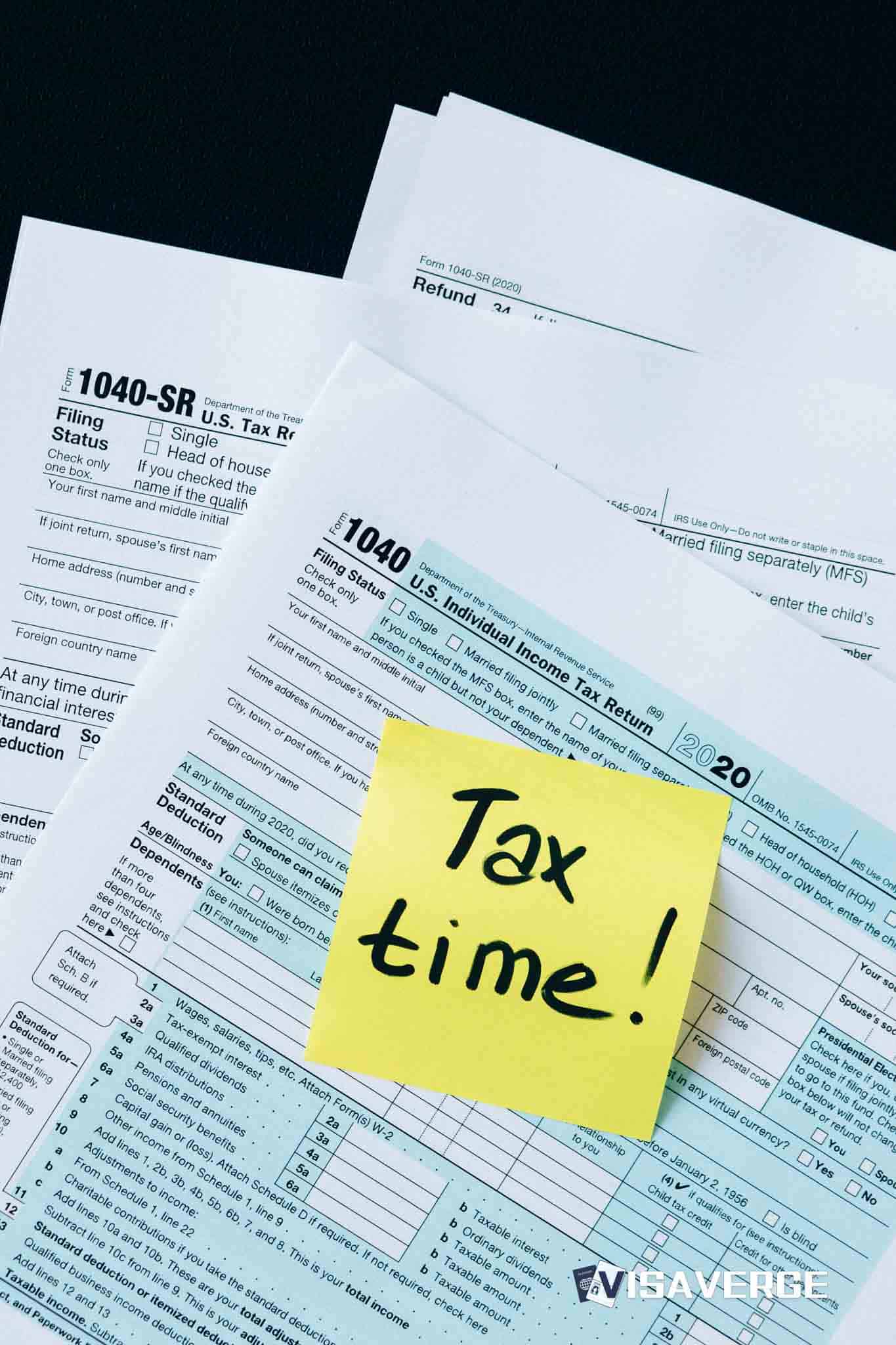
- H-1B workers can file the wrong return if they misread tax residency rules instead of immigration status.
- The IRS substantial presence test uses 31 days and 183 days to determine resident or nonresident filing.
- Full-year residents must report worldwide income and foreign assets, not just U.S. wages.
(UNITED STATES) — H-1B workers who file U.S. tax returns on time can still file the wrong return if they use the wrong residency status, the wrong income scope, or the wrong form, including `Form 1040`, `Form 1040-NR`, or a dual-status return.
The filing mistake turns on tax residency, not immigration status alone. An H-1B visa does not automatically decide whether a worker is a resident alien or nonresident alien for income tax purposes, and that distinction controls which return belongs on file.
Free toolH-1B Cost Calculator Online
Many errors fall into two patterns. Some workers file `Form 1040` even though they remained nonresidents for the year; others file `Form 1040-NR` even though they met the residency rules and should have filed as full-year U.S. residents.
The central test is the substantial presence test. The IRS generally requires at least 31 days in the current year and 183 days over a three-year weighted period, counting all days in the current year, one-third of days in the first preceding year, and one-sixth of days in the second preceding year.
That day count decides whether many H-1B workers file `Form 1040` or `Form 1040-NR`. A worker can hold H-1B status for immigration purposes and still need a nonresident return if the substantial presence test was not met.
Workers who qualify as U.S. resident aliens for the entire taxable year generally file `Form 1040`. In that situation, the IRS treats them like U.S. citizens for income tax purposes, which means they generally report worldwide income, not only U.S. wages.
That can extend far beyond a W-2. A full-year resident may need to include U.S. salary, bank interest, dividends, capital gains, stock compensation, side income, and foreign income such as Indian bank interest, Indian fixed deposit interest, Indian rental income, Indian capital gains, and other foreign earnings.
Indian income is a frequent blind spot for H-1B workers. Many report U.S. salary and stop there, even though a full-year U.S. tax resident generally must review NRE account interest, NRO account interest, FCNR deposits, Indian savings account interest, Indian mutual funds, stock gains, rental income, sale of Indian property, and foreign salary in part-year situations.
`Form 1040-NR` applies to nonresident alien individuals, estates and trusts that must file a U.S. income tax return. H-1B workers may need that form if they entered the United States late in the year, had a short period of U.S. employment, did not meet the substantial presence test, or remained nonresidents for part of the year.
Nonresident treatment does not depend on whether someone is “foreign” in an ordinary sense. It depends on whether the person counted as a resident alien or nonresident alien under U.S. tax rules during that tax year.
A common mistake arises when newly arrived workers use standard tax software that defaults to resident returns. If the software prepares `Form 1040` automatically and the taxpayer does not verify residency, the return can misstate filing status, standard deduction treatment, credits, dependent claims, spouse treatment, income reporting, treaty position, and state filings.
That problem can surface quickly in late-year arrivals. A worker who entered the United States in November 2025 on H-1B and filed `Form 1040` as a full-year resident may have filed the wrong return if the substantial presence test was not met and no valid residency election applied.
The reverse mistake is also common. Some H-1B workers assume they must file `Form 1040-NR` because they are neither U.S. citizens nor green card holders, even though they spent the full year in the United States and met the substantial presence test.
That error can leave worldwide income off the return and can also affect foreign tax credits, deductions, credits, spouse treatment, dependent treatment, foreign asset reporting, and state tax filings. If a worker should have filed as a resident and used `Form 1040-NR` instead, the omission can extend well beyond salary reporting.
The most confusing year often comes during the shift from student status to work status. Many H-1B workers first entered on F-1 visas, worked on OPT or STEM OPT, and then moved to H-1B, creating a tax year in which some days may be exempt for substantial presence purposes while H-1B days generally count.
That transition requires close attention to dates. The tax analysis can turn on the date F-1 status applied, the date OPT or STEM OPT employment began, the date H-1B status started, the total number of U.S. days in the year, whether exempt individual rules applied, whether `Form 8843` was required, and whether the worker ended up as a nonresident, resident, or dual-status taxpayer.
A worker on F-1 OPT for part of 2025 and on H-1B from October 2025 may not fit neatly into a simple resident or nonresident filing. A regular `Form 1040` can be wrong in some transition cases, and a regular `Form 1040-NR` can be wrong in others.
Dual-status treatment comes into play when a taxpayer is a nonresident alien for one part of the year and a resident alien for another. That split can arise in a year of arrival, departure, or a midyear shift in tax residency, and it affects which income belongs in each period, when worldwide income begins, what deductions are available, whether spouse filing options apply, whether treaty positions remain available, and which schedules or statements are required.
Because dual-status returns are technical, ordinary resident-tax assumptions can cause mistakes. The worker has to sort income by period rather than treat the year as one block, and the wrong approach can spill into foreign tax credit treatment and related filings.
Foreign reporting adds another layer. FBAR and `Form 8938` are separate from the `Form 1040` versus `Form 1040-NR` decision, but H-1B workers who are U.S. tax residents may still need to review foreign accounts and assets such as NRE accounts, NRO accounts, FCNR accounts, Indian fixed deposits, demat accounts, mutual funds, brokerage accounts, foreign pension or retirement accounts, and foreign company interests.
Those two filings do different jobs. FBAR is filed separately with FinCEN if the reporting threshold is met, while `Form 8938` is attached to the federal income tax return if specified foreign financial asset thresholds are met; filing one does not automatically satisfy the other.
Federal corrections also do not fix state returns automatically. Workers who moved to the United States during the year, changed employers, worked remotely, lived in one state and worked in another, moved between states, had withholding errors, filed as full-year residents instead of part-year residents, or failed to file where income was earned may need to amend state filings after changing the federal return.
The IRS directs taxpayers to use `Form 1040-X` to amend a return. It also says taxpayers should submit a complete amended `Form 1040`, `1040-SR` or `1040-NR` with the changes and attach supporting documents and changed forms or schedules.
`Form 1040-X` can be filed electronically in many cases through tax software to amend `Form 1040`, `1040-SR` or `1040-NR` for the current or two prior tax periods. Paper filing remains an option, though cases involving nonresident status, dual-status treatment, foreign income, foreign assets, or treaty positions often demand closer review.
The correction process starts with identifying the exact error. A worker may need to revisit the residency determination, review whether worldwide income was required, check whether Indian income or foreign tax credits were missed, examine whether FBAR or `Form 8938` obligations were overlooked, and determine whether the state return also changed once the federal position changed.
If the amended return increases tax due, payment should be made as early as possible to reduce further interest exposure. Waiting can make a filing problem more expensive even when the original mistake began with a residency misclassification rather than a failure to file.
Tax mistakes do not automatically amount to H-1B violations, but the records can matter outside the tax system. Tax filings can become relevant in H-1B transfers, H-1B extensions, visa stamping, employment verification, the green card process, mortgage applications, and future naturalization review, where income and residence history often come under scrutiny.
One example involves a worker who spent all of 2025 in the United States on H-1B, met the substantial presence test, and still filed `Form 1040-NR` because the worker assumed all visa holders are nonresidents. Another involves a full-year resident who filed `Form 1040` but reported only W-2 wages even though the worker also had NRO interest and Indian fixed deposit interest.
Each error points to the same question: whether the worker matched the return to tax residency rather than to the visa label. H-1B workers who want to know if the right form is on file have to check their physical presence, any F-1 or OPT history, any split-year treatment, foreign income, foreign asset reporting, and whether the state return still matches the federal one.
The distinction between `Form 1040`, `Form 1040-NR`, and dual-status treatment sits at the center of that review. For H-1B workers, especially those with Indian income or an F-1 to H-1B transition, the right filing position begins with the substantial presence test and ends only after the worker has checked worldwide income, foreign reporting, and any amendment needed through `Form 1040-X`.