- President Arévalo confirmed that two thousand two hundred eighty-four Mexicans were deported through Guatemala in twenty twenty-six.
- Mexico officially rejected the third-country strategy, stating they accept all nationals directly without intermediate transfers.
- The U.S. expanded this global deportation network to include countries like Honduras, Costa Rica, and Liberia.
Guatemala’s President Bernardo Arévalo said Thursday that about 2,284 Mexican nationals had passed through his country after U.S. deportation flights this year, with officials sending them onward to Mexico within 24 hours.
The transfers reportedly began in earnest around April 2026. Guatemala treated the arrivals as people passing through, rather than as asylum seekers or refugees.
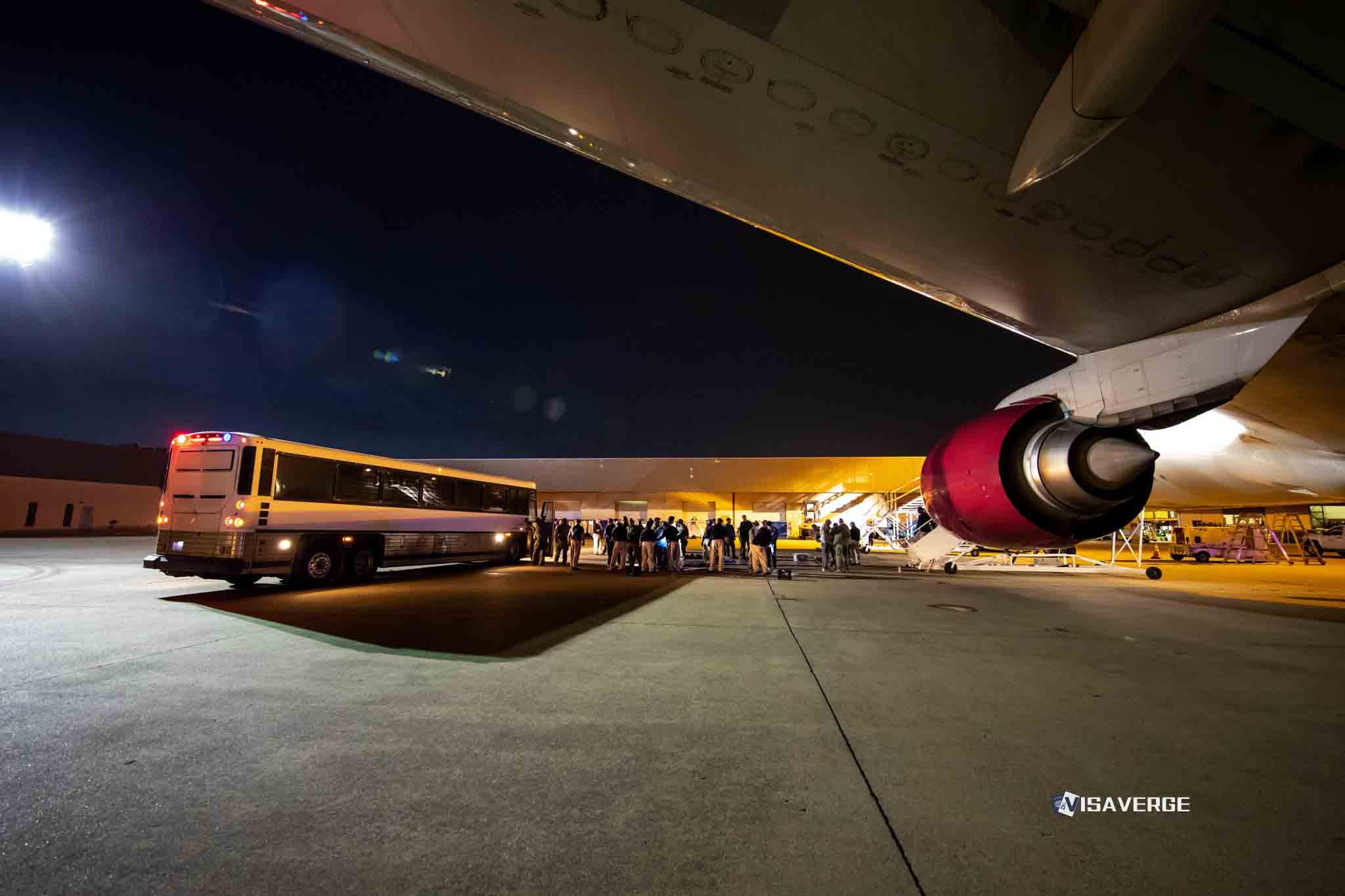
The government did not hold them in its protection system. Officials instead coordinated their onward movement with Mexican immigration authorities.
Arévalo described the flights during a televised interview on August 20, 2026.
“They are arriving in planes of Guatemalan returnees, and what we have done is process them as in transit, in coordination with the Mexican immigration authorities.”
The arrangement places Mexican citizens in a country other than their own before they continue home. The practice is part of a broader third-country deportation strategy that has drawn objections from Mexico and warnings from humanitarian organizations.
Honduras has received additional Mexican deportation flights
Honduras has also become an intermediate destination. At least 82 Mexican nationals arrived in flights to San Pedro Sula on August 13 and August 16, while another 35 were reportedly scheduled to arrive August 21.
Monitoring groups counted 165 Mexican arrivals between May and mid-July. Separate figures put the Honduran total at at least 282 Mexican nationals this year.
The pace is far above earlier reported levels. Guatemala received 15 Mexicans in 2025, while Honduras had reported only 6 as of February 2026. At least 11 Mexicans have also been sent to Costa Rica since the start of the current term.
The receiving government must agree to accept people before it can serve as an intermediate destination. In Guatemala, the arrivals were processed and moved onward rather than placed in an asylum procedure.
Mexico’s Foreign Ministry said it remains ready to receive its citizens directly. It also rejected sending them through other countries.
“The Government of Mexico accepts the return of all its nationals. It therefore rejects the deportation of Mexican nationals to third countries and has no such agreement in place.”
The statement places the transfers at the center of a diplomatic dispute. Mexico’s government, led by President Claudia Sheinbaum, has also protested the deaths of 17 Mexicans in U.S. immigration custody or during enforcement operations in 2026.
No publicly announced bilateral agreement with Mexico authorizes the transfers described by the ministry. The objections come as Washington seeks cooperation from Mexico and other Latin American governments on enforcement.
Washington presents the removals as a deterrence campaign
The policy sends people farther south instead of returning them directly to their citizenship country. DHS officials speaking anonymously described the objective as making an immediate attempt to re-enter the United States more difficult.
The administration presents the broader campaign as part of its effort to conduct the “largest deportation operation in history.” A Department of Homeland Security spokesperson said the government was using every lawful avenue available.
“The Trump Administration is utilizing all lawful options to carry out the largest deportation operation in history, just as President Trump promised.”
Markwayne Mullin, Secretary of Homeland Security, defended the enforcement effort in a separate statement.
“Deporting illegal aliens saves lives. Thanks to President Trump’s leadership, we are making America safe again.”
As of August 2026, the administration had sent roughly 22,000 third-country nationals to at least 26 different countries globally. The Central American transfers therefore fit within a campaign extending beyond Mexican nationals and beyond the Western Hemisphere.
The administration has also increased security demands on Mexico and allied Latin American governments to conduct joint operations against criminal groups. Deportation arrangements have been used as leverage in those negotiations.
The transfers raise legal and humanitarian questions when a person has an asylum claim or fears harm in a country where the person is not a citizen. The available accounts describe a policy practice, not a single publicly identified agreement governing every destination.
Deportees and advocates describe an opaque route
Arturo Trejo, a Mexican national deported to Honduras, said he received no explanation before boarding the flight.
“They didn’t tell us anything, just to get on the flight.”
Immigration lawyers, including lawyers at Human Rights First, characterize the transfers as a “legal loophole.” They argue that routing people through another country may help the administration avoid court orders that could otherwise restrict the direct return of asylum seekers to dangerous areas of Mexico.
The legal consequences may depend on the person’s immigration history, the destination’s treatment of the person and any pending protection claim. Individuals facing removal or transfer should obtain advice from a qualified immigration attorney about their specific circumstances.
Refugees International has warned that sending migrants to unfamiliar countries can leave them with few resources. The organization also raised concerns that the practice may conflict with international protocols that generally direct deportees to their countries of citizenship.
Savitri Arvey of Human Rights First said the apparent objective was to stop Mexican citizens from trying to cross the U.S. border again.
“They really don’t want any Mexicans crossing the border.”
Guatemala’s process differs from a protection arrangement. The Mexican arrivals were treated as transit passengers and moved onward quickly, rather than being held as asylum seekers or refugees.
The system is expanding beyond Central America
The United States carried out its first deportation to Liberia on August 20, 2026, under a new agreement allowing that country to accept up to 1,200 people who are not Liberian nationals.
The first 20 deportees arrived at Roberts International Airport. The operation opened a route to West Africa as the administration continued expanding its network of destinations.
As of August 21, 2026, the campaign included transfers involving Central America, Costa Rica and Liberia, with the Mexican flights forming one part of a wider enforcement effort.
This article provides general information and is not legal advice. Consult a qualified immigration attorney about your specific case.