- Baltimore Immigration Court is holding enlarged master calendar hearings with up to 120 cases per session.
- Compressed schedules in these mega masters limit time for securing counsel and correcting administrative errors.
- Respondents missing hearings face in absentia removal orders under strict new enforcement and massive funding.
(BALTIMORE, MARYLAND) – Relief in removal proceedings often turns on speed, notice, and preparation, and those pressures are sharper in Baltimore’s enlarged master calendar hearings, the high-volume sessions critics call mega masters.
At the Baltimore Immigration Court, George Fallon Federal Building, 31 Hopkins Plaza, Rm. 440, Baltimore, MD 21201, early June dockets showed as many as 120 cases in a morning session. Traditional master calendar hearings often carried about 10 to 15 cases. The Department of Justice describes the larger format as enlarged master calendar hearings, part of an effort to move a nationwide backlog of more than 3.3 million cases.

A master calendar hearing is usually brief. The immigration judge identifies the charges, confirms pleadings, sets deadlines, and asks what relief, if any, the respondent plans to seek. In mass deportation hearings, that basic structure remains, but the compressed schedule leaves little room to correct address problems, request records, or secure counsel before deadlines arrive.
The main defense question is often simple: is the person actually removable, and if so, what relief may still stop removal? Common forms of relief include asylum under INA § 208, withholding of removal under INA § 241(b)(3), protection under the Convention Against Torture, cancellation of removal under INA § 240A, adjustment of status under INA § 245, voluntary departure under INA § 240B, and termination where the Notice to Appear or underlying charge is defective.
Each option has its own statutory requirements. Asylum typically requires proof of past persecution or a well-founded fear of future persecution on account of race, religion, nationality, political opinion, or membership in a particular social group. Cancellation for certain nonpermanent residents requires 10 years of continuous physical presence, good moral character, and exceptional and extremely unusual hardship to a qualifying relative. Adjustment of status usually requires an approved visa petition or other immigrant basis, visa availability, and admissibility, though waivers may apply in some cases.
| India | China | ROW | |
|---|---|---|---|
| EB-1 | Feb 01, 2023 | Aug 01, 2023 ▲31d | Current |
| EB-2 | Nov 01, 2013 | Oct 01, 2021 | Apr 01, 2025 ▲90d |
| EB-3 | Jan 22, 2014 ▲21d | Jan 22, 2022 ▲14d | Jun 15, 2024 ▲31d |
| F-1 | Jan 22, 2021 ▲366d | Jan 22, 2021 ▲366d | Jan 22, 2021 ▲366d |
| F-2A | Oct 22, 2026 ▲30d | Oct 22, 2026 ▲30d | Oct 22, 2026 ▲30d |
Attorney representation is especially important in mass deportation hearings because the hearing that looks administrative often decides the entire path of the case. Pleadings made too quickly can concede removability. Missed filing deadlines can block relief. A request for more time, a change of venue, or a motion to rescind an in absentia order may depend on facts that are easy to miss without counsel.
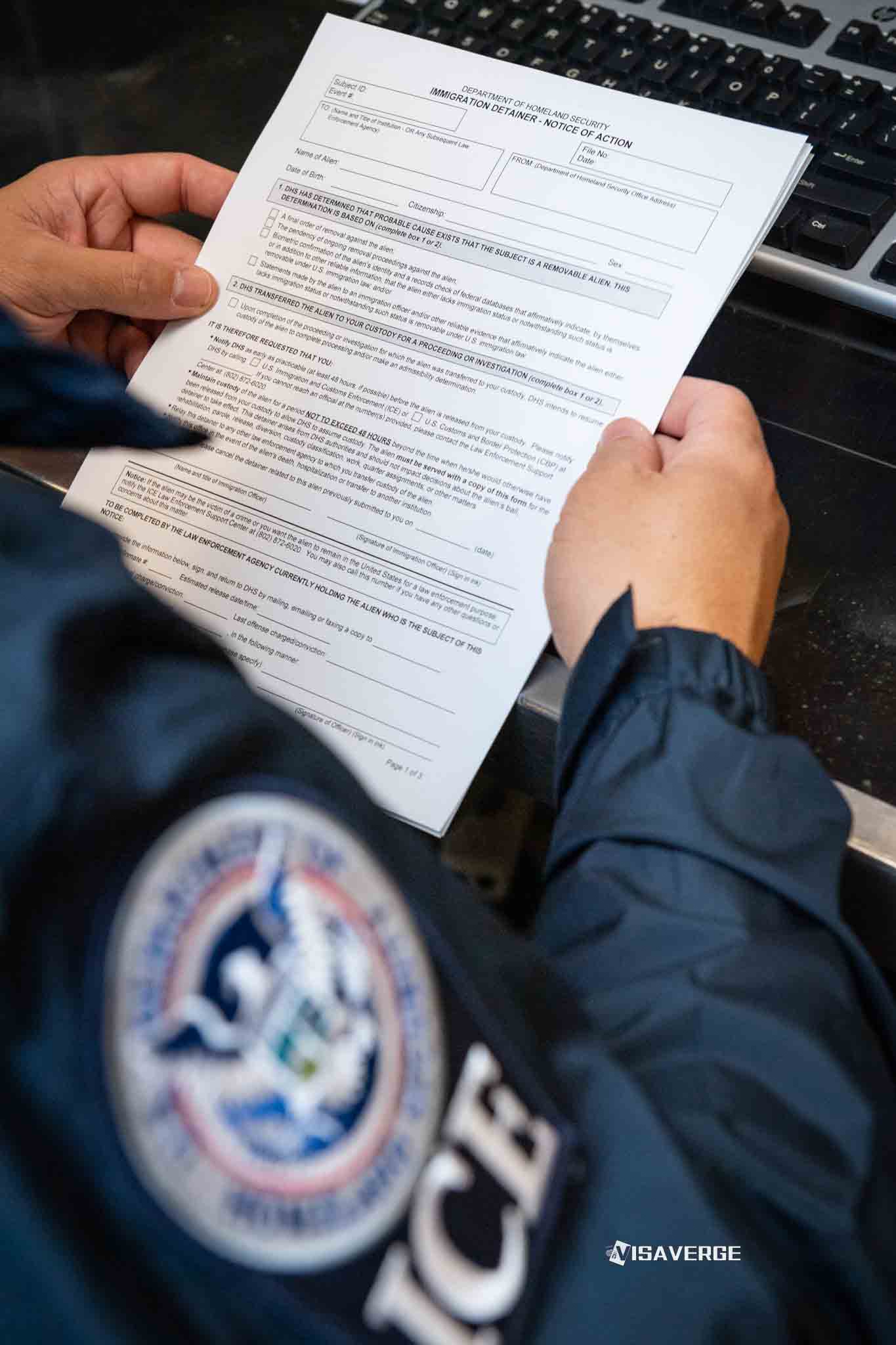
Warning: A respondent who misses a hearing may be ordered removed in absentia under INA § 240(b)(5). Notice problems, address changes, and mail delivery issues should be documented immediately.
The record needed to succeed usually starts with identity, entry history, and proof of residence. That may include passports, birth certificates, I-94 records, prior immigration filings, tax returns, school records, leases, utility bills, employment records, and certified criminal dispositions. Relief-based evidence varies. Asylum cases often require declarations, country conditions reports, police records, medical records, and affidavits. Cancellation cases usually need proof of continuous presence and hardship evidence for U.S. citizen or lawful permanent resident relatives, including medical reports, school records, and financial documents.
Some cases in Baltimore may also begin with a denied benefit application that triggered a Notice to Appear. USCIS policy now permits NTAs in a wider set of denied cases, including some adjustment and Temporary Protected Status matters. That means the defensive case in Immigration Court may depend on a USCIS filing history, prior biometrics records, inadmissibility findings, and statements made in earlier applications. Small inconsistencies can become cross-examination points.
Several factors tend to strengthen cases. A respondent who appears at every hearing, keeps the court informed of any address change, preserves copies of every filing, and submits evidence before the judge’s deadline is in a stronger position. So is a respondent with a clean criminal record, long U.S. residence, family equities, and a clear relief theory supported by documents. In asylum cases, detailed testimony that matches the written application and country evidence often matters more than volume alone.
Several facts weaken cases quickly. Prior removal orders, fraud findings, criminal convictions, inconsistent statements, late-filed applications, and unsupported hardship claims can narrow relief options. Some bars are absolute or close to it. An aggravated felony may bar asylum and cancellation for lawful permanent residents. Certain controlled substance convictions may foreclose adjustment and cancellation. The one-year filing deadline for asylum under INA § 208(a)(2)(B) remains a recurring problem unless an exception applies.
Case law also shapes strategy. The Supreme Court’s notice decisions, including Pereira v. Sessions, 138 S. Ct. 2105 (2018), and Niz-Chavez v. Garland, 141 S. Ct. 1474 (2021), changed parts of the notice analysis in some contexts, particularly the stop-time rule. But those cases do not erase every NTA defect, and arguments vary by posture and circuit. Cancellation strategy may also turn on hardship standards and continuous presence issues that remain heavily fact-specific.
Official statements from the administration frame the hearings as lawful and necessary. A DHS spokesperson said on June 6, 2026 that unauthorized entry is a crime and that people in custody broke the law. DHS also said noncitizens with final removal orders have received full due process. Secretary Markwayne Mullin defended the department’s budget request on June 2, 2026, and DHS General Counsel James Percival on June 9, 2026 directed stricter enforcement against noncitizens who illegally vote.
The policy backdrop is large. Congress recently approved a $70 billion infusion for immigration enforcement, on top of nearly $140 billion provided the previous year. The administration has paired that money with enforcement measures including Operation ICE Wall and broader NTA issuance after denied applications. DOJ and EOIR present the larger dockets as a backlog response. Critics describe the shift from individualized hearings to group processing as a due process problem, especially when hearing notices arrive only one or two weeks before the date.
Deadline issue: Filing dates set at a master calendar hearing are often strict. Missing an asylum filing date, biometrics instruction, or evidence deadline may lead to waiver findings or denial.
Representation rates show the pressure. In one recent Baltimore session, only 17 of 120 respondents had counsel on file. That matters because defenses often require immediate decisions about pleadings, venue, continuances, and relief selection. The Board has long treated continuances as discretionary, and standards can tighten where a judge believes the respondent has had enough time. Matter of Hashmi, 24 I&N Dec. 785 (BIA 2009), and Matter of L-A-B-R-, 27 I&N Dec. 405 (A.G. 2018), remain reference points in continuance disputes.
Mistaken enforcement also remains part of the record. Dulce Consuelo Diaz Morales, a U.S. citizen, was reportedly detained in Baltimore for 25 days before proceedings were halted and a passport issued. Cases like that do not establish a broad legal rule, but they underscore why identity, citizenship, and prior records should be checked early. U.S. citizenship is a complete defense to removal. Derivative citizenship claims, however, are often document-heavy and should be evaluated by counsel immediately.
Local officials have pushed back in some areas. Baltimore Mayor Brandon M. Scott signed an executive order on March 4, 2026 limiting city property use for unpermitted federal immigration enforcement staging. That order does not control Immigration Court proceedings inside the federal building, but it reflects the broader tension between aggressive enforcement and local efforts to limit cooperation.
Respondents facing enlarged master calendar hearings should expect short hearings and fast deadlines. The practical defense strategy is narrow and urgent: confirm the correct address with the court, obtain the charging document and prior filings, avoid admissions that have not been reviewed, identify every possible relief option, and ask for time to obtain counsel where appropriate. Cases with criminal records, prior orders, unlawful voting allegations, fraud issues, or possible citizenship claims require immediate legal review. In many cases, the first hearing is the point where avoidable damage occurs.
Official court and policy updates are available through EOIR’s Baltimore court page, the DHS newsroom, and the USCIS Policy Manual. Legal help directories are available through the American Immigration Lawyers Association and the Immigration Advocates Network.
Legal resources: [EOIR Baltimore Immigration Court Operational Status](https://www.justice.gov/eoir/baltimore-immigration-court); DHS Newsroom; [USCIS Policy Manual](https://www.uscis.gov/policy-manual); [AILA Lawyer Referral](https://www.aila.org/find-a-lawyer); Immigration Advocates Network.
⚖️ Legal Disclaimer: This article provides general information about immigration law and is not legal advice. Immigration cases are highly fact-specific, and laws vary by jurisdiction. Consult a qualified immigration attorney for advice about your specific situation.