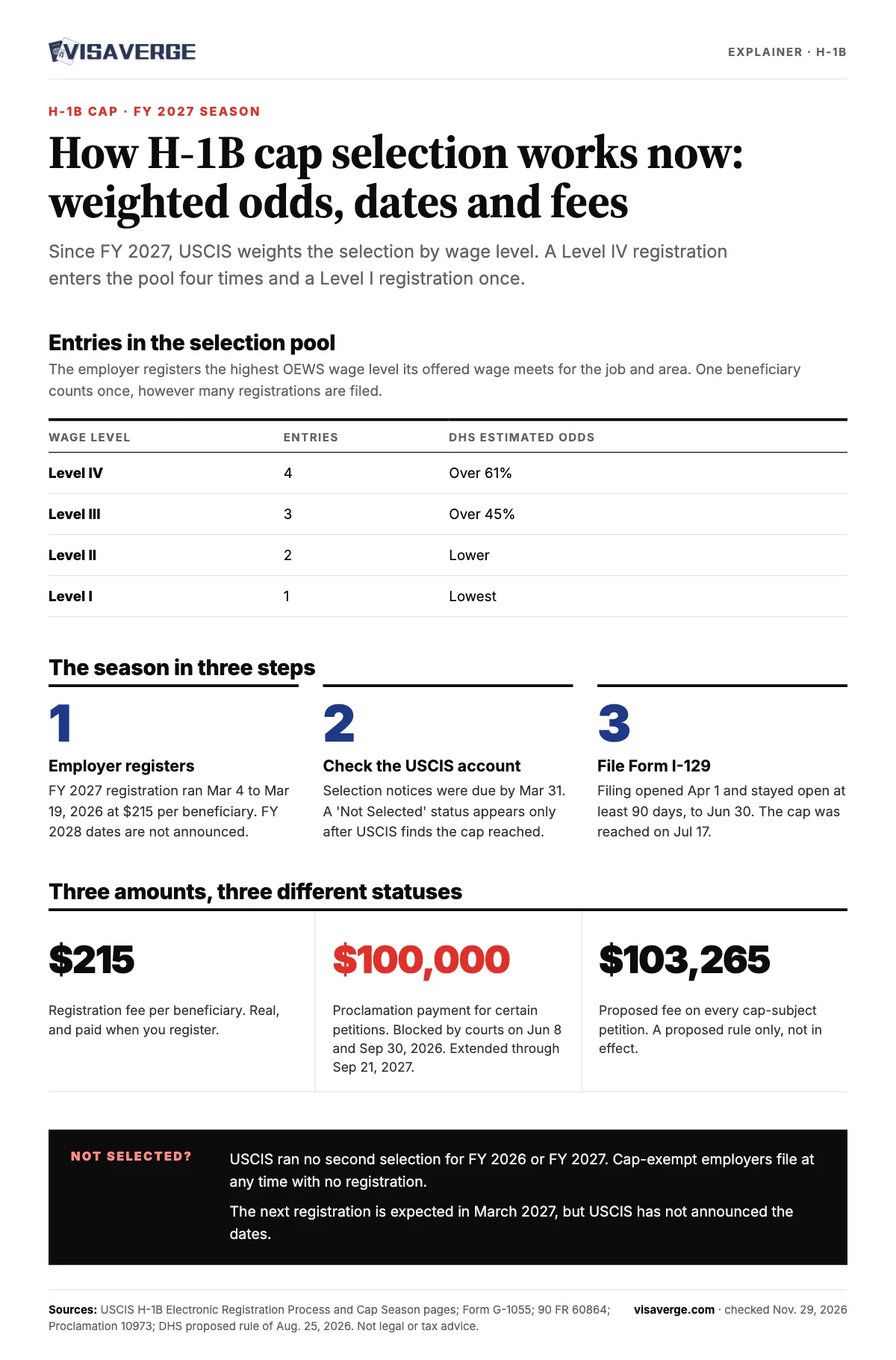
The H-1B cap is 85,000 new visas a year: 65,000 in the regular quota plus 20,000 more for people with a U.S. master’s degree or higher. Far more people are registered than there are numbers, so USCIS runs a selection every spring. Since the FY 2027 season (registration in March 2026) that selection is no longer a pure random draw. It is wage-weighted: a registration for a Level IV wage goes into the pool four times, Level III three times, Level II twice and Level I once.
This guide is the one page we keep current for the whole cap season. It explains how weighted selection works and what it replaced, the dates and the $215 registration fee, how to read your result in your USCIS online account, what to file after selection, what your options are if you are not selected, and where the separate $100,000 payment and the proposed $103,265 fee stand today. Every date and fee below was checked against USCIS, the Federal Register or the White House on November 29, 2026, and each one links to its official source.
The most important date question first: USCIS has not announced FY 2028 registration dates yet. Its registration page, last updated September 21, 2026, still shows the FY 2027 schedule. Last season USCIS announced the dates on January 30, 2026, five weeks before registration opened on March 4, so plan for an announcement in January or February 2027 and a March 2027 window, and treat that as a pattern, not a promise.
The second most common question is about the $100,000 fee. As of today it is not being collected. A federal court in Massachusetts vacated the agency guidance that implemented it on June 8, 2026, and a federal court in California blocked USCIS, CBP and the State Department from enforcing it on September 30, 2026. The President extended the proclamation through September 21, 2027, but the court orders still stand. The details, including who it was written to cover and the exceptions, are in the fee section below.
Who this guide is for: employers and HR teams planning a registration, F-1 students and recent graduates waiting on a result, people already in the United States on another status (H-4, L-2, O-1, TN, E-3) who are being sponsored for a first H-1B, and anyone who was not selected and wants the real alternatives rather than another list of tips. It is written for readers, not as legal advice for one person’s file, so use an immigration attorney for case-specific calls.
| India | China | ROW | |
|---|---|---|---|
| EB-1 | Feb 01, 2023 | Aug 01, 2023 | Current |
| EB-2 | Nov 01, 2013 | Oct 01, 2021 | Apr 01, 2025 |
| EB-3 | Jan 22, 2014 | Jan 22, 2022 | Jun 15, 2024 |
| F-1 | Jan 22, 2021 | Jan 22, 2021 | Jan 22, 2021 |
| F-2A | Nov 22, 2026 ▲31d | Nov 22, 2026 ▲31d | Nov 22, 2026 ▲31d |
How to use it: the timeline in the next section shows what changed and when, from FY 2025 to FY 2028. Then follow the season in order, from how selection works to registration, results, the I-129 petition and the options if you were not selected. The last sections cover the fee proclamation and the court status, cap-exempt employers, and mistakes that cost people their selection.
- Selection is wage-weighted since FY 2027: Level IV counts 4 entries, Level III 3, Level II 2, Level I 1. DHS estimated selection odds of over 61% at Level IV and over 45% at Level III.
- Registration was March 4 to March 19, 2026 at $215 per beneficiary. FY 2028 dates are not announced as of November 29, 2026.
- Selected employers had at least 90 days from April 1 to file Form I-129. The FY 2027 cap was reached on July 17, 2026, so there was no second selection.
- The $100,000 payment is blocked by two court orders and is not being collected, but DHS says it plans to collect it if the Massachusetts order is lifted. The proclamation now runs through September 21, 2027.
- A separate $103,265 fee for every cap-subject petition is only a proposed rule (published August 25, 2026) and is not in effect.
How H-1B cap selection works now (weighted selection)
Congress limits new H-1B status to 65,000 a year, with up to 6,800 of those numbers set aside for the Chile and Singapore H-1B1 programs, and another 20,000 for beneficiaries with a U.S. master’s degree or higher (USCIS H-1B Cap Season). Employers cannot file a cap-subject petition until USCIS selects a registration for that worker. If registrations for unique beneficiaries are fewer than the numbers available, every properly submitted registration is selected. If they are more, USCIS has to choose.
Since FY 2027, DHS chooses by weight. DHS published the final rule, “Weighted Selection Process for Registrants and Petitioners Seeking To File Cap-Subject H-1B Petitions,” in the Federal Register on December 29, 2025, and it took effect February 27, 2026 (90 FR 60864). The employer states on the registration the highest Occupational Employment and Wage Statistics (OEWS) wage level that the offered wage equals or exceeds for the job’s SOC code in the area of intended employment. That level sets how many times the beneficiary enters the selection pool.
| OEWS wage level | Entries in the pool | DHS estimated odds |
|---|---|---|
| Level IV | 4 | Over 61% |
| Level III | 3 | Over 45% |
| Level II | 2 | About 31% (our arithmetic from the 4:3:2:1 ratio) |
| Level I | 1 | About 15% (our arithmetic from the 4:3:2:1 ratio) |
| Offered wage below Level I, with an acceptable alternative wage source | 1 | Same as Level I |
The Level IV and Level III figures are DHS’s own estimates in the final rule. The Level II and Level I figures are not a USCIS number. We scaled them from the 4:3:2:1 weighting, and the real rate in a season depends on how many registrations arrive at each level. The rule left the order of selection between the regular cap and the master’s exemption unchanged. It also did not change how the Department of Labor sets prevailing wage levels, which is explained in our guide to prevailing wage for H-1B workers and how DOL sets OEWS levels.
The weight is based on the offered wage, not on the job’s minimum requirements, and one beneficiary counts once however many registrations an employer or a group of employers submitted. Law-firm analysis of the rule reads it to mean that when a job lists several worksites, the lowest applicable wage level among them should be used. In every case the wage level, SOC code and worksite you register must match the Labor Condition Application (LCA) and the petition you file later. The final rule also gives USCIS explicit authority to deny or revoke a petition when registration information appears built to inflate selection odds, according to Greenberg Traurig’s summary of it.
A selection is not an approval. A selected registration lets the employer file the petition. USCIS still decides whether the job is a specialty occupation, whether the wage and LCA match what was registered, and whether the beneficiary qualifies.
What weighted selection replaced
Before FY 2025, USCIS ran a random selection over registrations, so a beneficiary with several employers registering for them got several tickets. For FY 2025 and FY 2026 the process was beneficiary-centric: the registration needed valid passport or travel document information and USCIS selected among unique beneficiaries, one entry per person, under a final rule published February 2, 2024 (89 FR 7456). That removed the multiple-ticket strategy. It was still random: every unique beneficiary had the same chance whatever the salary. Weighted selection keeps one person, one beneficiary count, and adds the wage-level weight on top.
What it means in practice: a Level I offer, which is where many entry-level and new-graduate jobs sit, has the lowest odds, and employers often cannot change the wage level without changing the job. For how this looked in the first season, see the next section and our earlier report on weighted selection rules ending the entry-level lottery.
H-1B cap changes, dated: FY 2025 to FY 2028
This is the sequence of changes that shaped the current cap season. Dates are the dates on the official notices. Where a fact comes from a secondary source, it is marked.
| Date | What happened | Season |
|---|---|---|
| Jan 31, 2024 | USCIS fee rule published (89 FR 6194), moving the registration fee from $10 to $215 for registrations from FY 2026. | FY 2026 |
| Feb 2, 2024 | Beneficiary-centric selection rule published (89 FR 7456). | FY 2025 |
| Mar 6 to Mar 25, 2024 | FY 2025 registration, extended from March 22 by USCIS. First beneficiary-centric selection. | FY 2025 |
| Jul 30 to Aug 5, 2024 | USCIS ran a second selection for FY 2025: 14,534 additional registrations selected. | FY 2025 |
| Dec 18, 2024 | H-1B modernization final rule published (89 FR 103054), effective January 17, 2025. It moved the F-1 cap-gap extension to April 1. | FY 2026 |
| Mar 7 to Mar 24, 2025 | FY 2026 registration at $215 per beneficiary; selection results by March 31. FY 2026 cap reached July 18, 2025 with no second round. | FY 2026 |
| Sep 19, 2025 | Presidential Proclamation 10973 requires a $100,000 payment for certain new H-1B petitions filed from 12:01 a.m. EDT on September 21, 2025. | All |
| Oct 20, 2025 | USCIS guidance on who pays: not applied to change-of-status, amendment or extension petitions for people in the U.S. that are granted. | All |
| Dec 23 and 29, 2025 | DHS announces, then publishes, the weighted selection final rule. Effective February 27, 2026. | FY 2027 |
| Jan 30, 2026 | USCIS announces FY 2027 registration dates and the $215 fee. | FY 2027 |
| Mar 4 to Mar 19, 2026 | FY 2027 registration, the first with weighted selection. | FY 2027 |
| Mar 31, 2026 | USCIS says the initial FY 2027 selection is complete and that it received enough registrations to reach the cap, including the master’s cap. | FY 2027 |
| Apr 1 to Jun 30, 2026 | Filing window for selected FY 2027 registrations. | FY 2027 |
| Jun 8, 2026 | D. Mass. vacates the agency guidance implementing the $100,000 payment (State of California v. Mullin, 1:25-cv-13829). | All |
| Jul 17, 2026 | USCIS announces the FY 2027 cap, 65,000 regular and 20,000 master’s, is reached. No second selection is possible. | FY 2027 |
| Jul 24, 2026 | First Circuit denies the government’s motion for a stay pending appeal. | All |
| Aug 10, 2026 | 9-11 Response and Biometric Entry-Exit Fee rule published for H-1B and L-1 petitions, effective September 9, 2026 (see the fee table below). | All |
| Aug 25, 2026 | DHS proposes a $103,265 fee for every cap-subject H-1B petition (proposed rule). Comments closed September 24, 2026. | FY 2028 and later |
| Sep 18, 2026 | Proclamation 11069 renews the $100,000 payment through September 21, 2027 (Federal Register notice of Sept. 23). | FY 2028 |
| Sep 30, 2026 | A federal court in California (Global Nurse Force v. Trump) blocks USCIS, CBP and the State Department from enforcing the $100,000 policies until they complete Administrative Procedure Act rulemaking. | FY 2028 |
| Not yet announced | FY 2028 registration dates, fee and period. USCIS’s registration page (updated September 21, 2026) still shows FY 2027. | FY 2028 |
Two more facts from the first weighted season, both reported by law firms and trade press that cite USCIS figures, because USCIS had not posted a full dataset when we checked: registrations fell to about 211,600 from 343,981 the year before, and 71.5% of selected beneficiaries held a U.S. advanced degree, up from 57%. Only about 17.7% of selected registrations were at Level I. Read those as reported numbers, not as USCIS statistics, and check USCIS’s registration page for the official data when it appears. Our look at the employer side is in Infosys, TCS and Cognizant cut H-1B registrations.
Registration: dates, fee and how to register
Registration is the first step and only the employer (or its attorney or representative) can do it, through a USCIS online account. A beneficiary cannot register themselves. For FY 2027, USCIS announced on January 30, 2026 that the period would run from noon Eastern on March 4 to March 19, 2026, with selection notices intended by March 31 (USCIS announcement). By regulation, the registration period is a minimum of 14 calendar days each fiscal year.
FY 2028 registration dates
Not announced as of November 29, 2026. For the pattern, USCIS announced FY 2025 on January 30, 2024 (registration March 6 to 22, extended to March 25), FY 2026 on February 5, 2025 (registration March 7 to 24, 2025) and FY 2027 on January 30, 2026 (registration March 4 to 19, 2026). Each announcement came 30 to 35 days before the window opened. That points to a January or February 2027 announcement and a March 2027 window. USCIS can change that, and this guide will be updated the day it does.
Employers can create the organizational account and add clients before the window opens, but beneficiary information and registrations cannot be submitted until registration opens. Doing the account set-up in February removes the usual first-day bottleneck.
| Registration, FY 2027 (per beneficiary, non-refundable) | $215 |
| FY 2028 registration fee | Not announced |
| Online credit card limit, one card, registrations and online petitions, per day | $99,999.99 |
The $215 figure is in USCIS’s fee schedule, Form G-1055 (edition 11/19/26), as “$215 (per beneficiary).” Deleted and duplicate registrations are not refunded. The old $10 fee was replaced by the $215 fee for registrations from FY 2026. The registration fee is separate from the $100,000 proclamation payment and the proposed $103,265 fee: registering costs $215 whatever the status of those two.
- The beneficiary’s identity details and the passport or travel document information, from a valid document that will be used to enter the U.S.
- Whether the beneficiary has a U.S. master’s degree or higher, for the advanced degree exemption
- The SOC code, the area (or areas) of intended employment, and the offered wage
- The highest OEWS wage level that the offered wage equals or exceeds for that SOC code and area, using the lowest level if there are several worksites
- The employer’s details, and payment of the $215 fee
One beneficiary should be registered once by an employer that has a real job offer. Duplicate registrations for the same beneficiary lead to a “Denied” status, and the final rule gives USCIS explicit authority to deny or revoke petitions tied to false registration information. The practical rule is simple: register the job you will actually file, at the wage you will actually pay, in the location you will actually use.
Checking your H-1B lottery result and what each status means
Results are posted in the USCIS online account (the same account the employer or attorney used to register). A beneficiary does not see the registration unless the employer shares the status. USCIS intended to notify employers of FY 2027 selections by March 31, 2026, and it posted the completion notice on March 31 at 5:06 p.m. Eastern. Employers with no selected registration are not told they were not selected until USCIS determines the cap has been reached, which means a “Submitted” status can stay on screen for months.
| Status | What it means |
|---|---|
| Processing submission | The registration is being processed. It can take up to 72 hours to appear and the draft is locked while it processes. |
| Submitted | Eligible for selection. It remains eligible for any later selection that fiscal year unless it is invalidated. This is not a rejection. |
| Selected | The employer may file an H-1B cap petition for that beneficiary within the filing window on the selection notice. |
| Not Selected | The registration cannot be used to file a cap petition. USCIS posts this only after it determines the cap has been reached. |
| Denied | The passport or travel document information was invalid, or there were duplicate registrations for the same beneficiary. |
| Invalidated, failed payment | The payment was declined, did not reconcile or was otherwise invalid. |
| Deleted | The registration was deleted and is no longer eligible. |
Source: USCIS, H-1B Electronic Registration Process, last updated September 21, 2026.
If you do not see “Selected”
A beneficiary who is still “Submitted” is not out until USCIS says the cap is reached. In FY 2027 that happened on July 17, 2026 (USCIS cap alert). In earlier years USCIS ran a second selection when too few petitions came in, but in FY 2026 and FY 2027 it did not. Ask the employer for a screenshot of the status and the date, because the portal is the only place the result appears.
The registration status “Selected” is not a visa and not a work permit. A person who is not yet authorized to work for the new employer cannot start until the petition is approved and the validity date begins, which for a cap petition is October 1 or later.
After selection: the I-129 filing window, fees and cap-gap
Only an employer with a selected registration may file a cap-subject petition for that beneficiary, and USCIS opened filing for FY 2027 on April 1, 2026. The selection notice shows the filing window, which USCIS says is at least 90 days, so the FY 2027 window ran April 1 to June 30, 2026. A petition filed outside the window on the notice risks rejection, and selected registrations that do not become petitions in time are lost with no replacement.
- The registration selection notice, and the Beneficiary Confirmation Number on the H Classification Supplement
- A certified Labor Condition Application (ETA 9035) whose SOC code, wage level and area match what was registered
- A proffered wage at or above the prevailing wage for the wage level that was registered
- A passport or travel document and evidence of the degree and that the job is a specialty occupation
- A specific start date on or after October 1 of the fiscal year, not “ASAP,” and not more than six months after receipt
- The correct fees, and no duplicate copies (duplicates can be denied or revoked without refund)
Petitions can be filed online through a USCIS account or by mail. The current Form I-129 edition is dated 09/09/26 on the form page. For a transfer to a new employer, or if the beneficiary has a pending RFE, see our guides on H-1B portability and how to respond to an H-1B RFE.
| Form I-129 H-1B base fee (online; $780 on paper) | $730 |
| Asylum Program Fee (regular employer; $300 small employer; $0 nonprofit) | $600 |
| Fraud Prevention and Detection Fee (initial petitions and employer changes) | $500 |
| ACWIA training fee ($750 for employers with 25 or fewer full-time-equivalent workers) | $1,500 |
| Total petition fees | $3,330 |
| Registration fee (paid earlier, separate) | +$215 |
| Premium Processing, optional (I-907) | +$2,965 |
| Total with registration and premium | $6,510 |
All amounts are from Form G-1055, edition 11/19/26. Small employers pay a $460 base fee, and nonprofits pay $460 with no Asylum Program Fee. An additional $4,000 fee under Public Law 114-113, the 9-11 Response and Biometric Entry-Exit Fee, applies only to employers with 50 or more U.S. employees when more than half are in H-1B, L-1A or L-1B status, for petitions filed on or before September 30, 2027. A 2026 rule effective September 9, 2026 widened that fee to extension petitions for covered employers (see our report). Premium Processing gives a response within 15 business days of USCIS receiving the request, but it gives no priority in the cap count (USCIS premium processing).
The table does not include the $100,000 payment or the proposed $103,265 fee. Neither is being collected today. If either is later enforced, USCIS’s fee schedule would add it as a separate line, and the $100,000 payment is made on pay.gov before filing, not with the petition.
Cap-gap for F-1 students
Many selected workers are F-1 students on OPT or STEM OPT whose work authorization ends before October 1. The cap-gap rule extends their F-1 status and OPT work authorization automatically if the employer files a timely cap-subject change-of-status petition. Since the modernization rule effective January 17, 2025, the extension runs until April 1 of the fiscal year for which H-1B is requested, or until the petition’s validity start date if that is earlier (USCIS cap-gap page). The student does not apply for it and receives no new EAD, and the school updates the SEVIS record.
- It covers only cap-subject petitions requesting a change of status, not consular processing, and not cap-exempt petitions.
- If the petition is denied, rejected or withdrawn, the automatic extension ends and the 60-day grace period begins.
- A student who travels abroad while the change of status is pending risks having the change of status treated as abandoned.
- Students in the 60-day grace period get the status extension but not work authorization.
For the OPT side, see our guide to OPT and STEM OPT timely filing and compliance.
If you were not selected: second rounds, cap-exempt jobs and real alternatives
Not being selected means the registration cannot be used for a cap petition in that fiscal year. It does not affect immigration status or a future registration. For FY 2027 the cap was reached on July 17, 2026, and USCIS has not announced any further FY 2027 selection, so employers waiting for a second round will not get one. The next opportunity is the FY 2028 registration, expected in March 2027.
Second selections: how often they happened
| Fiscal year | Second selection? | When |
|---|---|---|
| FY 2021 | Yes (reserve selection) | August 2020 |
| FY 2022 | Yes, two | July 28 and November 19, 2021 |
| FY 2023 | No | – |
| FY 2024 | Yes, about 77,600 more registrations | July 2023 |
| FY 2025 | Yes, 14,534 registrations | Announced July 30, 2024; completed August 5, 2024 |
| FY 2026 | No | Cap reached July 18, 2025 |
| FY 2027 | No | Cap reached July 17, 2026 |
The FY 2025 figure is from USCIS’s announcement; the earlier years are from law-firm and trade-press accounts of USCIS notices and are given as history, not as a prediction. A second round is only possible when too few cap petitions are filed. Do not plan a career or a lease around a second lottery. Registrations that are still “Submitted” stay eligible for any later selection until the cap is reached.
Options when you are not selected
- Register again next season. If the job’s wage level can be higher, the odds improve under weighted selection. Do not change the job to game the level: the wage and duties must be real and match the LCA.
- Use remaining OPT or STEM OPT time. An F-1 student with STEM OPT can often register again in the following season. Check the end date of your EAD and SEVIS record.
- A cap-exempt employer. Universities, affiliated nonprofits, and nonprofit or governmental research organizations can file at any time with no registration. See the next section.
- Concurrent H-1B at a cap-exempt employer. A person who already holds H-1B status can be sponsored by a cap-exempt employer without the lottery.
- Other visas, depending on the person. O-1 for extraordinary ability, L-1 for transfers within a multinational (after a year abroad), TN for Canadians and Mexicans in listed professions, E-3 for Australians, H-1B1 for Chile and Singapore, and F-1 or J-1 continued study or training.
- Employment-based green card. If the employer will sponsor through PERM, the H-1B cap is not the only route, but there is no shortcut and the priority date queue is long.
Some strategies the internet recommends carry real risk. Switching to a Day 1 CPT program to preserve work authorization is risky, and USCIS has revoked H-1Bs and denied green cards in 2026 over Day 1 CPT work history, as we covered in our report on Day 1 CPT cases. A “cap-exempt” job that is not really at an eligible employer will not work, and neither will a second registration under another name: duplicates are denied. Consular processing after approval is also affected by slow interview calendars, as in the H-1B visa backlog pushing interview slots into 2027, and explained in our consular processing guide.
Cap-exempt H-1B employers: no registration, no lottery
An H-1B petition that is not subject to the cap is filed directly at any time of year, with no registration and no weighting, and the beneficiary can start as soon as the petition is approved and the employer follows the LCA rules. USCIS lists three types of cap-exempt employer: institutions of higher education and their related or affiliated nonprofit entities, nonprofit research organizations, and governmental research organizations (USCIS H-1B specialty occupations). Beneficiaries of those petitions are also exempt from cap-gap, because cap-gap applies only to cap-subject petitions. H-1B workers in Guam and the Commonwealth of the Northern Mariana Islands are exempt if the petition is filed before December 31, 2029.
| Cap-subject | Cap-exempt | |
|---|---|---|
| Registration | Required, $215, once a year | None |
| When to file | Only in the window after selection | Any time |
| Wage-weighted selection | Yes | No |
| F-1 cap-gap extension | Yes, for change of status | No |
| Proposed $103,265 fee (not in effect) | Would apply | Would not apply |
| Labor Condition Application | Required in both cases | |
The December 2024 modernization rule revised how a nonprofit affiliated with a university and a nonprofit research organization qualify, so the test in current regulations is not the one older articles describe. Our guide USCIS updates rules for cap-exempt H-1B explains it, and the legal definitions are in the Federal Register notice linked in the timeline. A cap-exempt job also does not make you cap-exempt for life. If you later move to a private employer, that employer’s petition is cap-subject unless you were counted against the cap before.
Ask a prospective employer directly whether it files H-1B petitions as cap-exempt and which qualifying category it uses. Having a campus does not make a company exempt. Contract researchers at a company that works with a university usually are not.
The $100,000 H-1B payment: who pays, exceptions and where it stands
Presidential Proclamation 10973, “Restriction on Entry of Certain Nonimmigrant Workers,” was signed September 19, 2025. It suspended entry of H-1B workers unless the petition is accompanied by a $100,000 payment, with an exception the Secretary of Homeland Security can grant in an “extraordinarily rare circumstance” where the hiring is in the national interest. It applied to petitions filed from 12:01 a.m. Eastern on September 21, 2025 (White House text). It is not a USCIS fee and not an increase in the registration fee: it is a payment made on pay.gov before filing, and a petition filed without proof of it, or an exception, was to be denied.
Who it was written to cover, and who it was not
| Situation | $100,000 payment? |
|---|---|
| New petition for a beneficiary outside the U.S. without a valid H-1B visa | Covered |
| Petition that requests consular, port-of-entry or pre-flight notification for someone in the U.S. | Covered |
| Change of status, amendment or extension petition where USCIS finds the person ineligible for that request (for example, not in valid status, or leaves before adjudication) | Covered |
| Change of status, amendment or extension petition for a person in the U.S. that is granted | Not covered |
| Currently valid H-1B visas, and petitions filed before September 21, 2025 | Not covered |
| Travel by current H-1B visa holders, or after petition approval | Not covered |
This is why a student changing from F-1 to H-1B inside the United States was generally not charged, and why employers who register workers abroad were the main target. USCIS’s list is on its H-1B specialty occupations page, last updated September 21, 2026. Our earlier explainer on petitions approved without the fee shows how this played out for in-country filings. National interest exception requests go to [email protected], with evidence.
What is in force today (November 29, 2026)
| Date | Event |
|---|---|
| Sep 19, 2025 | Proclamation 10973 signed; effective Sep 21, 2025 for 12 months unless extended |
| Jun 8, 2026 | D. Mass. vacates the agency guidance implementing the payment (State of California v. Mullin, 1:25-cv-13829); order administratively stayed while the government seeks a stay pending appeal |
| Jun 11, 2026 | Government appeals to the First Circuit |
| Jul 24, 2026 | First Circuit denies the stay. DHS says it “strongly disagrees” but “will comply with the court’s order while DHS considers next steps,” and that if the order is later lifted it still plans to collect the payment |
| Sep 18, 2026 | Proclamation 11069 renews the payment; it runs through September 21, 2027 |
| Sep 30, 2026 | A federal court in California (Global Nurse Force v. Trump) blocks USCIS, CBP and the State Department from enforcing the payment policies, including under the extension, until they complete APA notice-and-comment rulemaking |
So today there are two separate court blocks and the payment is not being collected. DHS’s position is stated on USCIS’s H-1B FAQ and its fee schedule page, which was updated November 19, 2026 and still carries the June and July language. The USCIS pages do not yet describe the September extension or the California ruling, so treat the court dockets and the Federal Register as the more current record. The details of the California order, including the September 18 extension and the case schedule, are taken from a law-firm summary of the order (Ogletree Deakins), not from the order itself. As of the sources we could find, there was no appellate ruling after July 24 and no final rule.
This can change on a single court order. If the First Circuit lifts the Massachusetts order, or a court narrows the California block, USCIS has said it will collect the payment under the terms of the proclamation. Employers filing for beneficiaries abroad should check the USCIS alert and the dockets the week they file. Our running report on the court action and the proposed fee carries the latest.
The separate proposed $103,265 fee
On August 25, 2026, DHS published a proposed rule, “Fee for Certain H-1B Petitions” (CIS No. 2861-26, DHS Docket USCIS-2026-0298, RIN 1615-AD20), for a $103,265 fee on every H-1B cap-subject petition, including those for the advanced degree exemption. Cap-exempt petitions are not covered. It is a different legal basis from the proclamation (INA section 286(j) and (m) cost recovery, not the entry restriction in section 212(f)), and DHS says that anyone subject to both would pay both. The number comes from dividing $8,777,488,035 in estimated costs across six agencies and components (USCIS, CBP, ICE, EOIR, DOS and DOL) by a projected 85,000 petitions, rounded to the nearest $5. Comments closed September 24, 2026, and as of the sources we checked no final rule had been published, so it is not in effect. For what it could mean for FY 2028 filings, see our earlier report on the plan.
Mistakes that cost people their selection
The wage level determines the weighting and is checked against the LCA and petition. A higher level than the pay supports risks denial or revocation, and the rule says so explicitly. Use the lowest applicable level when the job lists several worksites.
A different location, SOC code, duties or lower salary than registered can lead to denial. Registration is a commitment to the job, not a placeholder.
Wrong or expired passport information gives a Denied status, and a declined card gives “Invalidated, failed payment.” Neither is refunded or fixable after the window closes. The credit card limit for one card is $99,999.99 a day for online registrations.
The filing window on the selection notice is firm. Collecting the LCA, the degree evaluation and the wage evidence takes weeks, so start the day you see “Selected.”
$215 is the registration fee and is real. The $100,000 payment is a proclamation requirement that is blocked. The $103,265 fee is a proposed rule that is not in effect. Budget for the first, watch the other two.
USCIS ran none in FY 2026 or FY 2027, and one is only possible when the cap is unfilled. Make a plan for the next registration and for cap-exempt or other-visa routes.
F-1 students who leave the U.S. while the change of status is pending risk abandoning it. Talk to the school’s designated official before booking.
What to do now: a checklist for the FY 2028 season
FY 2028 is the first season that will run with the proclamation extension in place and the fee rule possibly final. A short list of tasks for employers and candidates, in order:
- Watch the USCIS registration page and newsroom for the FY 2028 announcement, expected January or February 2027
- Create or confirm the employer or attorney USCIS organizational account
- Confirm each candidate’s passport is valid and will stay valid, and collect the details exactly as printed
- Decide the SOC code, worksites and offered wage, and find the OEWS level for each area from the DOL data before registering
- Check master’s degree eligibility for the 20,000 exemption
- Budget the $215 registration fee per candidate, the petition fees in the table above, and a contingency in case the fee rule becomes final
- Re-check the status of the $100,000 payment on USCIS and the dockets in the week you register and again when you file
If you were not selected this year, the same list applies, with one addition: line up a cap-exempt or non-H-1B route in parallel instead of waiting for the registration to open.
Official sources used, and the last time we checked them
All facts above were checked on November 29, 2026. Law-firm summaries were used only to find sources, except where a paragraph says otherwise.
Frequently Asked Questions
How does the H-1B wage-weighted lottery work?
Since FY 2027, USCIS enters each registration in the selection pool by OEWS wage level: Level IV four times, Level III three, Level II twice and Level I once. Each unique beneficiary counts once. DHS estimated selection odds of over 61% at Level IV and over 45% at Level III.
When is H-1B registration for FY 2028?
USCIS has not announced FY 2028 dates as of November 29, 2026. For FY 2027 it announced on January 30, 2026 and registration ran March 4 to 19, 2026. Past announcements came 30 to 35 days before the window, which points to a March 2027 window.
How much is the H-1B registration fee?
The H-1B registration fee is $215 per beneficiary for FY 2027, according to USCIS Form G-1055. It is non-refundable, including for deleted or duplicate registrations. USCIS has not announced the FY 2028 fee. The fee is separate from the $100,000 payment and the proposed $103,265 fee.
How do I check my H-1B lottery result?
The employer or attorney checks the USCIS online account used to register. A Selected status means the employer may file Form I-129. Submitted means still eligible, and Not Selected appears only after USCIS finds the cap reached. USCIS intended FY 2027 selection notices by March 31, 2026.
Is there a second H-1B lottery for FY 2027?
No. USCIS announced on July 17, 2026 that it had received enough petitions to reach the FY 2027 cap of 65,000 regular and 20,000 master’s visas, so no second selection is possible. USCIS also ran no second round for FY 2026. The next chance is the FY 2028 registration.
Is the $100,000 H-1B fee in effect?
It is not being collected. A Massachusetts federal court vacated the agency guidance on June 8, 2026, and a California federal court blocked enforcement on September 30, 2026. The proclamation was extended through September 21, 2027, and DHS says it still plans to collect the payment if the Massachusetts order is lifted.
Who has to pay the $100,000 H-1B fee?
The proclamation targeted new petitions for beneficiaries outside the U.S. without a valid H-1B visa, and petitions requesting consular or port-of-entry notification. USCIS guidance says change of status, amendment or extension petitions for people in the U.S. that are granted are not covered. Currently valid visas are not covered.
What can I do if I am not selected in the H-1B lottery?
Register again in the next season, use remaining OPT or STEM OPT time if eligible, or work for a cap-exempt employer such as a university, affiliated nonprofit or nonprofit research organization, which files with no registration. Depending on the person, O-1, L-1, TN, E-3 or H-1B1 may also fit.