A green card holder can leave the United States for up to six months without a special travel document, and can use the card alone to return after any absence shorter than one year. No number of days is a safe harbor, though. The legal question is whether you kept your permanent home in the United States, and a border officer, and later an immigration judge, can answer it by looking at your whole life, not at a calendar.
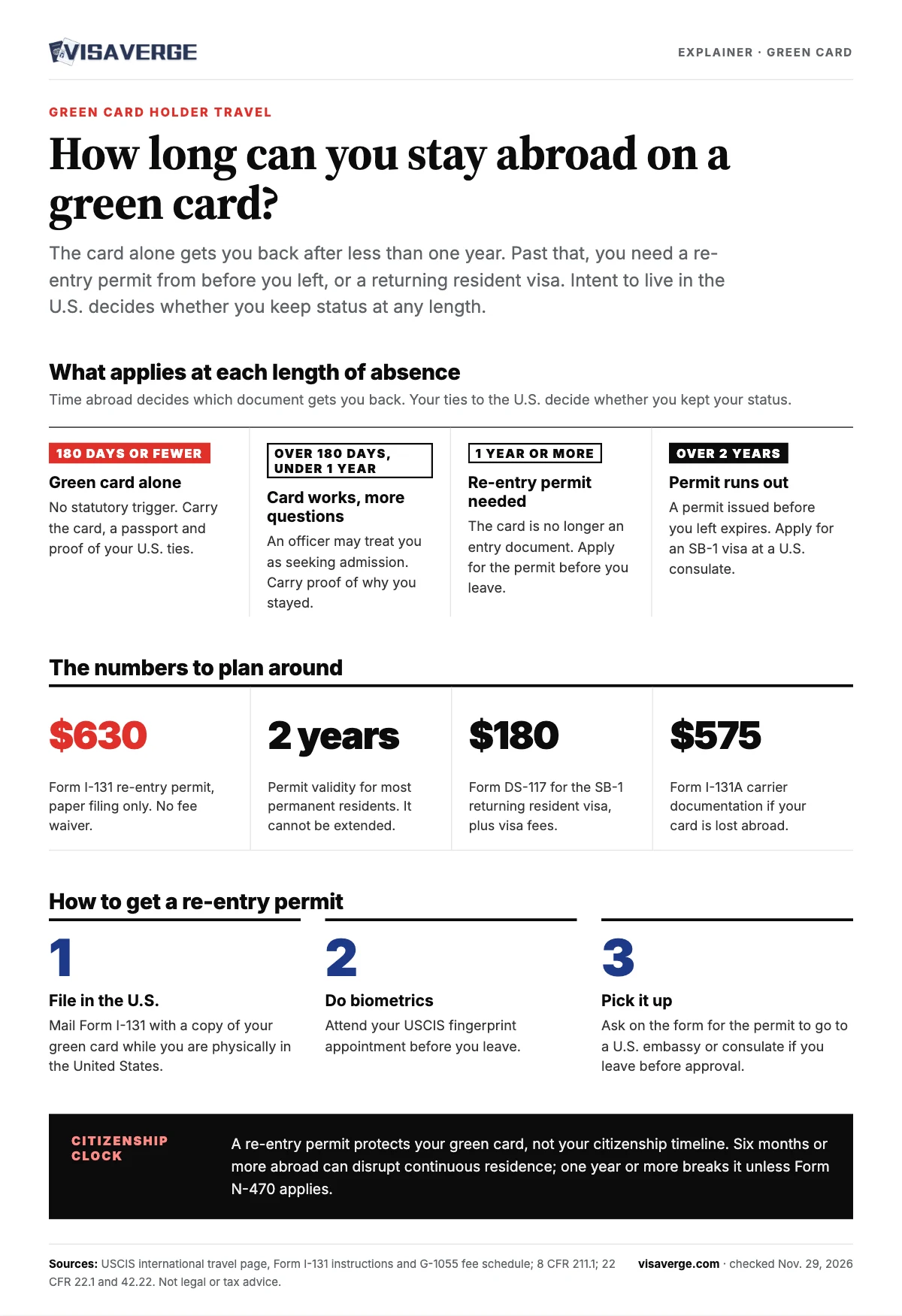
The length of the trip changes your paperwork in three steps. Past 180 days abroad, the law lets a border officer treat you as someone who is seeking admission, which brings more questions. At one year, the green card stops working as a re-entry document. Past two years, even a re-entry permit issued before you left runs out, and the only route back is a returning resident (SB-1) visa from a U.S. embassy or consulate.
Naturalization runs on a separate clock. You can keep your green card after eight months abroad and still put the continuous residence you need for citizenship at risk. A re-entry permit protects your green card status. It does not protect your citizenship timeline.
The border itself has also moved. On June 23, 2026, the Supreme Court decided Blanche v. Lau, a 6-3 ruling that lets border officers treat a returning green card holder as an applicant for admission on the strength of a past offense, without first proving it by clear and convincing evidence. The ruling is narrow, and this guide explains exactly what it did and did not change.
The money is fixed for now. A re-entry permit costs $630 on the USCIS fee schedule dated November 19, 2026, and you must file on paper while you are physically in the United States. USCIS publishes processing times in months, not weeks, so planning starts well before the ticket is bought.
| India | China | ROW | |
|---|---|---|---|
| EB-1 | Feb 01, 2023 | Aug 01, 2023 | Current |
| EB-2 | Nov 01, 2013 | Oct 01, 2021 | Apr 01, 2025 |
| EB-3 | Jan 22, 2014 | Jan 22, 2022 | Jun 15, 2024 |
| F-1 | Jan 22, 2021 | Jan 22, 2021 | Jan 22, 2021 |
| F-2A | Nov 22, 2026 ▲31d | Nov 22, 2026 ▲31d | Nov 22, 2026 ▲31d |
This guide covers every situation a permanent resident is likely to meet: how long you can stay abroad, how abandonment of residence is decided, the separate naturalization rules, how to get a re-entry permit, the SB-1 visa, what to carry, what Customs and Border Protection (CBP) can ask and do, Form I-407, a lost or expired card abroad, travel bans, and conditional residents. Every rule and fee below was checked against the official source on November 29, 2026, and each source is linked where it is used.
- Trips under one year: the green card alone gets you back (8 CFR 211.1(a)(2)), but intent to live in the U.S. decides whether you keep status.
- One year or more abroad: you need a re-entry permit issued before you leave, valid for 2 years and costing $630, or an SB-1 visa after the permit or card no longer works.
- Absences of 6 months or more can break continuous residence for citizenship; one year or more breaks it unless Form N-470 ($420) preserves it.
- Blanche v. Lau (June 23, 2026) lets officers treat a returning permanent resident with a past qualifying offense as an applicant for admission; it does not change the length-of-absence rules.
- Form I-407 is voluntary and waives your right to a hearing before an immigration judge. You can decline to sign it.
How Long Can a Green Card Holder Stay Outside the U.S.?
USCIS says on its international travel page for permanent residents that temporary or brief travel usually does not affect your status, and it frames the general line at an absence of more than one year. USCIS does not publish a separate 6-to-12-month rule. The 180-day number that people quote comes from the statute (INA 101(a)(13)(C)(ii)), and the one-year number comes from the entry-document regulation. They do different jobs, so keep them apart.
| Time abroad | Document to return | What changes |
|---|---|---|
| 180 days or fewer (about 6 months) | Valid green card | No statutory trigger. Abandonment is still possible if your life moved abroad. |
| More than 180 days, under 1 year | Valid green card | An officer may treat you as seeking admission and examine your admissibility. Naturalization continuity is in question. |
| 1 year or more | Re-entry permit, SB-1 visa, or a discretionary waiver | The green card alone is no longer a valid entry document. |
| More than 2 years | SB-1 returning resident visa | A re-entry permit issued before departure expires once you are abroad more than 2 years. |
The one-year line is in the regulation on documents for returning residents, 8 CFR 211.1(a). It accepts a valid, unexpired Form I-551 (the green card) from someone “seeking readmission after a temporary absence of less than 1 year.” After a year, the list of accepted documents is an immigrant visa, a re-entry permit (Form I-327 permit to reenter) or a properly endorsed refugee travel document.
The 180-day line is in INA 101(a)(13)(C). A permanent resident is not regarded as seeking admission on return unless one of six conditions applies. One is an absence “for a continuous period in excess of 180 days.” The others are abandoning or relinquishing status, illegal activity after departing, leaving while under legal process seeking removal, committing an offense listed in INA 212(a)(2) (without relief), and trying to enter at a place or time other than the one officers designate. Being “regarded as seeking admission” does not mean you lost your card. It means the officer can test you against the grounds of inadmissibility instead of treating you as someone already admitted.
Do not read “under a year” as “safe.” USCIS says a trip shorter than a year can still be treated as abandonment if you did not intend to make the United States your permanent home. Several 5-month trips a year, every year, can look like a life lived abroad.
Abandonment of Residence: How It Is Decided
Abandonment is about intent. You keep permanent resident status only while you intend to live in the United States permanently, and a long or frequent absence is evidence that you do not. USCIS’s own Form I-131 instructions say that without a re-entry permit, “lengthy or frequent absences” could support a conclusion that you abandoned status, and that if DHS decides so on your return, you can challenge the decision in removal proceedings.
The USCIS travel page names the evidence officers weigh. Build your file around the same items, and keep proof of each one that applies.
- Family and community ties in the United States
- U.S. employment, or a job waiting for you
- Filing U.S. income taxes as a resident
- A U.S. mailing address and a home you keep
- U.S. bank accounts and a valid U.S. driver’s license
- U.S. property or a business
- Evidence that the absence was meant to be temporary, such as a round-trip ticket, a leave letter or a medical record
Two details matter in practice. First, taxes cut both ways. Under 8 CFR 316.5(c)(2), voluntarily claiming nonresident alien status on a tax return, or not filing because you consider yourself a nonresident, creates a rebuttable presumption that you gave up your permanent resident privileges. Second, the burden shifts at a hearing. Form I-407’s instructions tell permanent residents that if they choose a hearing before an immigration judge, they can require DHS to prove abandonment “by clear, unequivocal, and convincing evidence.”
The sources we checked set no waiting period after you receive your card. The same tests apply on the first trip as on the fiftieth, but a trip right after approval, with little U.S. history to show, leaves you with less evidence to produce.
If your life will be split between countries, treat the re-entry permit as insurance, not as paperwork for people who have already left. Our guide on how permanent residents can avoid losing status over abandonment covers the day-to-day habits that build the record.
Naturalization Runs on Its Own Clock
The continuous residence rules for citizenship are stricter than the rules for keeping the green card. You can be a valid permanent resident and still have to wait to apply for citizenship. USCIS describes the rules on its continuous residence and physical presence page, and the regulation is 8 CFR 316.5(c).
| Continuous absence | Effect on continuous residence | How to deal with it |
|---|---|---|
| Under 6 months | No disruption | Nothing to file |
| 6 months to under 1 year | Disrupted unless you show otherwise | Evidence: kept your U.S. job, family stayed, kept access to your U.S. home, did not work abroad |
| 1 year or more | Disrupted | File Form N-470 before the absence reaches a year, if you qualify; otherwise restart the clock |
For absences of one year or more, the regulation sets the restart: a five-year applicant may file four years and one day after returning to resume permanent residence, and a three-year (spouse of a citizen) applicant two years and one day after. USCIS also requires 30 months of physical presence in the five-year period, or 18 months in the three-year period.
Form N-470 preserves residence for people who work abroad for certain recognized employers. It costs $420 on the November 19, 2026 fee schedule. A re-entry permit does not do this job: the Form I-131 instructions state that an absence of one year or more will generally break continuity for naturalization even with a permit.
Planning to apply for citizenship soon after a long trip? Check the timeline in our step-by-step N-400 guide before you book.
Who Needs a Re-Entry Permit
USCIS says permanent and conditional residents who will be outside the United States for one year or more should apply for a re-entry permit before they leave. While it is valid, it lets you apply for admission without first getting a returning resident visa abroad. You should also consider one if your trips are shorter but frequent or open-ended, because under 8 CFR 223.3(d)(1) a valid permit means you are not deemed to have abandoned status based solely on how long you were away while it is valid.
Know what it does not do. The Form I-131 instructions say a re-entry permit “does not exempt an alien from compliance with any of the requirements of U.S. immigration laws.” You are still inspected, you must still be admissible, and a CBP officer makes the final call. It also does not preserve continuous residence for citizenship (see Step 3).
You cannot get the permit after you leave. The Form I-131 instructions require you to be physically in the United States when you file and when you complete biometrics. CBP’s page on re-entry permits and other travel documents for returning aliens warns that failing to apply before leaving “may cause the alien to lose permission to re-enter the country.”
How to Apply for a Re-Entry Permit: Fee, Biometrics, Processing Time and Validity
The fee
The current USCIS fee schedule (Form G-1055), edition 11/19/26, lists a single fee for a re-entry permit. There is no online filing option and no fee waiver for this category. The schedule shows no separate biometric services line for it. Our news post on the schedule is USCIS Lists $630 Paper Fee for Reentry Permits.
| Form I-131, re-entry permit (paper filing only) | $630 |
| Fee waiver | Not available |
| Total | $630 |
Which form edition to use
USCIS published a new I-131 edition dated 04/22/26 on November 19, 2026. USCIS will accept both the 01/20/25 and 04/22/26 editions until December 20, 2026, and from December 21, 2026 it accepts only the 04/22/26 edition. File the 04/22/26 edition now and you avoid a rejection if your package is delayed in the mail.
The steps
- Complete Form I-131, select Part 1, Item 1 (re-entry permit), and answer Part 5 with the time you have been physically outside the U.S. since becoming a permanent resident
- Attach a copy of the front and back of your green card (if you do not have it yet: your passport biographic page and the admission page, the I-797 approval notice for a replacement card, or temporary evidence of status)
- Attach a copy of an official photo ID (a passport identity page or driver’s license works; Form I-94 does not)
- If you want to collect the permit abroad, choose a U.S. embassy, consulate or USCIS international office in Item 7.b (USCIS cannot mail a travel document to a foreign address)
- Pay $630 and mail the package to the lockbox listed for your state on USCIS’s I-131 filing addresses page
- Stay in the U.S. until USCIS sends your biometrics appointment and you attend it
Biometrics before you leave
Applicants between 14 and 79 may need to give fingerprints and a photo at a USCIS Application Support Center. USCIS tells you the time and place in writing after you file. Missing the appointment can lead to a denial. For a re-entry permit, the instructions require that you complete the biometric requirement while in the United States, so do not book a non-refundable departure until the appointment is done.
Processing time
Processing is slow. The latest range we found for the “re-entry permit or refugee travel document” category on USCIS’s case processing times data was 16.5 to 21 months, published November 20, 2026. Check the USCIS case processing times tool for the current figure before you plan, because the range moves. Our older post on reentry permit processing times tracks earlier readings.
A wait that long usually means you will leave before the permit is issued. That is allowed, as long as you filed in the U.S. and finished biometrics first, and you asked for the permit to be sent to a U.S. embassy, consulate or USCIS international office for pickup. The instructions warn that not every post offers this service. Confirm yours before you rely on it.
Validity
| Applicant | Validity |
|---|---|
| Permanent resident (general rule) | 2 years from issuance |
| Outside the U.S. more than 4 of the last 5 years since becoming a permanent resident | 1 year (exceptions: travel on U.S. Government orders, certain international organization employees, certain professional athletes) |
| Conditional permanent resident | Until the conditional status expires, not more than 2 years |
USCIS will not extend a permit. USCIS also will not issue a new one while you hold a valid permit unless the old one is returned or lost. Plan trips that run longer than the permit around that limit. If you stay abroad past the permit’s end, you are back to the SB-1 question in Step 6.
Older write-ups of Form I-131 follow earlier editions, so work from the 04/22/26 instructions for the re-entry permit parts.
The SB-1 Returning Resident Visa: When the Card or Permit No Longer Works
The SB-1 is an immigrant visa for former permanent residents who stayed abroad too long for a green card or permit to work. USCIS tells permanent residents who are abroad more than two years that a re-entry permit issued before departure expires, and that they can consider an SB-1 at a U.S. embassy or consulate. The Department of State describes the process on its returning resident visa page.
The test is in 22 CFR 42.22. The consular officer must be satisfied that you (1) had permanent resident status when you left, (2) left with the intention of returning and have not abandoned that intention, and (3) are returning from a temporary visit abroad and, if the stay was protracted, the delay was caused by reasons beyond your control and for which you were not responsible. A long stay that was a choice does not meet the third part.
| Form DS-117, Application to Determine Returning Resident Status (22 CFR 22.1, item 35(a)) | $180 |
| Immigrant visa application processing fee, medical exam and vaccinations | Per State Department fee page |
The process starts with Form DS-117 filed at the embassy or consulate where you will apply, followed by the immigrant visa application (DS-260), a medical examination and an interview. Procedures vary by post, so read your embassy’s instructions before paying anything. Check the State Department’s fees for visa services page for the immigrant visa processing fee that applies to returning residents. USCIS’s travel page also notes an exception for spouses and children of U.S. Armed Forces members and U.S. Government civilian employees stationed abroad on official orders; read it if that is you.
| Re-entry permit | SB-1 visa | |
|---|---|---|
| When you get it | Before you leave the U.S. | After you are abroad |
| Who it fits | Planned absence of 1 year or more | Stay past 2 years, or no permit, for reasons beyond your control |
| Main test | You are a permanent resident, in the U.S., with biometrics done | Temporary visit, intent to return, delay beyond your control |
| Where | USCIS, paper filing | U.S. embassy or consulate |
| Core fee | $630 | $180 (DS-117) plus visa fees |
| Protects against abandonment finding on length alone | Yes, while valid | Not applicable; it grants a new immigrant visa |
If you reach a port of entry without a valid document after a long stay, 8 CFR 211.1(b)(3) lets the DHS officer waive the missing visa, card or permit and admit you as a returning resident if you show good cause. That waiver is discretionary, it needs a filing and a fee, and it is a last resort, not a plan.
What to Carry When You Return
The regulation names the green card for trips under a year. USCIS adds that CBP may also review other identification, such as a passport, a foreign national ID or a U.S. driver’s license. Carry originals for the legal documents and keep copies of everything in a separate bag.
- Valid, unexpired green card (Form I-551) in your hand, not in checked luggage
- Passport from your country of citizenship (also needed by airlines and for foreign entry rules)
- Re-entry permit, if you hold one
- I-797 receipt notice if your card is expiring or you filed Form I-90 or Form I-751 (see Step 10)
- Proof of U.S. ties: lease or mortgage, recent pay stubs or an employer letter, most recent tax return and transcript, bank statements, driver’s license
- An explanation of any stay over 180 days with proof: medical records, a family emergency letter, an employer’s leave approval
- Return ticket or itinerary, and the contact details of a lawyer you can call
The document rules do not depend on the destination. A trip to Canada or Mexico by land, sea or air is still a departure that CBP will inspect on return, and the 180-day and one-year lines in Step 1 apply the same way. The destination country sets its own entry rules for your passport, and USCIS tells travelers to check those with the State Department at travel.state.gov.
Our earlier piece on bringing extra documents when coming back gives the reporting behind this list.
At the Border: What CBP Can Ask and Do, and the 2026 Supreme Court Ruling
Inspection basics
CBP’s page on what to expect when you return says CBP “must inspect everyone who arrives at a U.S. port of entry.” Officers may ask about your trip, your background and what you are bringing back, and have legal authority to search you, your baggage and your vehicle. Most returning residents are admitted after a short interview. Some are sent to a second, longer interview. Our reporting on airport detention rules for returning permanent residents and on detentions over decades-old records shows how that second step can go.
Phones and laptops
CBP’s border search of electronic devices page cites CBP Directive No. 3340-049B. A basic search is a manual review without equipment. An advanced search, which connects equipment to copy or analyze a device, needs reasonable suspicion of a violation or a national security concern plus senior manager approval. CBP says a device it cannot inspect because of a passcode may be detained or otherwise acted on, and that for foreign nationals, refusing to allow inspection may be considered in admissibility decisions. CBP may keep copies of information related to immigration or other enforcement matters, and information in its Automated Targeting System can be kept up to 15 years.
Blanche v. Lau (June 23, 2026)
The Supreme Court’s decision in Blanche v. Lau, No. 25-429 is the biggest change to returning-resident law this year, so here is what the opinion says.
Facts. Muk Choi Lau became a permanent resident in 2007. In 2012 New Jersey charged him with trademark counterfeiting. While the case was pending he traveled to China and, on June 15, 2012, tried to re-enter. The border officer treated him as not already admitted, because of the pending charge, and paroled him in. After he pleaded guilty in 2013, the government started removal proceedings and charged him as an applicant for admission who was inadmissible for a crime involving moral turpitude. Lau argued he was an admitted permanent resident who could be removed only on deportability grounds.
Holding. Justice Thomas wrote for a 6-3 Court (Chief Justice Roberts and Justices Alito, Gorsuch, Kavanaugh and Barrett joined; Justice Jackson dissented, joined by Justices Sotomayor and Kagan). The Court held that the INA does not require a border officer to have clear and convincing evidence that a permanent resident committed a crime involving moral turpitude before treating the resident as an applicant for admission. Under INA 101(a)(13)(C)(v), the government may regard a permanent resident as seeking admission as soon as he “has committed” an offense identified in INA 212(a)(2), even if the conviction comes later. The Court vacated the Second Circuit’s decision and sent the case back. It did not decide whether Lau’s offense is in fact a crime involving moral turpitude.
| Question | Answer after the ruling |
|---|---|
| Does a trip under 180 days now raise the risk? | The ruling did not change the length-of-absence rules. |
| Can an officer treat a returning resident as an applicant for admission over a past offense? | Yes. No “clear and convincing” proof is needed at the border for that step. |
| Does the government still have to prove inadmissibility later? | Yes. In Lau’s case, the guilty plea supplied the proof at the hearing; the Board of Immigration Appeals applies its own burden “at the time of the removal hearing.” |
| Did the Court decide what offenses count? | No. It left the question for the lower court. |
| Who is most affected? | Permanent residents with a pending charge or a past offense listed in INA 212(a)(2), whatever the trip length. |
The practical lesson is to talk to an immigration lawyer before you travel if you have any arrest, charge or conviction, including an old one that was dismissed or expunged. Our report on a green card holder denied U.S. reentry after past arrests shows the kind of case this rule reaches.
Form I-407: Do Not Sign Under Pressure
Form I-407, Record of Abandonment of Lawful Permanent Resident Status, is a form that a permanent resident signs to give up status. USCIS says the form is for permanent residents who are outside the United States or at a port of entry and want to abandon status, and that DHS officials and consular officers also use it to record abandonment facts. The form states that submitting it is voluntary and that U.S. law does not require you to complete, sign or submit it. You may ask for a hearing before an immigration judge if you disagree with DHS’s claim that you abandoned status.
- You waive your right to a hearing before an immigration judge on whether you abandoned status
- Without signing, you could be represented by a lawyer at no cost to the government, challenge DHS evidence, present your own evidence, require DHS to prove abandonment by clear, unequivocal and convincing evidence, and appeal
- USCIS gives your name and the filing date to the IRS, and there may be significant income tax consequences once you are no longer a permanent resident
- You surrender your green card and any re-entry permit
If an officer hands you Form I-407 after a long trip, you do not have to sign it. Ask what the form does, say you want to keep your status, and ask to have the case decided by an immigration judge. Then call a lawyer. A signed form waives your hearing.
Lost, Stolen or Expired Green Card Abroad
Airlines will not board a passenger without a valid document, and the carrier is fined for bringing in someone who lacks one. That is why the first problem after losing a card abroad is the flight, not the border. USCIS handles this with Form I-131A, carrier documentation, which takes the form of a boarding foil in your passport or a boarding letter.
| Form I-131A, carrier documentation (paid online first, no fee waiver) | $575 |
| Form I-90 replacement card, filed online (after you are back) | $415 |
| Form I-90 replacement card, paper filing | $465 |
Lost, stolen or destroyed card or permit
- Confirm first that your nearest U.S. embassy or consulate processes Form I-131A, then pay the fee online at the USCIS travel document payment page (each form’s fee separately; one combined payment can get the package rejected)
- Enter the correct name, date of birth and A-Number when paying, because they appear on the boarding foil
- Appear in person at the consular section with your original passport, a copy of the passport biographic page, evidence of permanent resident status, your travel itinerary, a signed form and one passport-style photo taken within 30 days
- Eligibility: you have not abandoned status, the trip was temporary, and you are returning after less than 1 year (card) or less than 2 years (re-entry permit)
Carrier documentation is generally valid for 30 days. The decision is discretionary and cannot be appealed. It lets you board, nothing more: you are still inspected on arrival, and you must file Form I-90 for a new card once you are back. A lost card inside the United States calls for Form I-90, with no carrier paperwork.
Expired card
An expired card is not a valid document under 8 CFR 211.1(a)(2). If your card is expired or about to expire, file Form I-90 before leaving. USCIS says the I-90 receipt notice, together with the expired card, is evidence of permanent resident status for 36 months from the expiration date, and that you remain authorized to work and travel. Our report on traveling with an expired green card and an I-797 notice goes through the airline side.
If you cannot show a valid card, the carrier may refuse to board you even with receipts. The I-131A instructions say to contact your carrier first and to file Form I-131A only if the carrier will not accept your documents.
Travel Bans and Green Card Holders
Presidential Proclamation 10998, published in the Federal Register on December 19, 2025 (Doc. 2025-23570), suspends or limits entry for nationals of the countries it lists. Section 6(b)(i) says those suspensions do not apply to “any lawful permanent resident of the United States.” The proclamation took effect January 1, 2026, and applies only to listed-country nationals who were outside the United States on the effective date without a valid visa.
So a green card holder from a listed country is not barred from returning by this proclamation. Three limits matter.
A spouse or child abroad who is a national of a listed country and needs a visa is not covered by Section 6(b)(i). Check the narrower exceptions in Section 6(b) and the case-by-case exceptions in Sections 6(d) to 6(f) before you plan a family trip.
CBP still inspects you, and the length-of-absence and applicant-for-admission rules in Steps 1 and 8 still apply.
Section 7 requires the Secretary of State to report within 180 days of the proclamation and every 180 days after on whether the suspensions should be continued, terminated, modified or supplemented, so the list can change. Check the current text before you travel.
Our earlier report on green card holders being exempt from the 2026 restrictions covers how the policy developed.
Conditional Residents (2-Year Green Cards)
The abandonment and re-entry rules apply to conditional permanent residents too, with two points to watch. USCIS says the same re-entry permit rules cover conditional residents, but the permit is valid only until the date the conditional status will expire, and never more than 2 years. The card expires after two years, so a trip near the end of that window needs special care.
If you filed Form I-751 to remove conditions and your card has expired, 8 CFR 211.1(a)(5) accepts the expired conditional card together with the filing receipt for a returning trip of less than one year, and the I-131A instructions say you may use the expired card with a valid I-797 for a timely I-751 to board without carrier documentation (check with your airline). For the filing itself, see our I-751 filing guide. For long trips on a conditional card, see our report on returning with a conditional green card after more than six months away.
USCIS requires you to file Form I-751 during the 90-day period immediately before your conditional residence expires. A long trip that overlaps that window can make you miss it. Plan the trip around the filing, not the other way around.
Other Situations: Refugee and Asylee Green Card Holders
If your green card came from refugee or asylee status, a Refugee Travel Document under the same Form I-131 may be the better document, and the instructions say to apply before you leave. The fee is $0 for a refugee, or $165 (age 16 and older) or $135 (under 16) for an asylee, on the same fee schedule. The same instructions warn that an asylee who returns to the country of claimed persecution risks having asylum status terminated for voluntary re-availment. Never plan travel to the country you fled without talking to a lawyer.
Common Mistakes Permanent Residents Make
The permit must be applied for before you leave, and biometrics must be done in the U.S. Fix this by filing at least a year early if you can, and by picking the consulate pickup option.
Coming back after 5 months and 29 days does not prove you did not abandon status. Keep the house, job, accounts and tax filings in the United States.
A re-entry permit protects the green card. A year or more abroad still breaks continuous residence for naturalization unless Form N-470 applies.
The form is voluntary, waives your hearing and notifies the IRS. Decline and ask for a hearing.
After Blanche v. Lau, a past offense listed in INA 212(a)(2) can lead an officer to treat you as an applicant for admission on any trip. Talk to a lawyer before you fly.
An expired card is not a valid return document on its own. File Form I-90 before you leave and carry the receipt.
8 CFR 316.5(c)(2) treats that as a rebuttable sign you gave up permanent resident privileges. File as a resident unless a lawyer or tax professional advises otherwise for a real reason.
- USCIS: International travel as a permanent resident (last reviewed 09/12/2025)
- USCIS: Form I-131 and its instructions (edition 04/22/26, page updated 11/19/2026)
- USCIS: Fee Schedule G-1055 (edition 11/19/26)
- USCIS: Form I-131A and Form I-407
- 8 CFR 211.1, 8 CFR 223.3, 8 CFR 316.5 and 22 CFR 42.22, with INA 101(a)(13)(C)
- Supreme Court: Blanche v. Lau, No. 25-429 (decided June 23, 2026)
- CBP: What to expect when you return and border search of electronic devices
- Federal Register: Proclamation 10998 and State Department: Returning resident visas
Frequently Asked Questions
How long can a green card holder stay outside the US?
On the green card alone, you can return after an absence shorter than one year (8 CFR 211.1(a)(2)). Past 180 days an officer may treat you as seeking admission. Staying abroad one year or more requires a re-entry permit or SB-1 visa, and intent to live in the U.S. decides abandonment.
How much does a re-entry permit cost in 2026?
The USCIS fee schedule dated November 19, 2026 lists $630 for a re-entry permit on Form I-131. You must file on paper, there is no online option and no fee waiver. The schedule shows no separate biometric fee for this category.
How long does a re-entry permit take to process?
Slowly. The latest USCIS range we found for re-entry permits and refugee travel documents was 16.5 to 21 months, published November 20, 2026. Check the USCIS case processing times tool, and ask for pickup at a U.S. embassy or consulate if you leave before approval.
What is an SB-1 returning resident visa?
It is an immigrant visa for former permanent residents who stayed abroad too long for the card or permit to work. You must show you left intending to return and that a long stay was beyond your control (22 CFR 42.22). Form DS-117 costs $180.
What can CBP do when a green card holder returns?
CBP inspects everyone, may question you about the trip, and may search bags and devices. After Blanche v. Lau (June 23, 2026), officers can treat a returning permanent resident with a past INA 212(a)(2) offense as an applicant for admission without clear and convincing proof.
Do I have to sign Form I-407 if an officer asks?
No. Form I-407 is voluntary, and U.S. law does not require you to sign it. Signing waives your right to a hearing before an immigration judge and notifies the IRS. If you disagree that you abandoned status, you may ask for a hearing.
What if my green card is lost or stolen while I am abroad?
Apply for carrier documentation on Form I-131A in person at a U.S. embassy or consulate. The fee is $575, paid online first. You must have been abroad less than one year with a card, or less than two years with a re-entry permit.
Does the travel ban apply to green card holders?
No. Proclamation 10998, Section 6(b)(i), exempts any lawful permanent resident of the United States from its entry suspensions. The exception does not cover relatives who need visas, and CBP still inspects you on arrival.