A marriage-based green card lets the foreign-born spouse of a U.S. citizen or lawful permanent resident live and work in the United States permanently. The route depends on who the sponsor is. A U.S. citizen’s spouse is an “immediate relative,” so no visa number is capped or queued, and the couple can apply from inside the U.S. (Form I-485 filed with Form I-130) or from abroad (a CR1 or IR1 immigrant visa through the National Visa Center). The spouse of a green card holder falls in category F2A and has to be inside the date shown in the monthly Visa Bulletin before a green card can be issued.
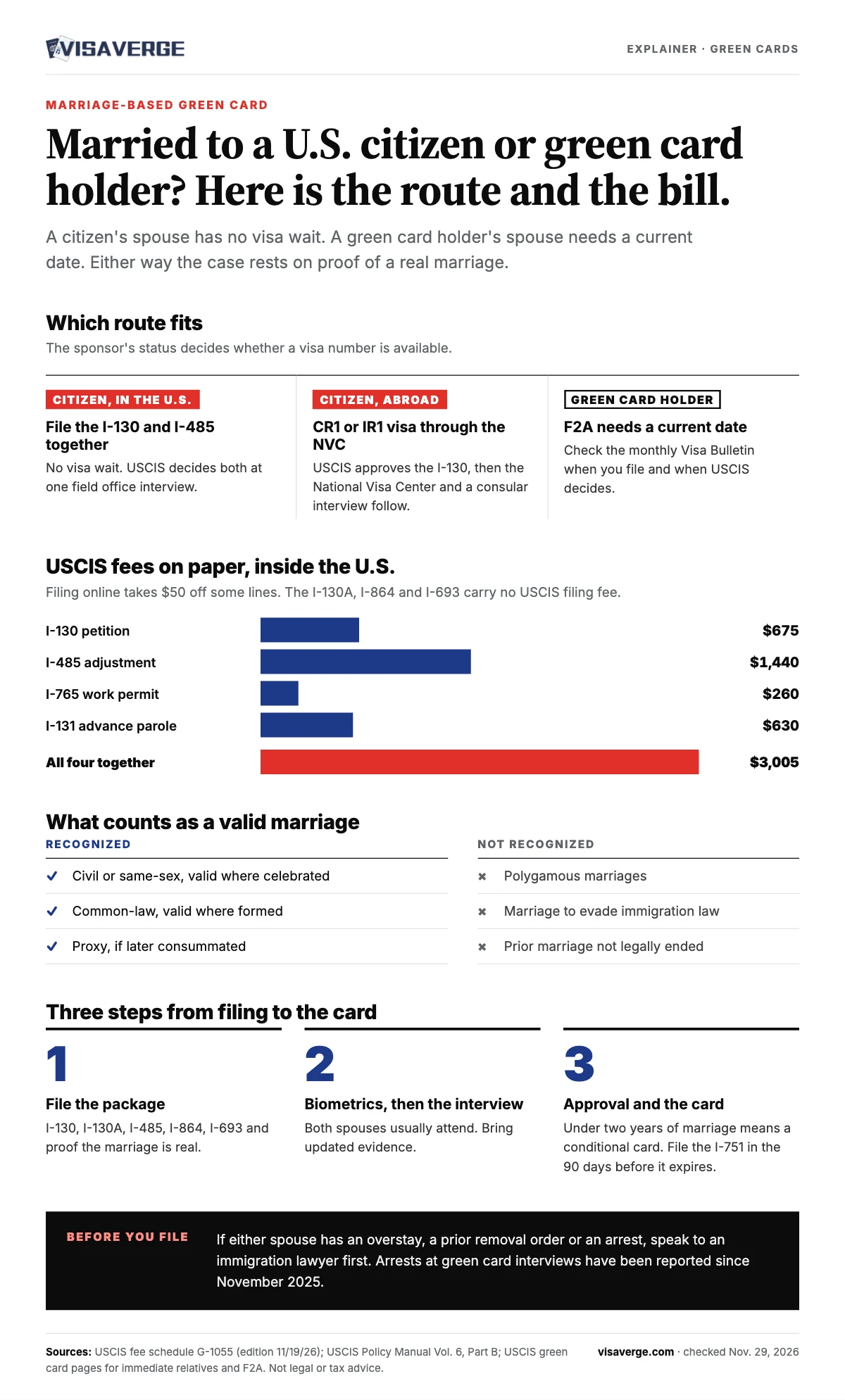
The government fees for the standard inside-the-U.S. package come from the USCIS fee schedule (Form G-1055, edition 11/19/26): $675 for Form I-130 and $1,440 for Form I-485 on paper, so $2,115, or $3,005 with the work permit ($260) and advance parole ($630) requests. The consular route has its own fee stack, laid out below.
USCIS’s FY2026 third-quarter report (April 1 to June 30, 2026) puts the median I-130 for the spouse of a U.S. citizen at 13 months and the median family-based I-485 at 7 months. Those are medians of finished cases, not promises; the interview wait, an RFE or a background check can add months.
This is a stricter system than two years ago. USCIS now calls adjustment of status extraordinary, discretionary relief (policy memorandum PM-602-0199, May 21, 2026). A new public charge framework took effect September 18, 2026. Forms I-485 and I-864 have new mandatory editions, and USCIS can deny a filing that lacks required initial evidence without sending a Request for Evidence first. Since November 2025, attorneys and news outlets have reported arrests of spouses of U.S. citizens at or after green card interviews. Proclamation 10998 also ended the categorical immigrant-visa exception for spouses (IR-1/CR-1) of nationals of the listed countries.
Every fee, edition date, rule and processing figure here was checked on November 29, 2026 against USCIS and other official sources, which are linked where the fact appears. Where a rule is being litigated we say what is in force today and what is pending. This is general information, not legal advice. If you have ever overstayed, been arrested, been in removal proceedings or been refused a visa, talk to an immigration attorney before you file.
| India | China | ROW | |
|---|---|---|---|
| EB-1 | Feb 01, 2023 | Aug 01, 2023 | Current |
| EB-2 | Nov 01, 2013 | Oct 01, 2021 | Apr 01, 2025 |
| EB-3 | Jan 22, 2014 | Jan 22, 2022 | Jun 15, 2024 |
| F-1 | Jan 22, 2021 | Jan 22, 2021 | Jan 22, 2021 |
| F-2A | Nov 22, 2026 ▲31d | Nov 22, 2026 ▲31d | Nov 22, 2026 ▲31d |
- A U.S. citizen’s spouse has no visa wait; a green card holder’s spouse (F2A) must be current in the Visa Bulletin both when filing and when USCIS decides.
- Core USCIS fees on paper: $675 (I-130) + $1,440 (I-485) = $2,115, or $3,005 with the work permit and advance parole requests.
- Marriages must be valid where celebrated and genuine from day one; polygamous marriages are never recognized, and proxy marriages count only if consummated afterward.
- USCIS FY2026 Q3 medians: 13 months for an immediate-relative I-130, 7 months for a family I-485, 22.6 months for an I-751.
- Eligibility is not immunity: an immediate relative can adjust despite an overstay, but arrests at USCIS interviews have been reported since November 2025, so get legal advice before attending if you have any status or enforcement history.
Who Qualifies: Spouse of a U.S. Citizen vs. Spouse of a Green Card Holder
Federal law lets U.S. citizens, U.S. nationals and lawful permanent residents petition for a qualifying spouse. USCIS’s page on green cards for immediate relatives of U.S. citizens lists the spouse of a U.S. citizen as an immediate relative and says immigrant visas for that group are unlimited, so one is always available. The spouse of a green card holder is covered by family preference category F2A, where an immigrant visa has to be immediately available both when the I-485 is filed and when USCIS decides it.
Neither filing an I-130 nor having it approved gives the foreign spouse any status. The USCIS Policy Manual says it directly: a family-based petition “accords no immigration status nor does it bar removal” (Volume 6, Part B, Chapter 5). Marriage by itself changes nothing in a person’s immigration position until a visa is issued or an adjustment is approved.
| Spouse of U.S. citizen | Spouse of green card holder | |
|---|---|---|
| Category | Immediate relative (IR1 or CR1 if abroad) | F2A (visa class F21 for spouses) |
| Visa number | Always available | Capped; must be current in the Visa Bulletin |
| Adjustment bars for unlawful status, unauthorized work, status violations | Do not apply | Apply (unless INA 245(i) or another exception fits) |
| Can file I-485 with the I-130 | Yes | Yes, if the date is current |
| If the sponsor naturalizes | Not applicable | Case becomes immediate relative |
Where the Visa Bulletin stands for F2A
The December 2026 Visa Bulletin, effective December 1, sets the F2A final action date at November 22, 2026 for most countries and May 22, 2026 for Mexico, one month ahead of the November figures (October 22, 2026 and April 22, 2026). The F2A date for filing is listed as current. Which chart USCIS accepts for family-sponsored filings changes monthly: for November 2026 USCIS said applicants “must use the Dates for Filing chart” for all family-sponsored categories. Check the State Department’s Visa Bulletin and USCIS’s visa availability and priority dates page on the day you file. Our December 2026 Visa Bulletin analysis tracks the monthly movement.
F2A dates can retrogress with little notice. A green card holder’s spouse who filed an I-485 while the date was current can be left waiting if the date moves backward before the case is decided.
One extra rule for green card holders: a petitioner who became a resident through an earlier marriage generally cannot petition for a new spouse within five years unless the earlier marriage was genuine by clear and convincing evidence or ended through death. The Policy Manual treats these as interview cases (Volume 6, Part B, Chapter 6).
What Counts as a Valid Marriage for Immigration
USCIS’s rules on spousal petitions were consolidated in a Policy Manual alert dated October 17, 2025 (Volume 6, Part B, Chapter 6, Spouses). A qualifying marriage must be legally valid in the place of celebration, consistent with U.S. public policy, genuine, and entered by two people who were free to marry.
- Civil marriages valid where they took place, including same-sex marriages
- Common-law marriages that are valid in the place they were formed
- Customary or traditional marriages valid under local law, usually with civil-authority proof
- Virtual ceremonies valid where the certificate was issued, if later consummated when the spouses were not together
- Marriages after a prior marriage was ended by a final divorce, annulment or death
- Polygamous marriages: only the first legally valid marriage counts, even if polygamy is legal where the ceremony took place
- Civil unions and domestic partnerships not treated as marriage where formed
- Proxy marriages (one party absent) unless the couple later consummates the marriage
- Marriages where a party was not free to marry or did not consent, including forced marriages
- Marriages entered to evade immigration law
Place of celebration, proxy and public-policy rules
The default is the place-of-celebration rule: if the marriage is valid where the ceremony happened, USCIS generally accepts it. Two exceptions matter. First, a marriage that violates U.S. public policy, such as polygamy or some marriages involving minors or close relatives, can still fail. When the couple lives, or will live, in a state that would not recognize the marriage, USCIS issues a Request for Evidence on that point. Second, the Immigration and Nationality Act requires both spouses to be present at the ceremony or the marriage to be consummated afterward. Evidence of consummation can include a child’s birth certificate, travel records showing the spouses together afterward, or a joint lease.
Free to marry: divorces, annulments and separation
Every earlier marriage of either spouse must have ended through a final divorce decree, annulment or death; an interlocutory decree with an unexpired waiting period is not enough. A legal separation obtained before the petition is approved leads to denial, while living apart without a court order does not, by itself.
Genuine from the start
The test is whether the couple intended to build a life together when they married. USCIS looks at that intent at the beginning of the marriage. The Policy Manual says the viability of the marriage and the likelihood that it will last are not relevant, so a rocky marriage can still qualify if it began in good faith.
Marrying while in the U.S. on a visitor visa or ESTA
For an immediate relative, marrying on a B-2 visa or ESTA does not itself ruin the case: Policy Manual Volume 7, Part B, Chapter 8 lists unauthorized employment, lack of lawful status, failure to maintain status and a last admission under the Visa Waiver Program among the bars that do not apply to a U.S. citizen’s spouse (Chapter 8). Misrepresentation is a different issue. The State Department’s “90-day rule” does not bind USCIS, but USCIS says it can find willful misrepresentation when conduct after entry is inconsistent with the stated purpose of the visit (Volume 8, Part J, Chapter 3). An ESTA entrant who has already overstayed should see a lawyer first. Our guide to cross-border marriage and the CR1 spouse visa covers marrying in the U.S. first.
Three bars to know about
Under INA 204(c), USCIS must deny any petition for a person who previously entered, or tried or conspired to enter, a marriage to evade immigration law; the standard is “substantial and probative evidence,” and the bar then applies to any later petition filed for that person. Under INA 204(g), a marriage that occurred while the foreign spouse was in removal proceedings cannot support a petition unless an exemption applies, most often by clear and convincing evidence that the marriage was genuine. A frivolous asylum application finding can also bar all immigration benefits.
Adjustment of Status or Consular Processing?
Every marriage green card begins with Form I-130, the petition proving the marriage. What differs is where the foreign spouse finishes the process. The I-130 is only stage one: it asks USCIS to recognize the relationship, and a visa or green card still requires either Form I-485 inside the U.S. or an immigrant visa application abroad through the Department of State’s National Visa Center (NVC).
| Adjustment of status (inside U.S.) | Consular processing (abroad) | |
|---|---|---|
| Where the spouse is | Physically in the U.S. | Outside the U.S. (or chooses to depart) |
| Core forms | I-130, I-130A, I-485, I-864, I-693 | I-130, I-130A, DS-260, I-864, medical exam |
| Decided by | USCIS field office | Consular officer, after NVC |
| Work permit while waiting | Yes (I-765) | No |
| Travel while waiting | Needs advance parole (I-131) | Not applicable |
| Arrival | Already in the U.S. | Enter on the immigrant visa, green card mailed |
| Unlawful presence bars (3 or 10 years) | Generally not triggered by adjusting | Triggered on departure if the spouse accrued unlawful presence; I-601A waiver may help |
Who can adjust inside the U.S.
INA 245(a) requires the applicant to have been “inspected and admitted or paroled.” A person who entered without inspection generally cannot adjust, whatever the marriage (Policy Manual, Volume 7, Part B, Chapter 2). That is why the manner of entry is the first question a lawyer asks. Immediate relatives are exempt from several bars that otherwise stop applicants who have been out of status, worked without permission, entered under the Visa Waiver Program or violated visa terms. The spouse of a green card holder (F2A) does not get those exemptions and must be in lawful status when filing unless INA 245(i) or another exception applies.
This is also where a past F-1 or H-1B violation shows up. For an immediate relative, the statutory bars do not apply, but the violation still counts in USCIS’s discretionary review and in any fraud or misrepresentation inquiry.
The 2026 discretion memo, in plain terms
On May 21, 2026, USCIS issued PM-602-0199, titled “Adjustment of Status is a Matter of Discretion and Administrative Grace, and an Extraordinary Relief that Permits Applicants to Dispense with the Ordinary Consular Visa Process.” It tells officers that where consular processing is available in the applicant’s category, adjustment is extraordinary relief, and that applicants must show unusual or outstanding equities to offset adverse factors. It lists immigration violations, fraud or false testimony, and failure to leave when expected as relevant, and says officers must weigh positive and negative factors “including family ties.” It creates no rights, and USCIS may issue category-specific guidance later.
The memo does not mention marriage cases specifically and does not change who is eligible. As of November 29, 2026 we found no USCIS guidance either carving marriage cases out or singling them out. Our report on the memo has the reaction. A spouse with a clean record and strong evidence is in a different position from one with an overstay and thin proof of a shared life.
Which is faster?
For a U.S. citizen’s spouse already in the U.S. with a lawful entry, filing the I-130 and I-485 together is usually shorter, because one agency decides the work permit and the green card in one cycle. Consular processing adds the NVC and a consular interview whose wait USCIS does not control. After approval, the petitioner can ask USCIS to switch between adjustment and consular processing (Policy Manual, Chapter 5). A K-1 fiance(e) visa is a separate pre-wedding path ($675 for Form I-129F on the USCIS fee schedule).
If the foreign spouse has been in the U.S. unlawfully for more than 180 days and leaving would trigger a 3-year or 10-year bar, Form I-601A (provisional unlawful presence waiver, $795) lets a spouse of a U.S. citizen or green card holder apply for the waiver before leaving for the consular interview. It requires an approved petition and evidence of extreme hardship to a qualifying relative. See the USCIS I-601A page.
Forms and Current Fees
A marriage-based case uses a short list of forms. Each links to its official USCIS page; always download the form from USCIS on the day you file, because wrong-edition filings are rejected.
USCIS filing fees (Form G-1055, edition 11/19/26)
The amounts below come from the USCIS fee schedule as published on November 29, 2026. USCIS notes that online filing often carries a $50 discount, and an incorrect fee means rejection.
| Form I-130, Petition for Alien Relative (online: $625) | $675 |
| Form I-485, adjustment of status, applicant over 14 (online: $1,390; biometrics included) | $1,440 |
| Core total (I-130 + I-485) | $2,115 |
| Form I-765 with a pending I-485 filed with a fee (paper and online) | +$260 |
| Form I-131 advance parole with a pending I-485 (online: $580) | +$630 |
| Total with work permit and travel document | $3,005 |
| Form I-130A, Form I-864, Form I-693 (USCIS filing fee) | $0 |
The civil surgeon sets the I-693 exam fee. Form I-131 can also carry an “Immigration Parole Fee” under Public Law 119-21, but the schedule lists an exception for adjustment applicants returning after temporary travel; those fees cannot be waived. Some other fees can be waived with Form I-912.
| Form I-130 filing fee (online: $625) | $675 |
| Immigrant visa application processing fee, immediate relative and family preference (State Department, 22 CFR 22.1) | $325 |
| USCIS Immigrant Fee, paid after the visa is issued | $235 |
| Form I-601A provisional waiver, if needed | +$795 |
The NVC may also charge an Affidavit of Support review fee. Check the current fee on the State Department fee page rather than relying on a figure here. The State Department lists its fees on its fees for visa services page and in 22 CFR 22.1. USCIS says the card is not produced until the $235 Immigrant Fee is paid; it may be paid after arrival.
Form editions in force on November 29, 2026
| Form | Edition to use | Notes |
|---|---|---|
| I-485 | 09/18/26 | Mandatory for filings postmarked or e-filed on or after Sept. 18, 2026; no grace period for the old 01/20/25 edition |
| I-864 | 08/24/26 | Only this edition accepted from Oct. 1, 2026; an I-485 filed with the older edition is not rejected for that reason |
| I-130 | 04/01/24 | Part 4: choose exactly one of questions 61 or 62 |
| I-693 | 01/20/25 | Filed in the civil surgeon’s sealed envelope |
| I-765 | 08/21/25 | USCIS is not accepting the 09/15/26 edition after a Nov. 16, 2026 court order vacating the rule |
| I-131 | 04/22/26 (01/20/25 also accepted until Dec. 21, 2026) | Only 04/22/26 accepted from Dec. 21, 2026 |
| I-751 | 04/01/24 | Used later, to remove conditions |
Sources: the USCIS I-485 edition alert and the form pages linked above. If a page’s edition changes again, that page controls.
The Affidavit of Support (I-864) and the income test
Almost every marriage-based applicant needs an I-864 signed by the petitioner. It is a legally binding contract: if the immigrant receives means-tested public benefits, an agency can seek repayment from the sponsor. Household income must reach 125% of the federal poverty guidelines for the sponsor’s household size (USCIS I-864P table, effective March 1, 2026, 48 contiguous states and D.C.):
| Household of 2 (sponsor and immigrating spouse) | $27,050 |
| Household of 3 | $34,150 |
| Household of 4 | $41,250 |
| Household of 5 | $48,350 |
Alaska, Hawaii and active-duty military sponsors have different figures (I-864P page). A joint sponsor can cover a shortfall. Our I-864 Affidavit of Support guide goes deeper.
Filing From Inside the U.S.: I-130 and I-485 Together
For an immediate relative (and for an F2A spouse whose date is current), the petitioner’s I-130 and the spouse’s I-485 can be filed at the same time. USCIS says the application can be filed with the I-130, while the I-130 is pending, or after it is approved (I-485 page). The I-485 now has an online filing option for certain applicants, and the I-130 can be filed online as well.
- Form I-130 (petitioner) with proof of the petitioner’s U.S. citizenship or green card, and Form I-130A for the spouse
- Form I-485 (09/18/26 edition) with passport-style photos, ID, birth certificate, passport pages and I-94 or entry record
- Marriage certificate and final divorce decrees or death certificates for every prior marriage of either spouse
- Form I-864 (08/24/26 edition) with tax transcripts or returns, W-2s and proof of current income
- Form I-693 in the civil surgeon’s sealed envelope (or the partial form, where allowed)
- Evidence the marriage is real (Section 7)
- Optional with the package: Form I-765 for work and Form I-131 for travel
- Form G-28 if an attorney or accredited representative represents you
Mailing locations depend on where the applicants live and whether the I-130 is filed concurrently; use USCIS’s I-130 addresses and I-485 addresses pages, and never send originals unless asked. Our marriage-based I-485 documents checklist gives a longer list.
Medical exam (Form I-693)
Form I-693 must go in with the I-485 or USCIS may reject it. By mail, file the civil surgeon’s envelope sealed; online, open it, upload the form and keep the original and envelope until a final decision. For validity rules see Policy Manual Volume 8, Part B, Chapter 4.
Work permit and advance parole while the I-485 is pending
A pending I-485 lets the applicant request a work permit under category (c)(9) on Form I-765 (write “(c)(9)” in Part 2, item 27) and a travel document on Form I-131 (Part 1, box 5.A). Both can go in with the I-485. In USCIS’s FY2026 Q3 report the median wait for an adjustment-based I-765 was 6.4 months and for an advance parole request 5.8 months.
USCIS says that if you have a pending I-485 and leave the U.S. without an advance parole document it will generally treat the application as abandoned. Even with a document, the Board of Immigration Appeals overruled Matter of Arrabally and Yerrabelly in Matter of Delcarmen-Lara, effective August 13, 2026, and USCIS now says leaving after obtaining advance parole counts as a departure for the 180-day unlawful presence ground. If you have accrued more than 180 days of unlawful presence, ask a lawyer before any trip. Our report on the BIA ruling explains it.
Consular Processing: CR1, IR1 and the NVC
When the foreign spouse lives abroad, the U.S. petitioner files the I-130 with USCIS (online, or by mail to the Chicago lockbox; a U.S. citizen petitioner abroad can in limited cases file at an embassy or consulate). Once USCIS approves it, the case goes to the Department of State’s National Visa Center. The State Department’s immigrant visa for a spouse of a U.S. citizen page and the USCIS consular processing overview describe the steps.
| CR1 (conditional) | IR1 (immediate relative) | |
|---|---|---|
| Marriage length when the visa is issued and the spouse enters | Under 2 years | 2 years or more |
| Green card validity | 2 years, then I-751 | 10 years |
| Process and fees | The same: I-130, NVC, DS-260, interview | |
The conditional period is set by the law on entry, not by the date of the wedding or the date of the petition.
Steps after USCIS approves the I-130
- The NVC opens the case and sends a welcome letter; pay the fees the NVC invoices through CEAC (check the current amounts on the State Department fee page).
- Complete the DS-260 immigrant visa application online and submit the I-864 and civil documents (birth, marriage, divorce, police certificates).
- When the case is “documentarily qualified,” the NVC sends it to the consulate and the consulate schedules the interview.
- Attend the medical exam with a panel physician approved by the consulate, then the interview.
- If approved, you receive a sealed packet for the border officer. Pay the $235 USCIS Immigrant Fee, enter the U.S., and the green card arrives by mail. USCIS says to contact it if the card has not arrived within 90 days of arrival.
Keep the NVC updated on address changes, a change in marital status or a child aging out.
Current restrictions affecting consular cases
Two State Department measures have affected spouse visas in 2026. First, a January 2026 State Department pause on immigrant visa issuance to nationals of 75 countries was challenged in court. On August 21, 2026, a federal court in New York (CLINIC v. Rubio, S.D.N.Y.) vacated the pause and set aside refusals based only on it, as CLINIC reports. The State Department has appealed, and consular officers still decide each case, so check the State Department notice before relying on this.
Second, Presidential Proclamation 10998, signed December 16, 2025 and effective January 1, 2026, fully or partially suspends entry and visa issuance for nationals of 39 countries and holders of Palestinian Authority documents. The State Department’s notice says the earlier categorical exceptions for IR-1/CR-1 spouse visas are no longer available; applicants can still be interviewed, and a case-by-case national interest exception can be requested. The 75-country ruling did not touch the proclamation. See the State Department notice on the proclamation and 90 FR 59717. Couples from those countries should check the proclamation’s exception process with an attorney. The USCIS benefit holds on nationals of those countries were vacated by a federal court on June 5, 2026 (Dorcas International Institute of Rhode Island v. USCIS); USCIS says it will comply with the order while the appeal proceeds and the vacated memoranda “should be treated as if they are not in effect.”
The public charge ground (INA 212(a)(4)) also applies to immigrant visa applicants, so the I-864 and the sponsor’s finances matter at the NVC and the interview.
Evidence of a Genuine Marriage: What to Submit
The petitioner carries the burden to show that the marriage is legally valid and was entered in good faith. USCIS generally decides by a preponderance of the evidence, meaning more likely than not. The Policy Manual’s list of bona fide evidence is the baseline, and officers weigh quality and consistency more than volume.
- Marriage certificate issued by the civil authority and timely registered (a license alone is not enough)
- Documents showing joint ownership of property
- A lease showing joint tenancy at a common residence
- Commingled finances: joint accounts, shared credit, shared insurance
- Birth certificates of children born to the couple
- Sworn affidavits from people with personal knowledge of the relationship
- Any other proof the couple did not marry to evade immigration law
- Photographs from before and after the wedding with dates and different settings, plus travel together
- Joint tax returns, health or life insurance naming each other, and utility bills at one address
- Mail and records at the same address for each spouse
- Messages, call logs and travel records for long-distance periods
- Full certified English translations of any non-English document
Affidavits help most when primary evidence is thin or missing. USCIS says third-party affidavits must include the writer’s full name and address, date and place of birth, and details of how the writer knows about the marriage. Generic letters adding only “they are a loving couple” add little. A few strong affidavits that describe specific events the writer saw are worth more than a stack of form letters.
Photos work best as a dated timeline across the relationship, not a single album. Never submit staged photos or altered records.
USCIS Policy Alert PA-2026-05 (August 5, 2026), effective immediately for filings pending or received on or after that date, says officers may deny a benefit request for lack of required initial evidence “or issue an RFE.” Do not file hoping to cure gaps later; the second chance is no longer guaranteed. Read the alert.
After You File: Receipts, Biometrics, Case Status and RFEs
USCIS sends a receipt notice for each form. Keep the I-130 and I-485 receipt numbers: the I-131 can be filed online with an I-485 only when the I-485 receipt number begins with IOE, and you need receipt numbers to track status in your USCIS online account.
The I-485 applicant is then scheduled for a biometrics appointment (fingerprints and photo). Bring the notice and photo ID. USCIS then decides whether to interview. For a spouse, the Policy Manual says all adjustment applicants must be interviewed unless USCIS waives it, and it lists categories where waiver is likely (unmarried children and parents of U.S. citizens) but spouses are not on that list, so plan on an interview.
Reading your case status
Typical messages move from “received” to a biometrics notice, to a transfer of the file to the field office that will interview, then an interview notice, then a decision. “Case Was Transferred” generally means your file moved to another USCIS office, often because a field office will conduct the interview. “Case Was Approved” means a decision has been made; the card follows after production and mailing. Only the notices USCIS mails (Form I-797) are authoritative.
Requests for evidence and notices of intent to deny
If evidence is missing or weak, USCIS may send a Request for Evidence (RFE) or a Notice of Intent to Deny (NOID). Respond in full by the stated deadline; do not send only part. Missing the deadline can lead to a denial. Under PA-2026-05, USCIS may also deny directly when required initial evidence is missing, so an RFE is no longer something you can count on. Our guide to marriage-based I-485 documents helps avoid the common triggers.
Traveling to the U.S. while the I-130 is pending (spouse abroad)
A pending I-130 does not bar a visitor visa, but a consular officer starts from the presumption in INA 214(b) that an applicant is an intending immigrant. The Foreign Affairs Manual says the burden is on the applicant to show entitlement to a nonimmigrant category (9 FAM 302.1). A refusal is not permanent, but it can make the application look unreliable. Approval of an I-130 is not permission to enter. Arriving on a tourist status and then switching course can raise the misrepresentation issue described in Section 2.
Expediting a case
USCIS accepts expedite requests only for narrow reasons such as severe financial loss or urgent humanitarian need; see how to make an expedite request.
The Marriage Green Card Interview (and the Stokes Interview)
Under the USCIS Policy Manual, “all adjustment of status applicants must be interviewed by an officer unless the interview is waived,” and for family-based applications “USCIS generally requires the Form I-130 petitioner to appear for the interview with the principal adjustment of status applicant” (Volume 7, Part A, Chapter 5). The interview takes place at the field office with jurisdiction over where the couple lives. Consular cases are interviewed by a State Department consular officer, usually with only the beneficiary present.
The petitioner’s appearance can be waived in narrow cases: a military spouse petitioner, an incarcerated U.S. citizen spouse, or illness with supervisory approval. The applicant must still appear. If a spouse cannot attend on the date, follow the reschedule instructions on the notice. Interpreters are allowed, but USCIS says a disinterested party should generally be used and it can disqualify an interpreter whose participation compromises the exam.
- The interview notice and both spouses’ passports and government photo ID
- Originals of every civil document you filed (marriage certificate, birth certificates, divorce decrees)
- Updated evidence of the marriage since filing: new lease or mortgage statements, recent bills, bank statements, recent photos
- The most recent tax return and proof of the petitioner’s income for the I-864
- Any I-693 or medical document USCIS asked you to bring, and any RFE response
- Evidence of how any past arrest, citation or status problem was resolved
How the interview goes
The officer verifies identity, reviews the application answers and lets the applicant correct anything that changed. Expect questions about the relationship and household: how you met, the wedding, who lives where, who pays which bills, daily routine, each other’s families, plans. Honest, specific answers matter more than identical ones; small differences in recalled details are normal, while a major contradiction on something both should know (the address, the wedding date) draws follow-up. Memorizing a script is worse than reviewing your own file.
USCIS may interview spouses together or separately. For a stand-alone I-130 the Policy Manual makes an interview mandatory when marriage evidence is insufficient, when there are material inconsistencies, when either spouse was very young at the wedding, when either side has a prior denied, withdrawn or revoked spousal petition, when an LPR petitioner became a resident through marriage under five years earlier, when the marriage occurred during removal proceedings, and when doubts remain after a first interview (Volume 6, Part B, Chapter 5). USCIS may also interview in concurrent filings.
What a Stokes interview is
“Stokes interview” is lawyers’ shorthand for the second-round, separate-spouse interview that follows when an officer’s doubts about the marriage persist after the first interview. The label comes from the federal case Stokes v. INS (S.D.N.Y. 1975 and 1976), which the Policy Manual cites. The Policy Manual says that when such an interview is required in the New York District Office, USCIS provides a written notice describing the parties’ rights, a separate list of those rights with the appointment letter, and a list of documents to submit at the interview. Officers in any office may separate spouses to test consistency. It does not mean denial; it means the officer wants more proof.
If you are called to a second interview, bring a larger set of evidence, consider having a lawyer attend (Form G-28 is how counsel enters an appearance), and expect more detailed questions about daily life.
After the Interview: Decisions, the Card and What You Can Do
At or after the interview, the officer can approve, request more evidence (an RFE), issue a NOID, continue the case for further review, or deny. A family-based petition can be approved only if the relationship is established; the Policy Manual says approvals of the I-130 itself generally involve no discretion. The I-485 is different: it is discretionary, and the officer weighs positive and negative factors in a written denial if it comes to that.
If the I-485 is approved, USCIS produces and mails the green card. For consular cases, a visa approval leads to the sealed packet and the card arrives after entry once the Immigrant Fee is paid; USCIS says to contact it if the card has not arrived within 90 days. Report address changes to USCIS on Form AR-11.
A new permanent resident can work for any employer and travel with the card. A conditional resident (CR1 or an adjustment of a marriage under two years old) holds a two-year card and must file Form I-751 (Section 11). After three years as a permanent resident while married to and living with the same U.S. citizen spouse, naturalization on Form N-400 is available under INA 319(a); see USCIS’s N-400 page.
If the case is denied
The I-130 and I-485 are separate decisions. A denied I-130 can be appealed to the Board of Immigration Appeals; a denied I-485 generally cannot be appealed but can be the subject of a motion. If USCIS finds the applicant removable it may issue a Notice to Appear, and adjustment can be renewed before an immigration judge.
Conditional Residence and Removing Conditions (I-751 Basics)
If the marriage is less than two years old on the day the spouse is admitted on an immigrant visa or adjusts status, the green card is conditional: it is valid for two years and cannot be renewed. USCIS says the conditional resident files Form I-751 within the 90 days before the card expires; losing that window without good cause means losing status and facing removal.
| Filing window for a joint petition | 90 days before the 2nd anniversary |
| Filing fee, paper (online: $700) | $750 |
| Fee for the abuse waiver | $0 |
| Median processing time, FY2026 Q3 | 22.6 months |
The conditional resident and the petitioning spouse file together with evidence that the marriage was and is genuine, and must list the actual residences and employers of each spouse since the conditional status began. The USCIS Policy Manual ties the evidence to the same categories as the first filing: joint property, joint lease, commingled finances, birth certificates and affidavits (Volume 6, Part I, Chapter 3). The conditional resident remains in lawful status while the petition is pending, evidenced by the receipt notice and the expiring card for the period the notice states.
USCIS interviews the couple unless it waives the interview, and for a joint petition both spouses must appear. A late joint filing needs good cause and extenuating circumstances; hospitalization or a family emergency can qualify, forgetting generally does not. If the marriage ended or the spouse refuses to sign, there are individual filing options and waivers for good-faith marriages ended by divorce or death, abuse and extreme hardship. Termination of conditional residence and denial of an I-751 trigger a Notice to Appear under USCIS’s February 2025 NTA policy.
For filing steps and sample evidence, read our guides on filing the I-751 within 90 days, the documents for an I-751 and I-751 affidavits from friends and family. See also the USCIS I-751 page.
Fraud Scrutiny, the 2025 to 2026 Rule Changes and Interview Arrest Risk
The system has changed in the last two years through policy memoranda, Policy Manual updates, a presidential proclamation, a new rule and court orders. The table below lists what matters for marriage cases, in order, with what is in force on November 29, 2026.
| Date | Change | Status today |
|---|---|---|
| Feb. 28, 2025 | PM-602-0187: USCIS issues Notices to Appear on denials where the person is removable and there is fraud or criminal history; I-751 denials trigger NTAs by regulation | In use |
| Aug. 1, 2025 | Policy Alert “Family-Based Immigrants”: expands when a stand-alone I-130 must be interviewed (insufficient bona fides, inconsistencies, prior petitions, others) | In force |
| Oct. 17, 2025 | Policy Alert “Spousal Petitions”: consolidates valid-marriage rules (place of celebration, proxy, polygamy, minors, divorce, 204(c), 204(g)) | In force |
| Nov. 2025 on | Arrests of spouses at or after USCIS interviews reported by attorneys and the press | Reports continue; no national figures published |
| Jan. 1, 2026 | Proclamation 10998 (39 countries): removes the IR-1/CR-1 exception for spouses; case-by-case national interest exception remains | In force |
| Jan. 21 to Aug. 21, 2026 | State Department pause on immigrant visa issuance for 75 countries | Vacated by a federal court in New York Aug. 21, 2026 (CLINIC v. Rubio); State Department has appealed |
| May 21, 2026 | PM-602-0199: adjustment described as discretionary and extraordinary | In force; no marriage-specific guidance found |
| June 5, 2026 | Court vacates USCIS benefit-hold policies for travel-ban nationals (Dorcas v. USCIS) | USCIS complying; appeal filed June 12 |
| Aug. 5, 2026 | PA-2026-05: officers may deny for missing initial evidence without an RFE; PA-2026-06: officers must suggest DNA testing where a claimed genetic relationship is not established | In force |
| Sept. 18, 2026 | New public charge rule (91 FR 45324) and Policy Manual Vol. 8 Part G; I-485 edition 09/18/26 | In force; challenged in court, no order blocking it found |
The primary documents: USCIS NTA policy, PM-602-0199, the USCIS alert on the court ruling and the public charge policy alert PA-2026-09. Our reporting on new scrutiny of I-130 filings and marriage fraud under intense scrutiny follows the same trend.
Public charge and the Affidavit of Support
Under INA 212(a)(4), anyone applying for a visa, admission or adjustment who is likely at any time to become a public charge is inadmissible unless exempt. DHS rescinded the 2022 regulation in a final rule published July 20, 2026 (Federal Register). USCIS’s rewritten Policy Manual applies to adjustment applications postmarked or e-filed on or after September 18, 2026; earlier filings back to December 23, 2022 are decided under the 2022 rules. Officers weigh the statutory factors, including current or past receipt of means-tested public benefits, and no single factor other than a missing or insufficient I-864, where one is required, can be the sole basis for a finding. The guidance also describes a public charge bond for applicants found inadmissible only on this ground. A coalition of 22 states and D.C. and a group of cities and counties have sued; we found no order blocking the rule.
Fraud: what it is and what follows
A finding under INA 204(c) of a prior sham marriage bars any later petition for that person, and officers can deny on “substantial and probative evidence,” drawn from earlier petitions and proceedings. Knowingly marrying to evade immigration law is a federal crime under 8 U.S.C. 1325(c), punishable by up to five years in prison and a $250,000 fine, often charged alongside 18 U.S.C. 1546 (statute; Justice Department’s archived manual). Paying someone to marry for a green card is also a bar to removing conditions, and the U.S. citizen who takes part is liable too.
Arrests at or after green card interviews: what is known
Attorneys report that since mid-November 2025, ICE has detained spouses of U.S. citizens at USCIS offices at or just after green card interviews. NBC News reported on December 12, 2025 that San Diego had several dozen known cases, with others in New York City, Cleveland and Utah, many involving people who had overstayed visas and expected a routine interview. Some were released on bond; one British applicant was released and her case approved. A USCIS spokesman told NBC that apprehensions at USCIS offices “may occur if individuals are identified as having outstanding warrants” and that “overstaying a visa is an immigration law violation that can result in deportation.” ICE said people unlawfully present, including at USCIS offices, “may face arrest, detention, and removal in accordance with U.S. immigration law” (NBC News). A 2026 case involved a Canadian-born dentist taken into custody at an interview, according to his wife.
What is established is limited. The Policy Manual says a family petition “accords no immigration status nor does it bar removal.” Federal law exempts immediate relatives from the unlawful-status and related adjustment bars, but that is a rule about eligibility to adjust, not about enforcement. We found no published USCIS policy announcing arrests at interviews and no published national count, so the odds for any one applicant cannot be stated.
The reports we reviewed mostly involve applicants who overstayed, had a prior removal order or had a warrant, but we cannot say every case fits that pattern. If any of those apply to you, or you have a criminal charge or conviction, speak to an immigration lawyer before filing and before the interview, file Form G-28 so counsel can appear, and plan for family contact and documents. Do not skip the interview: a missed appointment risks denial and does not remove the risk.
Before filing, list every entry and exit, every status you held with the dates, every arrest or citation (even dismissed), every prior marriage and every prior petition. The same list protects you on the I-485 questions and at the interview.
How Long Does a Marriage Green Card Take? Timelines by Path
USCIS publishes median processing times for completed cases each quarter. The figures below come from USCIS’s All USCIS Application and Petition Form Types report for FY2026 Q3 (April 1 to June 30, 2026, posted September 8, 2026). A median is the time in which half of the cases completed in that quarter finished. It describes what happened, not what will happen to you.
| Form | Median (months) | What it covers |
|---|---|---|
| I-130, immediate relative | 13 | Spouse of a U.S. citizen, filed on its own |
| I-130, all other relatives | 43.3 | All preference categories together, including F2A, so it overstates F2A |
| I-485, family-based | 7 | All family-based adjustment applications |
| I-765, adjustment of status | 6.4 | Work permit with a pending I-485 |
| I-131, advance parole inside the U.S. | 5.8 | Travel document with a pending I-485 |
| I-751 | 22.6 | Removing conditions on a 2-year card |
By path
U.S. citizen spouse, applying from inside the U.S. The I-130 and I-485 are decided together, usually at the field office interview. The 7-month family I-485 median is the closest official benchmark; the interview wait depends on the office. Expect longer if an RFE or extra security review is needed. U.S. citizen spouse, applying from abroad. The USCIS I-130 stage has a 13-month median. After approval come the NVC stage and the consular interview wait, which the State Department sets by post; we found no official median for that segment, so check the post’s wait times at travel.state.gov. Green card holder spouse (F2A). The date has to be current; F2A is close to current: the final action date in the December 2026 bulletin is November 22, 2026, so a petition filed today has a priority date just beyond it, and a visa number must be available when USCIS decides the case. Delays come from USCIS processing and from dates that can retrogress. Consular cases add the NVC and interview stage.
In every path the timing is sensitive to completeness. Missing initial evidence can mean denial under PA-2026-05; a thin marriage file invites an RFE or a second interview, which add months. Check your own case on the USCIS Case Processing Times page. If you are outside normal processing times, use the case inquiry process; urgent humanitarian situations may qualify for an expedite request.
Common Mistakes and RFE Triggers
USCIS rejects forms with the wrong edition or missing pages. The I-485 (09/18/26) has no grace period, and the I-864 (08/24/26) has been mandatory since October 1, 2026.
Missing the marriage certificate, prior-divorce proof, the I-864 or the I-693 can now lead to a denial or a rejection without a second chance. Submit everything up front.
A person who entered without inspection generally cannot adjust under INA 245(a). Get advice on the unlawful presence bars and the I-601A before leaving the country.
A green card holder’s spouse needs a current date and is subject to the unlawful-status bars. Many F2A filers with a status gap cannot adjust.
Leaving with a pending I-485 and no travel document is generally treated as abandonment, and after August 13, 2026 even advance parole travel counts as a departure for the unlawful presence ground.
Different addresses, dates, spellings or employment histories across the I-130A, I-485, I-864 and evidence draw RFEs and second interviews. Explain name variations.
Check household size, use the current I-864P table, attach tax documents and add a joint sponsor if income is short. A sponsor under 18 cannot sign.
Arrests, earlier marriages, earlier petitions, status violations and entries must be disclosed accurately. A false answer can create a fraud or willful-misrepresentation finding that outlasts the marriage case.
For a conditional card, the 90-day window before the second anniversary is a hard date. Calendar it the day the card arrives.
Frequently Asked Questions
How long does a marriage-based green card take?
USCIS’s FY2026 third-quarter report shows a 13-month median for an I-130 filed for a U.S. citizen’s spouse and 7 months for a family-based I-485. Consular cases add NVC and interview time. Medians describe past cases, and RFEs or extra review can add months.
What is the difference between CR1 and IR1 visas?
Both are spouse-of-U.S.-citizen immigrant visas. A CR1 is issued when the marriage is under two years old at entry and gives a two-year conditional green card. An IR1 is issued after two years of marriage and gives a 10-year card. The process and fees are the same.
How much does a marriage green card cost?
On paper, the USCIS fees are $675 for Form I-130 and $1,440 for Form I-485, so $2,115. Adding the work permit ($260) and advance parole ($630) brings it to $3,005. On the consular route, the I-130 fee is $675, the State Department visa fee is $325 under 22 CFR 22.1 and the USCIS Immigrant Fee is $235; check the current fees on the State Department fee page, because the NVC may charge other fees.
What evidence proves a marriage is real?
USCIS names joint property, a joint lease, commingled finances, birth certificates of children, and affidavits from people who know the couple. Many couples add dated photos, joint tax returns, insurance and travel records. Officers weigh consistent, specific evidence more than the sheer number of documents.
Can I be arrested at a marriage green card interview?
Attorneys and news outlets have reported ICE arrests of spouses of U.S. citizens at or after USCIS interviews since November 2025, mostly involving overstays or prior removal orders. USCIS publishes no policy announcing them or national counts. Anyone with status or enforcement history should consult a lawyer first.
Can I work or travel while my I-485 is pending?
You can request a work permit on Form I-765 and a travel document on Form I-131 with the I-485. Leaving without advance parole is generally treated as abandonment. Since August 13, 2026, travel on advance parole also counts as a departure for the 180-day unlawful presence ground.
When do I file Form I-751 to remove conditions?
File within the 90 days before the two-year conditional green card expires, together with your spouse and with evidence of a genuine marriage. The fee is $750 on paper or $700 online. Late filing needs good cause, and forgetting usually does not qualify.
Does the spouse of a green card holder have to wait?
Yes. The spouse of a green card holder is in category F2A and needs a visa number available under the Visa Bulletin when filing and when USCIS decides. The December 2026 bulletin lists a final action date of November 22, 2026 for most countries, so waits depend on the bulletin and USCIS processing.