An H-4 EAD is the work permit for the spouse of an H-1B worker, and only some H-4 spouses can get one: the H-1B spouse must either have an approved Form I-140 immigrant petition or be in the United States on an AC21 extension that lets them stay in H-1B status beyond six years. You apply on Form I-765 under category (c)(26). The permit lets you work for any employer, or for yourself, anywhere in the United States.
The paperwork is simple. The risk is in the timing. Since October 30, 2025, a renewal filed before your card expires no longer keeps you working while USCIS decides it. DHS made that rule final on October 14, 2026, and your work authorization ends on the date printed on your card unless USCIS approves the renewal first. This guide shows how to build a filing calendar around that.
This page is current as of November 29, 2026 and checked against USCIS, the Federal Register, the Code of Federal Regulations and the Unified Agenda. It covers who qualifies, the evidence list, the fee and the mailing address, filing together with Form I-539 or your spouse’s H-1B petition, processing times, renewals, what happens when your spouse changes jobs, what work you can do, and the separate rulemaking that could end the (c)(26) category.
Three things are in force today. The (c)(26) category itself still exists in 8 CFR 274a.12(c)(26). Automatic extensions are gone for renewals filed on or after October 30, 2025, except for seven named H-4 spouses in one federal case. And DHS has listed a plan to remove the category as a long-term action, with no proposed rule published yet. The table below keeps those three apart so you can see what applies to you.
It is written for H-4 spouses who are applying for the first time, spouses with a card that expires in the next year, H-1B workers who want to understand what their spouse needs from them, and HR teams that must verify the card. If your question is only “can I work at all on H-4 alone,” the answer is no: without an EAD an H-4 spouse may not work, and the card is what changes that.
| India | China | ROW | |
|---|---|---|---|
| EB-1 | Feb 01, 2023 | Aug 01, 2023 | Current |
| EB-2 | Nov 01, 2013 | Oct 01, 2021 | Apr 01, 2025 |
| EB-3 | Jan 22, 2014 | Jan 22, 2022 | Jun 15, 2024 |
| F-1 | Jan 22, 2021 | Jan 22, 2021 | Jan 22, 2021 |
| F-2A | Nov 22, 2026 ▲31d | Nov 22, 2026 ▲31d | Nov 22, 2026 ▲31d |
Read the guide in order if you are new to this. If you already hold a card, jump to Step 5 for processing, Step 6 for renewals and Step 11 for the rulemaking risk. The official pages that every figure here comes from are linked inline, so you can check the same source before you file.
| Item | Status today | Source |
|---|---|---|
| (c)(26) H-4 work permit category | In force | 8 CFR 274a.12(c)(26) |
| No automatic extension for renewals filed on or after Oct 30, 2025 | In force; final rule effective Oct 14, 2026 | 91 FR 65306 |
| Court order setting the October 2025 rule aside | Seven named plaintiffs only, signed Sept 10, 2026 | Order summary |
| Plan to remove H-4 spouses from EAD eligibility (RIN 1615-AD14) | Long-term action; proposed rule date “to be determined” | Unified Agenda |
| Premium processing for (c)(26) | Not available | USCIS |
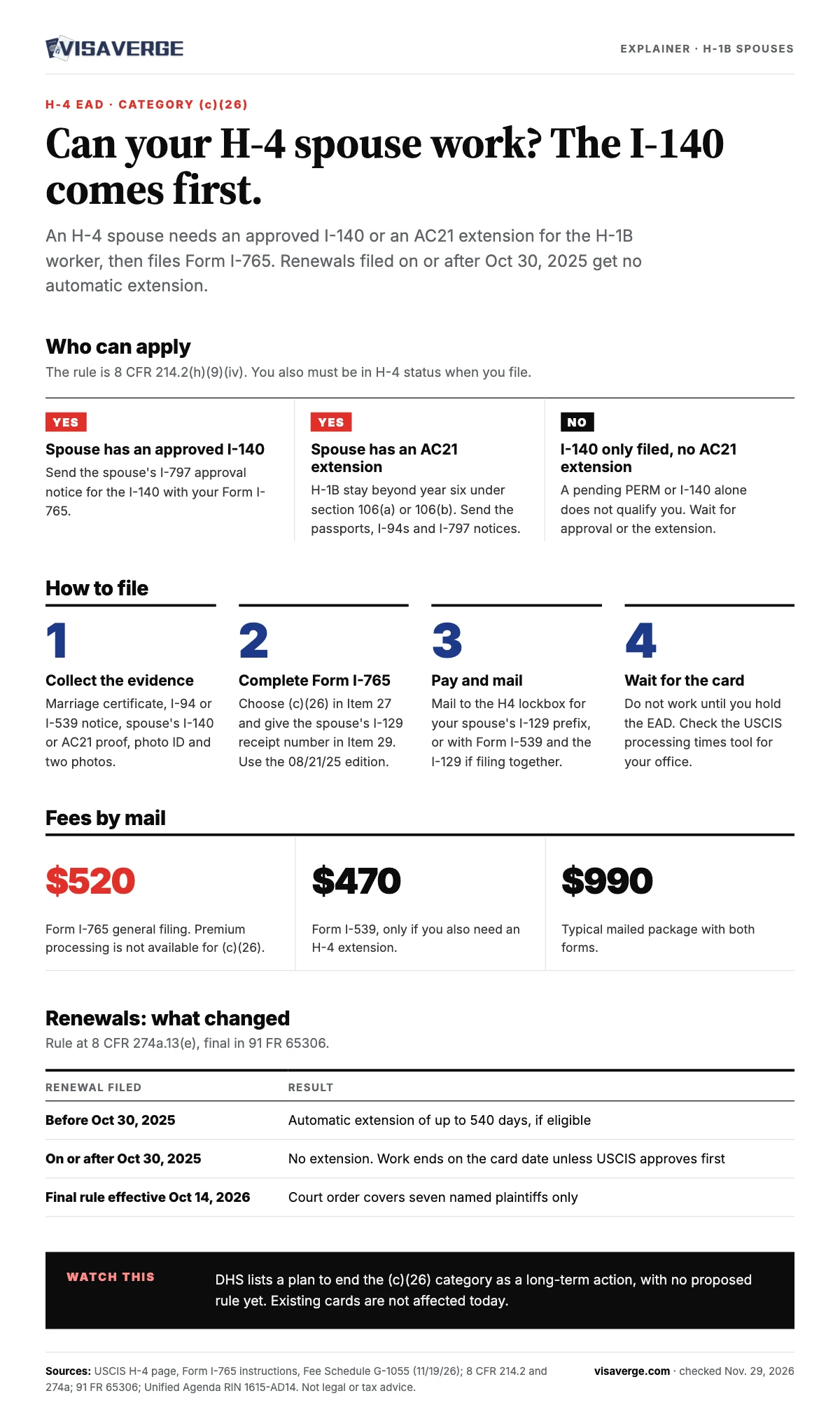
- You qualify only if your H-1B spouse has an approved I-140 or an AC21 106(a) or 106(b) extension, and you are in H-4 status when you file.
- The Form I-765 fee for (c)(26) is $520 by mail. USCIS’s list of forms you can file online does not include (c)(26), so plan to mail it.
- Renewals filed on or after October 30, 2025 get no automatic extension. File up to 180 days early, and expect a gap if USCIS is slower than your card.
- The card can run up to 3 years and matches your I-94 date. It lets you work for any employer, including your own business.
- DHS lists a rule to end (c)(26) as a long-term action with no proposed text. Existing cards are not affected today.
Who qualifies for an H-4 EAD
The H-4 EAD is not automatic for every H-4 spouse. Under 8 CFR 214.2(h)(9)(iv), H-4 status “does not confer eligibility for employment authorization incident to status.” A spouse may apply only if the H-1B worker is the beneficiary of an approved Form I-140, or the worker’s stay in H-1B status is authorized under sections 106(a) and (b) of the American Competitiveness in the Twenty-First Century Act (AC21). The rule also requires that the H-1B worker is currently in H-1B status and that you are currently in H-4 status. USCIS repeats the same two bases on its H-4 employment authorization page.
- You are the legal spouse of an H-1B worker (children on H-4 cannot get an EAD under this category)
- You are physically in the United States in valid H-4 status, or you file your I-539 and I-765 together to extend or change into it
- Your spouse is currently in H-1B status
- Your spouse has an approved I-140, or holds H-1B status under AC21 106(a) or 106(b)
- You have not already filed your own Form I-485 (if you have, use category (c)(9), see Step 4)
The two ways your spouse can satisfy the green card test
| Approved I-140 | AC21 106(a) / 106(b) | |
|---|---|---|
| What it means | USCIS approved your spouse’s immigrant petition (EB-1, EB-2 or EB-3) | Your spouse got an H-1B extension past year six because the green card process is long |
| Main evidence | Spouse’s Form I-797 approval notice for the I-140 | Spouse’s passports, prior I-94s, current and prior I-797 notices for Form I-129, plus proof of the basis below |
| Basis | The approval itself | A PERM labor certification filed at least 365 days before the AC21 period began, or an I-140 (in categories with no PERM) pending at least 365 days before it began |
| Where USCIS says it | Form I-765 instructions, category (c)(26) | |
If DOL certified the PERM, the I-140 must also have been filed within 180 days of that certification. A pending PERM or a pending I-140 alone does not qualify you in the first case, and the 2015 rule that created the category deliberately required an approved I-140 rather than a filing. Our guide to AC21 H-1B extensions when PERM runs over a year explains how your spouse gets that extension, and the Form I-140 guide covers the petition.
You cannot apply from abroad, because the rule requires you to be in H-4 status when you file. Your H-4 children are not eligible. After a divorce you are no longer the H-1B worker’s spouse, so the category no longer fits. If your spouse’s H-1B ends and no other status replaces it, your H-4 status ends with it. Speak to an immigration attorney before any of these events if work authorization matters to you.
Gather the evidence USCIS lists for (c)(26)
USCIS lists the evidence in the Form I-765 instructions (edition 08/21/25) and on its H-4 page. Send clear copies, not originals. Foreign-language documents need a full certified English translation. If you cannot produce a notice, USCIS says it will consider secondary evidence, for example the receipt number of your spouse’s latest Form I-129 or approved I-140.
- Proof of H-4 status: your current Form I-797 approval notice for Form I-539, or your Form I-94 showing H-4 admission or your latest extension
- Proof of marriage: a copy of your marriage certificate
- Proof of the green card basis: your spouse’s I-797 notice for the approved I-140, or the AC21 evidence described in Step 1
- Photo ID: your last EAD, the biographic page of your passport, a birth certificate with photo ID, a consular visa, or a national ID with photo
- Two identical 2 x 2 inch color passport-style photos, with your name and any A-number written lightly on the back
- The receipt number of your spouse’s most recent Form I-797 for Form I-129, which the form asks for in Item Number 29
- A signed form. A typed or stamped name is rejected
Missing evidence can mean a delay or a denial, not just a request for more. Because USCIS matches your form to your spouse’s petitions, a wrong or missing I-129 receipt number is a common cause of slow cases.
File Form I-765 under (c)(26): fee, edition and address
Select category (c)(26) in Item Number 27 of Form I-765. USCIS’s list of forms you can file online names the I-765 categories that can be filed online, and (c)(26) is not among them. The older USCIS H-4 page also describes filing on paper. Plan to mail your application unless the USCIS Form I-765 page shows an online option for (c)(26) when you read this, and check that page before you file.
| Form I-765, general filing, by mail (covers initial, replacement or renewal) | $520 |
| Form I-765, general filing, online (not listed for (c)(26)) | $470 |
| Form I-539, if you also need an H-4 extension, by mail | $470 |
| Form I-539 online | $420 |
| Typical mailed package: I-765 plus I-539 | $990 |
The Pub. L. 119-21 fee of $570 on the fee schedule applies to initial EADs in the (a)(12), (c)(8), (c)(11) and (c)(19) categories, not to (c)(26). USCIS rejects a filing with the wrong fee amount, so read the Fee Schedule (Form G-1055) again on the day you mail. By mail you pay with Form G-1450 (credit card) or Form G-1650 (ACH). Cash is never accepted.
As of USCIS’s notice of November 16, 2026, USCIS still accepts the 08/21/25 edition of Form I-765 and is not accepting the 09/15/26 edition until further notice. Every page must come from the same edition, and the edition date must be visible at the bottom of each page, or USCIS may reject the form.
Attn: H4
P.O. Box 660921
Dallas, TX 75266-0921
Attn: H4 (Box 660921)
2501 S. State Hwy. 121 Business, Suite 400
Lewisville, TX 75067-8003
Attn: H4
P.O. Box 20400
Phoenix, AZ 85036-0400
Attn: H4 (Box 20400)
2108 E. Elliot Rd.
Tempe, AZ 85284-1806
Addresses change. Confirm yours on the USCIS Form I-765 filing addresses page the day you mail, and keep the courier tracking number. USCIS lets you use Form G-1145 for an optional text or email notice when it accepts the filing.
Filing at the same time as Form I-539, the H-1B petition or a green card application
You can file the I-765 alone when your H-4 status is already valid for the whole period you want a card for. You can also file it with other forms. The Form I-765 instructions say you may file it with Form I-539, and may also file it at the same time as both your Form I-539 and your H-1B spouse’s Form I-129. USCIS will not decide the I-765 until it has decided the I-539 and found you eligible for the underlying H-4 status.
| Situation | What to file | Where it goes |
|---|---|---|
| H-4 status valid long enough, need a first or renewed card | I-765 alone, category (c)(26) | Dallas or Phoenix H4 lockbox by your spouse’s I-129 prefix |
| Your H-4 stay is ending and you need both an extension and a card | I-539 with I-765 | The same H4 lockbox, per USCIS’s H-4 page (confirm on the I-765 filing addresses page) |
| Your spouse’s H-1B extension is filed now and you need both | I-129 (spouse), I-539 and I-765 together | The service center that handles the I-129 |
| You have your own pending Form I-485 | I-765 under category (c)(9), not (c)(26) | With the I-485 or per the I-485 instructions |
USCIS warns that filing a (c)(26) application at the wrong location can cause the I-485 and its fees to be rejected. If your own green card application is part of the package, follow the I-485 instructions and use (c)(9).
Filing early with your spouse’s H-1B extension helps because the I-129 receipt notice, the I-539 and the I-765 all travel together. The extension itself is covered in our guide to the H-1B spouse visa and who can work. Can you get the EAD before the H-4 visa? There is no separate “before H-4” route. You must hold H-4 status, or be filing to extend or change into it, because USCIS will not decide the card ahead of the status.
Processing time, case status and what to do when it runs long
Read the current number from USCIS rather than from a blog, because it changes by service center and by month. The tool is the USCIS Case Processing Times page. Choose Form I-765 and the matching category, then the office named on your receipt notice. It gives a time range and a date from which you may ask USCIS about a case that is late.
USCIS said in the final rule that it has no fixed rule that you must wait 365 days before a case inquiry. It points applicants to this tool, which shows when a case inquiry is allowed for your receipt date. DHS also acknowledges, in the same document, that commenters said H-4 EAD processing times often exceed the 180-day early filing window. It says USCIS is “engaged in efforts to streamline and coordinate processing where operationally feasible.” Our own report on H-4 EAD delays beyond 12 months walks through the options when a case is stuck.
- Check the receipt number in your USCIS account or in Case Status Online.
- Compare your receipt date to the case-inquiry date in the processing times tool, then submit a case inquiry once you are past it
- Confirm USCIS has decided your I-539 first if you filed together, since the I-765 waits for it
- Update your address with USCIS if you move, so the card is not returned
- Ask your own employer early about leave or reduced duties if a gap looks likely
Premium processing does not help here. USCIS’s page lists only three Form I-765 categories for it, and they are the F-1 student categories: (c)(3)(A), (c)(3)(B) and (c)(3)(C). It also states that premium processing is not available for Form I-539 filed for dependents of Form I-129 beneficiaries, which includes H-4. USCIS says H-4 and L-2 dependents may instead request expedited processing, decided case by case. Our note on whether H-4 EAD premium processing exists covers the same point in brief.
Renewals and the end of automatic extensions
Until October 30, 2025, a renewal Form I-765 filed on time could extend your authorization automatically, first for up to 180 days, later up to 540 days. DHS ended that for renewals filed on or after October 30, 2025. The rule text is in 8 CFR 274a.13(e). It says the validity of an expiring EAD “will not be automatically extended by a request for renewal.” DHS published the interim rule on October 30, 2025 (90 FR 48799) and the final rule on October 14, 2026 (91 FR 65306), effective that day, after reviewing public comments.
| Renewal filed | Result |
|---|---|
| Before October 30, 2025 | Automatic extension of up to 540 days, if eligible, under 8 CFR 274a.13(d). Extensions already granted are not taken back |
| On or after October 30, 2025 | No automatic extension. Work authorization ends on the date printed on the card unless USCIS approves the renewal first |
| H-4 renewal that depends on an I-539 extension | Never covered by the automatic extension, even before the change |
In practice, that means a gap in work authorization is now a real possibility whenever USCIS decides after your card expires. Your employer must treat the expired card as expired for Form I-9 purposes and reverify with a new document. Our report on H-4 EAD renewals losing automatic extensions and our guide on what to do when your EAD expires after October 30, 2025 cover the employer side.
USCIS says you cannot file a renewal more than 180 days before your EAD expires. In the final rule DHS says it generally recommends not filing earlier than 180 days but will not reject or deny an otherwise eligible renewal solely because it was filed sooner. Count back 180 days from the printed expiry date, put that date in your calendar, and file inside the window.
Where the court cases stand
One federal case has produced relief, and only for seven people. In Jane Doe 1 v. U.S. Department of Homeland Security, No. 8:26-cv-00060 (C.D. Cal.), filed January 8, 2026, Judge David O. Carter signed an order on September 10, 2026, entered September 11, setting aside the October 30, 2025 interim rule as to the seven named plaintiffs. The court chose not to issue a nationwide injunction and certified the matter for appeal under 28 U.S.C. section 1292(b). A related case, Bade v. U.S. Department of Homeland Security, No. 3:26-cv-00436 (W.D.N.C.), was filed June 3, 2026, and we found no order granting interim relief in it. DHS finalized the same provision on October 14, 2026, after the order, which, according to one law firm analysis, makes the notice-and-comment argument harder to win going forward.
Congress has not reversed the rule either. On April 29, 2026 the Senate rejected a motion to proceed to S.J.Res. 99, a Congressional Review Act resolution to disapprove the October 2025 rule, by 47 to 50 (Senate roll call vote 111).
We could not confirm from a docket whether an appeal has been filed or accepted, and the order is described by one law firm as a preliminary injunction and by another as a temporary restraining order, so read the docket before relying on either label. Read our report on the seven-spouse order for the news at the time. Unless you are one of those plaintiffs, plan as if no automatic extension applies to you. Do not present a copy of the order or a news report to an employer as an I-9 document.
Validity, expiry and what the dates on your card mean
USCIS says the expiration date on your EAD should match the expiration date on your most recent Form I-94. USCIS has discretion over the exact period, and its Policy Manual caps H-4 spouse cards at three years. Generally, you are authorized to work only through the expiration date on your EAD. The card shows category C26. Your H-4 status is a separate matter: the EAD does not extend your stay, so keep your I-94 and I-797 notices current.
| Maximum card validity for H-4 spouses (USCIS Policy Manual) | 3 years |
| Earliest renewal filing recommended by USCIS | 180 days before expiry |
| Card date should match | I-94 end date |
| You may work through | Date printed on card |
Your spouse’s H-1B approval date normally sets your I-94 date, and so your card date. A short H-1B extension gives you a short card. If your spouse’s extension is delayed, your renewal may be too, because USCIS ties your eligibility to your spouse’s status.
When your H-1B spouse changes jobs, extends or gets laid off
The H-4 rule tests your eligibility when you file or renew. At that point your spouse must be in H-1B status and have an approved I-140 or an AC21 extension, and you must be in H-4 status. Nothing in that rule ties an issued card to your spouse’s employer, and the 2015 rule describes the card as authorization to work for any employer. Your spouse’s H-1B is employer specific. Yours is not.
| Event | Effect on your card and filing |
|---|---|
| Spouse moves to a new H-1B employer with an approved I-140 | Keep working on the card until its date. At renewal, show the I-140 approval and the new H-1B approval |
| Spouse changes employers and relies on AC21 106(a) | Your renewal needs the AC21 evidence in Step 1, so keep every notice |
| Spouse’s H-1B is extended | Your H-4 extension and card renewal usually follow it. File I-539 with I-765 if both are due, as in Step 4 |
| Spouse is laid off | Your H-4 status depends on your spouse’s H-1B. A grace period of up to 60 days may apply today under 8 CFR 214.1(l)(2), but DHS has proposed removing it. Comments closed November 10, 2026; it is not final |
| Spouse files an I-485 | You remain in H-4. When you file your own I-485, use (c)(9) to get a card based on it |
| Divorce | You are no longer an H-4 spouse, so the (c)(26) basis ends. Speak to an attorney about a new status |
| I-140 withdrawn or revoked | Your basis may change. Whether your spouse keeps AC21 protection depends on how long the I-140 was approved. Get legal advice before your next filing |
For the proposed grace period change see the Federal Register notice, “Eliminating the Discretionary 60-Day Grace Period” (September 11, 2026). If your spouse also needs to work while an H-1B extension is pending, see our explanation of the 240-day rule, and our look at what happens to prior I-140 approvals when changing employers.
What work an H-4 EAD allows
The H-4 EAD is an unrestricted card. In the 2015 final rule, DHS described the EAD as “evidence of employment authorization to lawfully work in the United States for any employer,” and it describes the group of card holders as having “open market” cards. You may hold more than one job, move to a new employer at any time, work part time or full time, and work remotely for a U.S. company. USCIS’s H-4 FAQ also states that the authorization does not prohibit self-employment or starting a business, including hiring employees.
- W-2 employment with any employer, in any field, in any state
- More than one job at the same time
- Self-employment, 1099 contract work and freelancing
- Owning and working in your own LLC or company, subject to state business rules
- Gig and platform work that you do as a business of your own
Three limits still apply. First, you must have the card in hand before you start. USCIS says you must receive the EAD before you may begin working, and a receipt notice is not enough. Second, authorization is not a license: professions such as real estate, nursing, teaching and law require a state license that has its own rules. Third, work authorization stops on the date printed on your card, so a business you run is covered only while the card is valid.
Investing your own money is generally treated differently from working, and day trading is a gray area when it becomes your business. Because tax and status consequences vary, ask an immigration attorney and a tax adviser before relying on it. Read the C26 category guide for how the code appears on other forms, and our EAD category codes list if an employer asks what C26 means.
Social Security number and unemployment basics
With an approved EAD you can ask the Social Security Administration for a Social Security number. The SSA says generally only noncitizens authorized to work by DHS can get one, and it lists the I-766 EAD among the accepted documents, with an unexpired foreign passport and, for an adult, an in-person interview unless you qualify for the online route. The documents list is on the SSA documents page. Our report on how long an SSN takes after an EAD is approved gives a realistic timeline. Employers who use E-Verify need an SSN to confirm eligibility, according to the Form I-765 instructions.
Unemployment benefits are run by each state, so the answer for you is in your state’s rules. DOL guidance says a noncitizen must generally be legally authorized to work when benefits are claimed, and that wage credits must have been earned while authorized (see UIPL 12-03). States also verify status for each claim. If your card has expired and you have no automatic extension, you may not meet the “authorized to work” test during the gap, which is another reason to protect your renewal timing.
Keep a file with every I-797, I-94, marriage certificate, your spouse’s I-140 approval and each EAD copy. You will need the same set for the next renewal, for Form I-9 and for the SSA.
The risk that DHS ends the H-4 EAD
DHS’s 2026 Unified Agenda lists an entry titled “Removing H-4 Dependent Spouses From the Classes of Noncitizens Eligible for Employment Authorization” (RIN 1615-AD14). Its abstract says DHS is proposing to remove certain H-4 dependent spouses as a class eligible to request employment authorization under (c)(26), reversing the 2015 rule. The entry is marked “First time published in the Unified Agenda,” sits in the Long-Term Actions stage, and gives the proposed rule date as “To Be Determined.” It cites 8 CFR 214 and 8 CFR 274a. You can read it on reginfo.gov. Our report is DHS lists H-4 EAD eligibility rescission as a long-term action.
The older court fight over the 2015 rule itself is over. Save Jobs USA challenged the rule, the D.C. Circuit affirmed judgment for DHS in 2024, and the Supreme Court denied review on October 14, 2025 in No. 24-923 (docket). That ended the lawsuit, not DHS’s authority to change the rule by new rulemaking, which is what the agenda entry describes.
| Question | Answer as of November 29, 2026 |
|---|---|
| Has a proposed rule been published? | No. A Federal Register search found no H-4 rescission proposal |
| Is there a comment period or an effective date? | No. The agenda gives “To Be Determined” for the proposed rule |
| Do existing cards stop working? | Not today. (c)(26) remains in 8 CFR 274a.12 |
| What would a final rule do to cards already issued? | Unknown until DHS publishes proposed text |
Long-term actions are items an agency does not expect to propose in the next twelve months, and they can move or disappear. A listing is a signal, not a rule. If DHS publishes a proposal, there will be a public comment period, and we would expect it to appear in the Federal Register first. Meanwhile, nothing changes for your filing: you can still apply and renew. If you hold a card, the practical steps are to keep your renewal timeline tight and to ask your spouse’s employer about a green card step that would give you a separate basis for a work permit later. The earlier explainer on the plan to end some H-1B spouse work permits gives the history.
Common H-4 EAD mistakes
For renewals filed on or after October 30, 2025 there is no automatic extension. File inside the 180-day window and plan for a gap.
You may work only after you receive the EAD itself, and only through the date on it.
Mix editions or pay $470 instead of $520 for a mailed filing and USCIS can reject the package. Check the edition date on every page and the fee schedule on the day you mail.
Use (c)(9) with the I-485 package. A (c)(26) filing at the wrong address can cause the I-485 to be rejected.
USCIS matches your form to your spouse’s petition. A missing or wrong receipt number slows the case.
Only the exempted plaintiffs in the one case can rely on that order. Everyone else needs an unexpired card or an approved renewal.
After you file or renew
Keep your receipt notice and tracking numbers, calendar your next renewal date 180 days before the new expiry, and send the card to your employer’s HR team when it arrives. If your spouse’s I-140 is approved and the green card process moves forward, your path to a work permit that does not depend on H-4 will come through your own green card application; see the C26 guide and the H-1B spouse guide for context. The official starting points are USCIS’s H-4 employment authorization page, the Form I-765 page and the processing times tool.
This guide explains how USCIS and DHS rules work. It is not legal advice for your case. Pending court decisions and rulemaking can change what applies to you, so confirm the points above with USCIS or an immigration attorney before you file.
Frequently Asked Questions
Who qualifies for an H-4 EAD?
An H-4 spouse qualifies if the H-1B worker has an approved Form I-140 or holds H-1B status under AC21 sections 106(a) and (b). The H-1B worker must be in H-1B status and you must be in H-4 status when you file. H-4 children cannot use this category.
How much does the H-4 EAD application cost in 2026?
USCIS’s fee schedule edition 11/19/26 lists $520 for a mailed Form I-765 general filing and $470 online. The USCIS online-filing list does not include (c)(26), so most H-4 spouses mail it. If you also file Form I-539 by mail, add $470.
Can I file an H-4 EAD with Form I-539 or my spouse’s H-1B petition?
Yes. The Form I-765 instructions say you may file it with Form I-539, or with both your I-539 and your spouse’s Form I-129. USCIS will not decide the I-765 until it has decided the I-539 and found you eligible for H-4 status.
Is there an automatic extension for an H-4 EAD renewal?
Not for renewals filed on or after October 30, 2025. DHS finalized that rule on October 14, 2026 (91 FR 65306). A federal court set it aside only for seven named plaintiffs, so for everyone else work authorization ends on the date printed on the card unless USCIS approves the renewal first.
How early can I file an H-4 EAD renewal?
USCIS says you cannot file a renewal more than 180 days before your EAD expires. In the final rule DHS said it will not reject or deny an otherwise eligible renewal solely because it was filed earlier, but 180 days remains the recommended window. File inside it to reduce a gap.
Is premium processing available for the H-4 EAD?
No. USCIS lists only the F-1 OPT and STEM OPT categories (c)(3)(A), (c)(3)(B) and (c)(3)(C) for Form I-765 premium processing, and says premium processing is not available for I-539 filings by dependents of I-129 beneficiaries. H-4 spouses may ask for expedited processing, decided case by case.
What work can I do with an H-4 EAD?
The H-4 EAD is an unrestricted card. You may work for any employer, hold more than one job, and be self-employed or run your own business. You must have the card in hand before you start, and licensed professions still need the state license.
Will the H-4 EAD be cancelled?
DHS’s 2026 Unified Agenda lists a plan, RIN 1615-AD14, to remove H-4 spouses from EAD eligibility under (c)(26). It is a long-term action with the proposed rule date ‘to be determined’ and no proposed text. The category remains in the regulations today.
Does my H-4 EAD stay valid if my spouse changes employers?
The H-4 rule tests eligibility when you file or renew, and the card allows work for any employer. At renewal you will need your spouse’s approved I-140 or AC21 evidence and valid H-1B status. A layoff can affect your H-4 status, so get legal advice early.