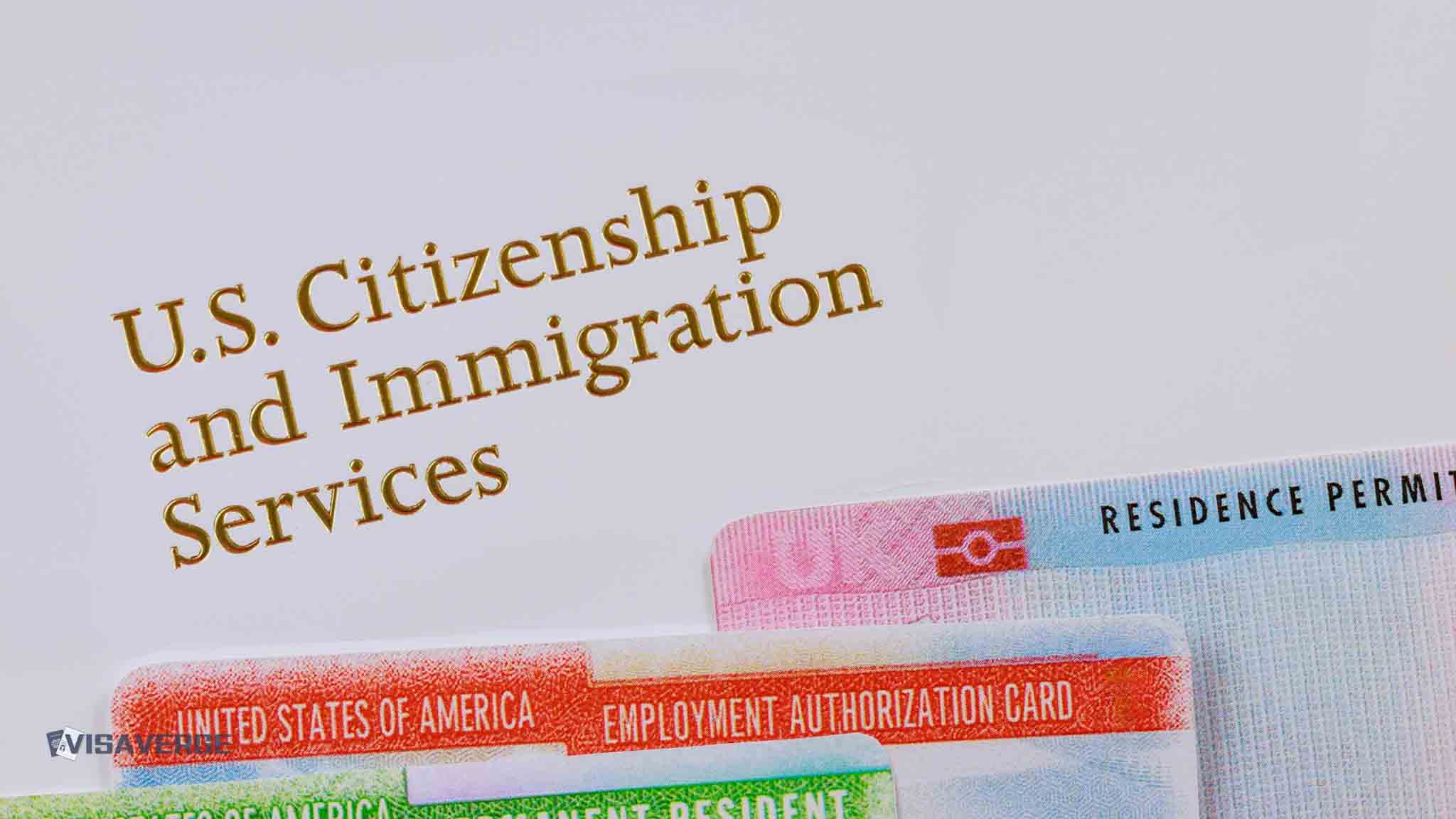
An Employment Authorization Document (EAD), the plastic work permit card USCIS issues on Form I-766, costs $470 to request online or $520 on paper through Form I-765, Application for Employment Authorization. Asylum, parole and TPS applicants pay an extra H.R. 1 fee on top of that, which rises to $570 for initial EADs postmarked on or after Oct. 16, 2026. And since Oct. 30, 2025, most renewal applicants no longer get an automatic extension while USCIS decides their case.
That last change is the one catching people out in 2026. For three years, a timely renewal meant up to 540 extra days of work authorization on an expired card. Under the interim final rule DHS published on Oct. 30, 2025, a renewal filed on or after that date gives you nothing extra. If USCIS has not approved your new card by the “Card Expires” date, you have to stop working.
This guide is the starting point for anyone dealing with a U.S. work permit: first-time applicants, people renewing, adjustment of status applicants, asylum seekers, H-4 and L-2 spouses, F-1 students on OPT, and DACA and TPS holders. It covers who qualifies, how to find your category code, what you will pay, which documents to send, where to file, how long cards take to arrive, how renewal works now, and the mistakes that lead to denials.
Each EAD category has its own rules, and VisaVerge has a detailed guide for the most common ones. Where a category needs more than a paragraph, we link to it rather than repeat it here. The full list of codes, with eligibility notes for each, is in our EAD category codes table.
Two filing details changed in the past few weeks. On Oct. 7, 2026, USCIS changed the mailing addresses for paper Form I-765 filings; it will accept forms sent to an old address if they are postmarked on or before Nov. 9, 2026. And because of a Sept. 14, 2026 federal court order, USCIS is still accepting only the 08/21/25 edition of Form I-765, not the new 09/15/26 edition.
The figures below were checked against the USCIS fee schedule (Form G-1055, edition 10/07/26), the USCIS Policy Manual and the Federal Register on Oct. 10, 2026. Fees and filing addresses change often, so confirm both on uscis.gov the day you file.
Check Whether You Need an EAD and Find Your Category Code
Not everyone who can work in the United States needs an EAD. Green card holders, H-1B, L-1 and O-1 workers are authorized to work by their status and never file Form I-765 for it. An EAD is for people whose permission to work comes from a pending application, a grant of humanitarian protection, a dependent status, or a period of parole or deferred action.
USCIS sorts these people into eligibility categories, written as a letter and number such as (c)(9). You write exactly one category in Part 2, Item Number 27 of Form I-765, and that code is printed on your card. Categories starting with “a” are work authorization that comes with your status; categories starting with “c” are permission you must apply for, and most of those are granted at USCIS discretion.
| Code | Who it covers | Maximum validity | Our guide |
|---|---|---|---|
| (c)(9) | Pending Form I-485 adjustment of status | 18 months | C09 guide |
| (c)(8) | Pending asylum or withholding application | 18 months | C08 guide |
| (a)(5) | Granted asylum (asylee) | 18 months | A05 guide |
| (c)(26) | H-4 spouse of certain H-1B workers | Up to the end of H-4 status | C26 guide |
| (c)(33) | Granted DACA | 2 years or end of deferred action | C33 guide |
| (c)(3)(B) / (c)(3)(C) | F-1 post-completion OPT / STEM OPT | Up to 12 months / 24 months | Codes table |
| (a)(12) / (c)(19) | TPS granted / TPS pending | 1 year or end of TPS, whichever is shorter | Codes table |
| (c)(11) | Parolees | 1 year or end of parole, whichever is shorter | Codes table |
| (c)(35) / (c)(36) | I-140 beneficiaries with compelling circumstances, and their dependents | 1 year | Codes table |
The 18-month caps for (c)(8), (c)(9), (a)(3), (a)(5) and (a)(10) took effect on Dec. 5, 2025, cutting what used to be cards of up to five years. The one-year limits for parole and TPS cards come from H.R. 1, the budget law signed on July 4, 2025. Cards issued under the older, longer validity periods stay good until the date printed on them.
E-1, E-2, E-3 and L-1 spouses with an unexpired I-94 marked E-1S, E-2S, E-3S or L-2S are authorized to work by that status. They can still file for an (a)(17) or (a)(18) EAD, but they do not need the card to start a job.
Work Out Exactly What You Will Pay
The base fee is the same for most categories: $470 when you file online through a USCIS account and $520 when you mail a paper form. Biometrics are included. The two big exceptions are adjustment applicants with a pending Form I-485, who pay less or nothing, and humanitarian categories, several of which pay no base fee.
| Most initial, renewal and replacement EADs, filed online | $470 |
| Most initial, renewal and replacement EADs, filed on paper | $520 |
| (c)(9) with a Form I-485 filed with a fee on or after April 1, 2024, still pending | $260 |
| (c)(9) with a fee-paid Form I-485 filed July 30, 2007 to March 31, 2024, still pending | $0 |
| (c)(33) DACA | $470 online / $520 paper |
| Initial (a)(3) refugee, (a)(5) asylee, (a)(10) withholding granted | $0 |
| Replacement card with a USCIS error, or never delivered because of USCIS or USPS error | $0 |
| Optional premium processing (OPT and STEM OPT only, Form I-907) | +$1,780 |
If you are filing a Form I-485 now and want a work permit with it, the $260 concurrent rate applies to your I-765. Our explainer on whether the I-485 fee covers the work permit walks through the math for a family-based package.
Asylum seekers, parolees and TPS applicants owe a second, separate payment created by H.R. 1, listed on the fee schedule as the Pub. L. 119-21 fee. It cannot be waived, it must be paid separately from the base fee, and it is due even when the base fee is $0 or waived. USCIS adjusted it for inflation on Oct. 16, 2026. Any application postmarked on or after that date without the new amount will be rejected.
| Initial (c)(8) asylum EAD (base fee $0 unless filed under special ABC procedures) | $570 (was $560) |
| Initial (c)(11) parole EAD (base fee $470 / $520 for most parolees) | $570 (was $560) |
| Initial (a)(12) or (c)(19) TPS EAD (base fee $470 / $520) | $570 (was $560) |
| Renewal (c)(8) asylum EAD (plus base fee $470 / $520) | $275 (unchanged) |
| Renewal parole or TPS EAD (plus base fee $470 / $520) | $280 (unchanged) |
| Example: initial TPS EAD filed online on or after Oct. 16, 2026 | $1,040 |
| Example: renewal asylum EAD filed on paper | $795 |
The renewal asylum fee stays at $275 because H.R. 1 does not allow it to be adjusted for inflation. Separately, USCIS has paused collecting the parole and asylum H.R. 1 fees from members of the Ms. L. v. ICE settlement class and their qualifying family members since Feb. 5, 2026. For every other form, our USCIS fee schedule tool lists current amounts.
The USCIS fee schedule PDF dated 10/07/26 still prints the old $560 H.R. 1 amount. The Federal Register notice published Oct. 1, 2026 sets $570 for anything postmarked on or after Oct. 16, 2026. Send $570.
Gather the Documents USCIS Expects
Every application needs the same core package, and then category-specific proof on top. Send clear photocopies, not originals, unless the instructions ask for an original. Anything in a foreign language needs a full English translation with a translator’s certification.
- Form I-94 arrival record (front and back, or the electronic printout), your passport or other travel document
- A copy of your last EAD, front and back, if you have had one
- If you have never had an EAD: a copy of a government-issued photo ID, such as a passport bio page or national ID
- Two identical color passport-style photos, 2 by 2 inches, unretouched and unmounted
- Proof of your category, such as the I-485 or I-589 receipt notice, asylum grant letter, or your spouse’s H-1B I-797 receipt for (c)(26)
- Form G-28 if a lawyer or accredited representative is filing for you
- Court dispositions if you answer yes to the arrest or conviction question for (c)(8) or (c)(35)
- Both fees, paid separately, if you owe an H.R. 1 fee
Category rules add their own items. A (c)(8) applicant must show the asylum application has been pending long enough. DACA requestors file Form I-765 together with Form I-821D and the Form I-765 Worksheet showing economic need. H-4 spouses give the receipt number of the H-1B spouse’s latest Form I-129 in Item Number 29. USCIS keeps an official checklist of required initial evidence broken out by category.
Asylum seekers face the strictest timing rule. You cannot file a (c)(8) application until 150 days after USCIS or the immigration court received a complete asylum application, and USCIS cannot grant the EAD until the case has been pending 180 days on the “asylum EAD clock.” Delays you cause, such as rescheduling an interview, stop that clock. A Form I-765 filed before day 150 may be rejected.
Photos are the most common reason for an avoidable delay. USCIS says edited or digitally enhanced photos can send you to an Application Support Center to verify your identity.
File Online or by Mail
Most applicants can file Form I-765 online by creating a USCIS online account, which saves $50 and gives you an instant receipt number. Paper filing remains available. A DHS rule that took effect on Aug. 11, 2026 lets USCIS make online filing mandatory for some forms after giving public notice. As of Oct. 10, 2026, USCIS still accepts paper Form I-765 filings.
If you mail the form, the address depends on your eligibility category and, for some categories, where you live. USCIS changed these addresses on Oct. 7, 2026, so an address copied from an old guide or a friend’s package may be wrong. Forms sent to a prior address are accepted only if postmarked on or before Nov. 9, 2026.
uscis.gov/i-765-addresses
Choose the row that matches the category you entered in Item Number 27
Sign the form; USCIS rejects unsigned applications. If you mail it, you can clip Form G-1145 to the first page to get an email or text when the lockbox accepts it. Once you have a receipt number, our receipt number decoder shows which service center has your case.
Biometrics, Requests for Evidence and Processing Times
After USCIS accepts the application, it mails a Form I-797C receipt notice. Many applicants then get an appointment notice for fingerprints and a photo at an Application Support Center. Missing that appointment without rescheduling can lead to a denial. If something is missing, USCIS sends a Request for Evidence; not answering by the deadline can get the application denied as abandoned.
How long the decision takes depends on the category and the service center. Times for (c)(9), (c)(8), (c)(26) and OPT cases can differ by many months. Rather than copy numbers that go stale, check our USCIS processing times tool, which tracks current Form I-765 waits using USCIS’s published data.
H-4 spouses have faced especially long waits. Our report on H-4 EAD processing times in 2026 covers what has helped and what has not. F-1 students filing for OPT or STEM OPT are the only applicants who can buy premium processing for Form I-765.
If your case passes the processing time shown for your category, use USCIS e-Request to ask about a case outside normal processing time.
Approval and Card Delivery
Once USCIS approves Form I-765, the card should be produced within about two weeks and mailed by USPS Priority Mail to the address on your application. USCIS asks you to allow 30 days from approval before contacting it about a missing card. Case Status Online usually shows a USPS tracking number once the card ships.
Keep your address current. If you move after filing, update it with USCIS and with USPS right away. A card returned as undeliverable because you did not update your address may mean filing again and paying again. If the card was never delivered because of a USCIS or USPS error, USCIS may reissue it without a new fee. Our guide on an EAD approved but not delivered covers the steps.
Check the card the day it arrives: name, date of birth, category code and validity dates. If the mistake is USCIS’s, you can request a corrected card without a new I-765 fee. If the mistake came from your own application, you file a new I-765 and pay again. Most new workers also need a Social Security number next; see our explainer on how long an SSN takes after EAD approval.
Renew Early, Because the Automatic Extension Is Gone
For renewals filed on or after Oct. 30, 2025, there is no automatic extension in most categories. DHS ended it with an interim final rule (90 FR 48799) and made the rule permanent, without changes, in a final rule published Oct. 14, 2026 (91 FR 65306). Lawsuits challenging it are pending; one court order, on Sept. 10, 2026, restored the extension for seven H-4 spouses who sued and no one else. The USCIS Policy Manual, updated Oct. 2, 2026, says automatic extensions apply only to renewals filed before Oct. 30, 2025.
| Renewal filed before Oct. 30, 2025 | Renewal filed on or after Oct. 30, 2025 | |
|---|---|---|
| (c)(9), (c)(8), (a)(5), (c)(26) and other listed categories | Up to 540 days, ending early when USCIS decides | No automatic extension |
| (c)(26) H-4, (a)(17) E, (a)(18) L-2 spouses | Up to 540 days or the I-94 end date, whichever came first | No automatic extension |
| (a)(12) and (c)(19) TPS | Up to 1 year or end of TPS under H.R. 1 (renewals pending or filed from July 22, 2025) | Only by law, a country Federal Register notice or an individual notice |
| STEM OPT (c)(3)(C) | 180 days if filed on time | 180 days if filed on time (separate rule) |
| Proof for your employer | Old EAD plus I-797C receipt notice | New EAD card, unless a TPS notice applies |
What that means in practice: file your renewal as early as USCIS allows. The Form I-765 page recommends filing up to 180 days before the card expires, and at least 90 days before. USCIS generally will not backdate or postdate the new card to line up with your old one, so filing very early can cost you a few weeks of validity. That is a far smaller loss than a gap in work authorization.
Renewal uses the same Form I-765, the same fee as your category and a copy of the expiring card. Asylum, parole and TPS renewals add the $275 or $280 H.R. 1 fee. If your card is about to expire with the renewal still pending, our guide on what to do when your EAD expires after Oct. 30, 2025 covers employer conversations, expedite requests and other options.
An automatic extension you already received under the old rule still counts. It runs until USCIS decides your pending renewal or until the 540 days end, whichever comes first.
Common Reasons EAD Applications Are Rejected or Denied
A rejection means USCIS returned the package without reviewing it, usually for a missing signature, a wrong fee or an old form edition. A denial means USCIS reviewed it and said no. Form I-765 denials cannot be appealed, but you can file a motion to reopen or reconsider on Form I-290B within 30 days of the decision (33 days if it was mailed), or simply file a new application if you are eligible.
Rules That Could Change Next
Several DHS proposals would tighten EAD eligibility but are not in effect as of Oct. 10, 2026. A rule proposed on Feb. 23, 2026 would make asylum seekers wait 365 days instead of 150 to apply and would pause new (c)(8) applications whenever asylum processing averages more than 180 days. A June 5, 2026 proposal would narrow discretionary work permits for parolees, people with deferred action and people under orders of supervision. Neither has been finalized, and current rules apply until a final rule says otherwise.
DHS has also said it plans a rule to end H-4 EADs for some H-1B spouses, with no immediate change for current holders; our report on the H-4 EAD proposal tracks it. We update this guide when any of these rules is finalized.
After You Have Your Card
Show your employer the EAD for Form I-9; it counts as a List A document proving both identity and work authorization. Put the expiration date in your calendar and set a reminder six months earlier, when the renewal window opens. If you also hold a status such as H-1B or L-1, ask an attorney before working on the EAD instead, because it can affect that status.
For category-specific rules, start with the guide for your code: C09 for adjustment applicants, C08 for asylum seekers, A05 for asylees, C26 for H-4 spouses and C33 for DACA recipients. Every other code is in our full EAD category codes table.
Frequently Asked Questions
How much does an EAD work permit cost in 2026?
Form I-765 costs $470 filed online or $520 on paper for most categories. Applicants with a fee-paid Form I-485 filed on or after April 1, 2024 pay $260. Asylum, parole and TPS applicants also pay a separate H.R. 1 fee: $570 for initial EADs postmarked on or after Oct. 16, 2026, and $275 or $280 for renewals.
Is the automatic EAD extension still available?
Not for most renewals filed on or after Oct. 30, 2025, when a DHS interim final rule ended the up-to-540-day automatic extension. TPS cards can still be extended by law, a country Federal Register notice or an individual notice. Extensions already granted on renewals filed before Oct. 30, 2025 keep running until USCIS decides or 540 days pass.
When should I file to renew my work permit?
USCIS recommends filing Form I-765 up to 180 days before your current EAD expires, and at least 90 days before. Because renewals filed since Oct. 30, 2025 get no automatic extension, filing at the start of the 180-day window gives the best chance of avoiding a gap in work authorization.
How long is a new EAD card valid?
It depends on the category. Since Dec. 5, 2025, (c)(9) adjustment, (c)(8) asylum-pending and (a)(5) asylee EADs are capped at 18 months. Parole and TPS cards are limited to 1 year or the end of parole or TPS. DACA cards last up to 2 years, and H-4 cards follow the H-4 status end date.
How long does it take to receive the EAD card after approval?
USCIS says the card should be produced within about two weeks of approval and mailed by USPS Priority Mail. It asks applicants to allow 30 days from approval before inquiring. Case Status Online usually shows a USPS tracking number, and e-Request handles cards that never arrive.
Can I appeal a denied Form I-765?
No. There is no appeal from a Form I-765 denial. You can file a motion to reopen or reconsider on Form I-290B within 30 days of the decision, or 33 days if the notice was mailed, or file a new I-765 if you can show you are eligible.
When can an asylum seeker apply for a work permit?
A (c)(8) applicant can file Form I-765 150 days after a complete asylum application was received, and USCIS can grant the EAD once the case has been pending 180 days on the asylum EAD clock. A February 2026 proposal to extend the wait to 365 days has not been finalized.
Do H.R. 1 work permit fees qualify for a fee waiver?
No. The Pub. L. 119-21 fees for asylum, parole and TPS EADs cannot be waived and must be paid separately from the base Form I-765 fee, even when the base fee is $0 or waived. USCIS has paused some of these fees for Ms. L. v. ICE settlement class members since Feb. 5, 2026.