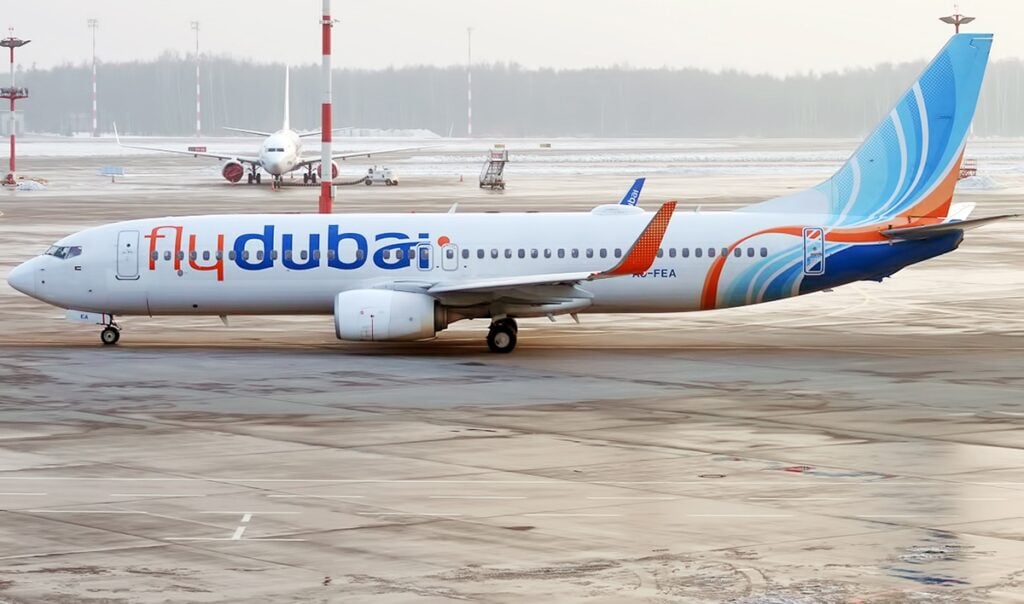
Flydubai’s schedule comparison identifies 24 destinations that do not appear in its flights listed for November 2026 through September 2027. It includes every Iranian destination the airline served earlier this year.
Cirium data underpins the comparison of schedules from January through October 2026 with the later period. The missing routes are not all described as ending on the same date: some are temporary suspensions, while Malaysia represents a complete market withdrawal.
The airline’s latest listed cancellations to Riyadh, Dammam and Abha run through October 29. The wider schedule points to a network reduction beyond those short-term changes.
Flydubai gives affected customers booking channels, not a blanket remedy
The airline directs affected customers to the Manage Booking section of its website to review refund or rebooking options. Passengers who purchased tickets through travel agents should contact those agents directly.
Flydubai has advised customers to check flight status and keep booking contact details current. Schedule changes may be communicated through its official channels.
- Check the flight status regularly.
- Confirm your booking has current contact details.
- Use Manage Booking to review refund or rebooking options.
- If an agent booked the ticket, contact the agent.
The 24 destinations span six country markets
The schedule comparison lists these markets and cities:
| Country or market | Destinations absent from the later schedule |
|---|---|
| Iran | Tehran (IKA), Mashhad (MHD), Bandar Abbas (BND), Lar (LRR), Shiraz (SYZ), Esfahan (IFN), Bushehr (BUZ), Kerman (KER) |
| Saudi Arabia | Alula (ULH), Neom Bay (NUM), Hofuf (HOF), Red Sea Project (RSI), Gizan (GIZ), Jouf (AJF), Qaisumah (AQI), Nejran (EAM), Yanbu al Bahr (YNB) |
| Pakistan | Islamabad (ISB), Lahore (LHE), Peshawar (PEW) |
| Malaysia | Langkawi (LGK), Penang (PEN) |
| Poland | Poznan (POZ) |
| Romania | Iasi (IAS) |
Iran accounts for eight routes and Saudi Arabia for nine. Pakistan contributes three, while Malaysia, Poland and Romania account for two, one and one respectively.
Saudi cancellations moved through successive extensions
Flydubai’s temporary Saudi suspensions developed through repeated extensions. On October 8, attacks at King Khalid International Airport killed three Saudi nationals and injured citizens and residents of several nationalities. The General Authority of Civil Aviation said one attack targeted airport facilities and another targeted a Saudia Airlines aircraft.
Saudia said one of its staff members died in an airport incident and mourned Captain Hamoud Ali Alkalthami. The next day, Flydubai said Riyadh and Yanbu flights were cancelled through October 10, and Abha flights through October 11.
The airline confirmed Dubai-Riyadh cancellations through October 14 on October 10–11. A NOTAM said Riyadh airport would stay closed through October 17. On October 13, the airline extended cancellations to several Saudi destinations, including Abha, Dammam and Riyadh, through October 19.
On October 18, it extended those three cities’ cancellations through October 24. Its October 22 update moved the end date to October 29. The airline said it expected disruption because of the situation and was monitoring developments with relevant authorities.
“We are closely monitoring the situation in coordination with the relevant authorities and will update our customers through our official channels regarding any changes to our flight schedules”
The airline apologized to passengers for the changes. Other international carriers, including Emirates, Qatar Airways and Etihad Airways, have also temporarily suspended some Saudi services.
Malaysia and Iran show how far the network pullback reaches
Flydubai’s two Malaysian destinations mark a full exit from that market, leaving Thailand as its only Southeast Asian market. The carrier entered Malaysia in 2024 with year-round services to Penang and Langkawi.
At the time, it was the only airline flying from Dubai International Airport to both destinations. Its Boeing 737 MAX 8 flew nonstop to Penang, then continued to Langkawi; the return followed the same routing. The Dubai-Penang leg stretched about 3,275 miles, making it the airline’s longest route.
Iran’s routes have a longer history. The airline entered the market in 2014 with Tehran and Mashhad, then added secondary cities. It had scheduled more than 60 weekly departures to Iran at certain points last year, and had reported strong demand on those services.
Aviation analytics provider Cirium puts Flydubai’s overall capacity 20% below last year. The Iranian routes could return if conditions in the region improve.