For L-1 Visa Holders, the first tax question is whether you’re a U.S. tax resident or a nonresident for 2026. That single call decides which federal return you file and whether the IRS taxes only your U.S. income or your worldwide income. Most L‑1 workers fall under the Substantial Presence Test, a day‑count formula set out in IRS Publication 519.
Do this calculation before you pick software, hire a preparer, or accept tax advice from a coworker. Mistakes here lead to the wrong form, missed treaty claims, or foreign asset reporting penalties. The steps below walk through the full filing journey — from tracking travel days to submitting your return and supporting statements on time.

Set aside an hour now to gather passports and I‑94 records, then build a simple day log for 2024–2026. That log drives every later decision and protects you in audits.
Set aside time to collect passports, I-94s, W-2s and 1099s, and create a 2024–2026 folder; keep scanned copies in a secure drive so you can quickly respond to IRS requests.
Run the Substantial Presence Test
Count your U.S. days of physical presence using the IRS’s formula: you meet the test for 2026 if you’re in the United States 🇺🇸 at least 31 days in 2026 and your weighted total reaches 183 days.
- Weighted total = (all days in 2026) + (1/3 of days in 2025) + (1/6 of days in 2024).
- Keep arrival and departure dates from your passport stamps and I‑94 history.
- If you held a green card at any time in 2026, you’re a tax resident even if the day count is lower.
The IRS lays out examples, exceptions, and definitions in IRS Publication 519. Create three totals in a spreadsheet — one for each year — and save supporting travel proof. If you travel for work, ask your employer for assignment letters; those records help if the IRS questions your residency position later.
Quick checklist for the day count
- Passport stamps (arrival/departure)
- I‑94 history (download and save)
- Employer assignment letters (if applicable)
- Spreadsheet with year totals (2024, 2025, 2026)
Pick the right federal return
Once you’ve classified yourself, choose the return that matches that status:
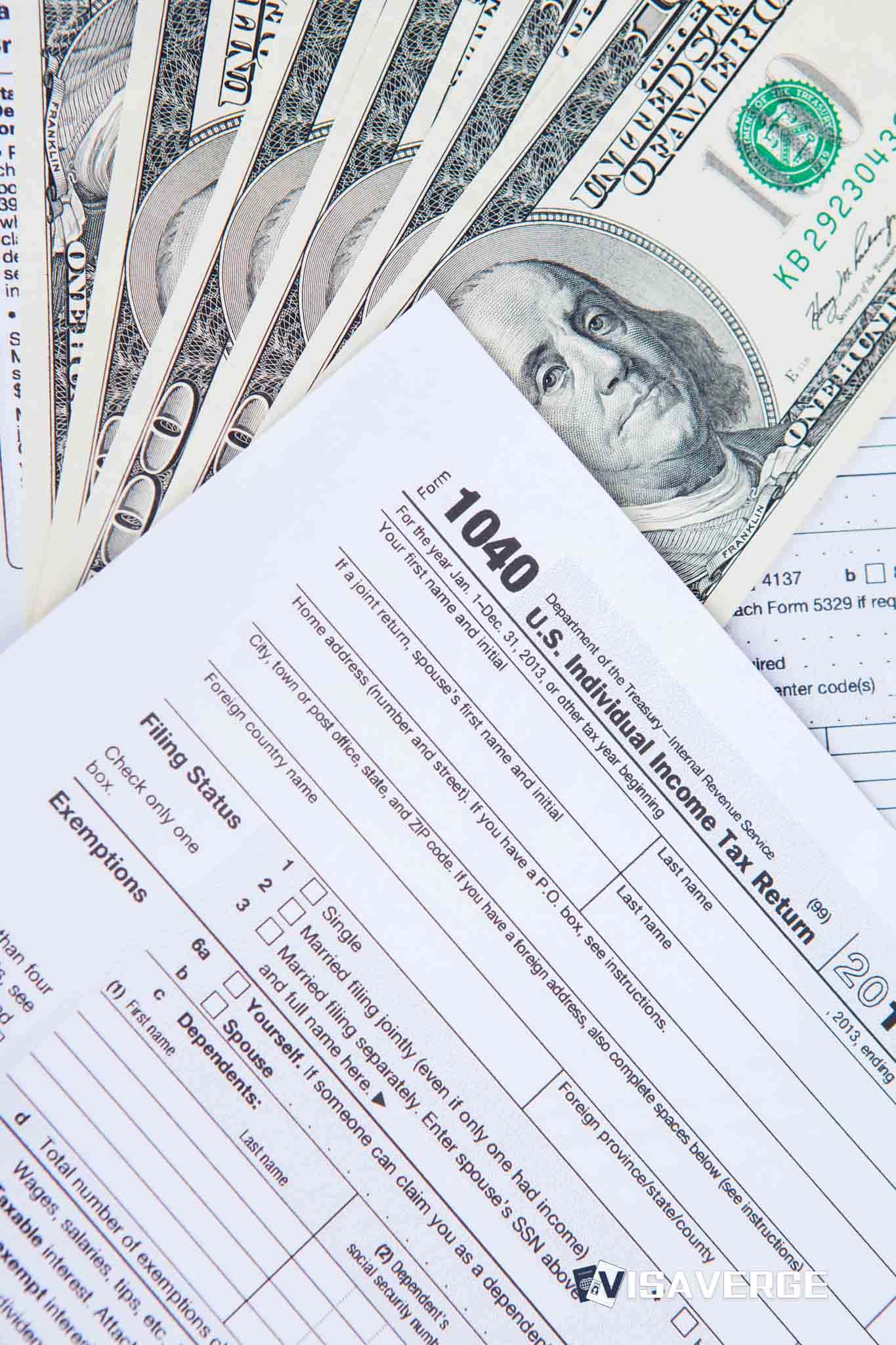
- Tax residents generally file Form 1040 and report worldwide income.
- Nonresident aliens generally file Form 1040‑NR and report only U.S. source income.
- If you switch status during 2026, you may be a dual‑status taxpayer; Publication 519 explains attaching statements for part‑year nonresident and part‑year resident periods.
Additional forms that may apply:
– Form 8833 — required for some treaty positions
– Form 8843 — sometimes required for nonresidents even when no tax is due
Don’t assume your visa type controls the tax form. Two L‑1 employees in the same office can file different returns because their travel histories differ. Keep a copy of your residency math with your tax file — it helps if you later amend a return, apply for a mortgage, or answer an IRS notice.
Gather documents before tax season
Good records save money and stress in April. Start a 2026 folder now and collect:
- Passport and L‑1 visa copy
- I‑94 entries for 2024–2026
- All wage statements (especially Form W‑2) and any Forms 1099, 1042‑S, K‑1, 1095 series
- If no SSN, apply for an ITIN using Form W‑7
- Foreign pay slips and proof of foreign taxes paid (for residents claiming credits)
- Year‑end bank and brokerage statements, including foreign accounts
- Employer relocation/housing records if reimbursements received
- U.S. address history (ties to state filing)
Put scanned copies in a secure drive. If you file jointly, collect the same items for your spouse and dependents. A complete file speeds refunds and cuts down on follow‑up requests.
Know what income is taxable
Your residency status sets the scope of tax:
- Nonresidents: report U.S. source income, e.g., wages for work performed in the U.S.
- Tax residents: report worldwide income, including foreign interest, dividends, rent, and side business income.
If the same income is taxed both abroad and in the U.S., residents often claim a Foreign Tax Credit using Form 1116. Keep foreign tax returns and receipts to match income and taxes by category.
Note:
– Don’t overlook small items that trigger reporting, like overseas savings interest or automatically reinvested dividends.
– Track currency conversion rates used; consistent rates help if the IRS reviews your foreign schedules.
Check withholding and pay on time
As an employee, your U.S. employer usually withholds federal income tax and FICA (Social Security and Medicare) from each paycheck. Review paystubs early in 2026 after any raise, bonus, or stock award.
If withholding won’t cover your expected tax, make quarterly estimated payments using Form 1040‑ES to reduce underpayment penalties. This commonly applies when you have large investment income or self‑employment income without withholding.
Key points:
– Estimated taxes are a payment system, not a separate return.
– Keep proof of each payment with your records.
– If you change jobs mid‑year, compare total withholding to expected tax; mismatches are common after international moves.
– Coordinate with payroll if you receive foreign pay while living in the U.S. to avoid a large April bill.
Handle Social Security edge cases
Most L‑1 assignments run through a U.S. payroll, so Social Security and Medicare taxes come out automatically. Complications arise when you remain on a foreign payroll or split pay between countries.
- A totalization agreement with your home country may prevent double social tax.
- Employers often need a certificate from the home system to apply the agreement.
- Ask HR which payroll entity reports your wages and which country withholds social taxes; keep answers with your tax file.
Watch for:
– Missing FICA or duplicate withholding
– Payroll errors — fix during the year, not after filing
– Self‑employment income — triggers different social tax rules and may affect visa compliance
Disclose side consulting to your tax adviser — it can have both tax and visa implications.
Use tax treaties the right way
Income tax treaties can reduce U.S. tax on specific income types, but they don’t override filing duties.
Steps to follow:
1. Read the treaty article that covers your income.
2. Follow disclosure rules in IRS Publication 519.
3. Attach Form 8833 when required.
4. Use Form 8802 to request Form 6166 (U.S. residency certification) if needed.
Keep copies of residency certificates and written treaty claims. Treaties are country‑specific — benefits for salary, dividends, or pensions depend on your home country’s text. Don’t mix treaty articles from different countries.
Caution: A wrong treaty claim can delay refunds or draw IRS mail. VisaVerge.com reports that treaty errors are a common trigger for amended returns.
Incorrect residency status can trigger refunds delays or penalties. Double-check the 183-day weighted total and remember that a visa type alone doesn’t determine your form or world income reporting.
Foreign accounts and asset reporting
Tax residents with money outside the U.S. must watch two separate reporting systems:
- Form 8938 — IRS information return for specified foreign financial assets when filing thresholds are met (Form 8938)
- FBAR (FinCEN Form 114) — bank‑account report filed online: https://bsaefiling.fincen.treas.gov/NoRegFBARFiler.html
These forms usually don’t change your tax bill, but penalties for skipping them can be severe.
Recordkeeping:
– Year‑end account statements and maximum balance for each foreign account
– Bank name and account number
– Include spouse’s accounts if filing jointly
Remember:
– Nonresident filers often avoid resident‑only reporting rules, but status can change quickly.
– If you become a resident mid‑year, reporting duties may start for that resident portion.
– Request foreign statements early — don’t wait until March.
Deadlines, extensions, and state tax reality
Plan around the federal deadline, generally mid‑April 2027 for tax year 2026. An extension gives more time to file, not more time to pay. Request it with Form 4868 and send payment for any expected balance.
If you qualify for foreign earned income rules, you may use Form 2555.
State considerations:
– State income tax residency often differs from federal residency.
– Track moves between states and keep lease and utility records.
– Many people learn this only after receiving a surprise state bill.
Before submitting:
– Review names, SSNs, and addresses across every form — small mismatches slow refunds.
– If filing Form 1040‑NR, confirm you reported only U.S. source income and attached required statements.
– If filing Form 1040, confirm you captured worldwide income and foreign tax details.
Use IRS instructions and keep copies for several years; that record set helps if questions arrive.
Key takeaway: Start early, document travel and payroll carefully, and save everything. The Substantial Presence Test drives the rest — get that residency decision correct and your tax year will go much more smoothly.
This guide outlines essential tax steps for L-1 visa holders in 2026. It focuses on the Substantial Presence Test to determine residency, selection of the correct IRS forms, and the necessity of reporting worldwide income for residents. It highlights the importance of documentation—including I-94 records and foreign account statements—and explains how tax treaties and totalization agreements can mitigate double taxation, ensuring compliance and penalty avoidance.