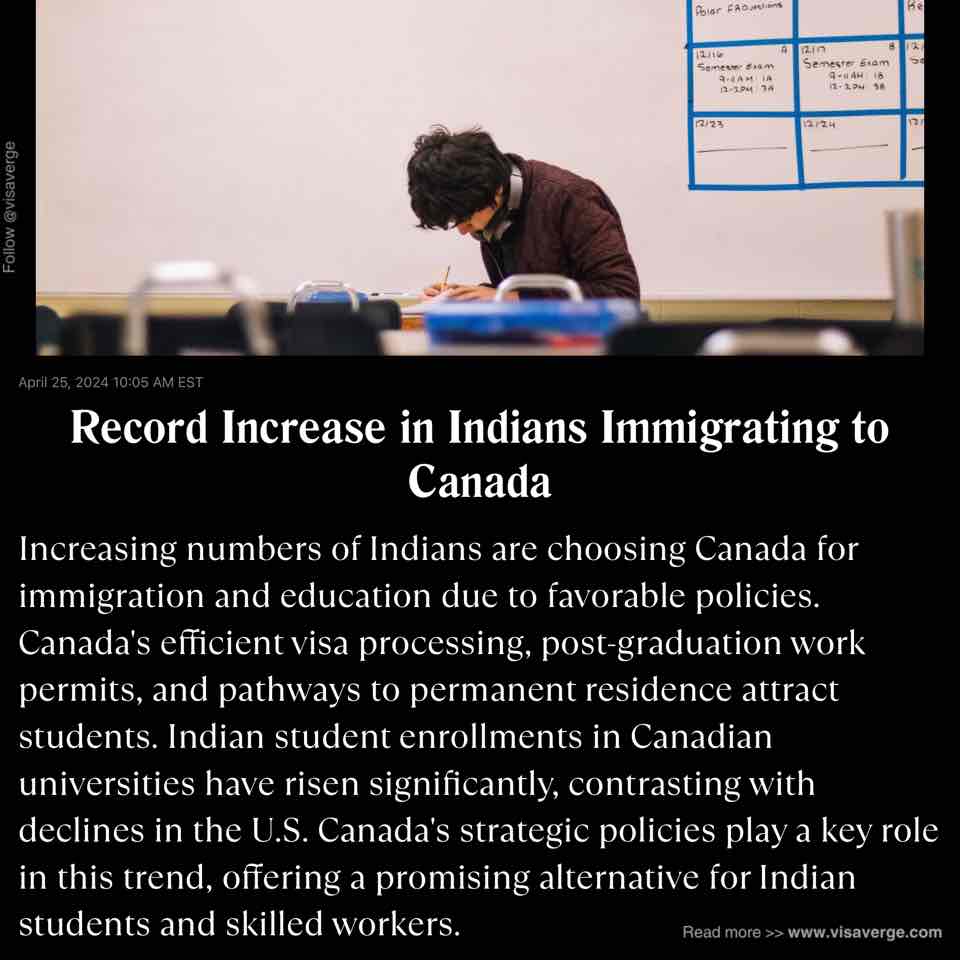
Why Are Increasing Numbers of Indians Immigrating to Canada?
Over the past decade, the landscape of immigration, particularly involving Indian nationals, has dramatically shifted, with Canada emerging as a favored destination. From 2013 to 2023, the numbers are telling: Indians immigrating to Canada increased from 32,828 to 139,715. This 326% rise parallels a significant trend in educational preferences, with Indian students opting for Canadian universities over those in the U.S. by a striking rate.

What has driven this seismic shift in immigration and education preferences? A peek into the detailed policies might provide some insights.
Free toolCanada Express Entry Points CalculatorWhat Makes Canada’s Immigration Policies Attractive to Indian Students?
Canada’s immigration policies are distinctively structured to attract and retain international talent, especially from India. While the U.S. has often been the go-to hub for educational pursuits, things are changing, largely due to restrictive visa policies and challenging pathways to permanent residence.
Canada offers a smoother transition from education to permanent residence. For instance, most Canadian visas for high-skilled foreign nationals are processed within just two weeks, and there’s no annual cap on the number of high-skilled temporary visas. This efficiency in handling visa applications is undoubtedly appealing. In contrast, securing an H-1B visa in the U.S. — a common route for students wishing to stay on after university — has become increasingly difficult. For over 20 consecutive fiscal years, the cap on H-1B visas has been quickly reached, leaving many potential applicants out in the cold.
How Does Canada Support International Students After Graduation?
Canada’s post-graduation policies significantly contribute to its attractiveness as an educational destination. The three-year post-graduation work permit in Canada offers international students a substantial period to gain professional experience. Importantly, work done during this period can help in gaining points under Canada’s Express Entry system, which is crucial for securing permanent residence.
Peter Rekai, an attorney with Rekai LLP in Toronto, highlighted a unique advantage in Canada: “In Canada, we have a program for graduating international students similar to but more generous than the U.S. Optional Practical Training category,” he noted. These programs allow students even without work experience to transition smoothly into the workforce and potentially secure permanent residency, especially advantageous for those with master’s or PhD qualifications from Canadian institutions.
Moreover, in July 2023, a specific program targeting H-1B visa holders to migrate to Canada reached its application cap of 10,000 in less than 48 hours — a testament to its popularity and the perceived opportunities it offers.
What Are the Recent Trends in University Enrollments?
The enrollment figures for Indian students in Canadian universities saw a meteoric rise, increasing by over 5,800% from 2,181 in 2000 to 128,928 in 2021. This contrasts starkly with the U.S., where Indian student enrollment witnessed a decline of 13% between 2016 and 2019, though numbers rose by 182% in Canada within the same period.
The broader context of international student enrollment further underscores Canada’s growing appeal. Canadian universities saw their international student body swell from 62,223 in 2000 to 400,521 in 2021, marking a 544% increase. During the same timeline, the U.S. saw a modest 45% increase.
Why Are Educational and Immigration Policies Integral to These Trends?
Educational policies and the ease of post-study work and residency permissions are crucial factors influencing students’ destination choices. The stark differences in the ease of transitioning from student status to working professional and potentially a permanent resident are pivotal. Predictive models suggest these trends will continue, especially if U.S. policies remain restrictive or become more so.
Understanding these dynamics is vital for educators and policymakers, especially in leveraging policies to attract international talent. Canada’s example shows that strategic policy frameworks can significantly influence global talent flows, specifically from countries like India that have a large number of potential international students and skilled workers.
Despite recent hitches due to diplomatic issues and visa processing delays, the long-term outlook for Indian students and professionals favoring Canada over the U.S. remains positive, bolstered by conducive policies and supportive administrative frameworks. For those pondering over their higher education and immigration prospects, Canada stands out as a compelling choice. For more detailed official information on Canadian immigration policies, please visit Canada’s Immigration and Citizenship page.
Learn Today:
- Express Entry System: A system used by the Canadian government to manage applications for permanent residence under certain economic immigration programs. It ranks candidates based on factors like age, education, work experience, and language proficiency and invites top-ranking candidates to apply for permanent residence. Points gained through this system are crucial for securing permanent residence in Canada.
-
H-1B Visa: A non-immigrant visa category in the United States that allows U.S. employers to temporarily employ foreign workers in specialty occupations that require theoretical or technical expertise. It has been a common route for international students studying in the U.S. to stay on and work after completing their education. However, due to annual caps and increasing difficulty in obtaining these visas, many are now exploring alternative options like Canada.
-
Post-Graduation Work Permit: A document issued by Immigration, Refugees, and Citizenship Canada (IRCC) that allows international students who have graduated from eligible Canadian institutions to work in Canada. The duration of this permit is usually based on the length of the study program completed, giving international students the opportunity to gain valuable Canadian work experience before applying for permanent residence.
-
Optional Practical Training (OPT): A program in the United States that allows international students on F-1 visas to gain practical work experience in their field of study. The OPT program typically grants a maximum of 12 months of work authorization after graduation. While similar to Canada’s post-graduation work permit, OPT has limitations compared to Canada’s program, making Canada an attractive alternative for international students seeking longer and more flexible post-graduation work opportunities.
-
International Student Enrollment: The number of foreign students studying in educational institutions outside their home country. With a significant increase in international student enrollment in Canada in recent years, particularly from countries like India, this statistic reflects the growing attractiveness of Canadian universities as educational destinations for students worldwide.
This Article In A Nutshell:
In recent years, a surge in Indian immigrants choosing Canada is linked to favorable policies offering smooth transitions to permanent residency. It includes a post-graduation work permit, attractive visa processing times, and supportive programs rewarding skilled individuals. These factors amplify Canada’s appeal over the U.S. as an educational and immigration hub.
— By VisaVerge.com
Read more:
- Big News for Indian Students: Petition for PGWP Extension in Canada
- Impact of the 2024 Canada Study Permit Cap on Indian Students
- Latest Changes to Canada Study Permits and Their Impact on International Students
- Increasing Trend: Indian Students Learning French to Gain an Edge in Canadian Visa Applications
- Canada’s Immigration Minister Announces New Limits on International Students