- Governor Reynolds signed Senate File 2218 mandating E-Verify checks for all public sector new hires.
- The new law requires SAVE checks for professional licenses and verification of voter citizenship status.
- Unauthorized immigrants charged with crimes face a rebuttable presumption against pretrial release under the statute.
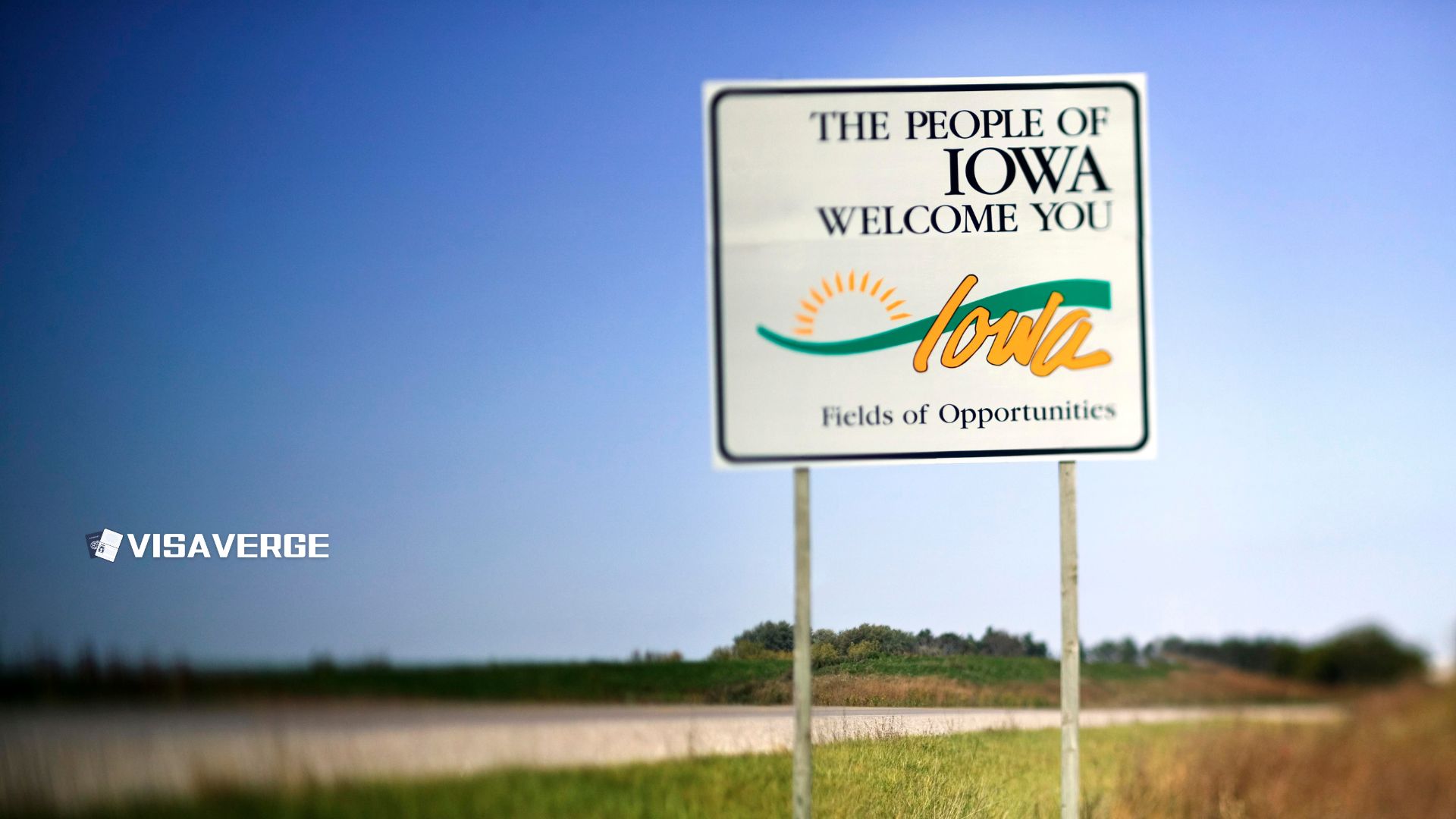
(IOWA) – Governor Kim Reynolds signed Senate File 2218 on June 1, 2026, requiring Iowa government bodies and schools to run E-Verify checks on new hires and directing licensing boards to use SAVE checks for professional and occupational license applicants.
The mandates take effect on July 1, 2026, extending immigration status verification across state executive branch agencies, the legislative branch, counties, cities, and public and private schools, including charter and innovation zone schools.
Reynolds described the measure as part of a broader enforcement push after the legislature finished its work. “One [bill] will require immigration checks for anyone applying to work in state and local governments in Iowa. Tuesday was the deadline to take action on all the bills that cleared the 2026 legislature. I am truly honored to have served the people of Iowa these last nine years.”
Iowa lawmakers moved the bill in the final days of the session after months of pressure over state hiring controls. The new law also writes into statute a requirement that licensing boards verify the citizenship or legal status of applicants for state-issued professional and occupational licenses through the federal Systematic Alien Verification for Entitlements program, known as SAVE.
Reynolds had already pushed state agencies in that direction through Executive Order 15 on October 8, 2025. In that order, she said, “While it’s the responsibility of employers to ensure those they hire are eligible to work in the United States. I am issuing Executive Order 15, putting safeguards in place that will verify the legal immigration or citizenship status. While some agencies voluntarily use E-Verify as part of the hiring process, my executive action now makes it a requirement.”
Senate File 2218 goes further than that order. It reaches beyond state agencies to local governments and school systems, and it ties public employment screening to a wider set of penalties and verification rules affecting workers, employers, voters and criminal defendants.
New public employees who receive a mismatch result in E-Verify will have 10 days to challenge it through an appeals process written into the law. Employers, including private businesses, face fines of up to $10,000 if they knowingly hire someone using a false Social Security number.
The law also orders the Iowa Secretary of State to use SAVE to verify the citizenship of registered voters. Anyone flagged in that review must provide proof of citizenship or face cancellation of their registration.
Criminal defendants without legal status face another change. Under the law, unauthorized immigrants charged with crimes, except simple misdemeanors, will face a rebuttable presumption against pretrial release.
The push for the measure followed a case that exposed gaps in state and local vetting. Ian Roberts, the former superintendent of Des Moines Public Schools, was arrested by federal agents on September 28, 2025 for possessing firearms while in the U.S. illegally, despite having a federal order of removal issued in May 2024.
State officials found that existing checks had not identified Roberts’ status when the district hired him in 2023. That case became the central example for supporters arguing that voluntary screening left too much room for error in public employment.
Federal immigration agencies had not issued a release focused specifically on Iowa’s law by early June, but the broader policy direction from Washington pointed the same way. In a March 30, 2026 update, USCIS said, “Since taking office, President Trump has prioritized national security and public safety by implementing a series of executive orders. that mandate strict screening and vetting of foreign nationals seeking entry or immigration benefits.”
That federal statement dealt with national vetting policy rather than Iowa’s statute, but Iowa’s legislation adopts the same screening tools already used in federal systems. E-Verify checks employment eligibility, while SAVE is used to confirm immigration or citizenship status for government benefits and licensing functions.
Public employers across Iowa now have less than a month to prepare for the rollout. State agencies, county offices, city governments and school systems must fold E-Verify into hiring for every new employee once the law takes effect on July 1, 2026.
Licensing boards face a parallel deadline. Boards that issue professional and occupational licenses must use SAVE before approving applicants, converting what had been an executive branch directive into a statutory requirement.
The law gives Iowa one of the broadest state-level verification structures in the country, combining hiring checks, licensing verification, voter review and bail limits in a single package. Its reach extends from classrooms and county offices to licensing counters and voter rolls.
Employers outside government are not covered by the new public hiring mandate, but the penalty section still touches them. Any employer that knowingly hires a worker using a false Social Security number can be fined up to $10,000.
School districts and private schools are also drawn directly into the law’s hiring rules. The statute covers public and private schools, including charter and innovation zone schools, rather than limiting the mandate to traditional state agencies.
Supporters of the law framed that breadth as a response to the Roberts case, which arose in a school system rather than a state department. The episode turned a personnel failure into a statewide legislative issue and accelerated a proposal that had already begun with Executive Order 15.
Iowa residents and employers looking for the legal text can review the bill through the [Iowa Legislature’s SF 2218 page](https://www.legis.iowa.gov/legislation/BillBook?ga=91&ba=SF2218). Reynolds’ public statements are posted in the [Governor Kim Reynolds newsroom](https://governor.iowa.gov/newsroom), while federal background on screening policy appears in the [USCIS newsroom](https://www.uscis.gov/newsroom) and hiring compliance information is available through the [E-Verify official site](https://www.e-verify.gov).
With July 1, 2026 approaching, Iowa’s public sector now has a firm statutory deadline where voluntary practice once stood, and workers, license applicants, voters and criminal defendants will all encounter a system built around E-Verify and SAVE checks.