- USCIS is issuing Requests for Evidence demanding $100,000 even for theoretically exempt H-1B petitions.
- Attorneys report that conflicting written guidance is causing planning paralysis for U.S. employers and healthcare providers.
- Workers are being warned against international travel to avoid triggering consular processing and the mandatory fee.
(UNITED STATES) — U.S. Citizenship and Immigration Services is demanding a $100,000 payment in some H-1B cases that official policy describes as exempt, immigration attorneys say, creating delays and raising the risk that employers lose workers when petitions stall.
The dispute centers on a Presidential Proclamation titled “Restriction on Entry of Certain Nonimmigrant Workers,” signed on September 19, 2025, and effective on September 21, 2025. USCIS says the measure applies to certain new H-1B filings, while lawyers report that officers are also issuing Requests for Evidence seeking the fee from current H-1B visa holders whose petitions appear to fall outside the rule.
As of April 24, 2026, attorneys at Murthy Law Firm and Reddy Neumann Brown PC say the mismatch between written guidance and day-to-day adjudications has left employers unsure whether they must pay, argue an exemption, or withdraw a filing altogether. In some cases, lawyers say, the agency stops moving a case after an employer cites the exemption, and the petition later fails when the worker’s current status expires.
USCIS set out its position on September 21, 2025 on its H-1B Specialty Occupations page. “This Proclamation: Requires a $100,000 payment to accompany any new H-1B visa petitions submitted after 12:01 a.m. eastern daylight time on Sept. 21, 2025. [It] does not change any payments or fees required to be submitted in connection with any H-1B renewals.”
| India | China | ROW | |
|---|---|---|---|
| EB-1 | Feb 01, 2023 | Aug 01, 2023 ▲31d | Current |
| EB-2 | Nov 01, 2013 | Oct 01, 2021 | Apr 01, 2025 ▲90d |
| EB-3 | Jan 22, 2014 ▲21d | Jan 22, 2022 ▲14d | Jun 15, 2024 ▲31d |
| F-1 | Jan 22, 2021 ▲366d | Jan 22, 2021 ▲366d | Jan 22, 2021 ▲366d |
| F-2A | Oct 22, 2026 ▲30d | Oct 22, 2026 ▲30d | Oct 22, 2026 ▲30d |
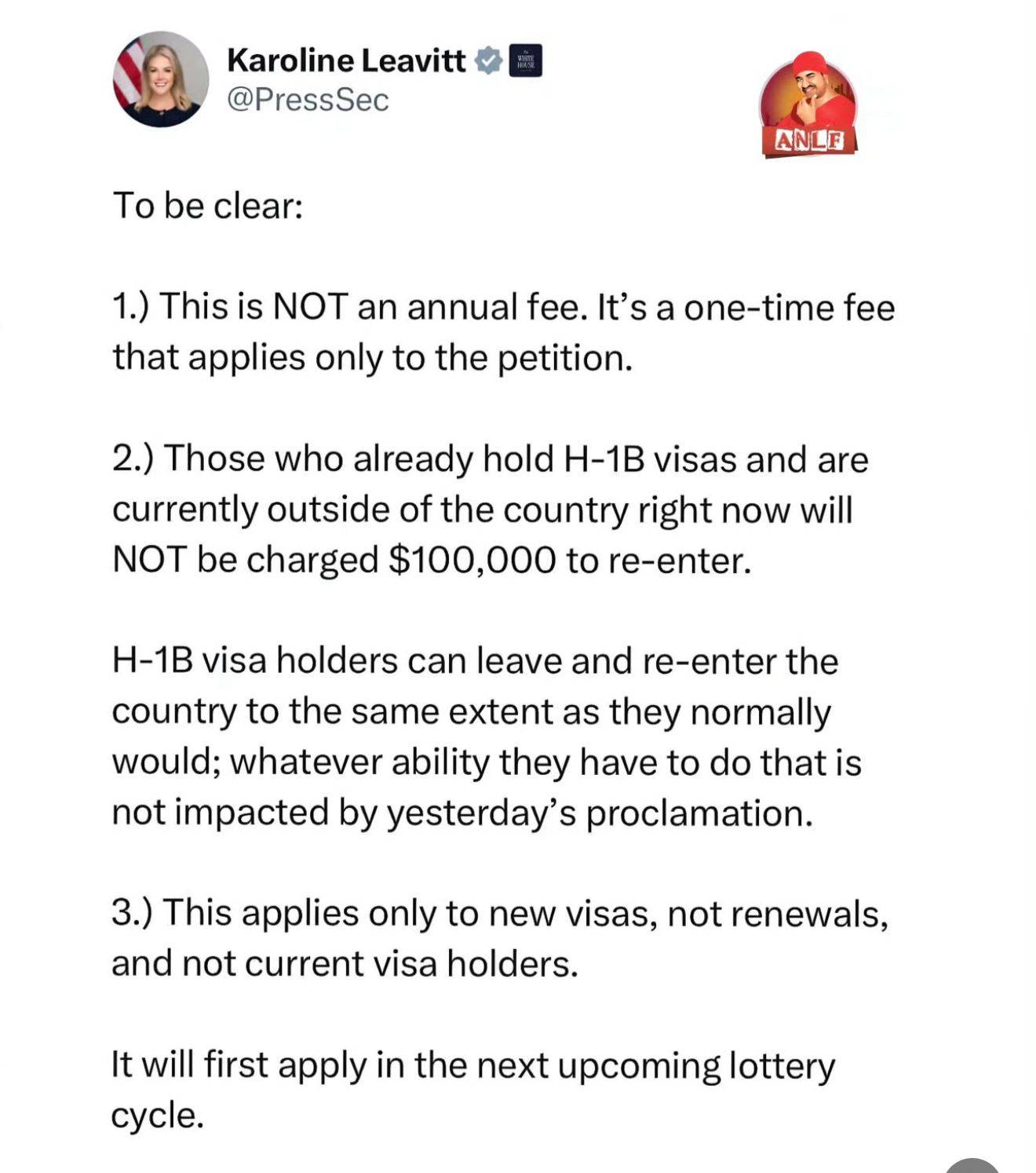
Karoline Leavitt, then White House press secretary, gave a similar public explanation in September 2025. She wrote that “current H-1B workers are not subject to the new fee” and will be able to file “future extensions without being subject to the fee.”
Department of Homeland Security guidance has also described a narrow route for exemptions. DHS Secretary Kristi Noem said on January 16, 2026 that requests can be sent through [email protected], but she said they are “considered extremely rare,” according to a congressional alert on fee implementation.
Under the policy as described by USCIS, the fee applies to new H-1B petitions for beneficiaries outside the United States. It also applies to petitions requesting consular notification, port of entry notification, or pre-flight inspection.
Another category can trigger the charge after a petition is filed. If a requested change of status is denied and USCIS approves the petition only for consular processing, the worker can face the $100,000 demand before entry.
USCIS guidance also draws clear exemption lines. Extensions or amendments for workers already in the United States in H-1B status do not require the payment, and change-of-employer petitions, often called transfers, for workers already in the country also fall outside the fee.
F-1 students who change status to H-1B from within the United States are also exempt under the agency’s written policy. That distinction matters for employers that rely on graduates already working in the country and expecting a routine status change rather than consular visa processing abroad.
Lawyers say the conflict begins when adjudicators treat any reference to consular processing as enough to trigger the charge, even when the worker otherwise fits an exemption. They point to proclamation language that uses “visa” and “status” in ways they say are blurring different parts of the immigration process.
Murthy Law Firm and Reddy Neumann Brown PC say USCIS has issued Requests for Evidence demanding the $100,000 fee in cases where beneficiaries appear to fall squarely within exempt categories. Those Requests for Evidence can force employers into a choice between paying a fee they believe does not apply or contesting the demand and risking a long delay.
Attorneys describe the effect as “planning paralysis” for U.S. employers. A business trying to renew a worker, amend a petition, or hire someone already in the United States may have written guidance on one side and a live adjudication asking for a six-figure payment on the other.
The uncertainty carries a different weight for smaller employers than for multinational companies. Small businesses, non-profits, and healthcare providers can find the $100,000 fee prohibitive, and lawyers say some petitions for hard-to-fill roles are being withdrawn rather than contested or paid.
Travel has become another pressure point for H-1B visa holders. Attorneys are warning workers against international travel while a petition is pending because leaving the country can turn a case into consular processing and prompt an immediate fee demand.
That risk extends beyond first-time entrants. A worker who began with an in-country filing may later face the same issue if travel changes how the petition must be completed, placing the case inside the fee framework even though the person had been working in the United States already.
Hospitals and medical schools have pressed DHS to carve out broader protection for healthcare employers. More than 100 members of Congress and 40 health organizations, including the AHA and AAMC, have petitioned the department for exemptions, warning that the fee “could push chronically underfunded hospitals to their financial brink.”
The healthcare campaign reflects how widely the issue can spread once a single filing gets delayed or abandoned. A hospital recruiting a physician, a rural clinic seeking a specialist, or a university medical center trying to keep a researcher can face the same question: whether a petition that looks exempt on paper will draw a demand for the six-figure payment anyway.
Congressional offices have circulated guidance as employers and attorneys seek answers from DHS and USCIS. Those alerts repeat the administration’s position that current workers seeking extensions are not subject to the fee, even as lawyers say adjudications do not always match that instruction.
Much of the dispute turns on process rather than formal rule text. Employers can point to the written exemptions, but an RFE can still halt a case long enough to change the worker’s status position, and attorneys say that timing can produce a denial even after an employer argues the fee never applied.
The outcome leaves companies, universities, and hospitals trying to build staffing plans around a rule that appears straightforward in official summaries but unsettled in practice. It also leaves workers balancing filing strategy against travel, because a trip abroad can change how a petition is processed and whether the $100,000 fee becomes part of the case.
USCIS continues to direct filers to its H-1B Specialty Occupations page, while DHS has identified [email protected] as the pathway for national-interest exemption requests. Attorneys say those channels have not resolved the basic problem they see in current adjudications: written policy says many current workers are exempt, yet Requests for Evidence are still asking for the money.