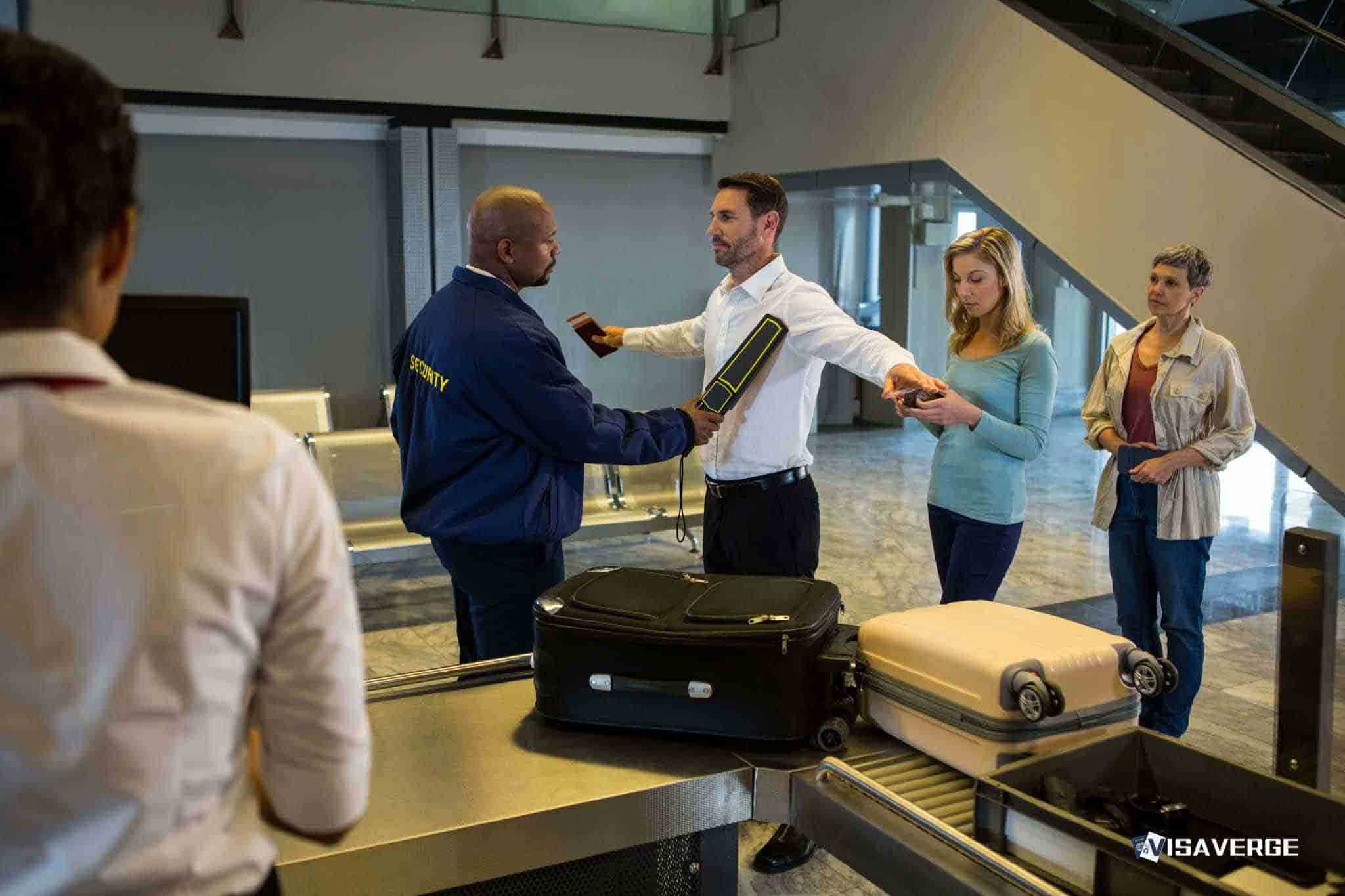
- Four workers and their union sued the Trump administration over revoked airport security clearances at Logan Airport.
- The lawsuit claims at least 80 immigrants with authorization lost their jobs due to the clearance removals.
- Customs and Border Protection cited unspecified security risks and residency requirements as justification for the revocations.
(LOGAN AIRPORT, MASSACHUSETTS) — Four former Logan Airport employees and their union sued the Trump administration on Friday over U.S. Customs and Border Protection’s revocation of “customs seal” security clearances they need to work at the airport.
The lawsuit, filed by the four workers and Local 32BJ of the Service Employees International Union, challenges CBP’s decision to pull those clearances, a move the plaintiffs say ended their ability to keep working even though they had valid work authorization.
Local 32BJ said the dispute extends beyond the four plaintiffs because “at least 80 immigrants with valid work authorization have been affected at Logan Airport,” and the union said “hundreds more” have been impacted nationwide.
All four plaintiffs worked as cabin cleaners or passenger service agents, jobs that depend on the customs seal clearance to maintain access at the airport and keep working.
Saint Paul Paul, one of the plaintiffs, came to the U.S. from Haiti in 2018 and holds temporary protected status while his asylum application is pending. He had worked as an airline cabin cleaner at Logan for three years before his badge stopped working in June.
Daisy Chavez, another plaintiff, worked as part of the cleaning staff at Logan for more than 30 years. The lawsuit describes her as among the workers who lost airport access when the customs seal clearance was revoked.
The case centers on how the customs seal clearance functions as a gatekeeper for continued employment at Logan Airport, separate from immigration work authorization, by controlling whether a worker can keep the credential needed to access secure areas to do the job.
Local 32BJ framed the effect in practical terms: once the clearance is revoked and a badge no longer works, workers can lose access needed to show up for shifts, even if they otherwise remain eligible to work.
CBP’s stated rationale appeared in a letter Paul received after he appealed his clearance revocation. In that letter, CBP wrote that he didn’t meet “authorized residency requirements.”
The same CBP letter said his employment “poses an unacceptable risk to public health, interest or safety, national security, aviation safety, the revenue, or the security of the area.” The lawsuit challenges how CBP applied those standards to workers with valid work authorization.
Kevin Brown, executive vice president of Local 32BJ, cast the revocations as part of a broader effort tied to immigration and employment. Brown described the action as “part of the cruel and racist effort to purge immigrants from the U.S. workforce, disappear them from our communities and scapegoat them for our nation’s problems.”
Lawyers from the Yale law clinic represent the workers. They expect a government response within 30 to 60 days.
The lawsuit asks for relief tied to restoring airport access and challenging the process and basis for pulling the customs seal clearances, as the plaintiffs argue that the revocations severed their ability to work at Logan even when their immigration status still allowed employment.
The Department of Homeland Security did not respond to requests for comment, leaving the union and workers to press their case in court while the government prepares its response.
For affected workers, the next phase hinges on what the government files and whether the revocations remain in place during the litigation, a question that carries immediate consequences for anyone whose job depends on keeping a customs seal clearance active at Logan Airport.