- CBP extended the Air Declaration Zone test by two years, pushing its expiration to October 16, 2028, in a notice published at 91 FR 47849 on July 29, 2026.
- The test still runs at one air port of entry, Dallas-Fort Worth, where entering the No Items to Declare queue can satisfy the oral or written declaration required by 19 CFR 148.12 and 148.13.
- Enforcement is unchanged: an undeclared article is seized and carries a penalty equal to its full value under 19 U.S.C. 1497.
U.S. Customs and Border Protection is keeping its Air Declaration Zone test alive for another two years. A general notice published in the Federal Register on July 29, 2026, at 91 FR 47849, extends the test at participating air terminals through October 16, 2028, unless CBP renews it again.
It binds travelers arriving on international flights at the air terminals CBP selects. Today that is one air port of entry: Dallas-Fort Worth, Texas. CBP may expand it at its own discretion, and says any expansion will be announced on cbp.gov rather than in a new Federal Register notice.
Free toolUSCIS Receipt Number DecoderThe mechanic is small in appearance and large in legal effect. Inside a participating terminal, CBP posts two labeled queues where passengers are processed after leaving the aircraft: No Items to Declare and Items to Declare. Walking into one is your customs declaration. CBP calls it a “demonstrative initial declaration.”

The program is not new. CBP announced it on July 19, 2024, at 89 FR 58747, under 19 CFR 101.9(a), which lets the agency run limited tests that depart from its own regulations. That test began around August 19, 2024, at Dallas-Fort Worth and was written to expire after roughly two years.
Every provision of the 2024 test carries forward. The only two things the new notice changes are the expiration date and the number of locations available for implementation.
One group sits outside it. CBP defines a “traveler” here as anyone subject to 19 CFR part 148, subpart B; crewmembers, who declare under subpart G, are not included.
How the Two Queues Actually Work
Where the queues sit depends on the terminal. CBP runs three types: standard, where you clear primary inspection, collect bags, then declare at the exit; modified egress, where the officer takes your declaration at primary; and baggage first, where you collect luggage before reaching primary. The zones go at the egress entrance or ahead of primary to match that flow.
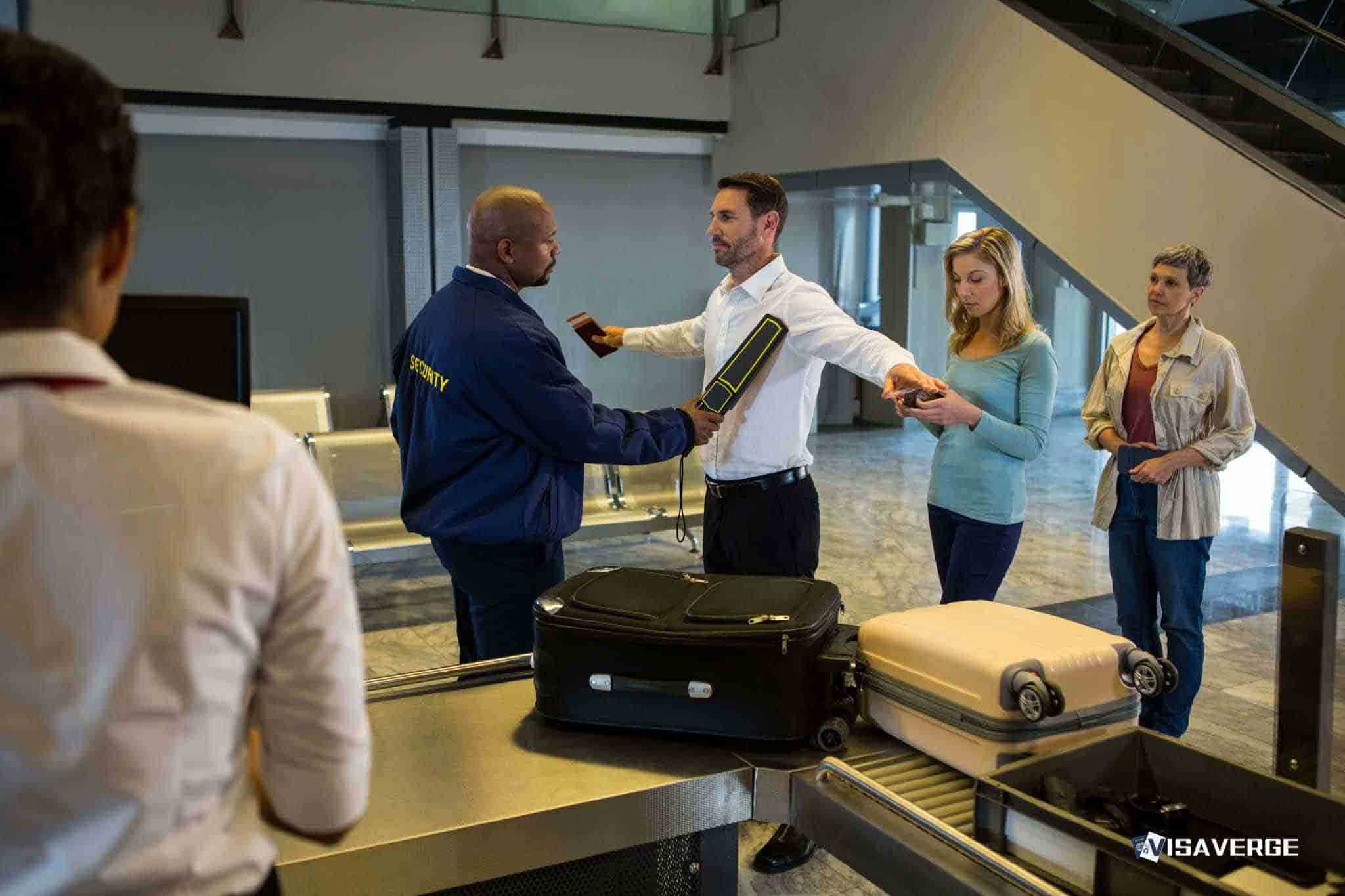
Choose the No Items to Declare lane and, if no officer stops you before you leave the egress area, your obligation under 19 CFR 148.12 and 148.13 is deemed satisfied. That is the real change. For everyone else, including anyone questioned in that lane, the queue choice only supplements the declaration you still owe. Officers work both lanes on roving enforcement, so an empty queue is not an unwatched one.
Nothing forces you into the new system. CBP says travelers keep the option of an oral or written declaration, so the familiar CBP Form 6059-B customs declaration is still available. If you are referred to secondary inspection, officers revert to standard procedure and collect a declaration there.
Your Duty to Declare Has Not Moved an Inch
CBP is explicit that the test “solely alters the method of declaration” and does not touch the obligation to declare accurately. Both enforcement provisions survive intact: 19 CFR 148.18 on failure to declare and 19 CFR 148.19 on false or fraudulent statements.
Those are not paperwork citations. Under 148.18, an undeclared article is seized when available for seizure and the personal penalty under 19 U.S.C. 1497 is demanded from you. That penalty equals the value of the article for ordinary goods, and either $500 or 1,000 percent of value, whichever is greater, for a controlled substance. No duty is collected, because undeclared goods are treated as smuggled.
So the No Items to Declare lane is a claim, not a shortcut. If you carry more than your personal exemption allows, $800 for most returning residents and $1,600 arriving from American Samoa, Guam, the Northern Marianas or the U.S. Virgin Islands, stepping into that lane is an assertion CBP can act on.
The Filing Requirements Side by Side
Arriving by air puts two separate duties on the table, and they belong to different people. The declaration duty belongs to each traveler. If you fly yourself in, a second and heavier advance-filing duty belongs to you as pilot in command.
What It Means for Private Pilots and General Aviation
One thing stands out for anyone who flies themselves across a border: this test does not reach you yet. It operates inside Federal Inspection Services air terminals, the halls built for scheduled international arrivals. A Cirrus landing at a general aviation ramp is not walking through a signed queue.
The advance-filing machinery under 19 CFR 122.22 is untouched by this notice and remains the harder deadline. As pilot you own the transmission, its accuracy and its timeliness, even if a dispatcher pushes the button. Sixty minutes before wheels up from the foreign field, eAPIS needs identity and travel-document data for every person aboard plus the tail number, aircraft type and color, estimated border crossing point, intended airport of first landing, your license number, and a 24-hour emergency contact.
Then you wait. Under 19 CFR 122.22(b)(6) you cannot depart until DHS sends the message approving the landing. Get that sequence wrong and 19 CFR 122.166 sets the price at $5,000 for a first violation and $10,000 for each one after, with the aircraft exposed to seizure.
Where the zones matter to general aviation is precedent. CBP is testing whether a physical act can substitute for a spoken or written statement of law, and that logic is portable to other arrival environments. It would be a real simplification in a sector where border paperwork keeps thickening, as operators found when Mexico narrowed general aviation and charter airport access and as airports weigh the advanced air mobility readiness gap. Every step cut from a single-pilot preflight is one fewer distraction in a cockpit where human factors already drive a large share of accidents.
Why CBP Extended a Test That Barely Ran
The notice gives an unusually candid reason. CBP writes that “given the limited participation under the initial test,” the extension is needed to learn how declaration zones affect inspection at different types of air terminal. Two years at one airport did not produce enough data.
The extension also lines the air program up with its maritime twin. CBP extended the cruise-terminal Declaration Zone test on September 12, 2025, at 90 FR 44202, three more years to the same October 16, 2028 date. Both now expire together, which points to one decision rather than two.
CBP reserves the right to discontinue the test at any time at its sole discretion. Participating airports must help build and maintain the zones and post the signage.
Two evaluation criteria are named: airline customer satisfaction surveys on the debarkation process, and a year-over-year comparison of enforcement statistics to confirm no impact on duty collection. That second one decides the program. If seizures and duty collections hold steady, CBP has evidence that letting most travelers walk a lane costs the government nothing. If they drop, the test is unlikely to reach a third extension.
What to Do on Your Next Arrival
If you land at Dallas-Fort Worth from abroad before October 16, 2028, read the signage and pick the lane that is honest for you. Tally what you bought, what you were given, what you carry for someone else, and any food, plant or animal products, then measure that against the $800 or $1,600 exemption.
- Unsure whether an item counts? Take the Items to Declare lane. Declaring costs a conversation; not declaring costs the item plus a penalty equal to its value.
- Remembered something late? Tell the officer before your bags are examined. Under 19 CFR 148.16 you can still add it; once the officer finds it, you cannot.
- Prefer the written route? Ask for CBP Form 6059-B. The test does not take that option away.
- Flying yourself? Put the eAPIS transmission in your preflight at the 60-minute mark and do not launch until the DHS approval arrives.
The practical effect through October 2028 is a shorter walk at one Texas airport and a rule that a stride into the right lane is a statement to the United States government. Treat it as exactly that.
Frequently Asked Questions
What is the CBP Air Declaration Zone test?
It is a CBP operational test that sets up two labeled queues in an arriving-passenger area, No Items to Declare and Items to Declare. Physically entering one of them counts as your initial customs declaration. CBP calls this a demonstrative initial declaration and runs it under 19 CFR 101.9(a).
When does the Air Declaration Zone test now expire?
October 16, 2028, unless CBP renews it again. The July 29, 2026 notice at 91 FR 47849 added two years to a test that originally began around August 19, 2024 and was written to run for about two years.
Which airports have declaration zones?
Only Dallas-Fort Worth, Texas, so far. CBP may expand the test to other air ports of entry at its discretion, and says any expansion will be announced on cbp.gov rather than in a new Federal Register notice.
Do I still have to fill out CBP Form 6059-B?
Not necessarily, but the option remains. CBP states travelers keep the choice of an oral or written declaration. If you enter the No Items to Declare queue and no officer questions you before you leave the egress area, the requirement under 19 CFR 148.12 and 148.13 is deemed satisfied.
What happens if I use the No Items to Declare lane and I actually had something to declare?
The same consequences as any failure to declare. Under 19 CFR 148.18 the article is seized when available for seizure, and 19 U.S.C. 1497 imposes a personal penalty equal to the value of the article, or $500 or 1,000 percent of value for a controlled substance. No duty is collected because the goods are treated as smuggled.
Does the Air Declaration Zone test apply to private aircraft and general aviation arrivals?
No. The test operates inside Federal Inspection Services air terminal facilities built for scheduled international arrivals. Private aircraft arrivals still follow the standard oral or written declaration plus the advance-filing rules in 19 CFR 122.22.
How far in advance must a private pilot file eAPIS before flying into the United States?
No later than 60 minutes before departure from the foreign airport, under 19 CFR 122.22(b)(2)(i). The pilot must also receive a DHS message approving the landing before taking off. Missing these steps exposes the pilot to a $5,000 civil penalty for a first violation and $10,000 for each later one.
How will CBP decide whether the declaration zones worked?
The notice names two criteria: airline customer satisfaction surveys covering the debarkation process, and a year-over-year comparison of enforcement statistics for each test period to confirm no impact on duty collection or on the frequency of enforcement activity.