- Police arrested a 19-year-old in Palatine, Illinois on October 11 over an alleged mass-shooting plot aimed at a Hindu temple in the Aurora area; he is due in court October 30.
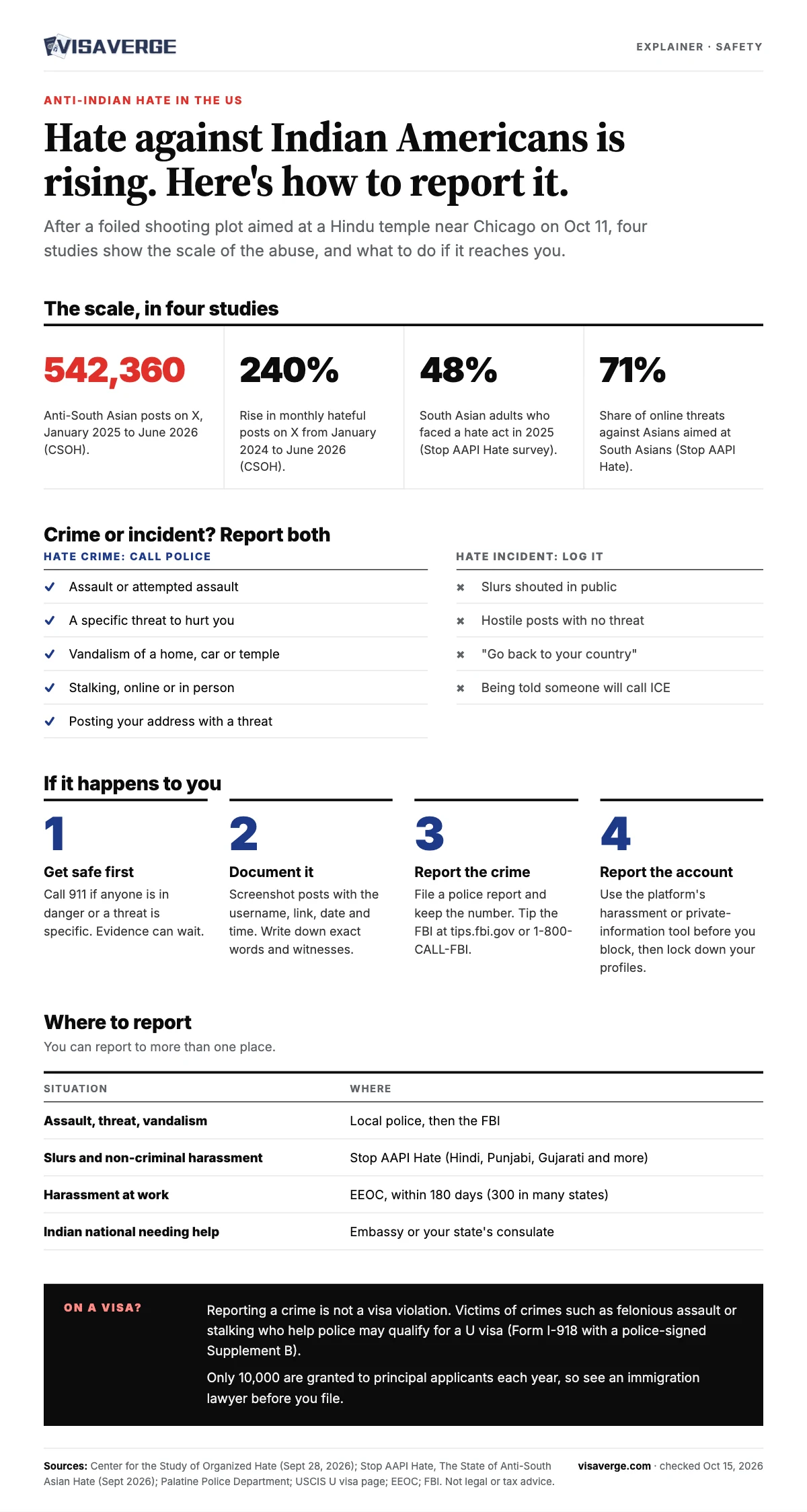
- Researchers counted about 542,360 anti-South Asian posts on X from January 2025 to June 2026, and 48% of South Asian adults reported a hate act in 2025.
- Victims can report to police and tips.fbi.gov; noncitizen victims of crimes such as felonious assault may qualify for a U visa with a police-signed Supplement B.
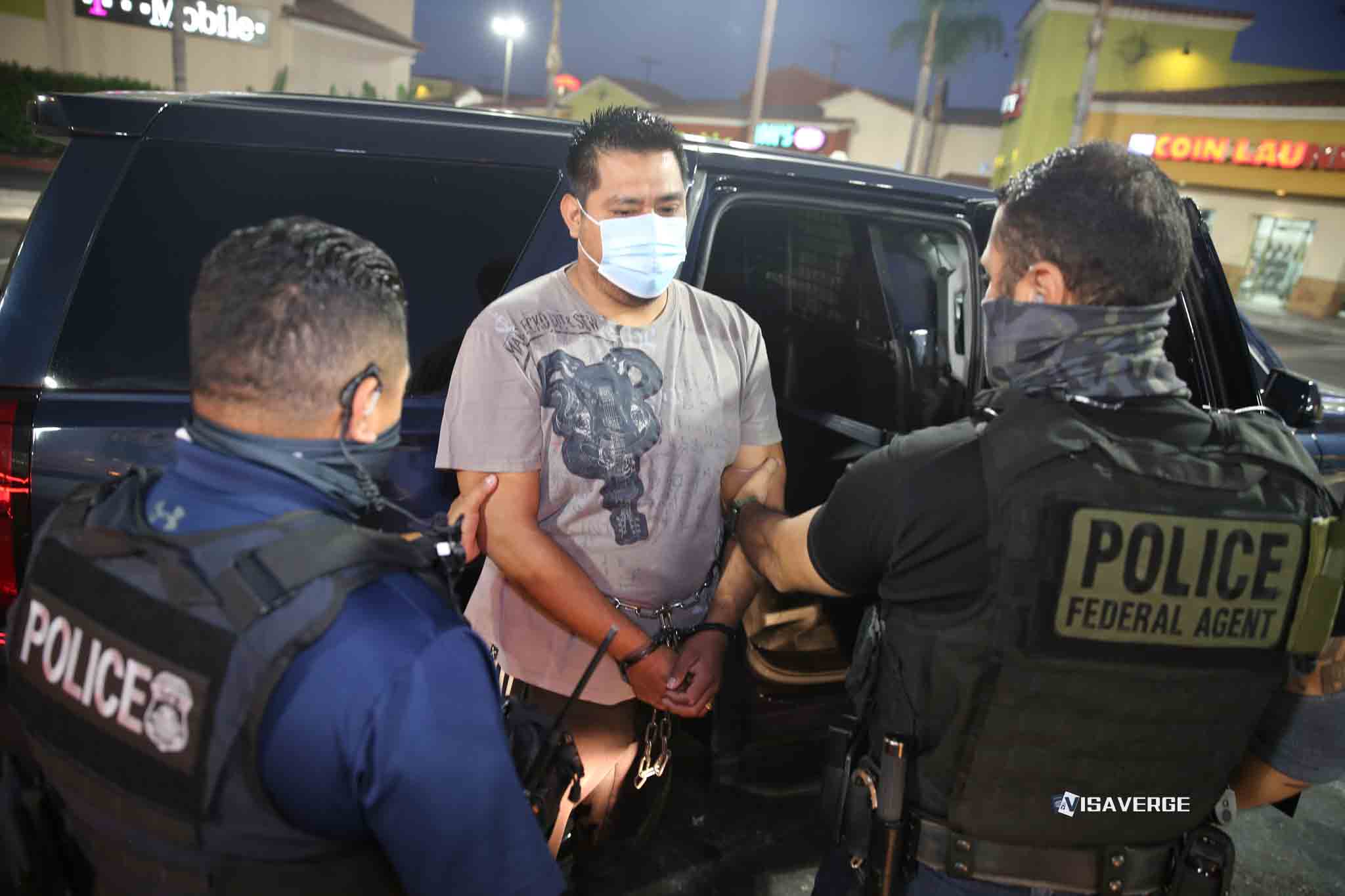
On Saturday, October 10, a 19-year-old Taco Bell worker in Palatine, Illinois, told a co-worker he was planning “it” at “the largest Hindu temple in Aurora,” prosecutors say. On Sunday he called another co-worker and said his gun had jammed. He then sent messages on Signal showing an AR-style rifle, along with an eight-page manifesto. His co-workers called the police. By Sunday evening, Alexandros Paporakis was in handcuffs outside his home.
Police say the manifesto described him as a white supremacist and spelled out hatred for “Jewish people, African Americans, Indians and other non-white people,” with violence aimed at people of Indian descent in particular. Officers found a rifle, loaded magazines, hundreds of rounds of ammunition and a tactical vest with body armor. He is charged with making a terrorist threat and unlawful possession of a weapon. A Cook County judge ordered him held on October 14. No one was hurt.
Free toolUSCIS Receipt Number DecoderThe plot did not come out of nowhere. In the six weeks before it, a federal agency posted, then deleted, an image telling “Mr Singh” to self-deport. A Sikh trucker was stabbed 17 times at a Wyoming rest stop. A research group counted more than half a million anti-South Asian posts on X in 18 months. And Vice President JD Vance called foreign outsourcing workers “indentured servants,” a term India’s government called “deeply offensive.” VisaVerge first reported the online surge in August 2025. Every measure tracked since then has gone up.
This article sets out what is confirmed, what the data actually measures and what is still unknown. The second half is a practical guide for Indian Americans, H-1B and H-4 families, students and green card holders. It covers how to document and report hate, how to deal with doxxing, how a crime report can open the door to a U visa, and where your consulate fits in.
What happened in Aurora and Palatine
Palatine police got the tip shortly after 3:30 p.m. on Sunday, October 11, when the Mount Prospect Police Department passed along a co-worker’s report of “concerning electronic communications.” Officers arrested Paporakis as he was leaving his home on the 1300 block of North Baldwin Court. The department announced the arrest on Wednesday, October 14, the same day prosecutors laid out their case at the Rolling Meadows courthouse.
Palatine Police Chief William Nord said the suspect “talked about mass killings and how he wanted to carry out this mass shooting.” Reading the manifesto, Nord said, “he did state some extremist ideologies and talked about violence.” Police also described a patch on the tactical vest with imagery linked to white supremacist extremism. Reports differ on whether he actually drove to a temple before the rifle failed. Prosecutors described the jam as something he told a co-worker on the phone, and the court has not tested that account.
Police have not confirmed which building was the target. Investigators describe the plan as “potentially targeting a Hindu place of worship in the Aurora area,” and say “a specific intended location has not been confirmed.” Aurora police contacted the city’s Hindu places of worship after the arrest. Court documents say Paporakis had mental and emotional health issues and had been without prescribed medication. The charges are allegations that have not been proven in court. He is due back in court on October 30.
Illinois treats making a terrorist threat as a Class X felony, the state’s most serious felony class below first-degree murder. India’s Ministry of External Affairs issued a statement on October 15: “We are deeply concerned by reports of an alleged plot to carry out a mass shooting targeting a Hindu temple.” It called “the reported anti-Hindu and racist nature of the alleged plot” “particularly disturbing” and said the case “adds to growing concerns over racist hostility and anti-India hate in the US.” Temple groups have urged members to stay alert.
The numbers: how much anti-Indian hate is there?
Four separate data sets now point the same way. They measure different things, though, so they cannot be added together. One counts posts, one counts reports to a hotline, one is a survey, and one is the FBI’s police-reported crime count. Taken together, they show a rise in both the volume of online abuse and the share of Indian Americans who say it reaches them personally.
Online volume. The Center for the Study of Organized Hate (CSOH) found about 542,360 posts on X expressing anti-South Asian hate from January 1, 2025 to June 30, 2026. Monthly volume rose from 12,904 posts in January 2024 to 43,843 in June 2026, an increase of 240%, and June 2026 was the highest month on record. The single biggest theme, 45% of posts, cast South Asians as “invaders,” job thieves or a demographic threat. On 4chan, 8chan and Gab, CSOH logged another 397,522 mentions in 2025 alone.
Threats. Stop AAPI Hate’s September 2026 brief, built on monitoring by the firm Moonshot, found that South Asians were the target of 71% of all online threats of violence against Asians (10,471 threats) between August 2024 and December 2025. Slurs against South Asians in those spaces more than doubled, from 22,996 in 2023 to 48,033 in 2025.
Lived experience. In a January 2026 NORC survey for the same brief, 48% of South Asian adults said they experienced a hate act in 2025, after 43% in 2023 and 54% in 2024. Half of those incidents happened online and 40% in public spaces. A separate Carnegie Endowment survey of 1,000 Indian American adults, run with YouGov from November 25, 2025 to January 6, 2026, found that half reported discrimination in the past year. One in four said they had been called a slur since the start of 2025, and 9% said they had been physically threatened.
Police data. The FBI does not count “anti-Indian” crimes as a category, so its figures only approximate the trend. Single-bias incidents reported by police for 2025, as tallied by Asian Americans Advancing Justice-AAJC, show anti-Sikh incidents rising from 142 to 226 (up 59%) and anti-Hindu incidents rising from 25 to 28. Anti-Asian incidents fell 16%, from 379 to 318. Hate crimes are heavily underreported, and many local agencies send the FBI little or no data. That is why advocacy groups lean on surveys and reporting hotlines.
Why it is rising: H-1B politics, “invasion” videos and official rhetoric
Every major report ties the surge to the fight over H-1B visas, where Indians receive the large majority of approvals. CSOH traced spikes in hateful posts to specific political moments. These included the December 2024 online fight over H-1B involving Vivek Ramaswamy and Sriram Krishnan, the $100,000 H-1B fee in September 2025, new bills to pause or end the program, and a Florida board vote to halt H-1B hires in March 2026.
Texas became the focus of a wave of “invasion” content. In February 2026, about a dozen speakers at a Frisco City Council meeting accused Indian residents of visa fraud. The city attorney replied that immigration is a federal matter and the fraud claims were unsubstantiated. In April, YouTuber Tyler Oliveira posted “I Exposed Texas’ Indian Invasion.” By September, CSOH said, the video had drawn about 3.2 million views on YouTube and 4.2 million on X. VisaVerge covered how Texas YouTubers used “H-1B fraud” as cover for targeting Indian immigrants. CSOH also documents accounts that pull South Asians’ LinkedIn profiles, employers and visa status and repost them alongside unproven fraud claims.
Government accounts have added to it. On September 9, the Department of Homeland Security posted an AI-generated “Transformers: Age of Deportations” image telling “Mr Singh” to self-deport. The post was deleted after protests from Sikh and Hindu groups. On September 13, Texas Railroad Commission nominee Bo French asked online “how many Americans have been displaced by foreigners” at the University of Texas. Senator John Cornyn and Texas House Speaker Dustin Burrows condemned the post.
Then came October 8. At a news conference on H-1B and J-1 visa abuse, Vance said that companies “bring in indentured servants from outside the country” and “lay off American workers.” He claimed that H-1B workers earn about $20,000 less than comparable Americans, and that workers placed by foreign outsourcing firms earn about $48,000 less. India’s foreign ministry answered the next day. It said the term carries “painful historical and colonial legacy connotations” and is “deeply offensive,” and that “such descriptions are unwarranted and ignore the fact that Indian professionals in the United States are highly educated and skilled contributors to its economy and innovation ecosystem.”
The pattern matches Stop AAPI Hate’s newest report, “License to Hate,” released October 14. It reviewed 1,825 anti-Asian hate acts reported to its center from January 2023 to June 2026. The share that included anti-immigrant hostility rose from 42% in 2023 to 62% in the first half of 2026. Among those incidents, threats of physical harm or actual harm doubled from 13% to 27%. Cases where the harasser policed the victim’s immigration status, such as threatening to call ICE or demanding proof of status, rose from 3% to 13%. “Hate thrives when leaders give it permission to,” said co-founder Cynthia Choi. One Indian woman in Georgia told the center a stranger said, “I’m going to call ICE.”
From posts to violence: what is confirmed and what is not
Attacks on people of South Asian origin get read as hate crimes very quickly online, sometimes before police know the motive. Two recent cases show why the details matter. In Utah, prosecutors have charged a religious hate crime. In Wyoming, police say they have no motive at all.
On July 13, 2026, a man at Valley Fair Mall in West Valley City, Utah, allegedly bought a knife, asked workers whether they were Muslim and stabbed Syed Sohail Uddin, a 37-year-old kiosk worker from India, after he said yes. A federal grand jury indicted Peter Larsen, 48, in August on a federal hate crime charge based on religion. He also faces state attempted aggravated murder charges with hate crime enhancements. “Anti-Muslim violence is a crime, and it will be met with the full force of federal law,” said U.S. Attorney Melissa Holyoak. The victim was Indian-born, but the charges describe an anti-Muslim attack.
On September 13, a Sikh truck driver from Sacramento was stabbed 17 times at the Bitter Creek rest area on Interstate 80 in Sweetwater County, Wyoming. He survived. Andrew Kris Bzdak is charged with attempted first-degree murder and is held on $1 million bond. “We have zero motive,” a sheriff’s office spokesperson said. The North American Punjabi Trucking Association urged prosecutors to pursue “all applicable hate-crime charges.” For now, though, no hate crime has been charged.
What it is doing to families
The harm reaches well beyond the people who are attacked. In the Carnegie survey, 48% of Indian Americans said they often or sometimes see anti-Indian racist posts online. Nineteen percent said they avoid wearing Indian clothing in public, and 31% avoid political discussion online. Fourteen percent said they frequently consider leaving the United States and 26% occasionally. Among those weighing a move, 41% named personal safety as a reason.
Status anxiety adds to the fear for families on temporary visas. Stop AAPI Hate counted 6,111 ICE arrests and 2,349 deportations of Indian nationals between January 20, 2025 and August 6, 2026. Deportations were about 15 times higher than in the same-length period before. When a harasser threatens to “call ICE,” an H-4 spouse or an F-1 student may stay quiet out of fear that reporting could put their own status at risk. That fear is the reason the next section exists.
Community groups across the country are telling temples, gurdwaras and mosques to review security, and telling members to keep reporting. Hindu groups have asked members to stay alert after the Aurora arrest. The arrest itself shows why: the plot came apart because co-workers took the threats seriously and called the police.
If you are targeted: a step-by-step guide
The law separates a hate crime from a hate incident. A hate crime is an actual crime, such as an assault, a threat, vandalism or stalking, committed because of race, religion, national origin or another protected trait. A hate incident is hostile conduct that is not a crime, such as a slur shouted on the street. You can report both. Police handle crimes, and groups such as Stop AAPI Hate log incidents so the pattern gets counted.
Doxxing needs fast action. If an account posts your employer, your home address, your visa status or photos of your family, report each post under the platform’s private-information or harassment rules, then lock down your own profiles. Remove your employer and city from public LinkedIn and Facebook views, turn off location tagging, and warn your HR or security team, since harassers sometimes contact employers directly. If a post includes a threat or your home address, treat it as a police matter, not just a platform complaint.
Where to report, and what each office can do
Different offices handle different parts of a case. The table below shows where each type of incident goes. You can report to more than one: a police report and a Stop AAPI Hate report do not cancel each other out.
India runs consulates general in Atlanta, Boston, Chicago, Houston, Los Angeles, New York, San Francisco and Seattle, plus the embassy in Washington, D.C. Each covers a set of states. Indian nationals who are victims of violence, or families in India trying to reach a relative, can contact the consulate for their state. The MEA’s MADAD portal (madad.gov.in) takes consular grievances, but it is not a channel for reporting crimes. Report the crime to US police first.
Reporting while on a visa: the U visa and your status
Many H-1B, H-4, F-1 and undocumented victims stay silent because they fear that contact with police will hurt their immigration case. Congress created the U visa for exactly this situation. It protects noncitizen victims of certain serious crimes who help law enforcement, and you need to report the crime to qualify for it.
- Qualifying crimes include felonious assault, stalking, murder, manslaughter, kidnapping, extortion and others, plus attempts, conspiracies and solicitation to commit them. “Hate crime” is not a separate category. The underlying crime, such as an assault or attempted murder, is what qualifies.
- Forms: you file Form I-918 with USCIS. It must include Supplement B, a certification signed by the police, prosecutor or other agency confirming you were helpful.
- Cap and wait: USCIS can grant only 10,000 U visas a year to principal applicants, and the backlog runs for years. Applicants with a bona fide case can get deferred action and a work permit while they wait.
- Get a lawyer: eligibility depends on the crime, the harm and your cooperation. An immigration attorney or a nonprofit legal clinic should review the case before you file. VisaVerge has covered the U visa backlog and enforcement climate in detail.
Two cautions. If your own status has a problem, such as an expired I-94 or a pending removal case, talk to an immigration lawyer before speaking with any federal agency. If immigration agents approach you after an incident, you have rights in that encounter too. The VisaVerge ICE know-your-rights guide walks through each scenario.
What to watch next
Several dates will shape this story over the coming weeks:
- October 30: Paporakis returns to court in Cook County. The FBI is involved in the investigation, and more charges are possible.
- The Utah and Wyoming cases: the federal hate crime case against Larsen is moving through court. In Wyoming, any change to the charges would signal whether investigators found a bias motive.
- H-1B policy: the Labor Department’s suspension of PERM labor certifications at certain companies, which India’s foreign ministry flagged on October 9, and any new restrictions are likely to set off fresh spikes in online hate. CSOH’s data shows that pattern after each H-1B announcement since late 2024.
- US-India relations: New Delhi has now objected publicly twice in a week, first to Vance’s remark and then to the temple plot. Further incidents will add diplomatic pressure on Washington to respond.
For Indian American families, the practical message is the same as the Palatine co-workers’: take threats seriously and report them. Screenshot the post, call the police when a threat is specific, log incidents even when they are not crimes, and do not let fear about your visa keep you quiet. Every report adds to the data that showed this rise in the first place.
Frequently Asked Questions
What happened with the Aurora Hindu temple shooting plot?
Palatine, Illinois police arrested Alexandros Paporakis, 19, on October 11, 2026 after co-workers reported messages about a mass shooting at a Hindu temple in the Aurora area. He is charged with making a terrorist threat and unlawful weapon possession, was ordered detained on October 14, and is due in court October 30.
Is anti-Indian hate increasing in the US?
Yes, by every available measure. CSOH counted about 542,360 anti-South Asian posts on X from January 2025 to June 2026, with monthly volume up 240% since January 2024. In a NORC survey, 48% of South Asian adults said they faced a hate act in 2025.
Why are Indian Americans being targeted online?
Researchers link the surge to the H-1B debate, including the $100,000 H-1B fee and bills to end the program, plus viral ‘Indian invasion’ videos about Texas and rhetoric from officials. CSOH found 45% of hateful posts portrayed South Asians as invaders or job thieves.
How do I report a hate crime against an Indian American?
Call 911 if there is immediate danger. Otherwise file a report with local police and get the report number, then submit a tip to the FBI at tips.fbi.gov or 1-800-CALL-FBI. Non-criminal incidents such as slurs can be logged with Stop AAPI Hate in Hindi, Punjabi, Gujarati and other languages.
Can H-1B or H-4 visa holders report a crime without risking their status?
Reporting a crime is not a visa violation, and Congress created the U visa to protect noncitizen victims who help police. Victims of crimes such as felonious assault or stalking can apply on Form I-918 with a police-signed Supplement B. Anyone with an existing status problem should see a lawyer first.
Does a hate crime qualify for a U visa?
Not as its own category. The U visa list covers specific crimes such as felonious assault, stalking, kidnapping, extortion and attempted murder. If a hate-motivated attack involves one of those crimes, the victim may qualify. Only 10,000 U visas are available to principal applicants each year.
What should I do if someone doxxes my H-1B status or employer online?
Screenshot each post with the username, URL and date, then report it under the platform’s private-information or harassment rules before blocking. Remove your employer and city from public profiles, alert your HR or security team, and contact police if the post includes a threat or your home address.
Which Indian consulate should I contact in the US?
India has an embassy in Washington, D.C. and consulates general in Atlanta, Boston, Chicago, Houston, Los Angeles, New York, San Francisco and Seattle, each covering specific states. The MADAD portal handles consular grievances, but crimes should be reported to US police first.