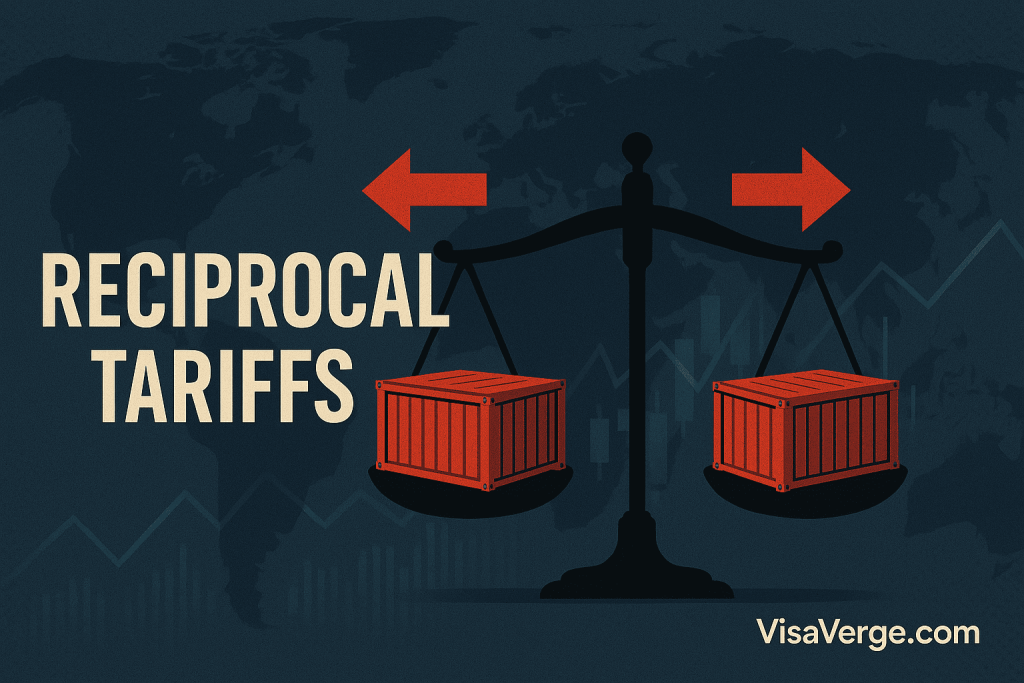
- Reciprocal tariffs mirror foreign trade barriers to ensure equivalent duty rates on imported goods.
- The policy raises costs for consumers and impacts visa-sponsored workers in trade-heavy sectors.
- Legal challenges led to shifting from IEEPA authority to Section 122 of the Trade Act.
Reciprocal Tariffs now sit at the center of U.S. trade policy, and they are reshaping costs for importers, exporters, and immigrant households tied to trade-heavy jobs. these tariffs match or mirror the duties and barriers that foreign governments place on U.S. goods. The result is a sharper and more unpredictable tariff environment for companies that rely on cross-border supply chains.
That shift matters beyond commerce. Higher tariffs raise prices for food, clothing, electronics, cars, and the inputs that many U.S. employers need to keep hiring. Visa-sponsored workers in agriculture, manufacturing, logistics, and semiconductors feel the pressure when companies face higher costs, slower orders, or retaliation abroad. VisaVerge.com reports that tariff policy now affects immigration-linked labor markets as much as it affects trade.
Reciprocal Tariffs and ordinary duties
A normal tariff is a tax on imported goods. Governments use tariffs to raise revenue, protect local producers, enforce safety standards, or pressure trading partners. Importers pay the duty at the border, and the cost usually moves down the chain to wholesalers, retailers, and consumers. The U.S. Customs and Border Protection system collects many of these duties.
Reciprocal Tariffs work differently. They are designed to copy a trading partner’s rate, barrier, or market restriction. If another country charges 20% on a U.S. product, a reciprocal tariff aims to charge the same amount on that country’s imports. President Trump described the idea bluntly: “If they tax us, we tax them the same amount.”
That logic sounds simple, but the trade rules are not. Reciprocal Tariffs often run against the World Trade Organization’s most-favored-nation rule, which requires equal treatment for similar products from WTO members. They also clash with tariff bindings, which limit how high a country can raise duties. Protective tariffs and retaliatory tariffs are different. Protective tariffs shield domestic industries. Retaliatory tariffs respond to a specific violation or ruling. Reciprocal Tariffs mirror foreign barriers first and ask questions later.
How the U.S. applied the policy in 2025 and 2026
The U.S. pushed Reciprocal Tariffs into the center of policy in 2025 through President Trump’s “Fair and Reciprocal Plan.” An April 2 executive order set a 10% baseline tariff on most imports, with higher country-specific add-ons, including China at 34%, Japan at 24%, and the EU at 20%. Some Canada and Mexico goods that met USMCA rules were exempt.
Those rates stacked on top of older duties. A shipment facing a 2.5% MFN duty and a 15% Section 301 duty could pick up another 10% reciprocal charge. That kind of layering pushed overall tariff exposure higher very quickly.
Legal fights followed. On February 20, 2026, the Supreme Court struck down IEEPA-based tariffs, including the reciprocal and fentanyl-related regimes on Canada, Mexico, and China. After that ruling, President Trump turned to Section 122 of the Trade Act of 1974, imposing a temporary 10% tariff that later rose to 15%. The administration also carved out exemptions for some Section 232 goods, USMCA-eligible products, critical minerals, pharmaceuticals, energy, agriculture, and electronics.
For current policy documents, the U.S. Trade Representative remains the most authoritative government source on trade actions and negotiations.
Industries, households, and immigration-linked jobs
The immediate effect of tariffs is higher prices. The burden falls hardest on low-income households, which spend a larger share of income on basics. Food, clothing, and household items become more expensive. So do imported parts used by U.S. factories.
Manufacturers face another hit. Tariffs on steel, electronics, lumber, and semiconductors raise input costs for autos, appliances, housing, and technology. Businesses often respond by cutting orders, delaying investment, or shifting production. Some try to stockpile inventory. Others renegotiate contracts or search for alternative suppliers.
Those moves reach immigrants and visa holders in direct ways. Farming communities feel the pressure when exports fall and when imported inputs cost more. Employers in agriculture may face slower demand for seasonal labor. At the same time, reshoring in semiconductors, minerals, and advanced manufacturing can create openings for skilled foreign workers, including H-1B employees. The policy does not hit one group only. It spreads through supply chains and labor markets together.
WTO friction and global retaliation
Reciprocal Tariffs create sharp legal tension because they ignore the multilateral trade framework that has governed most U.S. trade policy since 1947. The WTO system was built on broad rules, not bilateral matching. Economists also question the idea that trade deficits prove unfairness. Deficits usually reflect savings, investment, and exchange-rate patterns, not tariffs alone.
Other governments have answered with their own tariffs. China has raised duties sharply on U.S. agricultural and aviation goods. The EU and Japan have signaled or imposed countermeasures in response to earlier U.S. moves. That pattern is familiar: one round of tariffs leads to another, and both sides absorb higher costs. The public pays through prices, while businesses pay through uncertainty.
The U.S. Trade Policy Agenda for 2026 still pushes bilateral deals under an “America First Reciprocal Trade” approach. The goal is to get partners to cut their barriers while the U.S. keeps supplemental duties in place. That strategy may bring short-term leverage. It also keeps the risk of trade fragmentation high.
What people tied to immigration should watch
For immigrants, Reciprocal Tariffs matter because they alter the economic ground beneath hiring, wages, and household budgets. A family waiting on a work visa does not feel a tariff directly, but it feels the job slowdown, the higher grocery bill, and the pressure on a sponsoring employer. Communities with heavy trade exposure often see slower hiring when tariffs rise.
The policy also affects the sectors that depend on migrant labor and skilled foreign workers. Agriculture, trucking, food processing, and manufacturing sit close to the tariff shock. So do advanced industries that may expand if the U.S. keeps pushing reshoring. That means tariffs can tighten one part of the labor market while opening another.
As of early 2026, the U.S. has moved from broad tariff escalation toward negotiated exceptions and temporary legal workarounds. The policy still rests on a simple idea: mirror foreign barriers and force better terms. The practical result is less simple. Reciprocal Tariffs raise the price of doing business, deepen pressure on global supply chains, and keep trade policy tied closely to the fortunes of workers, employers, and immigrant families across the U.S.