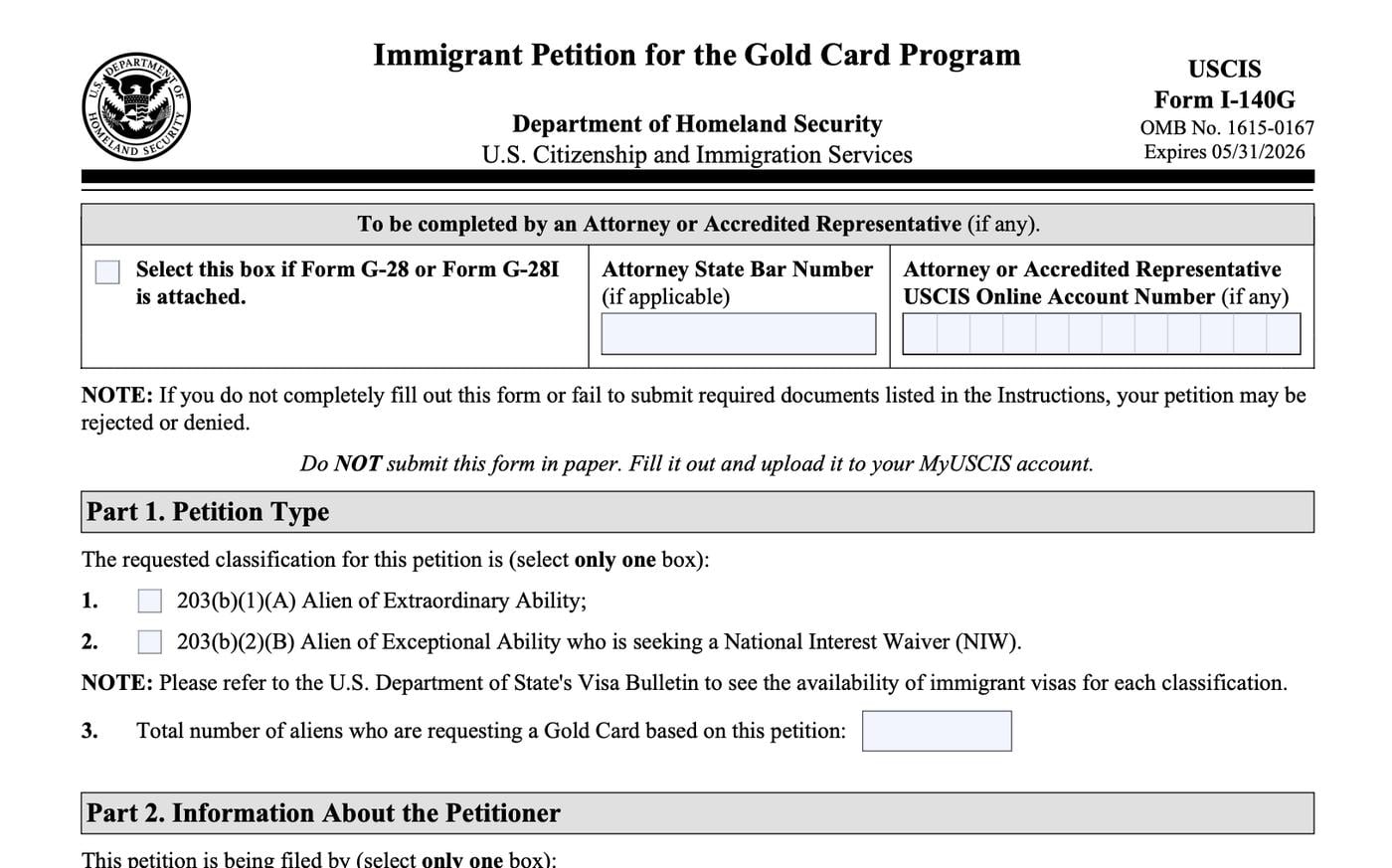
USCIS accepts only one edition of Form I-140 in 2026: edition date 06/07/24, expiration 02/28/2027. Anything older is rejected on receipt. This guide walks through every field on all 11 Parts of the current form, flags the entries that trigger the most Requests for Evidence, and shows the 2026 fee math every petitioner must get right before signing.
The form is short by immigration standards. The instructions run 11 pages, the petition itself is 8 pages, and most employers finish the data entry in under an hour. The hard part is not the typing. It is matching what you write in Part 2 to what you file in Part 4, what you certify in Part 5 to the underlying PERM, and what you sign in Part 8 to the person with legal authority to bind the company.
This walkthrough assumes you already have a petition strategy: an EB-1A, EB-1B, EB-1C, EB-2, EB-2 NIW, EB-3 Skilled, EB-3 Professional, or EB-3 Other Worker classification. If you have not picked a category yet, start with our Form I-140 complete guide for 2026, then come back here to fill the form.
Three groups file the I-140. U.S. employers sponsoring EB-1B, EB-1C, EB-2 non-NIW, EB-3 Skilled, EB-3 Professional, and EB-3 Other Worker cases. Beneficiaries self-petitioning EB-1A and EB-2 NIW cases. Attorneys acting on behalf of either. The field choices differ depending on which of you is filing.
VisaVerge has tracked I-140 denial trends since the April 2024 fee rule and again since the March 2026 premium processing increase. The denial reasons that show up most often on AAO dockets are not exotic. They are typos in Part 3, mismatched classification codes between Part 2 and the PERM, and ability-to-pay problems traceable to wrong entries in Part 5. This guide is organized around those failure points.
Before entering the first field, gather the I-797 for any prior petitions, the approved Form ETA-9089 (if the case needs PERM), the company EIN, the beneficiary’s full I-94 history, the passport, and the prevailing wage determination. USCIS will not allow blank entries; if a field does not apply, write “N/A” or “None.”
Header Boxes: Classification, Certification, and Attorney
Free toolDS-160 Form Filling Online Helper ToolThe top of page 1 has four boxes USCIS uses to route the file. Leave Fee Stamp, Priority Date, Consulate, Action Block, and Remarks blank. Complete the three boxes below.
| Box | Field | What to Enter |
|---|---|---|
| Classification | 203(b)(1)(A) | Check for EB-1A extraordinary ability |
| Classification | 203(b)(1)(B) | Check for EB-1B outstanding professor or researcher |
| Classification | 203(b)(1)(C) | Check for EB-1C multinational executive or manager |
| Classification | 203(b)(2) | Check for EB-2 advanced-degree or exceptional-ability |
| Classification | 203(b)(3)(A)(i) | Check for EB-3 Skilled Worker |
| Classification | 203(b)(3)(A)(ii) | Check for EB-3 Professional |
| Classification | 203(b)(3)(A)(iii) | Check for EB-3 Other Worker (unskilled) |
| Certification | National Interest Waiver | Check only for EB-2 NIW cases (no PERM attached) |
| Certification | Schedule A, Group I | Check for registered nurses and physical therapists |
| Certification | Schedule A, Group II | Check for exceptional-ability Schedule A (rare) |
| Attorney | G-28 attached checkbox | Check if Form G-28 is filed with the petition |
| Attorney | State Bar Number | Attorney’s state bar ID (leave blank if pro se) |
| Attorney | USCIS Online Account | Attorney’s USCIS OAN if they have one |
Do not check Classification 203(b)(2) and Certification National Interest Waiver if the case is a standard PERM-based EB-2. NIW cases do not use PERM. Mixing the two is the single most common Part 2 error on pro se filings.
Part 1: Information About the Person or Organization Filing This Petition
Part 1 identifies the petitioner. Complete either Item 2 (company) or Items 1.a-1.c (individual), never both. Self-petitioners (EB-1A, NIW) fill Items 1.a-1.c.
| Item | Field | What to Enter |
|---|---|---|
| 1.a / 1.b / 1.c | Family / Given / Middle Name | Only if an individual files (self-petition, LPR, etc.) |
| 2 | Company or Organization Name | Only if a company files; skip Items 1.a-1.c |
| 3.a | In Care Of Name | Law firm name if mail goes to counsel; else blank |
| 3.b | Street Number and Name | Company HR address or self-petitioner address |
| 3.c | Apt / Ste / Flr | Unit type + number if applicable |
| 3.d / 3.e / 3.f | City / State / ZIP | U.S. address only in these fields |
| 3.g / 3.h / 3.i | Province / Postal Code / Country | Foreign address fields; leave blank if U.S. |
| 4 | IRS Employer Identification Number | 9-digit EIN; self-petitioners leave blank |
| 5 | Nonprofit / governmental research org? | Yes unlocks the $0 Asylum Program Fee |
| 6 | 25 or fewer FTEs including affiliates? | Yes unlocks the $300 reduced Asylum Program Fee |
| 7 | U.S. Social Security Number | Self-petitioner SSN; blank for company filers |
| 8 | USCIS Online Account Number | OAN if previously filed online; else blank |
Verify the EIN matches the one on the PERM ETA-9089 and on the tax documents you will submit as ability-to-pay evidence. Every denial citing “inconsistent employer identification” traces back to an EIN that differs across filings, usually because a parent and subsidiary share payroll but file under different numbers.
Part 2: Petition Type
Part 2 is where most pro se petitioners trigger an NOID. Select exactly one box from Items 1.a-1.h. Items 2.a and 2.b are blank for almost every fresh filing.
| Item | Classification | When to Check |
|---|---|---|
| 1.a | Extraordinary ability | EB-1A self-petition, no PERM, no job offer required |
| 1.b | Outstanding professor or researcher | EB-1B employer-filed, no PERM |
| 1.c | Multinational executive or manager | EB-1C employer-filed, no PERM |
| 1.d | Advanced degree / exceptional ability | EB-2 with certified PERM attached |
| 1.e | Professional (bachelor’s degree) | EB-3 Professional with PERM |
| 1.f | Skilled worker | EB-3 Skilled (2+ years experience) with PERM |
| 1.g | Other worker | EB-3 unskilled (under 2 years) with PERM |
| 1.h | NIW (professional with advanced degree) | EB-2 NIW self-petition, no PERM |
| 2.a | Amend previously filed petition | Only to amend a prior I-140 by USCIS direction |
| 2.b | Schedule A, Group I or II designation | Only for RNs, PTs, or Group II cases |
Items 1.d and 1.h both mention “advanced degree.” Item 1.d requires an attached PERM. Item 1.h is the NIW waiver of the job offer. Attaching PERM to a 1.h filing triggers an immediate RFE asking which classification you intended.
Part 3: Information About the Person for Whom You Are Filing
Part 3 is the beneficiary identity block. Names must match the passport exactly. The I-94 block (Items 10-15) applies only when the beneficiary is physically in the United States.
| Item | Field | What to Enter |
|---|---|---|
| 1.a / 1.b / 1.c | Family / Given / Middle Name | Exactly as on passport, including diacritics |
| 2.a-2.i | Mailing Address | Where beneficiary wants I-797 notices delivered |
| 3 | Date of Birth | mm/dd/yyyy from passport |
| 4 | City / Town / Village of Birth | Birthplace city on passport or birth record |
| 5 | State or Province of Birth | State or province; N/A if none |
| 6 | Country of Birth | Use current country name |
| 7 | Country of Citizenship or Nationality | Current citizenship (drives priority date chargeability) |
| 8 | Alien Registration Number (A-Number) | 9-digit A-Number from prior USCIS filings; blank if none |
| 9 | U.S. SSN | SSN if one was issued; H-1B/L-1 always have one |
| 10 | Date of Last Arrival | From CBP I-94 record |
| 11.a | Form I-94 Arrival-Departure Record Number | Pull from i94.cbp.dhs.gov, not the I-797 notice |
| 11.b | Expiration Date of Authorized Stay | I-94 expiration date on CBP record |
| 11.c | Status on Form I-94 | Class of admission (e.g., H-1B, L-1A, F-1) |
| 12 | Passport Number | Current valid passport number |
| 13 | Travel Document Number | Only if using a travel document (e.g., refugee) |
| 14 | Country of Issuance | Country that issued the passport |
| 15 | Passport Expiration Date | mm/dd/yyyy from passport data page |
Pull Item 11.a fresh from i94.cbp.dhs.gov within 48 hours of signing. Every re-entry issues a new I-94 number. Using the number from the original H-1B I-797 approval notice is the fastest way to an RFE on status maintenance.
Part 4: Processing Information
Part 4 tells USCIS where the beneficiary plans to pick up the green card. Check exactly one of Items 1.a or 2.a. The selection is not binding and can be changed later.
| Item | Field | What to Enter |
|---|---|---|
| 1.a | Will apply at U.S. Embassy or Consulate abroad | Check for consular processing (CP) |
| 1.b / 1.c | City / Country of Consulate | Only if 1.a is checked |
| 2.a | Will apply for Adjustment of Status in U.S. | Check for I-485 AOS inside the U.S. |
| 2.b | Current country of residence abroad | Only if 1.a is checked |
| 3.a-3.f | Foreign address | Only if Part 3 mailing address was U.S. |
| 4.a-4.c / 5.a-5.g | Native-alphabet name and address | Required for non-Roman alphabets (Chinese, Hindi, Arabic, etc.) |
| 6.a | Filing other petitions concurrently? | Yes if filing I-485, I-131, I-765 together |
| 6.b | Concurrent form checkboxes | Check I-485, I-131, I-765, or Other as applicable |
| 7 | In removal proceedings? | Yes/No; explain Yes in Part 11 |
| 8 | Any prior immigrant visa petition? | Yes/No; explain Yes in Part 11 |
| 9 | Filing without original labor cert? | Yes only if PERM was submitted with prior I-140 |
| 10 | Requesting duplicate labor cert from DOL? | Yes only for specific duplicate-request cases |
Concurrent I-140 and I-485 filing is only possible when the beneficiary’s priority date is current under the Dates for Filing chart in the month of submission. Check the chart before committing to 6.a and 6.b. See PERM filing date vs I-140 approval date.
Part 5: Additional Information About the Petitioner
Part 5 is the ability-to-pay heart of the petition for every PERM-based case (EB-2 non-NIW and all EB-3 categories). Get Part 5 wrong and the RFE is almost guaranteed.
| Item | Field | What to Enter |
|---|---|---|
| 1.a | Petitioner type: Employer | Check if a company or organization files |
| 1.b | Petitioner type: Self | Check for EB-1A or EB-2 NIW self-petition |
| 1.c | Petitioner type: Other | LPR, U.S. citizen, or third-party; write explanation |
| 2 | Type of Business | Plain-English description (e.g., software development) |
| 3 | Date Established | mm/dd/yyyy the business was formed |
| 4 | Current Number of U.S. Employees | Total U.S. headcount, including affiliates |
| 5 | Gross Annual Income | From most recent federal tax return |
| 6 | Net Annual Income | Net income; must meet or exceed prevailing wage |
| 7 | NAICS Code | 6-digit code from census.gov/naics |
| 8 | Labor Certification DOL Case Number | PERM case number from certified ETA-9089 |
| 9 | Labor Certification DOL Filing Date | PERM filing date = priority date (EB-2 non-NIW, EB-3) |
| 10 | Labor Certification Expiration Date | 180 days after DOL certification; must file before this |
| 11 | Occupation (individual filer only) | Field of extraordinary ability or NIW endeavor |
| 12 | Annual Income (individual filer only) | Self-petitioner annual income |
| Net income equal to or greater than prevailing wage | Tax returns |
| Net assets equal to or greater than prevailing wage | Audited financials |
| Beneficiary currently employed at prevailing wage | W-2 / payroll |
| 100+ U.S. employees (Yates memo, 2004) | Financial officer statement |
| Loss-year or shortfall (Matter of Sonegawa) | Totality narrative |
Part 6: Basic Information About the Proposed Employment
Part 6 describes the job. For any PERM-based case, every field must match the certified ETA-9089 exactly. Divergence is an automatic RFE.
| Item | Field | What to Enter |
|---|---|---|
| 1 | Job Title | Copy verbatim from PERM; do not rewrite |
| 2 | SOC Code | 6-digit code from bls.gov/soc; pad with zeros if PERM is 5 digits |
| 3 | Nontechnical Job Description | PERM job-duties block in plain English |
| 4 | Full-time position? | Yes/No; match PERM |
| 5 | Hours per week (if part-time) | Only if Item 4 is No |
| 6 | Permanent position? | Yes/No; I-140 requires permanent |
| 7 | New position? | Yes if position was created for beneficiary |
| 8 | Wages | Amount + per hour/week/month/year; must meet prevailing wage |
| 9.a-9.e | Worksite Location | Only if worksite differs from Part 1 petitioner address |
EB-1C petitions require the U.S. position to be managerial or executive under INA definitions, not the corporate job title. A “Senior Software Engineer” title does not qualify as managerial. Match the Item 3 job description to the USCIS definitions in 8 CFR 204.5(j)(2), not the internal HR job ladder.
Part 7: Information About the Spouse and All Children
Part 7 lists every qualifying dependent: the spouse plus every unmarried child under 21. The form has space for six people; use Part 11 for overflow. The same 6 fields repeat for each person.
| Item | Field | What to Enter |
|---|---|---|
| 1.a / 1.b / 1.c | Family / Given / Middle Name | As on passport or birth certificate |
| 2 | Date of Birth | mm/dd/yyyy; drives CSPA age-out calculation |
| 3 | Country of Birth | Birthplace country |
| 4 | Relationship | Spouse, Son, Daughter, Stepson, Stepdaughter |
| 5 | Applying for adjustment of status? | Yes if dependent is in U.S. on F-2, H-4, L-2 |
| 6 | Applying for visa abroad? | Yes if dependent is outside U.S. (consular path) |
- Spouse (current, legally married)
- Every unmarried child under 21
- Unmarried children over 21 only if CSPA may freeze their age
- Adopted children with USCIS-recognized adoption (before age 16)
- Stepchildren if marriage occurred before stepchild turned 18
Part 7 itself does not secure status for dependents. Each dependent must later file their own I-485 or consular DS-260 once the priority date is current. Listing them here preserves derivative eligibility.
Part 8: Petitioner Signature (and Parts 9, 10 if Applicable)
Part 8 is the petitioner’s signature block. Parts 9 and 10 apply only if an interpreter or preparer was used. The company officer or attorney-in-fact signs Part 8.
| Part | Item | Field | Who Completes |
|---|---|---|---|
| Part 8 | 1.a / 1.b | Signatory Family / Given Name | Corporate officer or self-petitioner |
| Part 8 | 2 | Title | CEO, CFO, HR Director, General Counsel |
| Part 8 | 3 / 4 / 5 | Daytime / Mobile Phone / Email | Signatory’s contact details |
| Part 8 | 6.a / 6.b | Signature / Date | Ink signature; no stamps or typed names |
| Part 9 | 1.a / 1.b / 2 | Interpreter Name / Business | Only if petition was translated |
| Part 9 | 3 / 4 / 5 | Phone / Email | Interpreter contact |
| Part 9 | 6.a / 6.b | Interpreter Signature / Date | Certifies language fluency |
| Part 10 | 1 / 2 | Preparer Name / Business | Attorney, paralegal, form preparer |
| Part 10 | 3 / 4 / 5 | Phone / Email | Preparer contact |
| Part 10 | 6 | Preparer Signature / Date | Anyone other than petitioner who prepared form |
Corporate petitioners must have an officer or employee with authority to bind the company sign Part 8. A recruiter, HR assistant, or office admin does not qualify. USCIS accepts photocopied, faxed, or scanned reproductions of an original ink signature, but a stamped or typewritten name is rejected at intake.
Part 11: Additional Information and Final Assembly
Part 11 is the overflow page. Any Yes answer in earlier Parts that needs explanation goes here, each keyed to the original Page, Part, and Item Number. Make copies of the page if seven entries are not enough.
| Item | Field | What to Enter |
|---|---|---|
| 1 | Family / Given / Middle Name | Petitioner’s name (same as Part 1 or 8) |
| 2 | IRS EIN | EIN at top of every Part 11 sheet |
| 3-7 | Page / Part / Item Number + Explanation | Reference the prior field being expanded; then the explanation |
- Classification box, Part 2 Item 1, and PERM SOC all point to the same EB category
- All signatures handwritten in ink; no stamps
- EIN identical across Part 1 Item 4, Part 5, and tax return evidence
- I-94 number in Part 3 Item 11.a pulled fresh from i94.cbp.dhs.gov
- Wages in Part 6 Item 8 meet or exceed PERM prevailing wage
- All blank fields marked “N/A” or “None”; nothing truly empty
- Edition date 06/07/24 visible in the lower-left footer of every page
Fees, Payment, and Filing Choice
The I-140 fee structure changed on April 1, 2024 and the premium processing fee changed on March 1, 2026. The numbers below reflect the current 2026 rates. Every petitioner pays the $715 base fee. Most also pay an Asylum Program Fee, with the amount depending on employer size. Premium processing is optional.
| I-140 Base Filing Fee | $715 |
| Asylum Program Fee: standard employer (26+ FTEs) | $600 |
| Asylum Program Fee: small employer (≤25 FTEs) or self-petitioner | $300 |
| Asylum Program Fee: nonprofit / governmental research | $0 |
| Premium Processing (Form I-907) | +$2,965 |
| Total: Standard Employer without Premium | $1,315 |
| Total: Self-Petitioner without Premium | $1,015 |
| Total: Nonprofit without Premium | $715 |
| Total: Standard Employer with Premium | $4,280 |
USCIS strongly prefers separate checks for each fee line: one check for the $715 I-140, a second for the Asylum Program Fee, and a third for the $2,965 premium processing if you are filing I-907 concurrently. Lumped single checks are sometimes rejected if one component is calculated wrong. Make checks payable to “U.S. Department of Homeland Security” spelled out in full, not “USDHS” or “DHS.”
Three payment methods are acceptable. Personal or cashier’s checks drawn on a U.S. bank. Form G-1450 for credit card authorization, one form per fee line. Form G-1650 for ACH debit authorization. For details on the premium processing fee alone, see our premium processing I-140 worth-it analysis.
Online Filing vs Paper Filing
USCIS offers online I-140 filing, but only for standalone petitions. The moment you add Form I-485, Form I-907, or any other concurrent form, the online portal locks you out and the whole bundle must go in on paper. For EB-2 India and EB-3 India cases where concurrent filing is the whole point of the strategy, paper is the only option.
| Criteria | Online | Paper |
|---|---|---|
| Standalone I-140 | Yes | Yes |
| I-140 + I-485 concurrent | No | Yes |
| I-140 + I-907 premium | No | Yes |
| Attorney G-28 support | Yes | Yes |
| Receipt time | Instant | 3-5 weeks |
| Fee method | Credit card in portal | Check, G-1450, G-1650 |
| Evidence upload limit | 35 MB total | Unlimited paper |
Filing addresses depend on four variables: standalone vs concurrent, USPS vs courier delivery, whether I-907 is included, and the beneficiary’s work state. USCIS rotates lockbox assignments among Dallas, Chicago, Elgin, and Phoenix. Always pull the current address from the USCIS direct filing addresses page within 24 hours of mailing.
Attn: I-140
P.O. Box 660867
Dallas, TX 75266-0867
Attn: I-140 (Box 660867)
2501 S State Hwy 121 Business
Suite 400
Lewisville, TX 75067-8003
Common Part-by-Part Mistakes
These pitfalls account for the majority of I-140 Requests for Evidence and Notices of Intent to Deny. Every one of them is a self-inflicted wound that can be prevented at data-entry time.
The Classification box on page 1, the Part 2 Item 1 checkbox, and the PERM SOC code must all describe the same EB category. Checking 203(b)(2) at the top, then Item 1.d in Part 2, but filing PERM evidence for an EB-3 Professional position will generate an immediate RFE for “inconsistent classification.”
National Interest Waiver petitions by definition waive the job-offer and PERM requirements. If you check Item 1.h in Part 2 and then submit a certified ETA-9089, the officer will assume you meant Item 1.d and issue an RFE asking which you intended. Choose one and remove the other.
Applicants copy the I-94 from the original H-1B approval notice instead of the most recent CBP entry record. Every re-entry issues a new I-94 number. Pull from i94.cbp.dhs.gov within 48 hours of signing the petition to ensure you have the current record.
If Net Annual Income in Part 5 Item 6 is lower than the PERM prevailing wage in Part 6 Item 8, USCIS will issue an RFE unless you submit audited financials showing net assets cover the shortfall, W-2s showing the beneficiary is already being paid the wage, or a Matter of Sonegawa totality-of-circumstances narrative addressing the loss year. Verify the math before signing.
Every qualifying spouse and child under 21 should appear in Part 7, even if they are not in the United States yet. Omitting a child born abroad means that child will not receive derivative visa numbers when the priority date becomes current, and adding them later requires either an I-130 (for adult children) or a time-consuming beneficiary name update.
A printed name in the signature block, a photocopy of a photocopy, or a signature by someone without authority to bind the corporation (a recruiter, an admin) will cause USCIS to reject the petition at intake. Corporate officers or attorneys with G-28 authority are the only acceptable signatories for company filings.
What Happens After You Mail the Petition
USCIS assigns a receipt number starting with EAC (Vermont Service Center, historical only), LIN (NSC), SRC (TSC), WAC (California, historical), or IOE (online). The I-797C receipt notice arrives in 3 to 5 weeks by paper mail; online filers see the receipt instantly in their account. Track the case at egov.uscis.gov.
Standard processing runs 4 to 14 months depending on EB category and service center as of April 2026. Premium processing decides within 15 business days for EB-1A, EB-1B, EB-2 non-NIW, and EB-3, or 45 business days for EB-1C and EB-2 NIW. If USCIS issues an RFE, NOID, or NOIR, the premium clock stops until you respond. Approval, denial, or RFE, USCIS must act within the premium window or refund the fee.
Once approved, the I-140 unlocks several benefits immediately: AC21 Section 106(a) one-year H-1B extensions past the six-year cap once 365 days have passed since PERM filing, AC21 Section 104(c) three-year H-1B extensions for beneficiaries with an approved I-140 who cannot file I-485 due to per-country visa backlogs, H-4 EAD eligibility for the spouse, and priority date portability across employer changes. If an employer withdraws the I-140 after it has been approved 180 or more days, the beneficiary keeps the priority date and retains §104(c) and §106(c) eligibility; see I-140 withdrawal protections.
The next step is I-485 Adjustment of Status or DS-260 consular processing once the priority date is current. For EB-2 India, the April 2026 final action date sits at July 15, 2013; for most EB-3 cases, different cutoffs apply. Track the current month at travel.state.gov. Self-petitioners in EB-1A and NIW should review the self-petition filing guide for what comes after approval.
Important Caution Before You File
USCIS fees, filing addresses, form editions, processing times, and visa bulletin dates change without long notice. The numbers and addresses in this guide reflect the state of the record on April 18, 2026, but the system is designed to move faster than any static article. Confirm every number against the official source the same week you mail your petition.
This guide is educational content and is not legal advice. Form I-140 decisions carry long-term immigration consequences, and wrong answers can cause denial, status loss, or loss of a priority date that took years to earn. Before filing, verify the current form edition at uscis.gov/i-140, the current fees at uscis.gov/g-1055, and the filing address for your exact filing combination at the USCIS direct filing addresses page. Complex cases, including any involving prior denials, prior removal proceedings, EB-1C small-company petitions, or NIW petitions with limited evidence, should be reviewed by a licensed immigration attorney before filing. Ability-to-pay cases with loss-year tax returns, mergers, or shared-payroll affiliates benefit from counsel review even when the eligibility path looks straightforward.
- Form edition date on every page matches the current USCIS version
- Filing fees pulled fresh from uscis.gov/g-1055 within 7 days of mailing
- Filing address pulled fresh from the USCIS direct filing addresses page within 24 hours
- Visa bulletin final action date for the beneficiary’s country and category confirmed for concurrent I-485 eligibility
- Attorney G-28 on file before signing Part 8 if counsel is representing
- Copy of the complete signed petition retained for the petitioner’s records