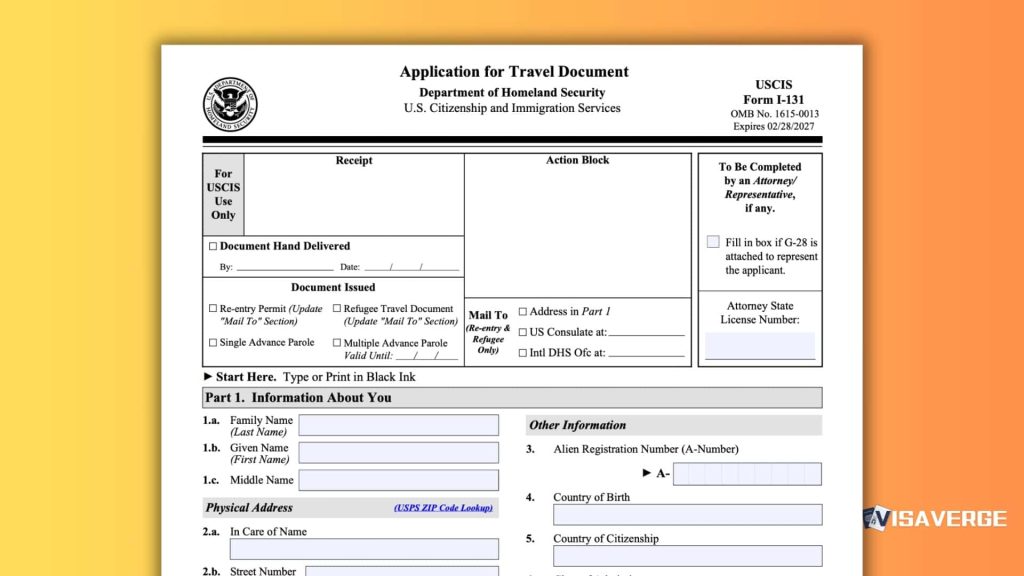
Form I-131 is the USCIS application used to request an Advance Parole document, a Reentry Permit, a Refugee Travel Document, or other travel authorization. Filing the form correctly is the single biggest factor that decides whether your case clears review in the standard window or sits in the rejection pile for weeks.
This guide walks through every part of the 2026 edition (OMB No. 1615-0013) in the order USCIS reviews it, using the agency’s own instructions as the source. If you are filing alongside Form I-485 for adjustment of status, the advance parole path is the most common version of this form, and it is the one we spend the most time on below.
Type or print your answers legibly in black ink. Handwritten forms in blue ink, pencil, or color are a quiet but frequent rejection reason. Write “N/A” for items that do not apply to you, and write “None” for items where there is no answer, such as a middle name you do not have. Never leave a required field blank.
If you run out of space for any question, do not attach a separate sheet with loose pages. Use Part 13 of the form for additional information; USCIS expects overflow answers there and will look for them there. Reference the item number and part you are continuing.
Bring together your supporting evidence before you start typing. You will need a copy of your passport biographic page, two identical passport-style photos taken within the last 30 days, and, for advance parole, a copy of your Form I-94 arrival and departure record. The photos are non-negotiable; filings without them are rejected without review.
The section-by-section walkthrough below treats Part 1 through Part 13 as discrete steps. If you are comfortable with USCIS forms generally, the three items most people miss are check box 5.A in Part 1 for advance parole, Parts 8 and 9 left blank for standard applicants, and Part 10 signed and dated in your own hand.
Part 1 tells USCIS what you are asking for. Pick exactly one box. The choices are Reentry Permit, Refugee Travel Document, Advance Parole Travel Document, and a set of narrower boxes for parolees and applicants with specific humanitarian needs.
If you are currently in the United States and need permission to travel abroad while an I-485 adjustment is pending, check box 5.A. This is the option that covers the vast majority of filers. Do not also check Reentry Permit; a Reentry Permit is for lawful permanent residents only and selecting both will force USCIS to issue a Request for Evidence.
If USCIS denies or delays this form, keeping your underlying status valid matters. Our six essential requirements for filing an I-131 reentry permit guide covers the documentation rules you must meet before you mail the packet.
Parts 2 and 3: Personal and contact information
Part 2 asks for your full legal name exactly as it appears on your passport. If USCIS has issued prior documents under another spelling or a maiden name, list those names in the “Other Names Used” fields. Do not abbreviate.
The A-Number, USCIS Online Account Number, and Social Security Number appear in this section. Enter the A-Number with the leading A followed by eight or nine digits. If you do not have one yet, write “None.”
Part 3 covers your physical address, mailing address, and phone and email for case communication. If your physical and mailing addresses are the same, still complete both blocks. Typing the same address twice is not an error; leaving the second block blank is.
- Name mismatch between the form and the passport biographic page
- A-Number missing the leading “A” or entered with only seven digits
- No phone number of any kind (at least one line is required)
- Mailing address blank when it matches the physical address
Parts 4 through 7: Travel plans and processing details
Part 4 asks when you expect to leave the United States, how long you will be abroad, and the countries you plan to visit. If your plans are not finalized, enter a realistic window. “Unknown” is not an acceptable answer; give the best estimate supported by your purpose of travel.
Part 5 is the purpose-of-travel block. Describe the reason concisely: a job interview, a family emergency, a wedding. USCIS reads this to confirm the trip is consistent with the underlying status you are maintaining in the United States.
Parts 6 and 7 collect information about prior travel documents you have held and whether any were lost or revoked. Answer truthfully; a prior revocation does not disqualify you from this filing, but concealing one does.
Parts 8 and 9: Leave blank for standard advance parole
Part 8 is for applicants requesting a Refugee Travel Document and Part 9 is for applicants already in parole status seeking re-parole. If you are filing a standard advance parole request concurrent with I-485, leave both parts entirely blank. Do not write “N/A” in every line; USCIS instructions explicitly say these sections are only for the populations they name.
Filers sometimes over-complete the form out of caution and fill in Parts 8 and 9 with zeros or repeated “None” answers. This triggers USCIS to review the filing as a different application type than intended, which slows decisions by weeks.
Part 10: Applicant signature and date
Sign and date Part 10 in your own hand, in black ink, on the paper copy you mail. USCIS rejects unsigned forms, forms signed with a stamp, and forms signed by anyone other than the applicant. If you are a parent filing on behalf of a minor child, the parent signs Part 11, not Part 10.
Make sure the date format matches the day you mail the packet. If you sign on April 10 but the packet does not leave the post office until April 22, the gap is fine; forms older than 30 days at intake may be returned.
Assemble the supporting evidence
The form itself is only half of the filing. For advance parole you must include a copy of your passport biographic page and a copy of your Form I-94 arrival and departure record, either the paper I-94 or a printout from the CBP I-94 website. Two identical passport-style color photos taken within the last 30 days complete the evidence packet.
Write your name and A-Number lightly on the back of each photo in pencil. Do not staple or paperclip the photos; place them in a small envelope inside the packet. USCIS instructions are specific about photo handling, and staples that puncture the image are a frequent cause of photo rejections.
If you are supporting the travel request with evidence of an underlying humanitarian purpose, include those records next. Our guide on filling out Form I-131 lists the evidence packages USCIS accepts for each category of travel.
- Copy of passport biographic page (all four edges visible)
- Copy of Form I-94 arrival/departure record (if applying for advance parole)
- Two identical passport-style photos taken within 30 days
- A signed copy of Form I-131 itself
- Filing fee check or money order, or Form I-912 fee waiver request
Mail to the correct USCIS lockbox
The filing address depends on whether you are sending Form I-131 alone or together with Form I-485. If you file them together, mail both to the lockbox that processes your I-485 for your state of residence. If you file I-131 alone because your I-485 is already pending, the standalone lockbox address applies.
Always confirm the address on the USCIS “Direct Filing Addresses for Form I-131” page before you mail. USCIS changes lockbox routing several times a year, and an out-of-date address is the most common cause of delays that do not generate a rejection notice.
If you are also preparing Form I-130 for a family member as part of the same adjustment path, see our I-130 step-by-step guide for filing it correctly in tandem.
Common mistakes to avoid
Most I-131 rejections come from a small set of repeated errors. Fix these before you mail and your filing will clear intake on the first attempt.
Only green card holders qualify for Reentry Permits. If you are not a permanent resident, check only box 5.A.
These sections are for refugees and parolees only. Leave them blank; do not write “N/A” on every line.
Two unstapled passport-style photos within 30 days are required. Place them loose in a small envelope.
USCIS returns unsigned forms automatically. Sign by hand in black ink before mailing.
After you mail the packet
USCIS issues a receipt notice within two to four weeks. The receipt includes your case number, which you can track on the USCIS case status page. If biometrics are required for your category, you will receive a separate appointment notice.
Keep a full photocopy of the packet you mailed, including the check or money order. If USCIS issues a Request for Evidence, the receipt and your copy are your fastest way to match the agency’s reference numbers to the documents in your file. For filers who are also preparing a supplemental application such as G-325R, our Form G-325R guide explains the newer USCIS rule for foreign nationals already in the United States.
Travel before you receive the physical advance parole document is risky and can abandon a pending I-485. Wait for the document in hand before booking international flights.